Baked Potato

0

A baked potato is a distinct potato recipe. It can be topped with butter, cheese, sour cream, gravy, baked beans, or even ground pork or corned beef.

Because of their size and consistency, many potato cultivars are more suited for baking than others. Despite the widespread belief that potatoes are unhealthy, baked potatoes can be part of a balanced diet.

You can bake your potatoes in a standard gas or electric oven, a convection oven, a microwave oven, a barbeque grill, or over (or in) an open fire. Some restaurants utilize customized ovens designed to cook huge quantities of potatoes while keeping them warm and ready for serving.

What Potato is Best For Baking?

You can bake any specie of potatoes, but russet potatoes are widely preferred for their appropriate flaky texture. Russet potatoes are also known as starchy potatoes, baked potatoes, or mealy potatoes. The starch is responsible for the potato’s characteristic fluffiness. When you’re craving a delicious, classic baked potato, Russet Potatoes are the way to go.

How To Make Baked Potatoes

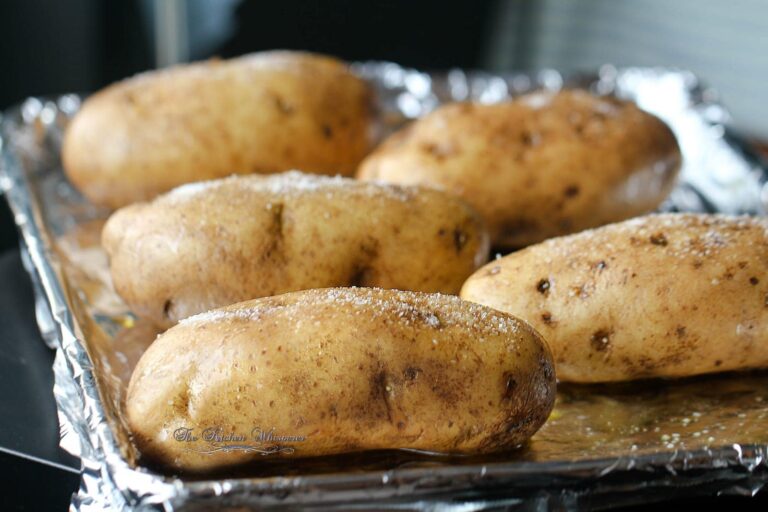
This is one of the easiest recipes ever but with a bunch of preparation rules in the process. The potato should be cleaned clean, washed and dried, with eyes and surface blemishes removed, and basted with oil (typically olive oil) or butter and/or salt before baking.

Using a fork or knife to prick the potato allows steam to escape throughout the baking process.

Wrapping the potato in aluminum foil before cooking it in a conventional oven helps to preserve moisture, but leaving it unwrapped results in a crisp skin. Cooking over an open fire or in the embers of a barbeque may necessitate wrapping in foil to avoid skin burns.

A potato cooked directly in the coals of a fire cooks exceedingly well, resulting in a mostly charred and inedible skin.

How Long Does It Take To Bake Potatoes?

A large potato takes one to two hours to bake in a standard oven at 200 °C (392 °F). Microwaving it however takes six to twelve minutes, depending on oven power and potato size, but does not always result in a crisp skin.

Variations Of Baked Potatoes

Some people bake their potatoes before scooping out the insides, leaving the peel as a shell. The white internal flesh can then be combined with other foods like cheese, butter, or bacon bits. Others appreciate the crisp skin’s flavor and texture, which is high in nutritional fiber.

Baked Potato

What's Cooking America
Servings 0

Ingredients
  

  • 1 tsp olive oil, vegetable oil, or butter
  • 1 medium Potato (Russet Potato)
  • ½ tsp coarse salt or sea salt

Instructions
 

  • Adjust the rack in your oven to the middle position and preheat oven to desired temperature (see Cooking Temperature Chart below).
  • Rinse and scrub (I use a stiff-bristled brush) each potato under cold running water, as you will be eating the skins of these perfect potatoes.  Do not soak the potatoes (that will make them soggy.   Also do not use hot water or you will start cooking the outside and the inside will not catch up).  Dry each potato thoroughly with a clean towel.
  • Look the cleaned potatoes over and remove any bruises or discolored spots with the tip of your knife.
  • Pierce each potato deeply with a fork or sharp knife four (4) times on each side at approximately 1-inch intervals (this will allow steam to escape during the baking).  If you do not pierce the potatoes, they may explode during baking in your oven.  You do not want this to happen as it makes a terrible mess in your oven
  • Wrapping the potato in aluminum foil will produce a soft skin (not crispy). Technically this is steaming rather than baking (as the moisture in the potato remains trapped) and the light, flaky texture will be missing.  The texture of a steamed potato is entirely different from that of a perfect baked potato.  Save yourself the trouble and expense of wrapping potatoes in aluminum foil and serve perfect baked potatoes. 
  • For a crispier potato skin:  Rub the outside of the potato with olive oil, vegetable oil, or butter over the skins.  I like to roll the potatoes in coarse or sea salt after rolling in the oil and before baking.  Place coarse salt onto a small plate.  Roll potatoes lightly in the salt.  The skin is so yummy to eat when baked!
  • Bake on racks of oven until tender.
  • Do not overcook potatoes as the insides will be dry, so it’s important to be vigilant.
  • The higher the oven temperature, the shorter the cooking time will be and the crustier the skin.  Larger potatoes will take longer to bake.  Bake potatoes along with whatever else you are baking and gauge the cooking time according to oven temperature.
  • Turn the potatoes over halfway through the baking time to prevent browning of the undersides where they touch the oven rack.
  • Potatoes are done if tender when pierced with a fork to see if it slides out easily and you can check the internal temperature reaches 210 degrees F.  Use a meat thermometer to test for doneness.  You can also test for doneness by gently squeezing the middle of the potato (using a pot holder or oven mitt).  If it gives in easily to your touch, it is done.
  • When baked to perfection, remove potatoes from the oven.  Slit across the top with a sharp knife.  Gently pinch (squeeze) in each end of the potato towards the middle (using your thumb and index finger).  The potato will then pop open and loosen the fluffy white interior from the skin.  Be careful as there will be some steam.
Tried this recipe?Let us know how it was!

After creating your perfect baked potato recipe, you may now enjoy with any toppings of your choice.

Maakouda – Moroccan Potato Cakes

Maakouda is a delicious little Moroccan potato cake. They’re traditional Moroccan street food and are served on their own or in sandwiches.

This Moroccan potato beignet ate as an appetizer, a side dish, or as a filling in a crusty sandwich. If you go to Morocco, try them, if not check the recipe below!

What is Maakouda?

Maakouda is a savory Moroccan Potato Beignet, deep-fried in oil and usually served in a small baguette. It’s the typical street food of Meknes, the wine capital of North Africa. It’s cheap, tasty, and widely available.

It’s also known as maaqouda, maqouda, or makouda and is a popular potato recipe not just in Morocco, but also in Algeria and Tunisia.

In a way, it’s like the Moroccan/Algerian falafel, except far less popular outside of those two countries. It’s also a great way to reuse your leftover mashed or baked potatoes.

Maakouda Recipe

These potato cakes are easy to make. Traditionally, they’re deep-fried, but you can also make them in an air fryer or bake them in the oven.

In makouda, mashed potato is mixed with flour and herbs, then rolled into balls and fried. The results are beautifully crispy outsides with soft, flavorful, and delicious soft potato insides. Bliss.

Tips For Best Maakouda

  • Try them baked in the oven at 400F / 200C for 25 minutes or until crispy and golden.
  • They’re also great in the air fryer. Just air fry until golden and turn them frequently if your air fryer doesn’t have a moving paddle.
  • You can serve them with a little spicy harissa paste mixed into yogurt for a quick dip.
  • Try them in a sandwich, as an appetizer, side dish, or party food.

Recipe Variation

  • Gluten-free: You can easily make maa’kouda gluten-free by using gluten-free flour.
  • Vegan: Make this vegan by using flax eggs. Simply mix 1 teaspoon ground flax in 3 teaspoons water and let it sit for 5 minutes to thicken. Use it in the recipe where the egg is called for.
  • Oil-free: You can make this recipe oil-free by cooking the makouda balls in an air fryer with no oil. Be sure to turn them often.

What To Serve With Maakouda

These potato cakes are typical Moroccan street food and are eaten as an appetizer, snack, side, or, commonly, in a sandwich with lettuce and tomato in a baguette.

They’re served on their own as a snack or in a baguette with salad. They also make a great side dish to the veggie tagine.

Be sure to recreate this Crispy on the outside and fluffy on the inside, Moroccan recipe, Enjoy!

Maakouda - Moroccan Potato Cakes

Idriss
Crispy on the outside and fluffy on the inside, this moroccan recipe is sure to please!
Prep Time 5 minutes
Cook Time 20 minutes
Course Appetizer, Main Course
Cuisine Moroccan
Servings 6
Calories 135 kcal

Ingredients
  

  • 3 medium size russet potatoes about 500g
  • Handful of coriander
  • 1 large egg lightly beaten
  • 1 tsp baking powder
  • 1/4 tsp ras al hanout OPTIONAL but highly recommended
  • 1 tsp turmeric
  • About a cup of flour to coat your fritters
  • 1/2 tsp salt
  • 1/4 tsp black pepper
  • 3 cups frying oil of your choice. I used grape seed oil.

Instructions
 

  • Peel and dice your potatoes into roughly 1-inch squares. Place in microwave-safe bowl with a plate on top and cook on high heat for 8 minutes or until soft (if you don't have a microwave, boil until soft). 
  • Finely chop coriander (or any other fresh herb you'd prefer), set aside.
  • Let the potatoes cool enough for you to be able to handle them, and then mash them until completely smooth. Add your egg and chopped coriander to the cool mashed potatoes. Add salt, turmeric, ras al hanout, salt, pepper, baking powder and mix thoroughly. Add half of the flour onto a plate, set aside the other half and use as needed.
  • Shape equal amounts of mashed potato mixture into a ball and flatten slightly. Coat flattened potato mixture in flour, set aside. Repeat until you're out of mashed potatoes. 
  • Heat up frying oil in a small pot, wok or small sauce pan on medium-high heat. Add 3-4 fritters at a time, keep turning them around until they're golden (about 3 minutes) then let them cool on a cooling rack, continue with the next batch.

Nutrition

Calories: 135kcal
Tried this recipe?Let us know how it was!

Braai

0

The term braai, derived from the Dutch Braden, which means “to grill,” is an acronym for braaivleis, which means “grilled meat.” It is an Afrikaans word for Barbecue.

Difference Between Braai and Barbecue

The major distinction between a braai and a BBQ needs to be the presence of fire. It isn’t authentic if it’s cooked on a gas grill. After eating, people will congregate around the fire and spend the rest of the day or evening there. We never braai by ourselves. We can do it regardless of the weather. Braais, unlike BBQs, are not limited to warm weather.

This South African equivalent of BBQ – is one of the most popular dishes in South Africa. The aroma of cooking meat can be found almost anywhere in Cape Town. Take a look around. Almost all gardens and outside areas have people sitting out and preparing meat, generally with a drink or glass of wine in hand. It is something that everyone does and is a must-see cultural event for any visitor to South Africa during the summer.

How To Braai

South Africans often cook their meat with wood or charcoal, with wood being the preferred method because it brings out the greatest flavors in the meat. Keep in mind that a gas grill is not considered a Braai in South Africa.

Some Braai Recipes For Summer

  • Lamb potjie.
  • Red-red.
  • Egyptian mesaka’a.
  • Braaied sweetcorn.
  • Vegan braaibroodjies.
  • Teriyaki sweet potatoes
  • Boerewors-stuffed flatbreads.
  • Pork sausage kebabs.
  • Braaied cabbage salad
  • Snoek tacos

Sides For a Typical South African Braai

  • Potato Salad.
  • Garlic Bread.
  • Five Bean Salad.
  • Roosterkoek.
  • Chakalaka.
  • Pap.

Egyptian Koshari

Koshari is one of the traditional Egyptian food. This dish is considered the national dish of Egypt and very popular street food.

You can find this dish in almost every home in Egypt, kind of like mac and cheese. Although this koshari recipe takes some time to put together, each element is fairly simple to make.

It may not look like much, but this Egyptian comfort food has every bit of a satisfying depth and texture. It’ll have you coming back for more!

What is Koshari?

Koshari (كشري) also called kusharikosheri, or koshary, is one of the most popular dishes in the land of the Pharaohs, a delicious vegan combination prepared with chickpeas, lentils, macaroni, and rice. It is a cousin to the Middle Eastern Mujadara.

Egyptian koshari is also called koshari Abu gibba. The full name can be explained by the presence, in the recipe, of black lentils, also called ads Abu gibba.

Origin Of This Recipe

Although positioned as the Egyptian national dish, the koshari recipe is clearly of Indian origin. Koshari arrived in Egypt in the mid-19th century, when the country was an important crossroads of cultures and food.

The Egyptians then experimented and added their touch to this simple, varied, colorful, and spicy dish from India.

This dish, therefore, has similarities to the famous Indian dish called khichdi, made from rice and lentils, but the Egyptian dish has more ingredients and flavors, especially the sauce which gives it its unique taste.

Some believe that koshari was first prepared in Egypt during the British occupation (1882-1914).

Indian khichdi is found under other names including khicharikhichadikohsherikhicaṛī, or even khichri and it is considered to be one of the oldest dishes in India.

Moroccan jurist and frequent traveler Abū ʿAbdallāh Muhammad Ibn Battūta, who visited India in the 14th century, already mentioned khichri in his writings as a popular breakfast. Also, Afanasy Nikitin, the Medieval Russian traveler, merchant and one of the first Europeans to document a trip to India mentioned khichri in his writings.

In the Mughal Empire, the very popular khichdi was mentioned several times in the meal plans of the Mughals.

There are also several references to khichdi in the writings of Abu’l-Fazl ibn Mubarak (1551-1602), an Indian chronicler and historiographer, who wrote his works in Persian, notably in his work Ain-i-Akbari.

Jean-Baptiste Tavernier (1605 – 1689), a French traveler and baron of Aubonne in Switzerland, brought back to the 17th century a variant of khichdi with green lentils, rice, and ghee.

During the colonial period in India (1858-1947), the British immersed themselves in Indian cuisine and therefore among other recipes, khichri.

In British households in India, khichri was often served for breakfast with fish, which was usually eaten in the morning with boiled eggs, immediately after fishing.

British India brought back khichdi to England under the famous name of kedgeree, which is made from fish, rice, eggs, butter, cream, and curry.

It would therefore be the British who probably made the koshari popular in Egypt.

You will find khichdi and kedgeree much later, via the British army which, passing from one colony to another carried along with the culinary habits of “British India”.

This is how koshari was introduced into Egypt towards the end of the 19th century or the beginning of the 20th century.

We can easily deduce that this vegan dish can satisfy the Coptic diet during Lent because it is devoid of meat. The Copts are the Christian inhabitants of Egypt.

Koshari Recipe

The koshari recipe is quite simple to make, even if it requires several steps for the cooking of the different ingredients.

Precooked lentils and chickpeas can be purchased to speed up the recipe’s preparation.

This cuisine is incredibly popular in all of the country’s eateries, to the point where there are even restaurants dedicated solely to koshari.
Large containers with the ingredients already cooked sit behind the bay windows of restaurants or on the shelves of food carts selling koshari on the streets. These items are simply reheated and seasoned over high heat. 
It is quick and easy-to-cook dish that is both affordable and incredibly nutritious due to its high protein and carbohydrate content.

How Long Does It Take to Make Koshari?

Each part is easy to do, but if you are in a hurry, it can get overwhelming. If you are making this for your first time, block off about 2 to 3 hours to take your time. When you’ve made kosher a few times, you can cook it in less than 1 hour and 30 minutes. If you have made this meal a lot, you can get it down to an hour.

How To Assemble The Perfect Koshari Bowl

Because kosher has several parts to it, you might be wondering how to assemble everything. Here is the list in order of how you assemble the bowl starting with the bottom-most layer (being the koshari lentil rice).

  1. Lentil rice
  2. Pasta
  3. Chickpeas in cumin
  4. Cooked red sauce
  5. Fresh red sauce
  6. Fried onions

What To Serve With Koshari

Normally, koshari is served as a standalone dish. At home, this dish is served family-style with additional tomato sauce and crispy onion rings to pass!

To complete the meal, you can typically add a side of this quick 3- ingredient Mediterranean salad dressed simply in olive oil and lemon juice.

Be sure to recreate this incredible delicacy that is not only delicious but also full of proteins, fiber, and tons of vitamins like iron and calcium needed for your body. Bon appétit!

Egyptian koshari

Amira Georgy
Koshari is a classic Egyptian dish made from rice, lentils and pasta. It's often served by street vendors and is prepared in large pots.
Prep Time 15 minutes
Cook Time 40 minutes
Course Main Course
Cuisine Egyptian
Servings 4

Ingredients
  

  • 1/3 cup extra virgin olive oil
  • 2 large brown onions, thinly sliced
  • 1 tsp cumin seeds
  • 1 cinnamon stick
  • 1 tsp mixed spice
  • 2 tsp Massel vegetable stock powder
  • 1/2 cup dried green lentils, rinsed
  • 1 cup dried macaroni
  • 1 cup white long-grain rice
  • 4 tomatoes, chopped
  • 1 eschalot, thinly sliced
  • 1/3 cup fresh flat-leaf parsley leaves, torn
  • 2 tsp white vinegar

Instructions
 

  • Heat 1/4 cup oil in a large heavy-based saucepan over high heat. Cook onion, stirring, for 6 minutes or until golden. Using a slotted spoon, transfer to a plate lined with paper towel.
  • Add cumin, cinnamon and mixed spice to the pan. Cook, stirring, for 30 seconds or until fragrant. Add stock powder, lentils and 1 litre of water. Cover. Bring to the boil. Reduce heat to medium. Cook for 15 minutes or until lentils are half-cooked.
  • Add pasta, rice and 1/2 cup water to pan. Cover. Return to a simmer. Reduce heat to low. Simmer for a further 15 minutes or until lentils, rice and pasta are tender.
  • Meanwhile, combine the tomato, eschalot, parsley, vinegar and remaining oil in a medium bowl. Season with salt and pepper. Set aside for 15 minutes to allow the flavours to develop.
  • Remove koshari from heat. Stand for 5 minutes. Fluff with a fork. Serve topped with the caramelised onion and tomato salad.
Tried this recipe?Let us know how it was!

Mujadara

Mujadara (mujaddara) is a signature Middle Eastern dish of lentils, rice, and deeply caramelized onions. A bold and comforting dish that’s typically served with a topping of crispy onion rings and a side of plain yogurt with a fresh Mediterranean salad.

What is Mujaddara?

In Arabic, mujaddara means “riddled with small holes”, or “pockmarked”. It is certainly not very appealing but it is a reference to the lentils among the rice that look like little pimples. This dish is nonetheless delicious.

Mujaddara consists of cooked brown or green lentils, usually combined with rice but sometimes bulgur or groats, with a good amount of caramelized onions, fried in olive oil.

Everywhere, it is nicknamed “the dish of the poor” as it doesn’t include any meat or expensive ingredients. It is to the Middle East what couscous is in the Maghreb countries.

Origin Of Mujaddara

When a dish is so old and so popular as the mujaddara, it is not possible to definitively attribute it to a particular territory or culture and, as is often the case, the more ancient and simple a dish is, the more a culture or country attributes tries to claim its paternity.

The first recorded recipe for the mujaddara appears in Kitab al-Tabikh, which simply means “cookbook”. It was written in 1226 by Mohammed bin Hassan al-Baghdadi in Iraq.

The original recipe, which included rice, lentils, and meat, was served this way during celebrations. Without meat, it was an Arab dish of the Middle Ages commonly prepared by the poor, a version that has become, over time, the most traditional.

Besides being known as the “dish of the poor”, mujaddara is also called “Esau’s favorite”. This dish would indeed have biblical origins.

Mujadara Recipe

The secret to an authentic mujadara recipe is in the onions! This dish starts and ends with onions.

First, deeply caramelized chopped onions are cooked with rice and lentils, imparting flavor and the deep, golden hue this dish is known for.

And to finish your mujadara, you’ll top the cooked rice and lentils with a thinly sliced, crispy onion ring! Comforting and bold in the best way.

You can use long grain or short-grain white rice to make mujadara. It’s important to rinse the rice well until the water runs clear, then soak it for about 20 minutes or so in cold water until you can easily break one grain of rice.

This will ensure that the rice cooks quickly and evenly, and it will help avoid mushy rice. If you want to use brown rice instead, you’ll extend the cooking time a bit.

What To Serve With Mujadara

To serve mujadara lentils and rice the traditional way, you’ll dish it in bowls and add the crispy onion on top. For sides, we typically add some plain yogurt and a big fresh Mediterranean salad such as cucumber and tomato salad, or Shirazi salad.

Be sure to recreate this incredible Mujadara recipe. Bon appétit!

Mujaddara

Vera Abitbol
Mujaddara is a traditional Middle Eastern dish made with lentils cooked with rice, bulgur or wheat, garnished with onions fried in olive oil.
Prep Time 15 minutes
Cook Time 35 minutes
Course Main Course, Side Dish
Cuisine Middle Eastern
Servings 4

Ingredients
  

  • ¾ cup brown lentils , well rinsed with cold water
  • ⅔ cup fragrant rice
  • ½ cup extra virgin olive oil
  • 4 large onions , sliced
  • ¾ cup boiling water
  • Salt
  • Pepper

Instructions
 

  • Add the drained lentils in a large Dutch oven and cover with 4 times their volume of cold water.
  • Cover for 20 minutes after reaching boiling point: first 10 minutes on high heat and then, 10 on medium to high heat.
  • Add the rice and ¾ cup (200 ml) of boiling water. Mix well and cook uncovered for 15 minutes over medium heat, stirring regularly.
  • If necessary, add a little boiling water if the rice absorbs the water quickly.
  • A few minutes before the end of cooking, season with salt and pepper and mix well.
  • While cooking the lentils and rice, heat olive oil in a large skillet and fry the sliced onions until the edges curl and turn golden brown.
  • When the 2 preparations are ready, pour the hot oil (without the onion) into the mujaddara pot, and mix well.
  • Arrange on a plate.Top with the fried onions.
Tried this recipe?Let us know how it was!

Biltong

0

Biltong is a type of dried, cured meat from Southern African countries (South Africa, Zimbabwe, Malawi, Namibia, Botswana and Zambia). Biltong is derived from the Dutch words bil (“buttock”) and tong (“noodle”) (“strip” or “tongue”)

It is made from a variety of meats, ranging from beef to game meats like ostrich or kudu. The cut may also differ, with fillets of flesh cut into strips that follow the grain of the muscle or flat chunks sliced across the grain. It is similar to beef jerky in that both are seasoned, dried meats; however, the typical ingredients, taste, and manufacturing procedures may differ.

Is Biltong Illegal?

You’ve probably never heard of this unique meat cut unless you’re from South Africa. Biltong, which is Dutch for “meat strip,” has been consumed for generations in Southern Africa. However, it is unlawful to import this adopted hunting snack into the United States due to the way it is cured.

Is Biltong Healthy?

This meal is one of the best to snack on. In fact, scientists say biltong is actually healthier than a regular protein bar, with less sugar and more than 10 times the protein. Here’s why;

  • Biltong is high in protein and low in carbs. Half of your daily protein needs can be met by 25 grams of lean beef biltong. Because of its high protein content, it makes an excellent post-workout snack.
  • It stores nicely, so it can not only wait in your workout bag, but it is also ideal for trekking, especially lengthy hikes like the famed Otto trail. It’s light since it’s dried, and it won’t spoil because of the drying and spicing.
  • Less toxic chemicals are used in its favoring and preservation.
  • It is low in fat, typically averaging 3%, making it a popular weight-loss diet option.
  • It is gluten-free by nature.
  • It’s the excellent snack for those on a diet.
  • It contains a lot of Vitamin B12, which is necessary for healthy blood and nerve cells as well as cell replication.

Biltong

Greedy Feret
Prep Time 30 minutes
Cook Time 5 days
Servings 0

Ingredients
  

  • 2000 g Beef—silverside or toprump
  • 5 tbsp Brown (malt) or cider vinegar
  • 2.5 tbsp Coarse salt (2% of the meat weight)
  • 2 tsps Ground black pepper
  • 2 tbsps Coriander seed
  • 1.5 tbsps Brown sugar

Instructions
 

  • Toast the coriander seeds in a dry pan, then grind down in a pestle and mortar or spice grinder.
  • It should be mostly powder, with a few pieces of seed shells left in.
  • Using a sharp knife, following the grain of the meat, cut into 1 inch (2.5cm) thick lengths and place in a non-metallic container.
  • Combine all the spices and sprinkle into the meat.
  • Sprinkle the vinegar on and rub everything in thoroughly whilst turning the meat with your hands.
  • Cover the container and let your biltong cure for 24 hours in the fridge, turning and rubbing through the meat occasionally.
  • Remove the meat from the container and pat dry with kitchen towels, taking care not to remove too much of the spice.
  • Add a hook to the thickest end of each length. Plastic-covered paper clips make for a cheap solution.
  • Hang in your biltong box, or in a well aired, ventilated space with a fan blowing gently to increase air flow.
  • Do not point a fan directly at the meat (to avoid case hardening).
  • Make sure none of the pieces are touching.
  • Place some newspaper below the meat to catch any liquid.
  • Drying times will vary with humidity, airflow and temperature. Test the readiness of your biltong every couple of days by squeezing the sides together with clean fingers.
  • If you feel any give in the meat, it’s still ‘wet’ inside.
  • Once ready, cut into thin slices with a sharp knife and enjoy some of the best meat you’ll ever eat.
Tried this recipe?Let us know how it was!

Mahshi

Mahshi is one of the Middle East’s most popular dishes for when you have a feast and want to make an effort for your guests.

Each country has slight variations in how they cook their stuffed vegetables which makes it a little more interesting when your friend invites you round for some mahshi.

What is Mahshi?

Mahshi is a dish that consists of vegetables filled with ground beef and rice and cooked in a tomato-cumin sauce.

Most often, Lebanese summer squash (kusa) is used for this dish, but there are a few variations based on squash, eggplant, bell peppers, and even tomatoes or potatoes.

Stuffing made with meat isn’t required, and there are many  vegetarian options available. Dolmas are the varieties that are simply made with vegetables and are served chilled or at room temperature.
The meat-based dishes are always served hot. Fresh mint and garlic are used in the Levantine variation. It is more commonly the zucchini flowers that are filled in Cyprus.

Origin of Mahshi

Mahshi is one of the many dishes of Ottoman origin that spread throughout the territory of the ancient empire, from the Balkans to Egypt through the Levant.

The name mahshi can translate as stuffed squash. In Croatian and Serbian, this dish takes the name of punjene tikvice. In Albania, it is called kungulleshka të mbushura. Finally in Turkey, it is called Kabak Dolmasi.

In Egypt, mahshi is present on all banquet tables for weddings, family reunions, and especially during the celebrations of the month of Ramadan.

As this dish is not expensive, it is, without doubt, one of the most popular in Egypt. It is often found at meals for families across the country. Meat-free for the poor and the wealthy.

Mahshi Recipe

It is critical to have pale zucchini in order to make decent maharishi. Depending on where they are sold, they are referred to as Lebanese zucchini or Egyptian zucchini.
manakra, an instrument similar to the apple corer used in Europe, is used to hollow the out. On the one hand, the filling with minced beef is made by sautéing an onion before adding the meat, parsley, cumin, and tomato puree.
Minced beef is common ingredient in Arabic cuisine, particularly in Egypt. Short grain rice icombined with this filling. The zucchini pulp, on the other hand, is cooked in tomato sauce.

The mahshi can thus be assembled by filling a Dutch oven with tomato and potato slices which will serve as a base for the zucchini. The zucchini stuffed with rice and meat are placed on top and then the tomato sauce, broth, olive oil, and lemon are added.

After a long stew, the zucchini is very tender, the rice cooked and the meat very soft. The reduced sauce is flavored with cumin and this dish can thus be tasted.

Mahshi Variation

Aside from using different vegetables, leafy greens such as kale, chard, and even lettuce can be filled. The Egyptian version is generally cooked in broth, but the Lebanese stuffed zucchini in yogurt is equally excellent and something you should try. 
This recipe can be made in slow cooker in the same way that these slow cooker stuffed onions were. The possibilities with mahshi are infinite.
If you made this recipe don’t forget to leave a comment below. Enjoy!

Mahshi

Amira
Mahshi is a family of stuffed veggies that is very popular throughout the Mediterranean region. Name and stuffing varies from country to another. Here I am showing you how to make the vegan Egyptian mahshi.
Prep Time 30 minutes
Cook Time 40 minutes
Course Main Course
Cuisine Middle Eastern
Servings 6
Calories 339.4 kcal

Ingredients
  

For the rice mixture:

  • 3 Tablespoons olive oil.
  • 1 medium yellow onion Chopped.
  • 2 Tablespoons tomato paste.
  • 1 can (16oz) tomato sauce.
  • 2 cups short grain rice Note1.
  • 1 cup fresh parsley chopped. Note2
  • 1/2 cup fresh cilantro chopped. Note 2
  • 1/3 cup fresh dill chopped. Note2
  • 1 Tablespoon dry mint.
  • 1/2 teaspoon ground black pepper.
  • 1/2 teaspoon salt or to taste.

The above mixture is enough for one of the following: Note3

  • 4 pounds Mexican squash.
  • 2.8 or almost 3 pounds Anaheim pepper.
  • 2.8 or almost 3 pounds white or Japanese eggplant.
  • 1/2 pound grape leaves.

Cooking liquid:

  • 2 1/2 cup hot stock or water.
  • 1 bouillon cube.
  • 1 teaspoon tomato paste

Instructions
 

Make the rice mixture:

  • In a pot over medium heat, add oil and then sauté onions until translucent for about 2-3 minutes.
  • Add the tomato sauce and paste. Stir to dissolve tomato paste.
  • When it starts bubbling, add rice, spices and herbs cook for just two minutes.
  • Turn heat off and set aside to cool down.

Prepare the veggies:

  • Wash the veggies thoroughly and clean them well, Note4.
  • Core veggies and make sure not to tear the walls especially when making zucchini or eggplants. Note5
  • For Anaheim pepper, I usually like to cut it in half for easy stuffing and make sure to buy long straight ones.

Stuff the veggies:

  • Stuff each one with the rice mixture making sure not to reach the top, so basically you want to leave about 1/2 cm of the top of your vegetable.
  • Rice will expand after cooking and if you are overstuffing the veggies, rice will come off. Not that it will taste bad but the presentation will not be as fancy.
  • Arrange herbs stems, the inside of your veggies that you just took out, lemon slices, tomato slices or onion slices at the bottom of your cooking pot to prevent scorching.
  • Arrange the stuffed veggies in your pot.

Cook:

  • Dissolve bouillon and tomato paste in the hot water.
  • Pour into the pot so that the cooking liquid is halfway through the veggies layers.
  • Place pot on medium high, bring to a boil then reduce heat and simmer for 40 minutes until veggies are cooked. Note6
  • Wait for it to cool down a bit and serve.
  • Serve Mahshi  with tabbouleh and tzatziki sauce.

Notes

Note1: Traditionally short grain rice is used. I usually use Calrose rice, other times I use Jasmine. I’ve also seen my friends use Basmati rice.
 
Note2: Keep the stems of the fresh herbs, we’ll use them to cover the bottom of the pot to prevent scorching and for flavor.
 
Note3: Please note that this is a rough estimate but it is almost exact according to my experience. Sizes of vegetables do vary greatly but if you end up with more rice mixture you can place them in a ziplock bag and freeze to add on and use in your next mahshi recipe. Or you can cook them in a small pot with some chopped bell peppers, they end up a little bit sticky and so delicious.
Note4: If you are making grape leaves please refer to the recipe here for how to prepare them.
 
Note5: do not discard the inside of the veggies that you just took out, I like covering the bottom of my pot with them too. I like eating them as well when the cooking is done especially the zucchini.
 
Note6: Some veggies take less time than others so it depends on what veggies you are cooking. Start checking at a 25-30 minutes mark.


Nutrition

Calories: 339.4kcal
Tried this recipe?Let us know how it was!

Sago Pudding

0

Sago pudding is a delicious pudding created by blending sago or tapioca pearls with water or milk, sugar, and sometimes other flavorings. It is made in numerous cultures with varying styles and in a variety of ways. The majority of sago is produced in Southeast Asia, particularly in Indonesia and Malaysia.

Sago is the starchy inside of a sago palm’s trunk. The pearls are made by extracting starch from other sections of the plant and shaping it into a dough. The dough is then sieved before being cooked to high temperatures. Sago can be found in the baking section of any store.

What is Sago Pudding?

Sago gula Melaka is a Malaysian sago pudding created by boiling pearl sago in water and serving it with palm sugar syrup (gula Melaka) and coconut milk.nIn New Guinea, sago pudding is also a popular delicacy.

In the United Kingdom, “sago pudding” is typically produced by boiling sago extracts and sugar in milk until the sago pearls turn clear, then thickening with eggs or cornflour. Depending on the amounts employed, it can have a runny to somewhat thick consistency, akin to tapioca or rice pudding.

Is Sago Pudding The Same As Tapioca Pudding?

Sago pudding can be substituted for Tapioca pudding. While Sago is an edible starch derived from the pith of many tropical palm plants. It’s a common staple in tropical areas.

Tapioca pearls, on the other hand, are manufactured from tapioca or cassava starch, a root crop. It is not usually possible to use either starch interchangeably. Tapioca is the byproduct of making manioc flour from cassava root. The Portuguese took it on their ships and spread it over Africa, Asia, and the West Indies.

Tapioca comes in a variety of shapes, but the little pearls are what are utilized to produce tapioca pudding. Tapioca pearls are often opaque while raw, but turn flexible and translucent when cooked.

Variations of Sago Pudding

  • Dark sugar or honey can be used to lend a delicate flavor to the dish. For a less caloric dessert, use stevia for sugar.
  • Also, just before serving, sprinkle some cinnamon, nutmeg, or cardamom on top of the pudding.

Sago Pudding

Servings 0

Ingredients
  

  • 2 cups skim/skim milk
  • ½ cup sago
  • 2 eggs
  • ¼ cup cup sugar
  • 1 tsp vanilla essence

Instructions
 

  • Pour milk into a large microwaveable dish. Add sago and let it soak for 1 hour.
  • Microwave sago on high for 4 minutes. Stir. Microwave sago on high for 4 more minutes. Stir then microwave sago on medium for 5 minutes. By now mixture should be thick, with glassy beads of sago showing through. If not, microwave again on medium for 1 minute at a time until cooked.
  • Beat eggs, sugar and vanilla together in a cup then quickly stir it into hot sago mixture.
  • Microwave sago on medium for 2 minutes then serve hot. Serving suggestion This pudding is delicious with a fruit salad or with a tablespoon of jam.
Tried this recipe?Let us know how it was!


Plantain Porridge

0

Plantain porridge is made by cooking tiny cuts of plantains and some vegetables. It is a popular Nigerian dish and quite enjoyable. With so many diets made with it, plantain is undoubtedly a culinary star. If you’re searching for a filling, healthy breakfast that will keep you going till lunch, this plantain porridge is for you.

Is Ripe or Unripe Plantain Better For Cooking Your Plantain Porridge?

Unripe plantains aren’t particularly appetizing to many people; they prefer ripe ones due to noticeable taste differences. Although ripe plantains taste better than unripe ones, this does not mean that they may be better than the unripe ones. It all depends on your choice.

Plantain Porridge can be made with ripe or unripe plantains, or a combination of the two. The green (unripe) plantains are thought to have greater healing benefits than matured plantains, although they are both suitable for this dish.

However, if you’re making this dish for kids, the ripe plantain is mostly preferred.

Health Benefits of Plantain Porridge

Plantains are high-carbohydrate food that is also high in fiber, vitamins, and minerals. 
They also have antioxidantswhich help to fight free radicals.
They can also help with immunological function if they have enough vitamin C. 
Similarly, their high vitamin B6 level may lower cardiovascular risk and boost mood.

How To Cook Plantain Porridge

Check out the following recipe for how to prepare your delectable Plantain Porridge. Before you start, take a quick look at what your should do;

  • Wash, peel and cut up the plantain
  • Rinse and cut the scent leaves or whatever vegetable you’ll be using for your own recipe into small pieces
  • Wash, cut and remove the fish intestines.
  • Grind the crayfish and pepper.

Plantain Porridge

Shoprite Nigeria
Servings 0

Ingredients
  

  • 4 Green Plantains (Cubed)
  • 1 Cooking Spoon Palm Oil
  • 4 Cups Water
  • 3 Handfuls Ugwu leaves
  • Handful Scent leaves
  • 3 tbsps ground Crayfish
  • 2 tsp dry ground Pepper
  • Smoked Mackerel Fish (Shredded)
  • 1 Bell Pepper (Chopped)
  • 1 tsp Salt
  • 2 Seasoning Cubes

Instructions
 

  • In a pot, add water, and every ingredient except the unripe plantains.
  • Allow to boil for 15 minutes then add the cut plantains.
  • Cook for 25 minutes till plantain is soft
  • Add vegetables, mix together and allow to simmer.
Tried this recipe?Let us know how it was!

Palm Wine Cocktail

Palm wine is a popular natural beverage produced from the sap of palm trees. It can be consumed in a variety of flavors from sweet unfermented to sour fermented.

In Ghana, it is locally called nsafufuo and called emu or ogogoro in Nigeria. It is made from oil palm trees in Ghana and is high in nutrients.

In this post, I’ll show you how to prepare flawless palm wine cocktail, as well as how to make palm wine.

What is Palm Wine?

It is an alcoholic beverage, known by different names across the planet, made from the sap of various species of palm trees.

The sap is normally taken from the plant’s highest regions, when tappers, or young lads from villages, climb to gather it. The sap is collected and allowed to ferment in the  presence of yeast in the air.
tiny torch is inserted into the trunk of felled palm tree to release the sap, which is then collected in jars.

The white sap begins to ferment as soon as it oozes out. Two hours are enough to develop the alcoholic component in palm wine, with the same alcohol content as a regular beer.

As fermentation takes place very quickly, this explains why traditional producers sell their wine immediately after extraction.

Health Benefits of Palm Wine

One of the reasons why this drink is so popular is the importance of its benefits. It is a drink not only special for the flavor that distinguishes it but also for the health benefits it brings to the body. A panacea for health, which combines pleasure and well-being.

Here are the benefits of this drink:

  • The content of riboflavin, also called vitamin B2, is very high: it is an antioxidant, and very useful for our well-being.
  • It is also rich in vitamin C and vitamin B1.
  • From the point of view of mineral salts, this drink is rich in iron and potassium, two micronutrients for good health.
  • The presence of mineral salts is useful for the proper functioning of certain cells in our body while maintaining a healthy heart, and being able to control high blood pressure.
  • In many areas where palm wine is commonly consumed, it is considered a very potent aphrodisiac, but its benefits could go further: a recent study has shown that palm wine can protect people with erectile dysfunction and impotence due to type 2 diabetes.
  • Due to its nutritional profile, it is believed to be able to improve eye health, to the point that in villages where it is usually consumed, older people are said to have incredibly sharp eyesight.

Palm wine is still an alcoholic drink, so it should be consumed with caution and moderation.

Palm Wine Tapping Process

  1. Cut 10 – 15 cm deep into the trunk of the fallen palm tree
  2. Fix a gourd below the cut. The sap is collected into the gourd each day
  3. After the sap has been fully tapped, filter and pour it inside a big gallon.
  4. Cover it and prepare for bottling and packaging.
  5. Clean glass or plastic bottles show be used to store the palm wine.

Tips

  • It is not recommended to keep the palm wine long overdue as natural fermentation takes place quickly.

Other Healthy Drinks To Try

  1. Tamarind Juice
  2. Zobo Drink
  3. Lemonade

Palm wine can be served on occasions and also taken independently at home. Alright, let’s get to the palm wine cocktail recipe!

Palm wine cocktail recipe

Palm wine is mostly consumed in West African countries. Palm is best enjoyed when slightly fermented.
Prep Time 8 minutes
Cook Time 7 minutes
Course Appetizer, Drinks
Cuisine African
Servings 4
Calories 106 kcal

Ingredients
  

  • Palm wine
  • Orange or lemon slices
  • Ice
  • Berries optional

Instructions
 

  • Pour some ice into a clean glass.
  • Pour palm wine onto the ice.
  • Garnish with fresh berries and orange slices.

Nutrition

Calories: 106kcal
Tried this recipe?Let us know how it was!

QUICK RECIPES