

Moroccan Chicken Rfissa
Overview
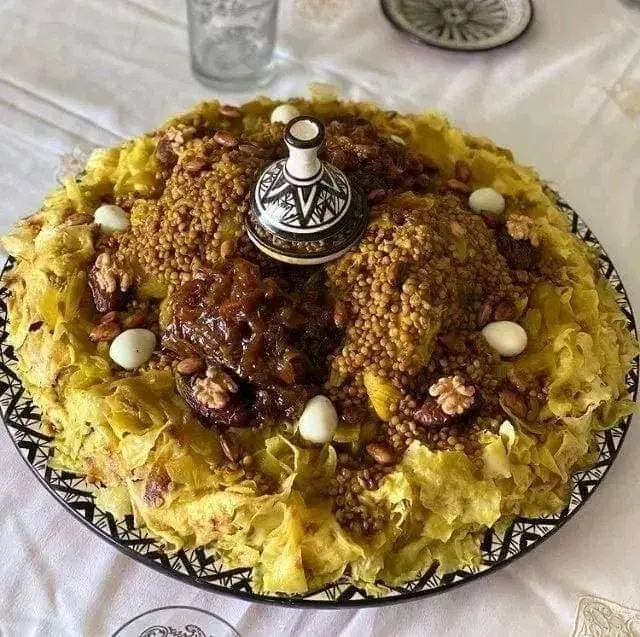
Rfissa is chicken and lentils stewed with onions in a broth heavy with fenugreek, ras el hanout and saffron, poured over a bed of shredded msemen or trid pastry. The pastry takes up the broth and becomes the base of the dish rather than an accompaniment to it, which is what distinguishes rfissa from a tagine served with bread. It is a family dish above all else. Rfissa is what appears at reunions and at religious occasions, at what Moroccans call a zarda, and it is not a restaurant dish. Its most specific role is at childbirth: it is served to women who have recently given birth, traditionally on the third day, because fenugreek, lentils and the spice blend are held to support recovery and milk production. A dish with a fixed place in a family's most significant week carries a weight that a good stew does not. The bed underneath it has its own vocabulary. Served over crumbled harcha it becomes rfissa medhoussa; over cubed bread it is treda. Moroccan households commonly buy the trid or msemen from a souk or a local bakery rather than making it, because the pastry is the slow part and the stew is not.
AFN Heritage Note
Rfissa descends from tharid, the centuries old Arab dish of stew and broth served over bread, by way of the Moroccan trid. It is documented as the dish served to women following childbirth, conventionally on the third day, for the fenugreek and lentils it contains.
Ingredients
Directions
- 1
Make and shred the msemen ahead of time, tearing it into bite sized pieces while it is still hot off the griddle. Store it in a sealed container, or freeze it if preparing more than a day ahead.
- 2
The night before, or at least six hours ahead, soak the fenugreek seeds and lentils in separate bowls of cold water. Drain when ready to use. The soaked fenugreek can be tied in cheesecloth to keep it separate in the pot.
- 3
The night before, mix the chicken with the onions, olive oil, salt, pepper, ginger, turmeric, saffron and ras el hanout in a heavy bottomed pot. Stir to coat the chicken well, cover and refrigerate to marinate.
- 4
Place the pot over medium heat and cook, covered, stirring occasionally, for 15 to 20 minutes until a rich sauce has formed.
- 5
Add the drained lentils, drained fenugreek seeds, parsley, coriander and water.
- 6
Simmer covered over medium low heat for about 1 hour, until the lentils are tender and the chicken is cooked through. There should be a generous broth; add a little water during cooking if not.
- 7
Taste the broth for salt, then add the smen and swirl the pot to incorporate it.
- 8
If you want crisp skin, lift the chicken out and place it under a hot grill for a few minutes.
- 9
Steam the shredded msemen in a couscoussier for about 10 minutes, until hot and tender.
- 10
Mound the hot shredded msemen on a large serving dish.
- 11
Set the chicken on the bed of msemen and distribute the lentils, onions and most of the broth over it.
- 12
Reserve a bowl or two of broth to offer at the table. Serve communally, each person eating from their own side of the dish.
Africook’s Notes
- If the chicken cooks faster than the lentils, take it out and cover it rather than leaving it in the pot. Left in, it falls apart before the lentils are ready.
- An organic free range chicken, known in Morocco as djaj beldi, holds up much better than a standard bird over this cooking time, which is why Moroccan cooks prefer it.
- Buy the msemen or trid rather than making it if time is short. Moroccan households routinely buy theirs from the souk or a local bakery, so this is standard practice rather than a compromise.
- Smen is preserved clarified butter and adds a distinctive flavour. It can be left out without ruining the dish, but anyone who knows rfissa will notice its absence.
- In some regions and on some occasions the spice blend msakhen replaces ras el hanout. Msakhen includes herbs and adds heat, so it is sometimes preferred in cold weather.
Reviews
4 reviews
You Might Also Like
Browse all Moroccan recipes →
Tanjia Marrakchia

Chebakia (Moroccan Sesame Cookies)

Maakouda (Moroccan Potato Cakes)
I had to run to the Middle Eastern shop on Georgia Ave in Silver Spring to find the whole fenugreek seeds, but c'est magnifique. Soaking them overnight as instructed removed all the harsh bitterness. Marinating the chicken with the sliced onions, turmeric, and ginger overnight gave such a deep flavor to the gravy. Reminded me a bit of soaking up rich sauce at home.
The technique here is so similar to Indian cooking, especially sweating down the onions with ginger and turmeric to create that rich spice base before adding the water. We use fenugreek (methi) a lot, but soaking it overnight first is crucial so it does not make the lentils bitter. Needed about 20 extra minutes on the hob for my lentils to fully soften though.
Tying the fenugreek seeds in cheesecloth saved my life, otherwise my kids would have complained about the bits! I didn't have ras el hanout so substituted 2.5ml cumin and extra ginger. Shredded the msemen while still hot off the pan like stated, made it so tender under that chicken broth. Cooked it after braai night and it was absolutely lekker comfort food.
Herh, tearing that hot msemen into bite sized pieces almost burned my thumb oo! But when the onion and saffron sauce soaked into the bread, chale, everyone at home was quiet. My Moroccan friend always said the fenugreek must soak overnight or it ruins the pot, so I am glad you emphasised that step paa.