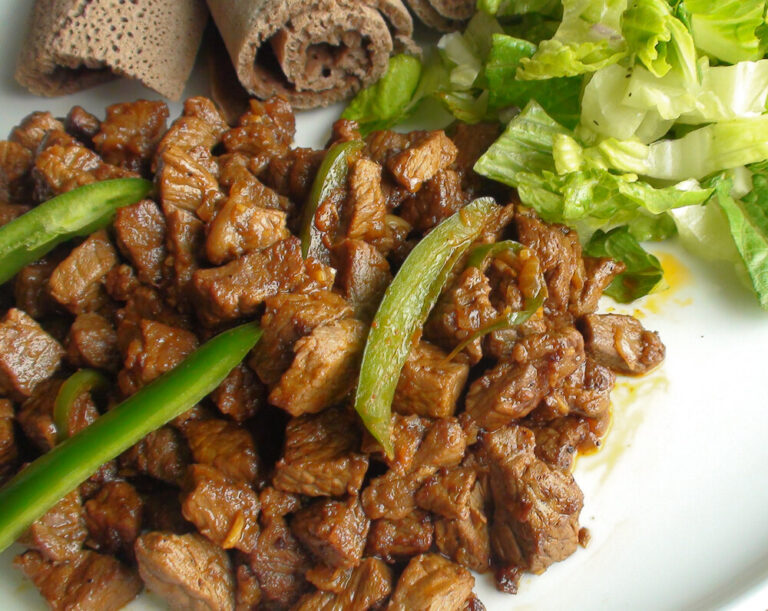
Tibs – Ethiopian Stir-Fried Beef

Tibs is a dish of sautéed meat with vegetables, flavored with berbere spice. Very versatile, it comes in many variations depending on the type of meat used, it’s cooking, and the vegetables that accompany it.

What is Tibs?

Tibs is meat dish that is sliced into small cubes and sautéed in skillet with niter kibbeh  (clarified butter), vegetables, herbs, garlic, ginger, and berbere spice to make flavorful sauce.

In Ethiopia, there are many versions. The most commonly used vegetables and herbs are onions, tomatoes, and green peppers. The most popular meats are beef, lamb, venison, and mutton.

Origin Of Tibs

Tibs (ጥብስ), written as tebs, t’ibs, or tibbs, is a culinary specialty from Ethiopia. While its exact origins remain unknown, it likely had its roots in the Aksumite Empire, like many other traditional Ethiopian dishes.

This monarchical state stretched over northern Ethiopia and part of Djibouti and Eritrea from the 4th century BC until the 5th century AD.

Ethiopians are known for their love of meat, and tibs have long been cornerstone of  Ethiopian cuisine. Except for the exception of fasting seasons when meat consumption is restricted, it has historically been associated with festivals and special occasions.
It was also dish served as token of respect for someone in the past. It is still one of the most popular foods served at family gatherings and other festive occasions today.

Tibs Recipe

This dish is super easy to make, but you do need a few unusual ingredients and spices, and you need to have everything set to go before you start cooking because it comes together very fast.

Traditionally, this dish should be eaten with your hands, using injera as a “utensil” to scoop bites of food. But if injera is not easy or convenient to make or find, substitute rice.

Berbere is a fairly hot blend of spices, characteristic of Ethiopian and Eritrean cuisine. In Ethiopia, its composition and the proportions of ingredients can vary a lot from place to place and there is no “official” recipe.

Berebere can be easily found online and is an essential flavor to the dish. It adds a good amount of heat as well.

There are also vegetarian versions, which may come as a surprise since meat is the central ingredient in this recipe.

In reality, these meatless versions are also called tibs about the similar cooking method, as well as the use of the same spices and condiments:

  • Inkolala tibs, literally “fried eggs,” refers to a dish of scrambled eggs served for breakfast with peppers, tomatoes and onions.
  • Inguday tibs, a variation with pan-sautéed mushrooms.

Be sure to recreate this incredible delicacy, this meal should come together in less than 30 minutes.

Be sure the get the pan nice and hot before adding the beef. That way, you will get a nice brown sear on the meat. Enjoy!

Beef Tibs Recipe – Ethiopian Stir Fry

Elenis Kitchen
Learn how to make one of the most popular Ethiopian stir fry dishes, called Tibs. This spicy stir fry is easy to prepare. Traditionally made with beef, it’s easy to make vegetarian, too.
Prep Time 30 minutes
Cook Time 50 minutes
Course Main Course
Cuisine East Africa, Ethiopia
Servings 4
Calories 593 kcal

Ingredients
  

  • 1 pound cubed flat-iron steak
  • ¼ cup red onion, sliced
  • 1 roma tomato, cut in wedges
  • 3 tablespoons olive oil (or preferred alternative)
  • 1 teaspoon salt
  • 1 tablespoon berbere
  • 2 teaspoon garlic, minced
  • 1 teaspoon ground black cardamom or black pepper to taste

Instructions
 

  • Start with the sauce by adding the tomatoes and onions to a pan and cook on medium heat for 3 to 4 minutes, until soft. Then add 2 tablespoons of oil and the berbere. Turn the heat to low and simmer for about 5 minutes.
  • Next, add the garlic and simmer for 2 more minutes. The last step for the sauce is to add ½ teaspoon of salt and the black cardamom or black pepper. In a separate pan, heat 1 tablespoon of oil on medium-high heat, then add the meat.
  • Sprinkle the meat with ½ teaspoon of salt and cook for 2 to 3 minutes, stirring occasionally. Move the meat to the pan with the berbere sauce. Cook until done, about 8-10 minutes.

Notes

TIP:

To get the best flavor, use the freshest meat you can get. Try to find a local butcher, ranch, or farm that sells high-quality, locally raised beef. It makes a difference. When I am making stews, I don’t mind getting stew beef from the grocery store. The meat cooks in spices for a long time and takes on the flavor of the sauce. Because tibs is a quick-cooking stir fry, better quality meat will make your dish taste better. If you are using any other meat cut than the flank steak, make sure it is tender meat.

NOTE:

Tibs is traditionally made with beef. To make it a vegetarian or vegan meal, replace the beef with any of the following vegan proteins:

Nutrition

Calories: 593kcal
Tried this recipe?Let us know how it was!

Porridge Beans

0

As Nigerian comfort food, porridge beans is generally inexpensive, healthy, simple to prepare, and delicious. Beans are a good source of plant protein, iron, fiber, and vitamin B. It is especially useful for vegetarians and dieters.

Most Nigerians, especially women believe that eating porridge beans daily can help their children grow taller apart from the fact that beans is an average family’s go-to meal..

Beans, in general, are members of the legume crop family. There are many different types of beans around the world, each with its own shape, size, color, and flavor; nevertheless, the kidney-shaped, black-eyed, and brown beans are the most popular in Nigeria.

Nigerian beans porridge goes well with Agege bread (a type of Nigerian bread) or any bread. Aside from bread, fried plantain and yam is a popular and delicious combination. It can also be eaten as a side dish with rice or with relished with the almighty garri.

What’s The Best Beans To Use For Porridge Beans?

Many chefs have confirmed that honey beans are the best to use because they have a unique and somewhat sweet flavor that truly ups your dish, but any of the other beans would suffice.

The Nigerian brown beans appear almost identical to the honey beans, so if you opt to pick them up in an African Market, make sure to ask for honey beans specifically.

How To Prepare Beans Porridge

Beans porridge can be made in a variety of simple ways, depending on the chef in charge of the dish.

However, you’ll need to pick the beans first. This is the first stage in the preparation of any Nigerian bean recipe. The beans are prepared locally and may contain stones or soil particles. Spread out the beans on a tray so you can see them all, then search for and remove any foreign bodies.

Except for slicing the onion, cooking Nigerian beans porridge requires no preparation. However, Nigerian beans require a lot of water to cook, so make sure you have plenty on hand. Check out the recipe below:

Porridge Beans

The Pretend Chef
Servings 0

Ingredients
  

  • 2 cups brown beans
  • 1 medium red onions
  • 2 tablespoons ground crayfish
  • 2 cubes seasoning cubes
  • 2  ground scotch bonnet (fresh pepper)
  • salt
  • 1/4 cup palm oil (1 cooking spoon)

Instructions
 

  • Pick through the beans, wash and place beans in a pot.
  • Add half of the onions and enough water to cover it well.
  • Add the rest of the onions, crayfish, seasoning cubes, and pepper, taste then add salt and palm oil.
  • Stir and lower the heat.
  • Cook for about 10 minutes. Take off the heat.
Tried this recipe?Let us know how it was!

Catfish Peppersoup

0

Catfish peppersoup is quite popular in Nigeria, especially in the local bars. The catfish itself is widely referred to as Point and kill. This pepper soup recipe is simple to make and all of the ingredients can be found at your local markets around.

Catfish pepper soup is a delectable dish. It’s so adaptable that it’s suitable for any cuisine. You can serve it with white rice, cornstarch (Agidi or Eko) or even take it hot as a temporary relief for extremely cold days.

Catfish pepper soup is one of the easiest and quickest Nigerian pepper soups to make, but it is also quite easy to botch up. Because of its delicate nature, it requires precise time and care to prepare.

This recipe is always popular among visitors at Nigerian gatherings, and it is the most commonly prepared pepper soup in Nigeria. During Omugwo, it is fed to a nursing mother.

How To Clean Your Catfish Before Cooking Your Catfish Peppersoup

  • Scrub the fish’s skin with salt.
  • Scrub with Alum
  • Soak it for 3 minutes in hot, boiling water. The slime will readily fall off and the fish’s skin toughened.

Things To Note When Preparing Your Catfish Peppersoup

  • Use the hot water method when cleaning, to keep your catfish firm and not disintegrated in your pot of soup.
  • Don’t use too many different flavors and spices in your fresh fish pepper soup.
  • Cook for long enough to remove the sharp raw flavor of the spices and the slimy flavour of the fish.
  • Use enough pepper, if you can.
  • Some suggestion for Amazon links to “Crispy Battered Fish Fillets“.
  • Crispy Battered Fish Fillets
  • Project Overview Docs Banner in Light Green Blue Vibrant Professional Style 1


cat fish peppersoup 2 e1466589211804

Catfish Peppersoup

Shoprite Nigeria
Course Appetizer
Cuisine Nigerian
Servings 0

Ingredients
  

  • Catfish
  • ¼ cup Peppersoup spice
  • Lemon grass/scent leave (optional)
  • 1 tbsp ground crayfish
  • 5 limes

Instructions
 

  • Wash your catfish with lime, lemon, salt or hot water.
    Catfish
  • Once slime has been removed, place it in a pot.
    5 limes
  • Add pepper soup spice.
    ¼ cup Peppersoup spice
  • Add some chopped fresh pepper.
  • Add seasoning cubes and salt for taste.
  • If you have chosen to add lemon grass to your dish, you may add it now.
    Lemon grass/scent leave
  • Cover the pot and allow to cook-the pepper soup should be ready in 35-50 minutes.
  • Optional: Adding chopped onion and yellow pepper will give the dish a special flavour.
Keyword Pepper Soup
Tried this recipe?Let us know how it was!

Ukwa

0

Ukwa is one of those unique dishes obtainable in a typical African restaurant, especially in Nigeria. It is eaten as a main course in Nigeria. The seeds are particularly appealing due to their great nutritional value.

It is a staple in the Pacific Islands, from where it moved to Africa. It is similar to jackfruit but has a better nutritional value. It has prickly skin, lumpy green flesh, and a texture similar to potatoes.

The African bread fruit is a diverse dish with a naturally wonderful flavor. It can be cooked without any ingredients, even salt, and still taste delicious, especially when made with fresh bread fruit seeds. It can be roasted and eaten with coconut or palm kernels. It can also be made into porridge, which is what this page is about.

Health Benefits of Bread Fruits

  • Breadfruit is high in nutrients that help lower cholesterol, fight infections, and promote youthful skin and healthy hair.
  • It is a diabetic-friendly food because it contains fiber, which slows the rate of glucose absorption.
  • It’s high in potassium, a heart-healthy vitamin that regulates blood pressure and heart rhythm.
  • Breadfruit is beneficial to the body because it includes omega-3 and omega-6 fatty acids, which promote skin and hair growth, regulate metabolism, and improve bone health.

What To Do Before Cooking Your Ukwa

  • If using dry ukwa, soak it in cold water overnight. If you’re using fresh ukwa, you may skip this step.
  • Soak, debone, and wash the dried fish or stock fish the next day, then cut into pieces.
  • In cold water, properly wash the ukwa. Stones and sand tend to collect in the bottom, so keep an eye out for them.
  • Pinch the pepper.

How To Cook Ukwa

It can be boiled with potash and eaten simply, or it can be separated from the water and the seeds mashed with certain seasonings before being served with plain cooked ukwa.q

Ukwa

Pulse Nigeria
Servings 0

Ingredients
  

  • African Breadfruit
  • Dry fish/Stock fish optional
  • 2 small stock cubes
  • Edible potash
  • Palm oil for colouring

Instructions
 

  • Put your thoroughly washed ukwa in a pot.
  • Pour enough water to cover the ukwa. The level of water should be about an inch above the level of the ukwa.
  • Add your potash. Add the dry fish or stock fish, cover the pot and cook till well done.
  • The ukwa is done when the seeds melt when pressed.
  • Add enough palm oil to the done ukwa, add pepper, stock cubes and salt to taste.
  • Stir, cover and cook on medium heat till the palm oil changes colour from red to yellow. Then stir and add the bitter leaves.
  • Enjoy your meal!
Tried this recipe?Let us know how it was!


Kitfo – Ethiopian Steak Tartare

Kitfo (Ethiopian Steak Tartare) Recipe – This Ethiopian beef tartare recipe uses high-quality steak seasoned with bold spices for delectable dish that goes well with almost any side! 
Serve raw or quickly seared as meal that everyone will enjoy sharing at the dinner table.

What is Kitfo?

Kitfo is an Ethiopian and Eritrean meal cooked with raw ground beef and spiced with mitmita, traditional spice blend incorporating pili-pili pepper. Niter kibbeh, a native clarified butter  Nister kibbeh, native clarified butter seasoned with a variety of spices, is also added. 
This recipe is similar to gored gored, but the meat is chopped differently, resulting in various flavor sensations. The meat in gored gored is sliced into cubes, but for this recipe it is minced.
It’s recommended to use top-quality lean beef for this recipe, such as tenderloin or sirloin. 

Origin of Kitfo

Kitfo is an extremely popular dish in Ethiopia, enjoyed at major annual celebrations and family celebrations. “Kitfo” means to finely chop or mince.

Kitfo Recipe

This Ethiopian recipe only includes a handful of ingredients, which are mostly vibrant spices. To make authentic Kitfo you need:
  • Beef filet – well-trimmed
  • Anchovy paste – for a unique salty and savory flavor
  • Seasonings – cayenne pepper, salt, garlic powder, ground cardamom
  • Clarified butter – or ghee

You can add more or less cayenne pepper to taste, depending on how spicy a dish you want. But even if you prefer a mild beef tartare I suggest you add at least a smidge of the spice for great flavor.

To make a proper kitfo, fresh, lean meat must be used. This should also be used very soon after purchase and must be partially defatted.

Recipe Variation

  • There is another Ethiopian dish called kitfo that’s made from finely chopped green cabbage. However, in addition to injera, this is frequently served as an accompaniment to beef kitfo.
  • The name of the dish may change depending on the level of cooking. When it is just hot enough to melt the butter, it is called lebleb, and it can also be called Geba yale. 
    If the cooking takes long time or takes the form of kofta, it’s yebesele.
  • This recipe is also reminiscent of the famous beef tartare found in France or Italy, only the seasoning is different. In the Ethiopian version, mitmita adds a very spicy dimension to the dish. This is due to it containing pili-pili pepper, which is particularly spicy and brings a certain freshness to the kitfo.

Serving Suggestions

Kitfo is best enjoyed at room temperature. You can enjoy a side of collard greens, misir wat lentils, and homemade injera bread.

You can also be served on a large plate containing many other dishes, such as gomen (stewed cabbage), for example, and different stews of legumes such as peas or beans. Presented like this, it’s reminiscent of mezze.

How Do you Eat Kitfo?

It’s traditional in Ethiopian cuisine to eat with your hands and use the injera bread or other flatbread as a kind of a scoop and edible plate.

Tear off a piece of the bread, and holding it in one hand, use it to grab a bit of the tartare almost like a small mit or glove. Then just take a bite and enjoy!

Storage

Tartare does taste best when eaten freshly prepared or refrigerated for about 30 minutes. You should only keep the beef tartare in the fridge for up to a day or so. To enjoy the next day after making, remove from the fridge and eat cold or let the Kitfo come to room temperature for about 15 minutes before serving.

Be Sure to Try These Other Authentic Ethiopian dishes!

Be sure to recreate this incredible Ethiopian and Eritrean dish of ground raw beef flavored with mitmita and niter kibbeh. Bon appétit!

KITFO

Spice trekkers
Kitfo can also be cooked and has its own unique names - tire, leb leb, geba yale and yebesele - according to the degree of cooking. It is traditionally eaten with your hands using tef crepes and braised green cabbage leaves. We serve it with lettuce. A little advice: make a lot of spiced butter; it's great to cook with and keeps for a long time.
Prep Time 20 minutes
Cook Time 20 minutes
Course Main Course
Cuisine East Africa, Ethiopia
Servings 4
Calories 487 kcal

Ingredients
  

  • 1 ½ lbs top round beef
  • 1 tbsp Reshampatti pepper
  • 1 tbsp Royal Berbere
  • Salt, to taste
  • Fresh jalapeño for garnish
  • 12 basil leaves
  • Lettuce leaves for serving

Instructions
 

  • Put clarified butter in a small pot. Coarsely grind dry spices; add to the pot along with garlic and scallion. Heat on low for a few minutes; remove from heat when the butter start to smell and the garlic begins to color. Let stand 10 minutes. Filter through a fine mesh sieve or paper coffee filter. Wipe the pot with a paper towel.
  • Cut meat into 1 to 1 ½-inch cubes then chop, not too finely, with a knife. If you use a food processor, chop the meat in 3 batches until fine but not minced.
  • Grind chile and spices finely in a mortar. Place the strained butter in the pot and warm gently. Add ground spices, beef and salt. Mix well and serve raw if you want a tire kitfo. Otherwise, continue to cook to leb leb, geba yale or yebesele (rare, medium or well done).
  • Garnish with chopped jalapeño and basil. Serve with lettuce leaves to make little rolls.

Notes

It is possible to keep leftover kitfo overnight, in an airtight container in the refrigerator. The next day, either sauté or heat over very low heat for a few minutes, stirring constantly, until the butter melts, and the temperature of the meat approaches room temperature. Serve immediately.

Nutrition

Calories: 487kcal
Tried this recipe?Let us know how it was!

Gored Gored

Gored Gored is essentially a raw beef dish that is largely consumed in Ethiopia and Eritrea. Raw beef cubes, usually tenderloin or round steak, are seasoned with niter kibbeh (spiced clarified butter), local spice blends such berbere and mitmita, and awazehot paste.

The savory preparation is an integral part of Ethiopian cuisine and is a must-have during special occasions and celebrations. The dish is a common household preparation as well.

Origin of Gored Gored

Apart from the fact that the dish has an Ethiopian origin, little is known about how exactly it came into being. There are various theories about the dish that came to light and its subsequent popularity, but most of the details shared are sketchy and questionable.

Over the years, the dish has grown in popularity and is today served in various places outside of Ethiopia and Eritrea. Different areas have even come up with different recipes and cooking styles.

Like most dishes of the Ethiopian cuisine, the raw beef preparation is also mostly modified when made and consumed in places other than the native regions.

Although the beef cubes are not to be cooked traditionally, raw beef is an acquired taste, and therefore, when served in places outside of Ethiopia and Eritrea, the meat is often cooked, albeit not in excess.

Gored gored is similar to kitfo, another Ethiopian dish, although the cut is not the same, and it makes the flavor different.

Gored Gored Vs Kitfo

Gored gored is a popular Ethiopian dish consisting of cubes of raw beef. Although the dish is often compared to kitfo, it is not marinated in spices and butter before consumption.

Kitfo is minced beef that is marinated in butter and spices, the raw beef preparation is cubed and not marinated.

Gored Gored Dish’s Health and Nutritional Facts

The meal is healthy enough to eat when prepared in its most basic and traditional form, as it contains no oil, butter, or spices. 
It’s crucial to remember, though, that beef is red meat, and too much of it can be harmful to your health. People with high cholesterol or heart problems should avoid eating the dish.
Because oil, butter, spices, and other ingredients are used, Gored Gored cooked with  additional ingredients may not be as healthful as the simple form. 
As a result, caution should be used when consuming the recipe, and persons with health health problems such as obesity, heart disease, high blood pressure, or high cholesterol levels should limit their intake.

How To Prepare Gored Gored

In its most basic and traditional form, the dish is simply cubes of raw meat served with a special Ethiopian bread.

With time, however, the preparation method and ingredients have changed in some places and the beef cubes are sometimes lightly cooked, alone or with some other vegetables.

When making Gored Gored the traditional way, the only ingredient needed is the beef. However, if a more elaborate cooked version is to be made, ingredients used, in addition to beef, range from onions and bell pepper to spices and herbs, and even butter.

The ingredients used and the time and method of cooking depend on individual preferences. When the dish is to be made in the traditional form, there is almost no preparation involved, except for cutting the beef into cubes.

On the other hand, when the beef cubes and other ingredients are to be cooked, the preparation method is a little more elaborate. The ingredients are all prepared in the required way.

The beef cubes are then cooked or sauted, along with the other ingredients in the preferred way. Once done, Gored Gored is ready to be served.

Which Beef Cuts Are Best for Gored Gored?

Beef is usually cut into four edible sections, known as noble pieces, which can be eaten rawor grilled. The components that will be cooked or simmered for an extended period of time. The sections that will be chopped, and then the offal.
The aristocratic sections of the animal should be picked for this dish, which are usually  found on the back and behind of the animal. Tenderloin is found on the back of the animal, whereas round steak is found in the thigh and hindquarters. 

Recipe Variation

One of the most popular and common variants of the preparation is the cooked variety. As mentioned earlier, raw beef is an acquired taste and for people who want to relish the preparation but find it difficult to consume raw meat, the beef is cook lightly.

Another popular variation of Gored Gored calls for the addition of more ingredients and the dish is prepared by adding spices, seasonings and vegetables to the raw beef cubes.

In some regions, chicken cubes are used instead of beef. This, however, is largely discouraged by traditionalists who strongly believe that real Gored Gored is made with beef alone and no other raw meats should be used.

Serving Suggestions

The preparation is served hot with injera, a special Ethiopian bread. The dish can be served all by itself, as it is considered a wholesome meal with bread on the side, or it can be a part of a major lunch or dinner meal.

Storage

It is possible to keep a leftover gored gored overnight, in an airtight container in the refrigerator.

The next day, either sauté or heat over very low heat for a few minutes, stirring constantly, until the butter melts, and the temperature of the meat approaches room temperature. Serve it immediately.

Be Sure to Try These Other Authentic Ethiopian dishes!

Be sure to recreate this incredible simply beef sautéed in butter and berbere spice. This dish literally takes 5 minutes to make. Bon appétit!

Gored Gored

Alex Gorgos
Gored gored is simply beef sautéed in butter and berbere spice. This dish literally takes 5 minutes to make. Top sirloin has the best price point for the tenderness. Serve the beef on injera with spinach or lentils.
Prep Time 2 minutes
Cook Time 5 minutes
Course Main Course
Cuisine East Africa, Ethiopia
Servings 2
Calories 351 kcal

Ingredients
  

  • 1 lb top sirloin cut into 1” cubes
  • 2 tbsp butter or neter kiba
  • 2 tbsp berbere

Instructions
 

  • Melt the butter over low heat. Mix in the berbere.
  • Add in the beef, making sure that the cubes are coated in the spices.
  • Turn up the heat to high and sear the beef for 3 minutes.
  • Serve over injera with sautéed spinach or lentils.

Nutrition

Calories: 351kcal
Tried this recipe?Let us know how it was!

Awaze – Ethiopian Chili Dip

This fundamental Ethiopian red chili dip, awaze, is so delicious and easy to make you’ll start to use it in everything! Try this traditional awaze recipe today.

Traditionally, it is made for special occasions like weddings and served with raw meat (many consider gored-gored – cubed raw meat with dipping sauce – an unofficial national dish in Ethiopia that no celebration is complete without).

What is Awaze?

It is an Ethiopian red chili sauce and it is extremely hot. Berbere is a traditional spice blend composed of dried chilies, garlic, ginger, onion, rue seeds, cardamom, cloves, and cinnamon sticks.

Other ingredients include mitmita, a spice blend containing hot pili-pili peppers, cardamom seeds, cloves, and salt. T’edj, a local version of mead, a drink made from fermented honey to which the leaves and buds of a local plant, gesho (aka “shiny-leaf buckthorn”), are added. And finally, salt and niter kibbeh (clarified butter), also typical of the country’s cuisine, and in which a large number of spices are infused.

This sauce is served as an accompaniment to most Ethiopian dishes and enhances flavor by bringing a particularly spicy note.

Awaze is often used with grilled meat, pieces of which are dipped directly into the sauce. Depending on taste and tolerance to chili, the amount used can be adjusted.

Origin of Awaze

Awaze is a sauce that brings together four typical Ethiopian staples; berbere, mitmita, t’edj, and niter kibbeh. These spice blends are hard to find in stores, which is why most Ethiopian families prepare them at home.

Berbere and niter kibbeh are two of the most well-known. It’s sometimes used in the same way as paprika is. Mitmita is frequently used to season kefto, raw meat dish.  Beans are also flavored with it.
Mitmita is especially spicy because it contains pili-pili peppers, which are among the hottest on the Scoville scale, which rates chili peppers from mild to deadly. 
T’edj, fragrant mead that can be drunk on its own, can also be used to make awaze or delleh, two Ethiopian hot sauces.

Recipe for Awaze

The awaze’s ultimate flavor should be healthy mix of spice, sweetness, and bitterness. 
Spiciness, however, must be present.

The preparation of this chili sauce is simple. Just combine the two different spice blends (berbere and mitmita), add Ethiopian mead (t’edj), a little salt, and some melted niter kibbeh.

Once the elements are combined in a mortar, they are worked together until a smooth paste is obtained.

If you are using whole spices to prepare berbere and mitmita, it is important to sift the blends before incorporating them into the other ingredients because the final result of the awaze should be smooth and without lumps.

Recipe Variation

  • T’edj is sometimes replaced in the making of awaze by other spirits such as beer, wine, or aniseed drinks, such as arak. Sometimes it is just a simple mixture of water and honey.
  • Awaze can differ from version to version, as sometimes one spice blend is used in greater quantity than the other depending on the desired taste.

Storage and Serving Suggestions

It can be kept for a week in the refrigerator and can spice up all meat, vegetable, or even fish dishes. It is also a sauce into which you can directly dip food such as kebabs, for example.

It’s also best to take the awaze out of the fridge a few minutes before using it so that the chilled butter will soften a little.

Like many Ethiopian sauces, different households and restaurants use slightly different ingredients and proportions based on their preferences. Below is our go-to recipe, but it’s truly customizable.

Awaze - Ethiopian Chili Dip

Elenis Kitchen
Awaze is a traditional Ethiopian sauce or spice paste, made from berbere, mitmita and t'edj (mead). It’s served with, and used to prepare, the country's main dishes.
Prep Time 5 minutes
Course Condiments
Cuisine East Africa, Ethiopia
Servings 150 ml jar

Ingredients
  

  • ¼ cup berbere
  • ½ tablespoon ground black cardamom
  • ⅛ teaspoon salt
  • 3 tablespoons red wine
  • 3 tablespoons warm water

Instructions
 

  • Mix all ingredients until you get a smooth consistency.
  • Store awaze in the refrigerator for up to a week.

Notes

TIP:

A more traditional awaze recipe will use tej (honey wine) as the alcoholic liquid or areka (a strong alcoholic drink similar to gin). I only make awaze with red wine, but you could also try white wine or one of these other stronger substitutes.
Tried this recipe?Let us know how it was!

Kitcha

Kitcha is an unleavened Ethiopian flatbread made with wheat flour, water, and salt. The dough is traditionally baked in a pan on both sides until it develops a golden-brown color of the exterior. The flatbread can be additionally spiced with chili and cardamom.

It is usually served warm with melted butter, or used in a dish called fit-fit.

What is Kitcha?

Kitcha (ቂቻ in Tigrinya, or ቂጣ in Amharic, kita), is a traditional unleavened flatbread typical of Ethiopian and Eritrean cuisine. It comes in the form of a thin pancake with characteristic black spots on the surface, which often appear during cooking.

This traditional Ethiopian flatbread is often pan fried in clarified butter, giving it a somewhat crunchy exterior and a soft interior. It tastes finest when served warm.

Kitcha is frequently consumed as part of traditional Ethiopian breakfast known as  chechebsa. It’s torn into little pieces before being combined with berbere and niter kibbehspicy butter. The final product has delicate feel. Some people add sautéed veggies to  this homey dish for added taste.

Kitcha Recipe

Although composed of simple ingredients, making kitcha can be tedious when kneading by hand, or if the dough is not elastic enough when rolling out.

Once you master the basic recipe, you can add a few pinches or warm spices to the dough. Any of the spices or spice mixes below will work well here.

  • Cinnamon
  • Cumin
  • Coriander
  • Fenugreek
  • Berbere, an Ethiopian spice blend

Tips for Making Kicha

It might seem intimidating to shape the dough in the hot pan, but there are some step you can take to do it successfully. Once you make Kicha a few times the approach will seem like second nature:

  • Wet your fingers
  • Work gently but quickly to press the dough out into a circle around the warm pan

Kneading the Dough

Traditionally, in Africa, kitcha is kneaded by hand. It is a process that may seem rewarding to some, but can be messy and tiring.

Today, the use of a stand mixer fitted with a dough hook works very well to reduce the kneading time. In addition, it often leads to better results. It takes about 25 minutes to knead the bread dough by hand, compared to 8-10 minutes with a mixer.

Furthermore, using food processor boosts the likelihood of good results, particularly for individuals who have never baked before and hence have never prepared bread dough.
Furthermore, when baking beginners add too much extra flour to the mix, difficulties can emerge. This may affect the bread’s texture, causing it to become heavy.

What to Serve with Kicha

Ethiopian breakfasts are frequently served with hot coffee or tea, but this flatbread is endlessly versatile. You can enjoy it for breakfast with yogurt, eat it along with stewed greens, stew or just as a snack with butter.

Be sure to recreate this incredible delicacy flatbread recipe, Enjoy!

Kitcha

Kicha Fit Fit From Hawa Hassan With Julia Turshen
Kitcha (or kita) is a very thin flatbread that’s typical of Ethiopia and Eritrea. It’s usually made with wheat flour, water and salt, and cooked in a pan.
Prep Time 15 minutes
Cook Time 15 minutes
Course bread, Breakfast
Cuisine East Africa, Ethiopia
Servings 4

Ingredients
  

Kicha Fit Fit

  • 3 tablespoons unsalted butter or ghee
  • 1 tablespoon berbere (homemade or store-bought)
  • 1 batch Kicha (recipe below), torn into bite-size pieces (about 6 cups)
  • 1/2 teaspoon kosher salt
  • 1 cup plain yogurt

Kicha

  • 1/2 cups whole-wheat flour
  • 1 cup all-purpose flour
  • 2 teaspoons kosher salt
  • 1/2 cups warm water
  • 2 tablespoons canola oil

Instructions
 

Kitcha fit fit

  • Place the butter in a large nonstick skillet set over medium heat. Once the butter melts, add the berbere and cook, stirring, until the spices sizzle and smell fragrant, about 30 seconds.
  • Add the kicha pieces and sprinkle with the salt. Cook, stirring, until all the pieces of kicha are coated with the spiced butter and warmed through, about 3 minutes. Transfer the mixture to a serving platter or individual bowls, top with the yogurt, and serve immediately.

Kitcha

  • Place the whole wheat and all-purpose flours and salt in a large bowl and whisk well to combine. Using your hands, mix in the water. The batter will be like a very thick pancake batter.
  • Line a plate with paper towels and set aside. Set a 12-inch nonstick skillet over medium heat and add 1 tablespoon of the oil, tilting the pan so the oil lightly greases the bottom of the pan. Once the oil is hot, add half the dough to the skillet and use wet fingertips to gently and carefully press the dough into a wide circle that covers the surface of the skillet. Cover the skillet and cook until the top of the dough is glossy and the underside is golden brown, about 3 minutes. Carefully flip the bread over, cover, and cook until the second side is browned, another 2 to 3 minutes.
  • Transfer the flatbread to the prepared plate, adding the remaining 1 tablespoon oil to the pan, and repeat the process with the remaining dough.
  • Serve immediately while the breads are warm, or let cool to room temperature to use for Kicha Fit Fit. Leftover breads can be stored in a plastic bag at room temperature for a day and rewarmed in a skillet over low heat.
Tried this recipe?Let us know how it was!

Misir Wot (Ethiopian Spiced Red Lentils)

Misir Wot is a stewed vegetarian dish from Ethiopia made with red lentils. This is a popular dish very rich in flavor thanks to the presence of spices and spicy clarified butter known as niter kibbeh.

If you order a vegetarian platter at an Ethiopian restaurant, Misir Wot is sure to be present at the table! The flavor is simply out of this world!

What is Misir Wat?

Misir wat, also known as misir wot, is tasty red lentil-based vegetarian dish. It is a 
unique blend of flavors that falls in between spicy lentil soup and dhal. The use of berbere, spice blend, lends this simmering meal distinct flavor. 

Misir wat has a deep red color due to the presence of tomatoes and tomato puree. It also contains garlic and onions confited in spicy clarified butter, niter kibbeh.

It is a popular dish and in addition, it is found on the menu of several Ethiopian restaurants. Its texture is semi thick. It is often eaten as an accompaniment to injera.

Misir Wot Recipe

Misir wat starts with onions that are slowly caramelized in niter kibbeh, Ethiopia’s popular and incredibly flavorful spiced clarified butter.  Garlic and tomato paste are added.  The comes a generous dose of berbere, Ethiopia’s famous chili seasoning blend.

It’s normally fiery-hot (and what you get in Ethiopia is even hotter than what you typically find outside of the country), but our blend tones down the heat and gives you the option of adding it according to your preference.

The lentils are then slow-simmered with these highly aromatic and flavorful ingredients until they’re soft.  Another spoonful of niter kibbeh and berbere are added in at the end for an added boost of flavor.

Tips to Make the Best Misir Wat

  • To achieve creamy, semi-thick consistency without breaking the lentils, make sure to  thoroughly wash them and do not overcook them. When lentils are overcooked, they  become heavy and mushy.
  • Another technique is to cook the onions in the kibbeh niter slowly before adding the rest of the ingredients. This step is necessary to liberate all of the spices’ scents from the  spicy clarified butter.
  • Also, when caramelizing the onions in the niter kibbeh, be careful not to burn them. 
    As result, use wooden spatula to constantly whisk the onion mixture.
  • The secret to the success of this spicy Ethiopian lentil stew lies in the cooking. Indeed, the misir wot is a simmered dish that requires slow cooking. The red lentil dish should simmer for 40 minutes to an hour over low heat. It is during this slow cooking that the aromas of misir wot will develop.
  • Also, if the water evaporates too quickly, don’t hesitate to add more during cooking. Ideally, add half a glass of water at a time so as not to alter the consistency of the misir wat.

Storage and Reheating

Misir wot can be refrigerated for up to 4 days. Reheat in the microwave on full power (covered) or on the stove top over medium-low to medium heat, stirring occasionally.

Also, leftover mekelesha spice blend can be stored in an airtight container in a cool, dark place for up to 2 months.

Be Sure to Try These Other Authentic Ethiopian dishes!

Be sure to recreate this incredible delicacy that is not only delicious but also full of proteins, fiber, and tons of vitamins like iron and calcium needed for your body. Bon appétit!

Misir Wat

Lisa Cherkasky for The Washington Post
Misir wat (or misir wot) is a delicious traditional Ethiopian vegetarian dish made with red lentils, tomatoes, niter kibbeh, and berbere.
Prep Time 15 minutes
Cook Time 45 minutes
Course Main Course, Side Dish
Cuisine Ethiopia
Servings 4
Calories 252 kcal

Ingredients
  

For the mekelesha spice blend

  • About 30 green cardamom pods (may substitute 1/2 teaspoon ground cardamom)
  • 2 teaspoons ground cinnamon
  • 1/2 teaspoon ground cloves
  • 1/2 teaspoon freshly ground black pepper

For the lentils

  • About 1 1/2 cups (8 3/4 ounces) dried split red lentils
  • 1/4 cup sunflower, canola or other neutral vegetable oil
  • 1 medium (8 3/4 ounces) yellow or red onion, finely chopped
  • 1 clove garlic, grated or finely chopped
  • 1-inch piece peeled fresh ginger, grated or finely chopped
  • 4 teaspoons berbere
  • 1/2 teaspoon ground nigella seeds (buy pre-ground or grind yourself )
  • 3 cups water, plus more as needed
  • 1 teaspoon kosher salt, plus more as needed
  • 1/2 teaspoon mekelesha spice blend

Instructions
 

  • Make the mekelesha spice blend: In a dry skillet over medium-low heat, toast the cardamom pods until fragrant. Crack open the pods with the back of a knife, the bottom of a solid glass, a mortar and pestle or just your fingers and remove the seeds. Grind the cardamom seeds in a mortar and pestle or spice grinder. You will need 1/2 teaspoon of the ground spice.
  • In a small bowl, blend the cardamom, cinnamon, cloves and black pepper. You’ll need only 1/2 teaspoon for this recipe. (Store the rest in a cool, dry place for future misir wot batches or other stews and curries.)
  • Make the lentils: Place the lentils in a large bowl or colander, and pick over and discard any debris. Rinse the lentils until the water runs mostly clear (a little cloudy is okay, but you’ll see it turn from almost white to much more transparent as you go).
  • In a 12-inch nonstick skillet over medium-low heat, warm the oil. You may see a little rippling, but not much since the pan won’t get too hot. Add the onions and cook, stirring occasionally, until soft and translucent, about 10 minutes. Add the garlic and ginger and cook, stirring constantly, until aromatic, about 1 minute. Stir in the berbere and nigella along with a splash of water. Cover the skillet, reduce the heat to low and cook for 10 minutes. Uncover, stir, add another splash of water and cook for 5 minutes. Repeat the process every 5 minutes until the onions have cooked for a total of 25 to 30 minutes (no need to add more water at the end unless it’s looking very dry). Don’t rush the process or crank up the heat: The goal is to get the onions very soft and cooked down to almost a paste, as well as rounding out the berbere flavor and darkening its color.
  • Stir in the lentils, 2 cups of water and 1 teaspoon of salt. Increase the heat to medium-high and bring the mixture just to a boil. Reduce the heat to medium, or as needed, to maintain a gentle simmer. Stir occasionally, adding water as you go along to ensure the lentils cook through and the dish doesn’t dry out. You should use about 3 cups of water total. If you prefer a soupier stew, use more. Cook until the lentils are tender but not mushy, with just a bit of bite, 10 to 12 minutes, stirring in the 1/2 teaspoon of the mekelesha when they’re almost done. You can choose to cook the lentils longer, or gently mash them, if you want them broken down more. Taste, and season with more salt, if desired.
  • Remove from the heat. The misir wot is ready to serve, but will be better if refrigerated overnight, then reheated

Nutrition

Calories: 252kcal
Tried this recipe?Let us know how it was!

Niter Kibbeh (Ethiopian Spiced Butter)

If you adore Ethiopian cuisine but can’t seem to get the flavor right at home, you might be missing the ultimate secret ingredient: Niter Kibbeh!

It is a wonderful and uniquely delicious clarified butter that you will fall in love with.  And absolutely nothing compares to homemade niter kibbeh.  Once you’ve made it (it’s super easy) and tried it (it’s incredible) you’ll make it again and again!

What is Niter Kibbeh?

Niter kibbeh sometimes spelled Nit’ir Qibe in Amharic, or known as tesmi in Tigrinya, is clarified butter similar to the famous Indian ghee. It is an ingredient integral to Ethiopian cuisine and is made by clarifying butter that has been infused with herbs and spices.

In the process of clarifying the spiced butter, the same process used to make ghee, the butterfat is separated from the milk solids and water and the result is highly aromatic and flavorful cooking fat.  This clarified butter has a higher smoke point and longer shelf life than regular butter.

Origin Of Niter Kibbeh

Because cattle rearing is so common in Ethiopia, it’s no surprise that there are so many dairy products. Clarified butter, also known as niter kibbeh, is a common ingredient in  Ethiopian cooking that adds lot of flavors.

One of the most common uses of niter kibbeh is in Doro wat (or doro wett), Ethiopia’s national dish. It is quite adaptable and may be used in variety of cuisines. 

Add dollop to your favorite stews, beans and lentils, sauces and gravies, vegetables and eggs, brown your meat or chicken with it, spread some on your sandwich…and then relax and enjoy your dinner.

How To Prepare Niter Kibbeh

The preparation of niter kibbeh is very simple but requires a wide variety of spices and herbs. Some are used as seeds, others are ground.
For truly authentic niter kibbeh you would include two Ethiopian spices that are very difficult to find outside of Ethiopia:  Besobela and Kosseret.
  • Besobela is also known as Ethiopian sacred basil though it tastes nothing like basil.  It’s also traditionally included in Berbere, the famous fiery hot Ethiopian spice blend.
  • Kosseret is in the verbena family of plants and likewise has a very unique flavor.  There are no adequate substitutes for either.

If you can find them, use about a tablespoon of each.  If you can’t, simply omit them.  The resulting niter kibbeh will still be incredibly delicious without them.

Cardamom is another key element in niter kibbeh. However, most of us are not familiar with green cardamom. Rather, it’s korarima, fake cardamom, and Ethiopian cardamom, a  sort of cardamom that’s considerably larger and has a brown color. It also has a distinct flavor from green cardamom. The bad news is that finding it is practically impossible. 
The good news is that you may use black cardamom from India instead. It more closely resembles Ethiopian cardamom in flavor than does green cardamom and is a vital spice in Ethiopian cooking.

All the ingredients are then placed in a saucepan with a large amount of butter. The whole thing should be brought very slowly to a boil so that the flavors gradually develop.

Once the butter is highly flavored, the foam, which has risen to the surface, is separated from the rest. This is what usually burns when the butter is cooked at too high a temperature. This foam is removed with a skimmer and the rest of the butter is strained through very fine cheesecloth to remove all impurities and residual spices.

Storage

When it is ready, it is poured into sterilized glass jars and can be stored for several weeks. You can also freeze it and store it for several months using only the amount needed.

It is preferable to make a large amount at the start because when the butter separates, a significant amount of the initial weight is lost. This separated residue can still be used in cooking. To do this, it will be necessary to favor very gentle cooking.

Now that you know how to make this Ethiopian Spiced Butter you can make some phenomenal-tasting Ethiopian food right at home. I will recommend Doro Wat and Gomen Wat. Enjoy!

Ethiopian Butter

Hank Shaw
Our spiced butter, called niter kebbeh, at the Ethiopian restaurant I worked at absolutely required four things (other than butter): minced shallots, toasted cardamom, fenugreek and turmeric. Oh, and one other thing — time. Slow cooking is essential to this concoction.
Prep Time 10 minutes
Cook Time 30 minutes
Total Time 40 minutes
Course Condiments
Cuisine East Africa, Ethiopia
Servings 16
Calories 214 kcal

Ingredients
  

  • 1 pound unsalted butter
  • 2 minced shallots, about 1/4 cup
  • 2 cloves minced garlic
  • 2 tablespoons minced fresh ginger
  • 12 to 15 crushed cardamom pods
  • 5 whole cloves
  • 1 piece cinnamon stick, about an inch long
  • 1 tablespoon dried oregano
  • 1/2 teaspoon ground turmeric
  • 1 teaspoon ground fenugreek

Instructions
 

  • Toast the cardamom, cloves and cinnamon in a dry pan over medium heat until they are aromatic, about a minute.
  • Cut the butter into cubes.
  • Toss everything into a heavy pot and turn the heat on low. Let this come to a bare simmer and cook gently for at least 30 minutes. We cooked ours at least an hour. It is vital that the milk solids do not burn. If they do, you have ruined the butter. Watch for browning, and when you see it, turn off the heat.
  • Strain through cheesecloth and store in a clean glass jar. It’ll last 6 months in the fridge, at least a week on the counter, and forever in the freezer.

Notes

This recipe makes about 2 cups

Nutrition

Calories: 214kcal
Tried this recipe?Let us know how it was!

QUICK RECIPES