Cooking tips are very essential as they make hard tasks simpler. Today we are going to be doing something different and I’m sharing some cooking tips I got from my grandmother and you definitely need to try them. I have tried a few of them and they always saved me from my cooking disasters.
Here are some cooking tips you need to adopt to make your cooking experience easier.
Cooking tips are tips, tricks, and suggestions that help improve one’s cooking skills and outcomes. These tips can be related to different cooking techniques, such as baking, grilling, frying, or roasting, and can be on any topic, such as temperature, ingredient substitution, measurement, equipment, and more. These tips help make cooking easier, faster, and more efficient.
Who Needs These Cooking Tips
Literally, anyone and everyone needs these cooking tips. As long as you spend some time in the kitchen making food for yourself, your family, or for commercial purposes, these cooking tips would be of great help. Cooking tips are oftentimes stumbled upon when trying to either fix a problem or try something new.
Simple Cooking Tips You Need
There are several cooking tips, however, in this article, we will be highlighting 11 cooking tips I got from my grandmother.
1. The first would be to wash your meat thoroughly with lime or lemon. It kills off all the bacteria & gets rid of all that awful smell.
2. When boiling rice or pasta always add a tablespoon of butter. It gives it a wonderful aroma & makes it taste even nicer.
3. If you don’t like the skin of the chicken and you happen to be the one taking it off, all you have to do is get a cloth or napkin, place it on top of the chicken part & pull the skin off. Easy!
4. If you aren’t sure how fresh your eggs are, place them in about 10cm of water. Eggs that stay on the bottom are fresh. If only one end tips up, the egg is less fresh and should be used soon. If it floats, it’s past the fresh stage. Trust me when I say this is a tip that you never know you need until you do.
5. Best in not knowing how to properly spice soup and if it gets too salty then you definitely need to jump on this tip. If you over-salt a pot of soup, just drop in a peeled potato, the potato will absorb the excess salt.
6. Some tips can literally save the day and this is definitely one of them. For burnt rice, place a piece of white bread on top of the rice for 5-10 minutes to draw out the burned flavor. I am trying this one of the cooking tips out.
7. Don’t store your bananas in a bunch or a fruit bowl with other fruits. Separate your bananas and place each in a different location. Bananas release gases that cause fruits (including other bananas) to ripen quickly. Separating them will keep them fresh longer.
8. After working with garlic, rub your hands vigorously on a stainless steel sink for about 30 seconds before washing them. This helps remove the lasting odor.
9. When chopping vegetables, toss a little salt onto the cutting board, it will keep the leaves from flying around.
10. Drop moi moi broad leaves in the freezer, and leave them frozen and hard for as long as you want, when it’s time for moi moi making or ofada rice, rinse and use your fresh-looking leaves.
11. Sprinkle some salt on fresh pepper while pounding to prevent your pepper from jumping out of the mortar and landing on the floor. Of all the cooking tips, this particular tip has been a helpful one.
There are several cooking tips that are very helpful in the kitchen and in making your cooking experience worthwhile. There are so many more tips that can make cooking so much more fun and seamless, you can share your own tips with us in the comment.
A lot of meals eaten around the world are of African Origin. The African continent has diverse foods that have been adopted by other parts of the world and publicized as their meals whereas these foods are of African Origin. In today’s article, we will highlight 5 popular foods that you probably always thought originated in the Western world but are actually of African Origin. Your jaw might drop once or twice in shock so be prepared for this informative jolly ride.
African Food, History, and Its Authenticity
African food is a staple of the culture of the continent, and its history is always intersecting with the story of the African people.
The majority of the food eaten by Africans is influenced by their religion, some by the climatic conditions, and others by their lifestyle. The first Africans to live on the continent were hunter-gatherers who ate what could be found in nature. Agriculture became popular as well as agriculture-based diets.
The roots of foods of African origin date back thousands of years to the Bronze Age in Northeast Africa when early civilizations began the cultivation of grains such as wheat and barley. In the Fertile Crescent settled agriculture was practiced by the Ancient Egyptians in this area. Animals such as donkeys and sheep were also domesticated starting the spread of agriculture to other parts of Africa, notably West Africa. However, most tribes still lived a simple hunter-gather diet. The American rice growing in the Carolina Lowcountry was influenced by West African techniques of rice cultivation and many slaves hailed from rice-growing regions of West Africa.
Arab explorers Leo Africanus and Ibn Battuta provided accounts of African foodways that they encountered on their travels through sub-Saharan Africa. Most of the staples introduced in Africa were colonized by Europeans. Foods that are now integral in African foods are maize and potatoes which were not common until the 19th century.
The influence of foods of African origin on Caribbean, Brazilian, and American cuisine is seen in rice dishes and green stews such as Afro-Caribbean Efo, duckanoo, and callaloo. The vegetable and the okra, introduced from Africa, and is used in classic Louisiana gumbos
The American rice growing in the Carolina Lowcountry was influenced by West African techniques of rice cultivation and many slaves hailed from rice-growing regions of West Africa.
The authenticity of foods of African Origin is that they are widespread across the world and used by different people of various descents. They have unique tastes and styles so much so that they inspire a lot of meals and agricultural processes around the world.
Foods You Didn’t Know Are of African Origin
Foods of African Origin have been adopted as staples in a lot of cuisines in the world. People eat many foods of African origin without knowing that it is actually from the continent of Africa, Africans included. In researching for this article, I too got shocked by some of the foods of African origin because I always thought they were Western dishes and we Africans were just adopting their cuisines. So let us talk about foods of African origin that you and I did not know about.
Jambalaya
Jambalaya
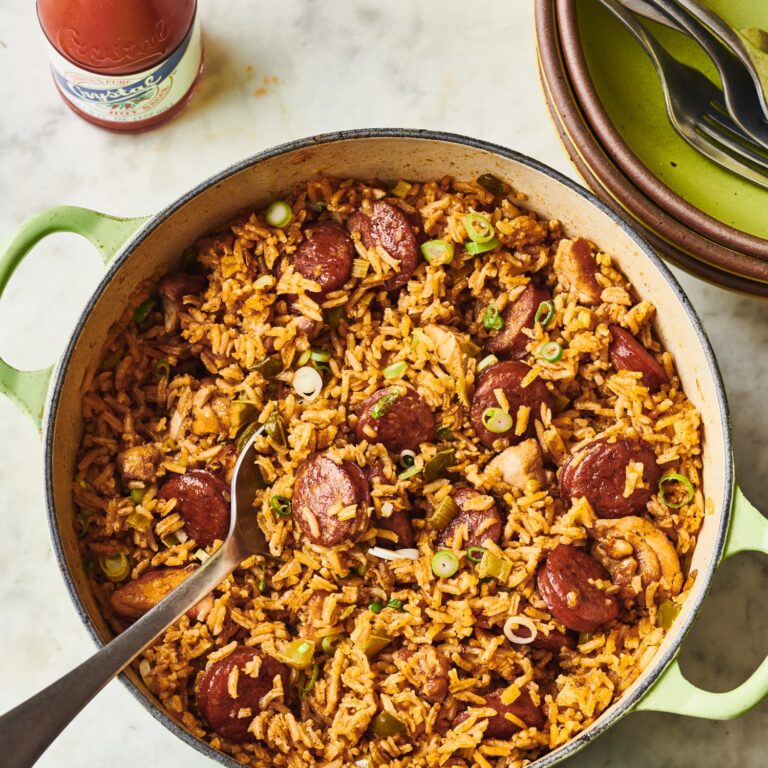
The first food of African Origin that we are going to be talking about is Jambalaya. I honestly have always thought that this meal was probably of Caribbean descent. So imagine my shock when I discovered that it is of African origin. Although Jambalaya is tied more to the Lousianna people, history shows that it was during the trans-Atlantic slave trade period that this dish came about, thanks to the Creole African roots of the people who settled in Lousianna.
Jambalaya is rice-based as it begins with a rice base and incorporates a variety of flavors. Some of the main ingredients include different kinds of meat, vegetables, and stock. It’s a type of dish that can be enjoyed in a variety of ways. traditionally, the meat includes sausages of some sort, smoked meat along with pork or chicken. Some Jambalaya recipes also include seafood such as crawfish or shrimp. The vegetables consist of onions, celery, and green bell pepper, though other vegetables such as okra, carrots, tomatoes, corn, chillis ad garlic are also used.
After browning and sauteeing the meat and vegetables, rice is added with seasonings and broth, and the entire dish is cooked together until the rice is done.
Watermelon
Watermelon
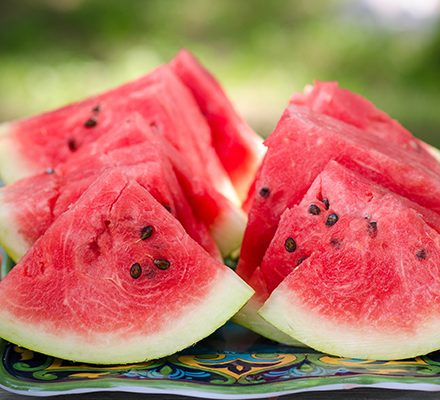
The second food of African origin that might not necessarily come as a surprise because of how prevalent and popular it is in Africa is Watermelon. I for one believe that no fruit tastes as good as Watermelon and I know you agree too.
Watermelons come from the Citrullus species(Cucurbitaceae) are native to the African continent and have been cultivated since ancient times. They originate from a series of selection events in a single ancestral population.
Early watermelons were not sweet, but bitter, with yellowish-white flesh and difficult to open. Through breeding, watermelons later tasted better and were easier to open. Watermelons were originally cultivated for their high water content and were stored to be eaten during dry seasons, as a method of storing water.
Indications show that northeastern Africa is the birthplace of Watermelons. They have been domesticated for food and water over 4000 years ago and sweet watermelons emerged in the desert land approximately 2000 years later
Watermelons are eaten globally, they are very rich in amino acids and very essential for the bodily function of the human body. It is now grown in diverse parts o the United States of America in places such as Florida. This fruit of African origin is one to be proud of as it has become one of the most sort after fruits in the world.
Okra
Okra
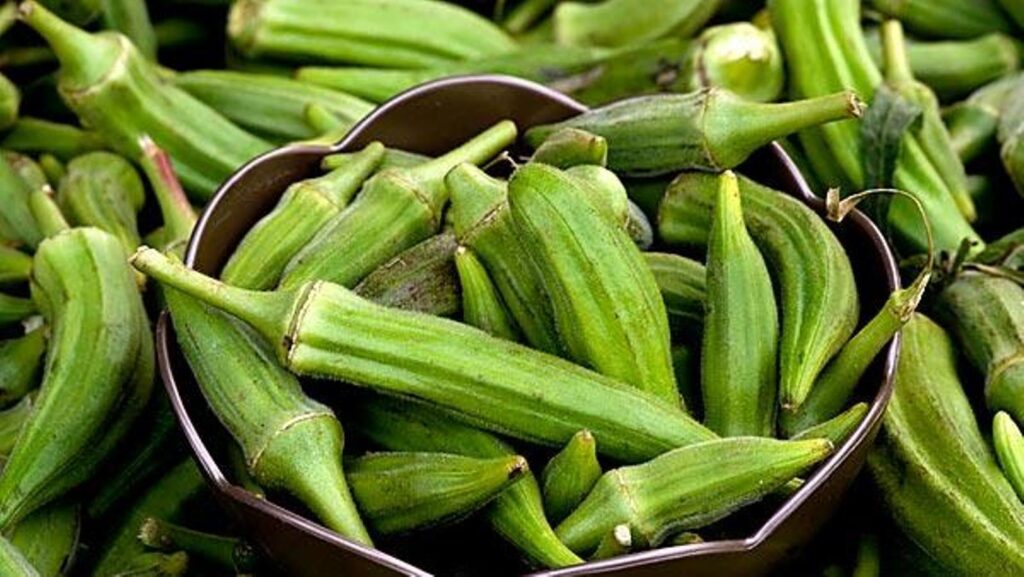
The next item on the foods of African origin that is eaten across the world is Okra. Okra/Okro also known as ochro or ladies’ fingers, is a warm-season vegetable. It is a good source of minerals, vitamins, antioxidants, and fiber. It contains a sticky juice that people use to thicken sauces.
The origin of Okra is often disputed amongst the Western, Northern, and Eastern parts of Okra as they all claim that it originated from their parts of the world. However, history shows that it most likely originated from the Egyptians and Moors of the 12th and 13th centuries who used the Arabic word for the plant, bamya.
Okra is said to have come into Egypt from Arabia, but earlier it was probably taken from Ethiopia to Arabia. The plant may have entered southwest Asia across the Red Sea or the Bab-el-Mandeb strait to the Arabian Peninsula, rather than north across the Sahara, or from India.
The scientific/botanical name for Okra is Abelmoschus esculentus. Okra is a very versatile vegetable that is used to make diverse meals across the world. Some Popular Okro meals include Miris, Superkanja, Okra and Rice Casserole. This is one food that is of African origin that is eaten by so many ethnicities that most times it is easy to forget its actual descent.
Coffee
Coffee
Another food of African origin on our list is Coffee. If you watch Telenovelas as I do, you were probably thinking that Coffee originated from places like Columbia or Mexico. Well, it actually originated in Africa.
Wild coffee plants originated from Kefa, Ethiopia, and were taken from southern Arabia and placed under cultivation in the 15th century.
Coffee is a beverage brewed from the roasted and ground seeds of tropical evergreen coffee plants of African origin. It is one of the three most popular beverages in the world alongside Water and Tea. Though coffee is the basis for an endless array of beverages and it is mainly attributed to its invigorating effect which is produced by caffeine, an alkaloid present in coffee.
Coffee is very common in the Western world, such as Europe, Canada, Arab Nations, the United States, Columbia, and Mexico and it has been tweaked to suit different cultures. This is one beverage of African origin that has gained worldwide recognition.
Black-Eyed Peas
Black-eyed Peas
Last but not least would be the Black eyed peas. This is another food of African origin that is eaten in different parts of the World. The black-eyed pea or black-eyed bean is a legume grown around the world for its medium-sized, edible bean. It is a subspecies of the cowpea, an Old World plant that is domesticated in Africa. The Black-eyed peas originate from West Africa, despite their name black-eyed peas are actually beans. Black-eyed peas have an earthy, slightly sweet flavor and firm texture, and pair well with greens, onions, garlic, and tomatoes.
There is a Myth about black-eyed peas, if it is eaten on New Year’s Day, they’ll bring prosperity in the upcoming year. It is also said that the swelling of the simmering peas symbolizes prosperity and others say that the peas represent coins and the greens accompanying the meal represent dollars.
These above-mentioned foods, beverages, and fruits are popular foods eaten around the world but they are of African Origin. It is very easy to assume that they are not of African Origin because they are eaten by different people around the World and it is easy to get carried away by the different adaptations done to these meals by different cultures that after a while forget or never know that they are of African Origin.
This article highlights some popular foods eaten by all and sundry that are of African Origin, let us know in the comments about any other such foods that you know about, that are of African Origin and it just might be helpful.
The African Horned Melon, also known as the Kiwano or African Horned Cucumber, is a unique fruit that is native to Africa. While it is not very common in many parts of the world, it has been used for centuries in Africa as food and medicine owing to its many health benefits. In this article, we will be talking about the African Hoorned melon, its origin, history as well as health benefits.
What is African Horned Melon?
African Horned Melon
The African Horne dd Melon is a traditional food plant in Africa. It is one of the few sources of water during the rainy season in the Kalahari Desert. In northern Zimbabwe, it is called gaka or gakachika and it is primarily used as a snack or salad and rarely for decoration. It can be eaten at any stage of ripening.
The African Horned Melon can be compared to taste like a combination of banana and passion fruit or a combination of banana, cucumber, and lime. A small amount of salt or sugar can increase the flavor, but the seed content can make eating the fruit less convenient than many common fruits.
The peel of the Horned Melon is also edible as the ripe fruit has orange skin and lime-green, jelly-like flesh.
The African Horned Melon is resistant to several root-knot nematodes; meaning that the horned melon is highly resistant to pests. It is highly resistant to watermelons but extremely sensitive to the squash mosaic virus.
Some Horned Melon variants are susceptible to the Fusarium wilt, however more often than not the African Horned Melon is one fruit that weathers the storm.
The common names of Kiwano are Melano, the African Horned Cucumber, Spiked Melon, Brownfish fruit, Jelly Melon, Horned Melon, English tomato, and Hedged gourd.
Origin of African Horned Melon
The African Horned Melon also known as Kiwano is a Cucurbitaceae family member. This fruit is a tropical fruit found in Africa’s tropical and subtropical sub-Saharan areas, Australia, and several Pacific islands.
The African Hornd melon was nicknamed ‘Kiwano’ because its flesh resembled a kiwi fruit: juicy, emerald-green, jelly-like meat.
The Horned Melon is Native to South Africa’s semi-arid regions, including Botswana in the south and Nigeria in the center, especially the Kalahari Desert. It is now grown as far as New Zealand and Australia for sale in the United States and Europe as well.
On the outside, the African Horned Melon resembles an oval Melon with spikes while on the inside it looks gelatinous, lime green, and pulpy. Despite its obvious resemblance to Kiwi, it has no relation with the Kiwi family. It has a tangy flavor and a cucumber-like texture.
Nutritional Composition of the African Horned Melon
It is very high in water, it contains up to 89 grams of water, and has low calories, carbohydrates, and fat content. The nutrient component that provides the majority of the calories in the African Horned Melon is Proteins and carbs.
It is said that every 100 grams of the Horned Melon composes of 44 calories, 1.7 grams of protein, and 7.56 grams of carbohydrates, higher than other fruits.
The African Horned Melon is rich in essential vitamins and minerals, many of which promote health. The Horned Melon composes of 123 milligrams of potassium and 40 milligrams of magnesium for every 100 grams. The antioxidants composed in this fruit include vitamin C, vitamin A, zinc, and lutein.
While the seeds of this African Horned Melon include antioxidants such as tocopherol and a-tocopherol, which are both organic forms of vitamin E.
According to USDA data, 100 g of Kiwano offers 44 kcal of calories and is cholesterol-free. As a result, Kiwano is an excellent choice if you want to lose weight because of its unique nutrient distribution.
Health Benefits of the African Horned Melon
Horned Melon
Studies have shown that this fruit is an essential fruit for preventing malnutrition and treating diseases because it has very high nutritional compositions.
It has helped fight malnutrition in several parts of Africa and other underdeveloped countries because it contains large quantities of essential nutrients. The leaves, roots, and seeds are beneficial for so many things, however, the fruit itself takes the cake.
Regardless of the fact that it is not widely available, the African Horned Melon is a nutritious addition to anyone’s diet as it provides protein, magnesium, vitamin C, and iron.
African Horned Melon can boost cognitive performance, prevent chronic diseases, aid weight reduction, protects the skin from blemishes, increases metabolism, improve vision, strengthen muscles, regulate digestion, slow down aging, and reduce inflammation. It is a low-calorie, cholesterol-free, high-nutrient fruit with various health-promoting components. So when it comes to health, the African Horned Melon is a fruit with numerous health benefits.
We are going to be highlighting the elemental benefits of the African Horned Melon to the human body;
Rich in Antioxidants
The African Horned Melon is abundant in vitamin E-based antioxidants such as alpha-tocopherol and beta-tocopherol. These antioxidants support the immune system while helping to keep neurons and blood vessels healthy. It helps neutralize free radicals that cause oxidative damage to the cells and protects bodies from degeneration, heart disease, and cancer. It is also said that vitamin E helps reduce the risks of Alzheimer’s and Parkinson’s disease.
The African Horned Melon is high in antioxidants which help prevent skin blemishes and it contains vitamin C which helps your skin glow and aids in preventing aging by increasing collagen production.
Helps Lower The Risk of Diabetes
It is very rich in dietary fiber, which slows down the absorption of sugar in our bloodstream and lowers blood sugar levels thereby reducing the risks of Diabetes. It is also high in Magnesium which helps with blood sugar regulation.
Studies have shown that magnesium helps regulate insulin action and insulin-mediated glucose uptake in type 2 diabetes. The Horned Melon is highly recommended for people with diabetes.
Boosts Eye Health
The African Horned Melon is rich in beta-carotene and vitamin A, which helps with vision improvement. Its antioxidant properties protect the eye cells from free radical damage.
Also, vitamin A is an essential nutrient for good retinal health and it strengthens the mucosal lining, protecting the nasal passages, throat, and digestive tract against infection.
Prevents Early Aging
This African fruit offers many essential elements required for the function of numerous body functions, including vitamin C. The Horned Melon provides 5.3 milligrams of vitamin C in every 100 grams.
Also, the Horned Melon helps produce collagen which is an element of skin tissue utilized for repairing damaged skin and organ tissues. The fruit also protects cells from injury caused by free radicals and harmful toxins that can develop many aging disorders.
Boosts Metabolism
The African Horned Melon aids metabolism in the body because it has a large composition of zinc. Zinc is an essential dietary component because it aids in creating protein, which aids in the healing of wounds, tissues, and blood vessels. It also contains sufficient zinc, which helps insulin release and boosts proper carbohydrate metabolism.
Helps Digestion
This fruit is high in dietary fibre content aids and promotes regular bowel movements. Dietary fibre boosts healthy digestion and cleanses the urinary tract and protects against dangerous illnesses, including stomach ulcers and colon cancer.
It also ensures great cardiac health by helping manage cholesterol levels in the body and manage cholesterol levels in the body and insulin receptors. It contains high amounts of antibacterial and antiviral properties which are beneficial in preventing different types of gastrointestinal tract infections.
Reduces Blood Pressure
African Horned Melon is high in potassium and other electrolytes and can help lower blood pressure. Potassium is a mineral found in cells and body fluids that aid in regulating heart rate and blood pressure induced by sodium. In addition, potassium works as a vasodilator that relaxes blood vessels and allows blood to flow smoothly through the arteries which help in lowering blood pressure. It helps the heart’s functionality.
The African melon is one amazing fruit from the African continent that is diverse and unique because of its unique health composition. It is definitely a fruit that should be included in your diet if you can find it in your area.
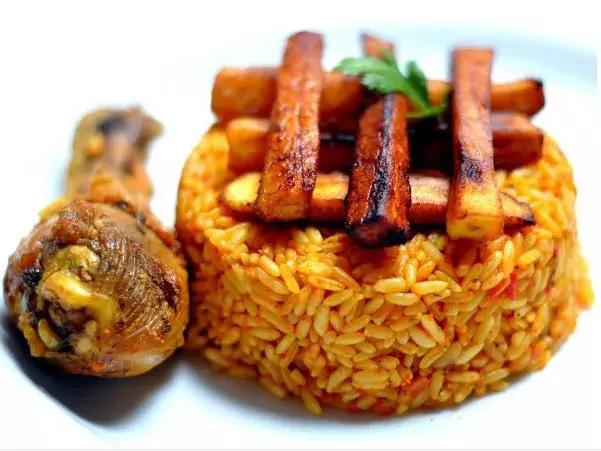
Jollof rice is a West African meal that has gained international acclaim for its extraordinary depth of flavor. Whereas most rice dishes are served as side dishes to the main course, Jollof is unquestionably the headliner.
The cuisine is a celebration of West Africa’s sharing culture, and it is smoked, spicy, and aromatic. Nobody ever leaves Auntie’s place without going home with a bowl.
Jollof Rice is mostly common in west Africa and it is consumed in most regions like Nigeria, Gambia, Sierre Leone, Togo, Cameroon, Senegal, and many others. The only thing is that their ingredients are different.
Origin Of Jollof Rice
The roots of jollof rice may be traced back to the Senegambian territory governed by the Wolof or Jolof Empire in the 14th century, which spanned portions of today’s Senegal, The Gambia, and Mauritania and was where rice was farmed. The cuisine is based on a classic dish called thieboudienne, which includes rice, fish, shellfish, and vegetables.
Spices For Jollof rice
Whether you’re making Jollof in Ghana, Nigeria, or Senegal, your skillfully prepared spice will help you make the ideal meal.
How to cook party Jollof rice
Party Jollof is traditionally cooked over an open fire to absorb the smokiness, before adding smoky paprika, thyme, rosemary, and nutmeg to boost the taste. You may also add butter or coconut oil, and serve it with grilled chicken, salad, fried plantain, or avocado because added fat is always a good idea.
Party Jollof is usually served at open ceremonies such as birthdays or weddings and people always look forward to it.
Jollof Rice Ingredients
Rice, tomatoes and tomato paste, onions, frying oil, fish, lamb, goat meat, chicken, or beef are the main components in jollof rice. Different regions, however, have their unique method and components for preparing this dish.
There is a distinction between Ghanaian and Nigerian Jollof, as everyone interested knows. Perhaps the defining component is the ingredients utilized.
To Prepare Your Jollof Rice, You have To Get These Things Ready First
Tomato Stew
Chicken or any other meat (wash and cut your chicken or any meat into pieces. Cook with thyme, knorr cubes, and chopped onions. Your cooking time here depends on whatever meat you will be using when done grill it in an Oven. You may also fry it (if you want) this is to give it a nice look that is more presentable especially when you have a guest.
Parboil the rice, rinse the parboiled rice and put it in a sieve to drain.
How To Cook Jollof Rice
Explore the recipe below to make your tasty Jollof. Be sure you have prepared your elements before you start.
Pour the chicken or meat stock and the tomato stew into a sizeable pot and leave to boil
Add the parboiled rice, curry powder, salt, and pepper to taste and make sure your water level should be at the same time level of the rice so that all the water dries up at the same time the rice is cooked.
Cover the pot and leave to cook on low medium heat so the rice won’t burn before the water dries up
Ofe Akwu(palm nut soup) is a popular soup/stew in Nigeria which is definitely a must-try as it is very tasty and highly nutritious. This recipe is popular amongst Nigerians, while other African countries also have their own variations of palm nut soup.
What is Ofe Akwu ?
Ofe Akwu
Ofe Akwu is a Nigerian soup made from palm nuts. It is native to the Niger Delta and South Eastern parts of Nigeria. It is called Banga soup in Niger Delta areas and is eaten with various swallows such as Fufu, Starch, Pounded Yam, Semolina, and Garri.
Ofe Akwu is the South Eastern name for palm nut soup. Ofe means soup/stew and Akwu means palm fruit. It is eaten more with boiled white rice.
Ofe Akwu Recipe
Credit: Dooney’s Kitchen
Ofe Akwu is an easy soup to prepare if you have the right ingredients. the major ingredients used in making this soup are Palm nuts, vegetables, meat, dried fish, and spices.
The palm fruit oil extract that is used in cooking this soup is quite different from the red palm oil used in cooking food in Africa. This is because Palm oil is pure oil that is extracted from the palm fruit pulp at high temperatures while the oil used in making this soup is extracted at a very low temperature and is a mixture of oil and water.
The palm fruit oil extracted contains less saturated fats than Palm oil.
This recipe is quite seamless, boil the palm nuts and extract the oil from them, then boil the oil in a pot for a while. After which add your meat, dried fish, and spices and allow to boil.
Add your vegetables last and serve your Ofe Akwu with boiled white rice.
Some suggestions for Amazon links to “Ziploc Quart Food Storage Freezer Bags, New Stay Open Design with Stand-Up Bottom”.
Ofe Akwu
Ofe Akwu(palm nut soup) is a popular soup/stew in Nigeria which is definitely a must-try as it is very tasty and highly nutritious. This Ofe Akwu recipe is popular amongst Nigerians, while other African countries also have their own variations of palm nut soup.
Extract the Palmnut oil from the palm fruits. If using the tinned palm fruit concentrate, open the tin and set aside.
1 Kg Palm nuts
Cook the beef and the dry fish with 1 bulb of diced onion and the stock cubes till done.
6 pcs Beef, 2 pcs Dryfish, 2 pcs Onions
Wash and cut the scent leaves into tiny pieces
Cut the remaining bulb of onion. Pound the crayfish, ogiri okpei and pepper in a mortar and set aside. You can also grind them with a dry mill.
Set the pot of palm fruit extract on the stove and start cooking at high heat. Leave to boil till you notice come red oil at the surface of the Ofe Akwu Stew. If you think that the Ofe Akwu Soup is watery, cook till the soup has thickened to the consistency you like for your stews.
Now, add the beef, dry fish and stock, the onions, crayfish ,and pepper and leave to boil very well
Add the scent leaves or other vegetable and salt to taste. Leave to simmer for about 2 mins. The Banga Soup is done. Serve with
Igisafuri is a delicious Rwandan food prepared with chicken, vegetables, and plantains whose name means “pot” in Kinyarwanda. It is prepared by pouring all the ingredients into one pot and cooking just like the Moroccan tagine and it is a very nutritious and healthy meal.
Igisafuri Recipe
This Rwandan food is very easy to prepare because it does not require too many ingredients to cook it. It is said to be one of the favorite Rwandan foods because of how seamless the preparation process is. The major ingredients in this Rwandan food are chicken, vegetables, and plantain.
Just like other Rwandan food such as Isombe, and Kachumbari; this meal is one to try out. Share with us on our social media platforms if you do use this recipe.
Igisafuri
Debbie Obierika
Credit: 196 FlavoursIgisafuliya is a delicious Rwandan food prepared with chicken, vegetables, and plantains whose name means "pot" in Kinyarwanda.
In a pot with hot oil, sear the chicken over medium-high heat to color on all sides
4 Chicken thigh, 4 tbsp Oil
Add onion, leeks, and peppers. Stir and leave for about 10 minutes, stirring occasionally
2 Onions, 2 Leeks, 4 Green bell pepper
Add the tomatoes, celery, and tomato paste and mix well. Cook on medium heat for 15 minutes, stirring regularly.
4 tomatoes, 5 celery stalks, 3 tbsp Tomato paste
Cover with water, salt, and pepper, and bring to a boil. Reduce the heat to low and simmer for about 15 minutes.
Salt, Water
Then remove 2 pieces of chicken, place the plantains, cover them with the spinach, and put the chicken back on top. Add water if necessary so that the bananas are fully submerged
4 Plantain, 10 oz Spinach
Cover, add the whole hot pepper, and simmer over low heat for about 25 minutes
Ramadan is a special time of the year for Muslim faithful across the world. Different recipes are significant with this season and in this article, we will be sharing easy Ramadan recipe ideas for Iftar and Sahur.
What is Sahur and Iftar?
Sahur (Arabic: سحور) also called Sahari, Sahri, or Sehri is the meal eaten early in the morning by Muslims before fasting. It is eaten before dawn during the Islamic month of Ramadan. The meal is eaten before fajr prayer. Sahur corresponds to Iftar during Ramadan, replacing the traditional three meals a day (breakfast, lunch, and dinner).
Being the last meal eaten by Muslims before fasting from dawn to sunset during the month of Ramadan, Suhur is regarded by Islamic traditions as a benefit of the blessings in that it allows the person fasting to avoid crankiness or weakness caused by the fast. According to a hadith in Sahih al-Bukhari, Anas ibn Malik narrated, “The Prophet said, ‘take suhur as there is a blessing in it.
Iftar (Arabic: افطار) is the fast-breaking evening meal of Muslims in Ramadan at the time of adhan (call to prayer) of the Maghrib prayer. This is usually their second meal of the day; the daily fast during Ramadan begins immediately after the pre-dawn meal of suhur and continues during daylight hours. Iftar is one of the religious occurrences of Ramadan and is often done as a community, with Muslim people gathering to break their fast together.
Traditionally three dates are eaten to break the fast, in emulation of the Islamic prophet, Muhammad, who broke his fast in this manner but this is not mandatory. Muslims believe that feeding someone Iftar as a form of charity is very rewarding and such was practiced by the Prophet Muhammad.
10 Easy Ramadan Recipes
Several Ramadan recipes from across the world are very easy and simple to make and are a must-try. We will be sharing some of these Ramadan recipes below;
Dolma is a popular Ramadan meal and is quite easy to make, Its name is derived from the Turkish word “dolmak”, meaning to be stuffed. Dolma is stuffed with vegetables such as zucchini, tomato, pepper, onion, garlic, eggplant grapes, or cabbage leaves, stuffed with minced meat, and cooked in a white sauce flavored with cinnamon.
However, many other vegetables can be used too, including carrots, peppers, and tomatoes. Grape or cabbage leaves are mostly used for wrapping this delicacy. Now, you’ll find many variations of stuffed grape leaves recipes, from Turkey and Greece to Lebanon, and Egypt where it’s called Warak Enab (Grape Vine Paper.)
Some recipes contain meat, others vegetarian. Some contain tomato sauce, and others are cooked in a lemony broth.
Kahk is believed to date back to Ancient Egypt, where carvings of people making it have been found in the ruins of ancient temples in Memphis and Thebes. A recipe was also found in the Great Pyramid of Khufu in Giza. In ancient Egypt, these cookies would be molded into different ornamental and geometrical forms.
The tradition of making this recipe continued over the years and also became part of Islamic history. It became prominent among the Ikhshidits and soon became one of the signature recipes associated with Eid-el-fitr, the celebration that happens right after the month of Ramadan.
During this Islamic period, the markings on kahk were replaced with geometric designs, sayings, and stylized foliage designs.
Kahk can have so many different fillings or can be left plain. The markings on top are usually used to indicate the filling of the cookies. The most popular filling by far is the Agameya. It’s a cooked mixture of ghee, honey, sesame seeds, and optional nuts; most often walnuts. It’s sweet and gooey and irresistible.
It can also be stuffed with Turkish delight (malban), sticky sweet date paste (agwa), or plain nuts like walnuts and pistachios.
There is also a special seasoning added to this cookie called kahk seasoning. It is a special blend of powdered spices that are added to the cookies to give them their distinctive flavor.
It is also known as kahk essence or reehet el kahk and is available at Egyptian stores.
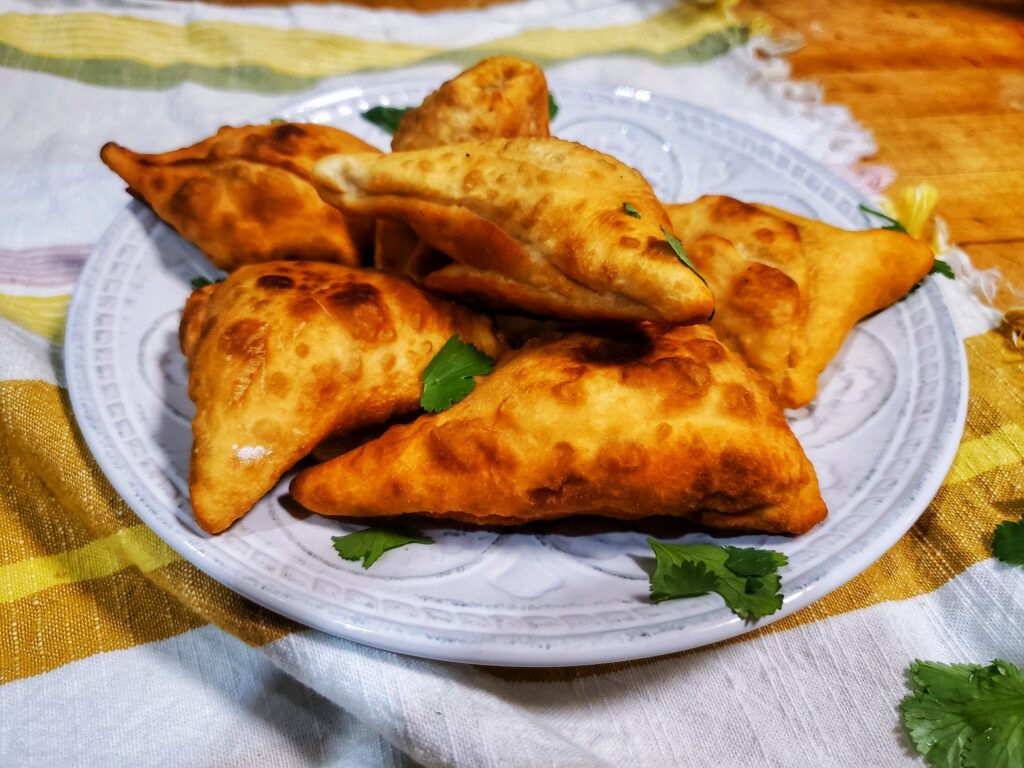
Somali sambusa is a spicy meat mixture folded into a dough pastry and fried. They can be enjoyed in Africa as a snack or an appetizer but they tend to be saved for special occasions.
In supermarkets, these delicious snacks can be bought both frozen or already fried and ready to eat.
They are fried triangle-shaped pastries with savory fillings, are a popular and tasty snack and they often have spiced ground beef fillings, but vegetarian ones can be found too, with fillings such as lentils, spiced potatoes, and onions. any restaurants also serve them as appetizers.
Couscous is a traditional North African dish made with meat, vegetables, and spices. It has Amazigh (Berber) origins and is a staple dish in Tunisia, Algeria, Morocco, and Libya. Its popularity has spread to Europe as well. It is also Tunisia’s official national dish. couscous.
In this celebratory dish, a plate of fluffy couscous is piled high with meatballs, lamb chops, chicken skewers, merguez sausage, and a saffron-scented chickpea stew.
Couscous originated among the Berbers of Algeria and Morocco between the end of the 11th-century Zirid dynasty, modern-day Algeria, and the rise of the 13th-century Almohad Caliphate, according to Charles Perry. Wheat grains could have been boiled or cracked and then boiled before being ground into flour. The precise origin of couscous is unknown. Because couscous is made from ground wheat, it appears unlikely that it could have been made before 6,000 BC.
Boeber is the Cape Malay name for a South African pudding. It has evolved into a classic Cape Malay sweet milk drink made with vermicelli, sago, sugar, and flavors such as cardamom, stick cinnamon, and rose water.
The pudding is usually offered on the 15th night of Ramadan to commemorate the midpoint of the This rich, creamy milk drink is made with fresh full cream milk that has been toasted with fine vermicelli, pure choice butter, sugar, creamy rich condensed milk, sago, cinnamon cardamom powder, drizzled with silvered almonds and pistachios, and garnished with desiccated coconut.
To avoid burning, keep stirring at regular intervals fast for those who have finished the first 15 days of fasting. They are also known as op die berg folk.
Jollof rice is a West African meal that has gained international acclaim for its extraordinary depth of flavor. Whereas most rice dishes are served as side dishes to the main course, Jollof is unquestionably the headliner.
The cuisine is a celebration of West Africa’s sharing culture, and it is smoked, spicy, and aromatic. Nobody ever leaves Auntie’s place without going home with a bowl.
Jollof Rice is mostly common in West Africa and is consumed in most regions like Nigeria, Gambia, Sierre Leone, Togo, Cameroon, Senegal, and many others. The only thing is that their ingredients are different.
The roots of jollof rice may be traced back to the Senegambian territory governed by the Wolof or Jolof Empire in the 14th century, which spanned portions of today’s Senegal, The Gambia, and Mauritania and was where rice was farmed. The cuisine is based on a classic dish called thieboudienne, which includes rice, fish, shellfish, and vegetables.
Jollof is traditionally cooked over an open fire to absorb the smokiness, before adding smoky paprika, thyme, rosemary, and nutmeg to boost the taste. You may also add butter or coconut oil, and serve it with grilled chicken, salad, fried plantain, or avocado because added fat is always a good idea.
Chicken soup is a soup made from chicken that has been cooked in water with various other ingredients including vegetables. Without blinking, the ultimate comfort dish can be said to be chicken soup.
Chicken soup has earned a reputation as a folk treatment for colds and influenza, and it is considered a comfort dish in many nations. This broth can be consumed on its own or in a variety of recipes, ranging from chicken noodle soup to a creamy chicken casserole.
Chicken soup is high in protein and vital fatty acids that help your body in the formation and repair of healthy muscle, bone, skin, and blood cells. Chicken broth is also high in minerals like iron. Selenium is also found in chicken broth. This aids in the prevention and management of cardiovascular illnesses and consequences, such as strokes and excessive cholesterol.
This is a quick dish to make during Ramadan and does not require a lot of ingredients.
This recipe comes in many shapes and varieties. Depending on geography or time of year, one type of fruit salad may be more popular than another.
Here are some of the most popular –
Simple Fruit Salad – served with no nuts, marshmallows, or heavy dressings, this is the version that you see in this post. It is all about the fruit.
Fruit Cocktail – typically sold canned, you can also make a homemade fruit cocktail. The defining difference is that fruit salad contains larger pieces of fruit, while the fruit cocktail is diced into smaller pieces.
Jello Salad – Made with a unique combination of flavored gelatin, fruit, and grated carrots, and To make, you start by washing all your vegetables that need to be washed. Slice the kiwi, watermelon, and cantaloupe – as well as the grapes if there will be young children
Toss in a bowl and refrigerate with blueberries and kiwi. Right before you are ready to serve it, slice the blueberries and fold them in
Serve immediately and refrigerate the leftovers! sometimes other ingredients such as cottage cheese, marshmallows, nuts, or pretzels.
Beans, in general, are members of the legume crop family. There are many different types of beans around the world, each with its shape, size, color, and flavor; nevertheless, kidney-shaped, black-eyed, and brown beans are the most popular in Nigeria.
Nigerian beans porridge goes well with Agege bread (a type of Nigerian bread) or any bread. Aside from bread, fried plantain, and yam is a popular and delicious combinations. It can also be eaten as a side dish with rice or with relished with the almighty garri.
Many chefs have confirmed that honey beans are the best to use because they have a unique and somewhat sweet flavor that truly ups your dish, but any of the other beans would suffice.
Katayef is the Egyptian version of pancakes. They are sold almost exclusively during the holy month of Ramadan in every bakery.
Some people choose to eat them straight out of the box. Other people choose to fill them up with custard or even feta cheese and bake them or air fry them for a healthier version.
Most Egyptians fill Katayef with nuts and sugar, deep fry them, and then add sugar syrup on top. It is an indulgent Egyptian dish worth trying.
Qatayef is the star dessert in Egypt during the month of Ramadan. It is also the easiest to make.
These are some of the Ramadan recipes we think you should try out. If you do try any of them, do well to share them with us on our social media pages.
What is Ramadan?
Ramadan
If you are not Muslim or know very little about Islam you might have no idea what Ramadan is, so let’s get to know what Ramadan is all about.
Ramadan (Arabic: رَمَضَان) also spelled as Ramazan, Ramzan or Ramadhan is the ninth month of the Islamic Calendar. It is observed worldwide by Muslims as a month of fasting (sawm), prayer, and reflection. This is a commemoration of Prophet Muhammad’s first revelation and the annual observance of the Five pillars of Islam. It lasts for about twenty-nine to thirty days from one sighting of the crescent moon to the next. Fasting is done from dawn to sunset and is compulsory for all Muslim adults who are not seriously ill, traveling, elderly, breastfeeding, diabetic, or menstruating.
It is believed that the spiritual rewards of fasting which are known as thawab are multiplied during Ramadan. During the hours of fasting Muslims not only refrain from food and drink, but they also avoid tobacco products, sexual relations, and sinful behavior and focus instead on prayer and study of the Quran.
Origin Of Ramadan
The word Ramadan is derived from the Arabic root R-M-D (ر-م-ض) which means scorching heat and is the classical Arabic verb Ramida meaning becoming “intensely hot – become burning; become scorching; be blazing; be glowing”
Ramadan is thought to be one of the names of God in Islam by some and as such it is reported in many hadiths that it is prohibited to say only “Ramadan” about the calendar month and that is necessary to say “month of Ramadan” when referring to the calendar month as reported by Sunni which is the largest sec of Islam.
Muslims believe that all scripture was revealed during Ramadan. The scrolls of Abraham, Torah, Psalms, Gospel, and Quran have been handed down on the first, sixth, twelfth, thirteenth, and twenty-fourth of Ramadan. Prophet Muhammad is said to have received his Quranic revelation on Laylat-al-Qadr, one of five odd-numbered nights that fall during the last ten days of Ramadan.
There are Food bloggers as a foodie interested in African cuisine that you must know and follow because they give you premium tea with the best and easiest recipes.
Food Bloggers in Africa need to be appreciated so much more as it is not an easy feat. in times past, most parts of the world did not think or find African food exciting. This mentality has since been changed by several African Food bloggers who decided to change the narrative and the perception of other nations toward African food and culture. In this piece, we will highlight 6 African Food bloggers everyone needs to follow and know about.As a sure foodie gang member, you should keep reading.
Who are Food Bloggers?
Food Bloggers
Food bloggers are people who curate written and visual content on food.
It could be recipes, cookbooks, cooking shows, cooking tips, food, and kitchen hacks
Food bloggers are also known as authors of food blogs.
Why do We need Food Bloggers?
Most people think that they do not need food bloggers, but they are very helpful with
Providing New recipes
They help improve your cooking or baking skills
They provide cooking tips you probably would not have thought off
Help you explore other cultures’ foods without having to travel.
Popular Food Bloggers in Africa
There are a lot of food bloggers in Africa, who have carved a niche for themselves in different regions of Africa and specialize in delicacies that are nutritious and highly sort after globally. In this article, we will be listing 6 of them.
Chef Lola’s Kitchen
Chef Lola
Chef Lola’s Kitchen is one of such food bloggers from the western part of Africa, Nigeria to be precise.
If you need to sleep on for everything African food and recipes this is a food blogger to check out. She specializes in Nigerian food.
Chef Lola is said to have started her food blogger career five years ago, she curates written content and videos from Orange County in the United States of America.
She shares creative, family-friendly recipes rooted in her African heritage.
Her recipes are easy to make and you do not need chef skills to put them to use.
Immaculate Bites
Immaculate Bites
Immaculate Bites is a Cameroonian and one of the popular food bloggers in Africa who creates food and recipe content around African, Caribbean, and Southern cuisines.
She started her cooking career at a young age, cooking for family and friends.
She started her website in 2014 naming it African Bites, but it was later renamed Immaculate Bites.
She showcases different recipes from diverse cultures in Africa to communities in America.
She shares these amazing cooking tips and recipes from Los Angeles, California in the United States of America.
Sisi Yemmie
Sisi Yemmie
Sisi Yemmie is a Nigerian and one of the renowned food bloggers who have made her mark in the food industry with her sensational meals.
She started her food blogger career in 2011, and in 2018 she was profiled by CNN as one of the women “who have struck social media gold” alongside Linda Ikeji.
Her blog is a one-stop shop where she shares recipes, cooking tips, kitchen hacks as well as restaurant reviews.
She has several cookbooks and recipe books.
She also creates easy African timetables and recipes for families and students and most people find it relatable as thinking of what to eat daily can be a herculean task.
She curates written and visual recipes and also has a Youtube channel that showcases so many recipes and meal ideas.
She is definitely one of the African food bloggers you should check out.
African Food Network
Afri Food Network
African Food Network, popularly known as Afri food network is a website dedicated to African food and lifestyle.
We can call them Food bloggers as there is almost no African recipe you are looking for that cannot be found on this site.
This site was launched in 2017, in Abuja Nigeria’s Federal Capital Territory by Kevin Eze.
It started as a regular website with just 50 recipes and now has one of the biggest food recipe directories for African food with over 500 recipes.
It was created to help redefine the world’s view of African cuisines, chefs, and traditional cooks.
For everything African Food, the Afri Food Network blog is one website that houses recipes curated from across all the regions of Africa on the website.
Jikoni Magic
Jikoni Magic
Jikoni Magic is a Kenyan cook and host of the hugely popular Kenyan TV show “Let’s Cook”.
She enjoys sharing recipes with the world and the name of her blog is coined from the Swahili word for Kitchen.
She believes that the transformation of ingredients into easy home-cooked recipes is a magical process.
She hopes to showcase her African heritage through her cooking.
Miriam Malaquias
Miriam Malaquias
Miriam Malaquias is a Tanzanian cook, amongst the popular food bloggers and an author.
She is the first Tanzanian to have a website dedicated to Tanzanian food, which is quite record-breaking.
She started her blog in 2004. She is a Bantu native of Tanzania who lives in the United States.
If you are looking for amazing East African recipes and African-inspired recipes, you should check out and follow Miriam.
Africa is blessed with a lot of food bloggers and they are changing the perception of the western world towards the African continent, its food, recipes, cooks, and chefs.
There are several upcoming chefs, food bloggers and food influencers fom Africa and they are doin a fantastic job showcasing our rich culture through food.
Let us know in the comments who your favourite food bloggers are and we will probably do another piece.
The Algerian Hariri is a very rich stew that is very popular amongst the people. This meal is especially good for the season of Ramadan which we are in currently.
The people take this meal as one of their favorite stews and it can be eaten with potatoes or rice.
What is Algerian Hariri?
Hariri is a traditional North African soup prepared in Algeria and Morocco. The Algerian Hariri differs from the Moroccan Hariri as it does not contain lentils.
It is popular as a starter and it can be eaten as its own light snack. It is mostly used traditionally as a filling soup for Iftar meals.
Algerian Hariri Recipe
When making the Hariri it is important to start early as it takes about 2 hours and 20 minutes in total cook time.
The ingredients required to prepare the Hariri are Lamb meat, carrots, tomato, garlic, salt, black pepper, ginger, tomato puree, turmeric, paprika, cinnamon, onion, one bunch of coriander, chickpeas, lemon, and water.
Put a pot or casserole pan on fire, melt the butter, and add onions.
Stir fry until it is translucent.
Add the lamb meat and fry for about 15 minutes.
Add all the spices into the mix, stir, and fry for another 5 minutes.
Pour in your blended tomatoes as well as your tomato puree and bring to a boil and simmer for about 15 minutes
Now pour in water and cover the pot. Allow the contents to slowly cook and simmer for 2 hours
Approximately 15 minutes before the cooking time elapses, add in your chickpeas and your coriander
Serve hot and garnish with some lemon wedges
This a must-try dish as it is a very rich stew and is popular across the world especially now that the Ramadan season is upon us.
If you do try out this recipe be sure to share it with us on our social media handles.
The Algerian Hariri is a very rich stew that is very popular amongst the Algerian people. This meal is especially good for the season of Ramadan which we are in currently. The Algerian people take this meals as one of their favorite stews and it can be eaten with potatoes or rice.