5 Types Of Meat And New Methods Of Enjoying Them (African style)

0

If you are a meat lover, your thought process for meat would be to find new, fun, and exciting ways to enjoy and prepare your meat.

Guess what? Congratulations! You have found the best place for your inspiration and creativity to explore the world of meat.

This article is based on opening your kind to the world of meat and showing you different ways you can be creative and innovative with your food.

Meat is a pretty versatile food, that is why there are so many ways to enjoy meat. Before we look deeper into new and exciting ways to prepare your meat, let’s get into the basics.

beeff
image from: Pinterest.com

Let us Look into The Basics What Is Meat?

You should already have some sort of idea of what exactly meat is, but not to worry, the African food network is here to help you with a simple definition of what meat is.

Meat can easily be described as the flesh of an animal. Some of these animals include; Fish, lamb, goat, cow, turkey, crab, and so many others.

We are going to be taking a look at some of the types of meat and different, exciting, and new methods of preparing the meat.

red meat picture

Now you know what meat is, in simple terms. Most people enjoy and consume meat, almost every day, without even knowing the nutritional content of the meat that you consume.

You don’t need to worry, you would get all the information about the general health benefits of meat, but before we look into that, let us look at the different types of meat. Yes, the different types of meat.

Did you know that there are so many types of meat? Let us take a closer look at the different types of meat.

Did you know that these different types of meat are known to possess some great health benefits that are required by the body to function properly?

The health benefits of these meats help in the provision of some of the required nutrients, needed by the body to undergo some processes.

We will take a closer look into that, before we do, let us take a look at the different types of meat.

picture of meat
image from: Pinterest.com

The Different Types Of Meat

  • Poultry
  • Red Meat
  • Crabs
  • Fish
  • Lamb
  • Pork
  • Goat
  • Chicken
  • Turkey
  • Duck
  • Rabbits

These are a few different types of meat to get you started, but we mentioned earlier that these different types of meat also have great health benefits, so let us take a look into the health benefits of the different types of meat;

The first type of meat we would be looking at on this list of different methods of preparing your meat is:

CHICKEN

The first chicken dish on this section of the different types of chicken dishes is:

 SENEGALESE CHICKEN YASSA

The Senegalese chicken Yassa is a very popular chicken dish that is also highly nutritious.

Chicken Yassa is that African dish that you just cannot omit when making a list of African chicken dishes because it is an African dish that everyone should try.

This chicken dish is another fun and interesting way of exploring the different methods and techniques involved in the preparation of chicken.

These chicken dishes are great because they give you different options to choose from and of course have fun with. Is this not great?

To prepare the Senegalese Chicken Yassa, you would need a few ingredients like;

  • Lemon juice
  • Onions
  • Peppers
  • Chili peppers
  • Bell peppers
  • Dijon mustard
  • Salt
  • Chicken
chicken yassa
image from: Pinterest.com

There is a simple process to the preparation of this amazing chicken dish, the first step Is to prepare the marinade. This is mostly what determines the taste and flavor you would get out of the chicken, so it is important you make the marinade extra spicy and hot so that after the chicken is done marinating, the taste would be exquisite.

After marinating the chicken for some time, the next step would be to brown the chicken. This is where the different methods of preparing your meat come in because you can either brown your meat (chicken), which can be done on a grill, which is considered to be the most authentic and appropriate method, or you can brown the chicken in a skillet.

After you have successfully completed the second step, the next step would be to garnish your chicken, usually, onions are used to add a little flavor to the chicken spices. Sauté the chicken until the chicken pieces are caramelized and golden, then you remove them from the pot.

 The Second Method Of Preparing Your Meat (Chicken) Is:

THE NIGERIAN CHICKEN STEW

The Nigerian chicken stew is something you do not want to miss out on, the great taste and versatility of this African chicken dish is a major reason why it just cannot be omitted from this list of different methods of preparing meat, especially since we are talking about African chicken dishes right now.

The Nigerian chicken stew is an amazing chicken dish that is not only highly nutritious and rich in vitamins, it is also a very versatile dish, and here is why we think the Nigerian chicken stew is versatile.

The Nigerian chicken stew can be enjoyed with almost anything you want, this gives you the opportunity to explore different tastes, and flavors all with the African chicken dish, but let us take a look at some of the ways you can enjoy the African chicken stew.

picture of African stew
image from: Pinterest.com

How Do You Enjoy African Chicken Stew?

  • The Nigerian chicken stew and white rice
  • The Nigerian chicken stew and boiled yam
  • The Nigerian chicken stew and unripe boiled plantain

Do you now see why the African chicken stew just had to be on this list? Don’t worry, there is always a recipe here at the African food network for you to have fun with, so feel free to check out the recipe for this amazing African chicken dish here at the African food network.

Do you want other African chicken dishes? Are you tired of the regular and boring methods of preparing meat? You can check out this article about chickens and get other fun, exciting, nutrient-filled, and rich African chicken dishes, here at the African food network.

 The Second Type Of African Meat To Try, And Also See New Methods Of Preparation Is:

cooked crabs
image from: Pinterest.com

CRAB

Before we look into the different African crab dishes, why don’t we take a look at the health benefits of these crabs?

Health Benefits Of Crabs
  • Crabs are known to be rich in protein.
  • Crabs are said to contain high levels and amounts of fatty acids.
  • Crabs are rich in vitamin B12.
  • Crabs are known to help in the prevention of some major diseases.
  • Crabs are highly rich in omega-3 acids.

Now that you know the nutrients and health benefits of crabs, are you ready to get familiar with some of the African crab dishes that we have ready for you?

 The first African Crab Dish On This List Of New Methods Of preparing meat (Crabs), Is: AKONTOSHI

This incredible African crab dish is a dish that is hard to describe, and the only way of getting to know just how amazing this African crab dish is, you would have to try it for yourself.

Akontoshi is a Ghanaian crab cuisine that is highly nutritious and rich in flavors and spices.

This is what can be described as a stuffed crab dish, and this is something you must try, when you are in Ghana, or you just want to try something exotic and spectacular.

Here are a few ingredients required for the preparation of this incredible African crab dish, and they are;

  • Cooking oil
  • Tomato paste
  • Onions
  • Ginger and garlic
  • Salt
  • Cloves
  • Paprika
  • Nutmeg
  • Ground thyme leaves
  • ground cumin
  • Shrimps
  • Parsley
  • Whole crabs or crab meat

You can get the recipe for this amazing African crab dish, here at the African food network.

 The Second African Crab Dish On This List Of New Methods Of Preparing Meat (Crabs) Is:

crab dish
image from: Pinterest.com

SPICY PEPPERED CRAB

From the name of this African crab dish, you already know this is going to be a spicy, hot n interesting African crab dish.

Are you looking for new crab dishes to spice things up a bit in the kitchen? Don’t worry, that is why the African food network is here for you, to take you out of your comfort and boring food techniques, and bring you into new, fun, and exciting African cuisines, just like these different and new methods of preparing meta (crabs).

The Third Type of Meat On This list of new methods of preparing meat is;

RED MEAT

Be patient, we would not just dive into the amazing African red meat dishes, without talking a little about red meat.

biltong
image from: Pinterest.com
What Is Red Meat?

In simple terms, red meat can be described as meat that was gotten from reared mammals.

Some of the farm-reared animals are;

  • Beef
  • Pork
  • Ham
  • Lamb

What Are The Health Benefits Of Red Meat?

  • Red meat is known to be rich in protein and Vitamin B
  • Red meat is also rich in iron, which is usually by the body from red meat.
  • Red meat is known to contain zinc, which is required by the body, usually for DNA synthesis, and also helps the immune system function properly.

The health benefits are too exciting to miss out on, but the dishes? The African red meat dishes are something you just cannot ignore.

The Different And New Methods Of Preparing Meat (Red meat): African Red Meat Dishes

The first African red meat dish on this list is; African Beef Stew

The African beef stew is a very popular staple in Nigeria, it is popular for its highly nutritious benefits and taste.

This African beef stew can be enjoyed with whatever it is that you love, that is what makes the African beef stew so special.

goat meat stew
image from: Pinterest.com

Another reason why the African beef stew is so special is that there are different ways of preparing the African beef stew and it can be enjoyed with anything you love, here are a few ideas on what you can enjoy your African beef stew with

 How To Enjoy Your African Beef Stew

  • African beef stew and white rice
  • African beef stew and fried yam
  • African beef stew with soup and Pounded yam
  • African beef stew and spaghetti

You are free to create your magic, after all, life is what you make it, but in this case, your African food, is what you make it to be.

There are a few ingredients that would be required for the preparation of the African beef stew, remember the main focus here is red meat.

Here are a few ingredients you would need to get you started on the preparation of the African beef stew;

  • Tomatoes
  • Fresh peppers
  • Onions
  • Ginger and garlic
  • Groundnut oil
  • Chili peppers
  • Red meat
  • Water
  • Salt
  • Seasoning

Once you get these few ingredients, you are a step ready to prepare this African beef stew. But there is just one thing missing to complete the requirements for this African beef stew, and that would be the recipe, but not to worry, the African food network has got you covered on that.

Remember that it is our duty to keep you healthy, informed, and happy with our fresh ideas on different ways of preparing and enjoying your African dishes.

Giving you the recipe for the African dishes is another way we show you just how much we support and encourage your creativity in the kitchen.

You can always get the recipe for these African dishes, but especially the African beef stew, all here for you at the African food network.

These are the health benefits of a few of the different types of meat, don’t they seem interesting already? Are you ready to know more? Of course, you are.

For anyone who would say they love meat, you would understand why, apart from the amazing health benefits of meat, the taste is something to talk about.

chicken pepper soup
image from: Pinterest.com

There is this satisfaction that is derived from the consumption of meat after a meal, or during a meal.

The taste and feeling of satisfaction you get from eating meat is something that everyone should get to experience by themselves, just to understand why almost everyone you encounter would say they love meat.

Think of this article as a surprise you have been waiting and hoping for, a new recipe, technique, or method of spicing things up with your meat, and guess what makes this so special? This is the African edition of the different ways of enjoying meat.

Remember we said there are a lot of health benefits of meat? It’s time we look into that, what would you say are the health benefits of meat?

These are the nutrients and content of the meat that goes into the body, some of the nutrients or content of the meat are essential to the human body.

There are some nutrients found in meat that are very important for the body’s proper functioning, we will look into that while we take a glance at the world of the health benefits of meat.

What Are The Health Benefits Of Meat?

  • Meat helps with muscle mass retention.
  • Meat is known to be of great help with the strengthening of the bones.
  • Meat helps the body absorb iron better.
  • Meat is highly rich in proteins.
  • Meat is very rich in vitamins and minerals.

It is almost impossible to say that you didn’t get excited reading about the health benefits of meat.

Did you enjoy reading about the health benefits? Do you now understand the nutritional benefits of meat, and why it is one of the most loved food?

It is important that you know this information for the next phase of this article that will be discussing the different methods, techniques, recipes, and ways of enjoying meat. Is this not exciting?

This article will be the joy of so many meat lovers because you are getting a kind of mind-opening to the possibilities and experience you are about to get.

It can be boring enjoying the same technique and style of preparation of meat, who wouldn’t want to try out something new, exciting, spicy, and best of all, African?

If you are having a hard time trying out meat, and you are looking for some motivation and a sign to try it out, this is your sign and your motivation.

You cannot go wrong with anything African food-related, why? You may ask, well, here’s why.

African is a continent known to have several countries and each of these countries have their various traditions that are usually expressed in different means and techniques, and guess what other means or technique is part of the mode of expression? Food.

African food is a very popular category of food, around the world; Everyone who has taken a bold step to give African food a try, always comes back with songs of praise for the taste, nutrients, and overall flavor of the food.

You have seen the different ways of enjoying your meat, did you enjoy reading about this? As a meat lover, this should be the favorite thing you’d see today, and the African food network has given it to

You as a gift. Be sure to use this gift to your advantage, make use of the recipes, experiment and play around with the spices, have fun with it, be creative, and have the best time with these different ways of enjoying your meat.

Do you now see reasons why you just have to experiment and have fun with your food? If you don’t have enough reasons, not to worry, we will give you enough reasons just to open your mind and let you explore the world of African food because it really is an amazing feeling and experience to get insight into the different techniques and methods of food preparation.

picture of lamb
image from: Pinterest.com
Let us take a look at reasons why you should try new experiences and techniques with food, especially your meat:
  • You would get to explore different flavors and spices.
  • You would have the opportunity of stepping out of your comfort zone with African food.
  • You would be allowing your body to get new and healthy nutrients that would help your body with some activities that are necessary for proper functioning.
  • Exploring the world of food and the different methods of preparing meat, would help you in the improvement of your cooking techniques and make you great at what you do.
  • It is amazing to try new spices.
  • Your friends and families would be excited and happy to try your new recipe and method of preparing meat.

Are these reasons good enough for you? Or do you need more? Of course, you don’t, these reasons are good enough for you to try out the new recipes and methods of cooking meat.

Which of these new methods of preparing meat is your favorite? Let us know.

Have you tried any of these mew methods of preparing meat? What were your favorite spices to use?

Be sure to share these recipes with your friends and families, share your Fun and experience with everyone, and let everyone share in your joy of new techniques and methods of preparing meat.

Did you enjoy this read? What was your favorite aspect or section of this read?

Be sure to give these new methods of preparing meat a try, and you would be sure of getting the most out of the new methods of preparing meat, not just the nutrients, you would be getting to experience e new tastes, flavors, and overall goodness.

Have a nice day, drink some water, wear a huge smile on your face, and enjoy your new methods of preparing meat.


6 Unbelievable Facts About Olives

0

Olives

An Overview on Olives

Olives are little fruit produced by olive trees (Olea europaea) a species of small tree in the family Oleaceae, found traditionally in the Mediterranean Basin. The species is cultivated in all the countries of the Mediterranean, as well as in Australia, New Zealand, North and South America, and South Africa. Olea europaea is the type species for the genus Olea.

They are related to mangoes, cherries, peaches, almonds, and pistachios, and are classified as drupes, or stone fruits.
The olive tree, Olea europaea, is a Mediterranean evergreen tree or shrub native to Asia, Africa, and Europe.
It is short and squat, rarely reaching a height of more than 8–15 m (26–49 ft).
‘Pisciottana,’ a rare variety found exclusively in the area near Pisciotta in the Campania region of southern Italy, regularly exceeds this, with huge trunk diameters.
The oblong silvery green leaves are 4–10 cm (1.6–3.9 in) long and 1–3 cm (0.39–1.18 in) wide and measure 4–10 cm (1.6–3.9 in) long and 1–3 cm (0.39–1.18 in) wide.
Typically, the trunk is gnarled and twisted.
The small, white, feathery flowers with ten-cleft calyx and corolla, two stamens, and bifid stigma are borne in racemes in the axils of the leaves on the previous year’s wood.
When fully ripe, the fruit is a small drupe measuring 1–2.5 cm (0.39–0.98 in) in length, with a thinner flesh and smaller size than orchard cultivars.
Olives are collected when they are between green and purple in color.
Canned black olives are frequently chemically blackened (see below for more information on this technique) and may contain the chemical ferrous gluconate to improve appearance.
Olea europaea has a seed that is known as a “pit” in American English and a “stone” in British English.

Olives in Africa

Olives

The African Olive (Olea Europea subspecies Africana), also known as Woira-woira in Amharic, is a wild olive variety endemic to Ethiopia that can be found in the dry woods of eastern Africa, as well as southern Africa, Arabia, India, and China.

It thrives in forests, but it can also withstand droughts and poor soils.
It may reach a height of 45 feet, with greenish-gray foliage, and a crooked trunk.
The flowers are white, and the fruit is little with little flesh; it matures to a purple-black color, and it does not generate oil, but it serves as food for humans as well as animals such as baboons, monkeys, and birds.


This
tree’s wood is used to make firewood, poles, and furniture, as well as medicine to treat malaria, high blood pressure, and sore throat.

In 2019, Morocco was the leading North African country in terms of olives production, which exceeded 1.9 million metric tons. Egypt ranked second with nearly 1.1 million metric tons. Tunisia, Algeria, and Libya followed in terms of domestic olive production.

South Africa

The evergreen African Wild Olive grows in the Afromontane forests in Sudan, Somalia, Eastern tropical Africa, and South Africa. The Olive tree prefers the drier highland forests between 1,250 and 3,000 meters above sea level.

It grows between 5 and 15 meters tall, with many branches and a circular crown, and is frequently seen adjacent to Juniperus (the East African pencil cedar). The Olive tree was first planted in South Africa by Jan Van Riebeeck in 1661. Its cousin, the wild olives (Olea Africana) is native to the region but is inedible.

Hundreds of years transpired after the first olive trees were planted before olive oil production began.
Ferdinando Costa planted an orchard in Paarl in 1936, which was the first commercial olive grove.
In South Africa today, there are over 120 olive producers, most of whom are centered in the Western Cape region. Olive oil production in South Africa is more of a highly made art than a basic manufacturing process, with tiny, expansive gardens and hand-harvested olives.


Ethiopia

This tree is usually found as a relic tree in monasteries, communities, churches, and Afromontane natural forests in Tigray, Ethiopia.

Morocco

Morocco is the world’s second-largest producer of table olives and olive oil, and the sixth-largest producer of olive oil.
Marrakesh, Casablanca, Meknes, and Fez are the country’s key olive-producing regions.
Marrakesh is known for its table olives, whereas Meknes and Fez are known for their olive oil.
The olive tree was brought to Morocco by Greek colonists from Sicily.
The colonists introduced the olive tree to the island and transplanted trees to the mainland.

The olive was eventually carried west as trade networks evolved.

Olive cultivation is the heart of Moroccan cuisine. They are served as an appetizer in Morocco, with herbs such as thyme, rosemary, and oregano, while crushed olives are used to make fuel and “Saboun El Baldi.”
When it comes to olive exports to the global market, Morocco is a significant player.
There’s a lot to know about olives and how beneficial they are. Here are 9 interesting facts about olives you should know:

Here are 6 Unbelievable Facts About Olives

1. Olive Oil and its By-Products

Olive oil

Olive oil is the oil derived from the ripening fruit of the olive tree, Olea europaea.
The oil ranges in color from pure yellow to golden, with a greenish tinge in some cultivars obtained from unripe fruit.
Almost every country that grows olives produces oils with different characteristics and quality, with the differences dependent on the district and the freshness of the fruit.
Pure olive oil is mostly used in cooking and in the preservation of foods, especially canned fish.
It’s also used in the textile sector for wool combing, in the pharmaceutical business for medical purposes, in the production of high-quality castile soap, and as a lubricant.
Olive oil is used healthwise for heart disease, high cholesterol, and high blood pressure.

By-Products

Olive oil extraction generates several by-products that can be used to feed animals, particularly the cakes and pomaces obtained from the extraction process, and leaves and other residues resulting from the cleaning operations. The young shoots coming out from the base of the tree can be browsed by sheep and the olives themselves can be eaten by pigs in extensive systems, such as those producing the Jamón ibérico in Spain

Olive Cake
Olive cake by-product
Image from Dogus Pirina
The olive cake is one of the by-products of the olive oil production process.
The olive is made up of four parts: skin, pulp, stonewall, and kernel.
Water and oil, which are largely removed from the olive during processing, run through all of this physical matter.
Approximately 35% of the fruit will be left as olive cake after the extraction procedure.
Olive cake production was predicted to be around 3 million tonnes worldwide in 1985.
Uses of olive cake
  • Heating is the most typical application for olive cake. Because there are still small amounts of olive oil in the cake, it burns quite effectively in fireplaces and heating furnaces when dried.
  • The olive cake could be used as fresh, ensiled, dried, or as a component of concentrated pellets and multi-nutrient feed blocks in animal and especially ruminant diets.
Other by-products
  • Exhausted or defatted olive oil cake, obtained by mechanical and solvent extraction. This product contains stones and less residual oil than the previous one.
  • Crude olive oil cake without stones, obtained by mechanical extraction and de-stoning. This product contains residual oil and no stones.
  • Exhausted or defatted olive oil cake without stones, obtained by solvent extraction and de-stoning. This product contains little residual oil and no stones.
  • Olive oil pulp, obtained after stone removal followed by mechanical extraction.
  • Exhausted olive oil pulp, after stone removal and solvent extraction.
  • Olive oil vegetation water (“black water” or alpechin), obtained by centrifugation or sedimentation of the oil. This sugar-rich product is sirupy, black and bitter with a distinctive odour due to polyphenols and other substances. It can be (partially) dried, resulting in a molasse-like product.

The Extraction Process

Crushing, malaxation, and centrifugation are the three primary stages in the traditional extra virgin olive oil (EVOO) extraction procedure.
Olive fruits are crushed using a stone mill, hammers, disc crushers, de-stoning equipment, or blades after being washed.
The goal of this step is to make it easier for the oil droplets to escape from the Elaioplasts.
The minimal size for continuous separation of olive oil is 30 m, yet after crushing, only 45 percent of the oil droplets have a diameter greater than 30 m.
With the development of bigger diameter drops from the oil droplets caused by malaxation, this ratio reaches 80%.
The major steps that determine the quality and quantity of oil are malaxation and crushing.

2. Nutritional Facts About Olives

Nutrition facts

Olives contain 115–145 calories per 3.5 ounces (100 grams), or about 59 calories for 10 olives.

The nutrition facts for 3.5 ounces (100 grams) of ripe, canned olives are:

  • Calories: 115
  • Water: 80%
  • Protein: 0.8 grams
  • Carbs: 6.3 grams
  • Sugar: 0 grams
  • Fiber: 3.2 grams
  • Fat: 10.7 grams
    • Saturated: 1.42 grams
    • Monounsaturated: 7.89 grams
    • Polyunsaturated: 0.91 grams

3. What are the Benefits of Eating Olives?

  • Ozonated Olive Oil

Olive oil infused with ozone (ozonated olive oil) is used to treat everything from bee stings and bug bites to bacterial and fungal skin illnesses, as well as cancer.
The FDA has approved the use of ozone to combat bacteria on food, including meat and poultry, but the food sector has been slow to accept it.
Because ozone is so unstable, it must be manufactured on-site.
Topical olive oil formulations containing ozone are unlikely to remain stable after transportation.
There are no medical uses for ozone or ozonated olive oil that have been proved in clinical trials.
Antibacterial creams applied to the skin are a superior option.
  • Use of Olive Leaf in Treating Infections and Diseases

Influenza, swine flu, the common cold, meningitis, Epstein-Barr Virus (EBV), encephalitis, herpes, shingles, HIV/ARC/AIDS, and hepatitis B are among the viral, bacterial, and other illnesses that olive leaf is used to treat.
Olive leaf is also used to treat pneumonia, chronic fatigue syndrome, tuberculosis (TB), gonorrhea, fever, malaria, dengue fever, “blood poisoning” (bacterial infections in the bloodstream), severe diarrhea, infections of the teeth, ears, and urinary tract, and infections after surgery.
High blood pressure, diabetes, hay fever, enhancing kidney and digestive function, and boosting urine flow are some of the other uses.
  • Cardiovascular Benefits

Blood vessels are damaged and fat builds up in arteries when free radicals oxidize cholesterol, potentially leading to a heart attack.
The antioxidant elements in black olives aid to reduce cholesterol oxidation, which helps to avoid heart disease.
Olives do have fat, but it’s the good kind, monounsaturated fat, which has been shown to reduce the risk of atherosclerosis and raise good cholesterol.
Monounsaturated fatty acids, which are abundant in olives, have been associated to decreasing LDL (“bad”) cholesterol while preserving HDL levels (“good” cholesterol”).
Olive polyphenols’ potent antioxidant qualities may help protect against oxidative stress and chronic inflammation, two major causes of heart disease.
  • Cancer Prevention

Vitamin E, which is abundant in black olives, has a remarkable ability to neutralize free radicals in body fat.
Vitamin E can make cellular activities safer, especially when dealing with the stable monounsaturated fats found in olives.
When such processes as mitochondrial energy generation aren’t effectively safeguarded, the resulting free radicals can cause oxidation, harming a cell’s mitochondria and preventing it from producing enough energy to meet its needs.
A cell’s DNA can be damaged, causing it to mutate and become malignant.
According to studies, a diet supplemented with olive oil reduces the risk of colon cancer to practically the same level as a diet high in fish oil.
Olives protect the tissues of essential organs (including your brain!) from damaging and perhaps irreparable damage by reducing oxidative stress induced by inflammation.
Another advantage is that olives contain vitamin E, an antioxidant that has been linked to increased cognition and a lower risk of cognitive decline.
Diets high in olive oil as a primary fat source have been linked to a reduced risk of Alzheimer’s disease.
  • Eye Health

One cup of black olives includes 10% of the daily recommended consumption of vitamin A, which is essential for eye health when converted to the retinal form.
It improves night vision by allowing the eye to discriminate between light and dark.
Vitamin A is also thought to be useful in the treatment of cataracts, macular degeneration, glaucoma, and other age-related ocular illnesses.

4. The Bitter Truth About Olives

A luscious-looking olive plucked from a sun-warmed tree is revolting. Oleuropein, a phenolic molecule bitter enough to shrivel your teeth, is the ingredient that renders it essentially inedible.
Bitterness serves as a defense strategy for olives, allowing them to fend off unwanted microbes and seed-crunching animals.
Birds disseminate olives in the wild, avoiding the bitterness issue by consuming them whole.

5. Colors of Olives

Olive colors
Image from Knowledge Nuts
The color of an olive is an indication of its ripeness. Green olives ripen and become black olives. Or rather, they transform from green to light brown, to a vibrant red and purple, to the deepest, darkest black. In general, the darker the olive, the riper it was when it was plucked from the tree.
Green olives are often gathered between September and October in the northern hemisphere, at the commencement of the harvest season.
They have a nice, nutty flavor and a sturdy texture.
Black(er) olives are softer, richer, and meatier, and are harvested throughout November and December, sometimes as late as January.


6. Fun fact

It takes approximately 7 liters of olives for the production of one liter of olive oil.


The Different Types of Olives

There are so many varieties of olive tree species. There are over a hundred, each with a unique taste, color, and texture. Here are the top two.

  • Agrinion olive
  • Alfonso
  • Beldi
  • Gordal
  • Kalamate
  • Leccino
  • Manzanilla
  • Nicoise
  • Nyon
  • Picholine
  • Picual
  • Lugano
  • Gemlik
  • Cordovil

Are Green or Black Olives Healthier?

The color of an olive, whether green or black, is based on when an olive is picked and preserved. Green olives are unripe, but black olives are collected after they have ripened. Let’s not forget about preservation methods, as they play a role in these two colors as well.

Typically, green olives are soaked in lye (a chemical solution) and then fermented in brine. To minimize bitterness, black olives are steeped in lye and then cured in brine, just like green olives. The bitterness of the olive decreases as it soaks in the solution for longer periods of time.

Because olives are ingested in such little quantities, there isn’t much of a difference between green and black olives. Black and green olives have essentially comparable nutritional profiles. The sodium concentration of green and black olives differs the most nutritionally. Green olives have nearly twice as much sodium as black olives. The color difference is mostly attributable to the ripeness of the olive at the time of harvest, but it is also influenced by processing procedures.

Now you have in-depth knowledge about olives, how would you be incorporating them into your daily meal?

Tuwon Dawa Da Miyan Kuka Recipe

Tuwon Dawa  is pounded guinea-corn that is thickened and solidified (swallow) and served with soups such as Kuka and okra.

On the other hand, Miyan Kuka, is a Northern Nigerian soup prepared with dried and ground baobab leaves (Kuka). The green draw-soup is made from ground baobab leaf and special spices, preferably ‘Yaji’ – a mixture of ground pepper, ginger, garlic, and other seasonings/herbs.


TUWON DAWA DA MIYAN KUKA
Image from CookandRecipes

What is Kuka Powder?

Kuka powder is dry baobab leaves that have been ground into powder, which is used for a popular soup from Northern Nigeria, Miyan Kuka.

What Are The Health Benefit of Kuka?

It is good for the digestive system. Miyan kuka is a healthy soup that is rich in fiber, which supports your digestive system. Its fiber content helps keep bacteria out of the intestinal tract and therefore helps prevent constipation.

How To Make Tuwon Dawa Da Miyan Kuka:

Although it may seems simple to make but to make it testy and appealing you may need to apply some art of cooking. Be careful in selecting your ingredients as too much wrong ingredients can mess the taste of the soup. Many ingredients can be added to miyan kuka but the perfect combination for great outcome is what we would teach you how to do today.

Don’t forget to save this page in your browser, and share it to your family, colleague and friends. Thank you for reading. Go on get cooking!

Also see here how to make Tuwon Masara.

Some suggestions for Amazon links to “Pyrex 3 Piece Measuring Cup Set”.

Pyrex 3 Piece Measuring Cup Set

Project Overview Docs Banner in Light Green Blue Vibrant Professional Style 1

Tuwon Dawa Da Miyan Kuka

Servings 0

Ingredients
  

  • Get of Guinea corn flour.
  • Take of Baobab powder.
  • Get of Pepper and onion and tattashe, palm oil, daddawa: &seasoning.

Instructions
 

  • Boil water and fetch and a little powder and mix with cold water then add to the hot water and stir.
  • When it is boiling you then layer add the flour into the boiling mixture, reduce the heat and let it cook for a while. Then serve with soup of your choice.
  • Avoid miyan kuka, you're better off with masa/waina, fura da nono, kilishi or kunun koko. Even if they are mostly snacks. 
  • This is a side dish made with ground guinea-corn made thick and cassava.
Tried this recipe?Let us know how it was!

Top 10 Ethiopian Dishes You Should Try

0

In this article, we’re all about the top dishes the lovely country and its people have to offer. If you are a fan of African cuisine, then Ethiopian dishes are a must-try for you. First, let’s take you on a trip to Ethiopia.

Learn a Little About Tanzania

Geography

First of, Ethiopia is one of the most beautiful countries in Africa and a crowd favorite travel destination. Ethiopia, in the Horn of Africa, is a rugged, landlocked country split by the Great Rift Valley. With archaeological finds dating back more than 3 million years, it’s a place of ancient culture. Among its important sites is Lalibela with its rock-cut Christian churches from the 12th–13th centuries. Aksum is the ruins of an ancient city with obelisks, tombs, castles, and Our Lady Mary of Zion church.

Ethiopia is a country with a wide range of geographical features. Rugged mountains, flat-topped plateaus, deep gorges, and river valleys make up the landscape. Erosion, volcanic eruptions, and tectonic shifts have all contributed to the country’s varied geography over time.

The capital of Ethiopia is Addis Ababa. The capital is often referred to as the “political capital of Africa” since it is home to many continental and international organizations, like the African Union, the United Nations Economic Commission for Africa (UNECA), and many more groups. The capital is also home to many cultural sites like the Imperial Palace, National Palace, Holy Trinity Cathedral, and various museums. Other major cities include; Dire Dawa, Mek’ele, Gondar, and Bahir Dar.


Tourism

Blue Nile Falls Ethiopia tourism
The Blue Nile Falls In Ethiopia – Image from GettyImages


Ethiopia, which has more UNESCO World Heritage Sites than any other African country (including Egypt), is a hidden jewel that many tourists ignore. There’s a reason it’s so high on the Wild Frontiers travel list, with its cultural richness, archaeological heritage, and natural beauty.

Ethiopia has a lot to offer international visitors, from the Blue Nile Falls to world-class ancient sites and kind and welcoming people.
The Erta Ale volcano, one of the world’s most famous adrenaline locations, is located in the African country.

There are other major tourist attraction sites in the country. But in all, the circular Ethiopian Orthodox Churches on islands in Lake Tana, the Blue Nile Falls, the castles of Gondar, the Stellea of Axum, the rock hewn churches of Tigray, the ancient temple of Yeha, and the rock hewn churches in Lalibela are among Ethiopia’s most famous tourist attractions on the historical circuit.


Culture

Ethiopia is a country that is multi-cultural and multi-ethnic. Religion has a significant impact on Ethiopian culture. The Ethiopian Orthodox Church is home to over half of the people, but there is also a sizable Muslim minority. Others practice an older style of Judaism. As the capital city, Addis Ababa has great ethnic diversity. 56% of the population are Amhara, 34% Oromo, 16% Gurage, 5% Tigray, 3% Silt’e, and 1% Gamo. About 75% of the people in Addis Ababa follow Ethiopian Orthodox Christianity, 16% follow Islam, 7% are Protestant Christians, and 0.5% are Catholic.

Ethiopia is also a multilingual nation, with around 80 ethnolinguistic groups, the four largest of which are the Oromo, Amhara, Somali, and Tigrayans. Most people in the country speak Afroasiatic languages of the Cushitic or Semitic branches. Additionally, Omotic languages are spoken by ethnic minority groups inhabiting the southern regions.

Economy

Ethiopia’s economy is a mixed and transitional economy with a significant public sector. Ethiopia’s government is in the process of privatization numerous state-owned firms and transitioning to a market economy. Government-owned enterprises, on the other hand, dominate the banking, telecommunications, and transportation sectors of the economy.

The country is Africa’s second most populated country and has one of the world’s fastest-growing economies. Many government-owned properties have now been privatized or are in the process of being privatized under the previous regime. Telecommunications, banking and insurance services, air and land transportation services, and retail, on the other hand, are deemed strategic industries and are expected to remain under state control for the time being.


Cuisine

Injera Ethiopian dishes
Injera Image from Wikipedia

Ethiopian cuisine is one of the most distinctive, fascinating, and delectable cuisines in the world. Ethiopian cuisine has a rich culture surrounding how food is presented and shared with friends and family, in addition to its delectable meals, stews, and spices.

Ethiopian cuisine characteristically consists of vegetable and often very spicy meat dishes. This is commonly in the form of wat, a rich stew served on top of injera, a huge sourdough flatbread produced from fermented teff wheat and measuring around 50 centimeters (20 inches) in diameter. Ethiopians eat with their right hands the majority of the time, picking up morsels of entrées and side dishes with pieces of injera.

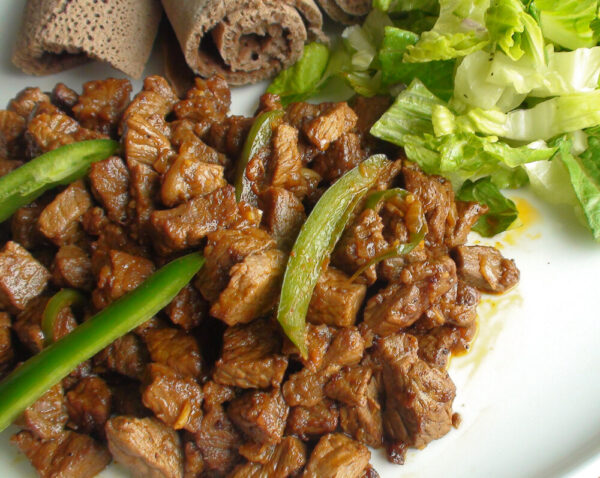
Tibs is by far the most popular Ethiopian dish consisting of sliced beef or lamb pan-fried with butter, garlic, and onion. It comes in a variety of shapes and sizes, depending on the type, size, and shape of the meat slices used and can be spicy or mild, with little to no vegetables.


Top 10 Ethiopian Dishes You Have To Try

It is time to get to the business of the day. As said earlier, most Ethiopian dishes can be heavy on meat and vegetables. Here are the top 10 Ethiopian dishes you should definitely try when visiting Africa, visiting an Ethiopian restaurant around you, or looking for something new for the family.


1. Injera

Injera Ethiopian dishes
Image from Wikipedia

Injera is a sour fermented flatbread made traditionally of teff wheat with a slightly spongy feel. This dish is the staple food in Ethiopia and other countries like; Eritrean, Djiboutian, and Somali cuisines, as well as other countries in the Horn of Africa.

This Ethiopian dish is often referred to as an “eating utensil” because it is mostly used to scoop up meat and vegetable stews.

This Ethiopian dish is made with teff, a small, round grain native to Ethiopia’s highlands. Teff is a gluten-free grain with a high nutritional value. As a result, Teff is not suitable for manufacturing risen bread, but injera makes use of yeast’s unique qualities. A brief fermentation period gives it an airy, frothy texture as well as a slightly sour flavor.

Teff has a symbiotic relationship with yeast, which allows the flour to be used as a starter, or in Amharic “Ersho,” without yeast additives. Many renditions of this simple starter use yeast, baking powder, mineral water, or even beer to speed up the process or enhance the results.

One can buy premade Injera in the freezers of some stores, but the best taste you will get by making this delicious Ethiopian food yourself. When making Injera take into account that the best result for homemade injera is to let the dough ferment for at least a day or two. If you can’t wait this long you can add warm water instead of cold to fasten up the process.

Click here to view the recipe.

This Ethiopian dish can be served with these Ethiopian recipes:

  • Tikil Gomen (Ethiopian Cabbage)
  • Doro Wat (Ethiopian Chicken)
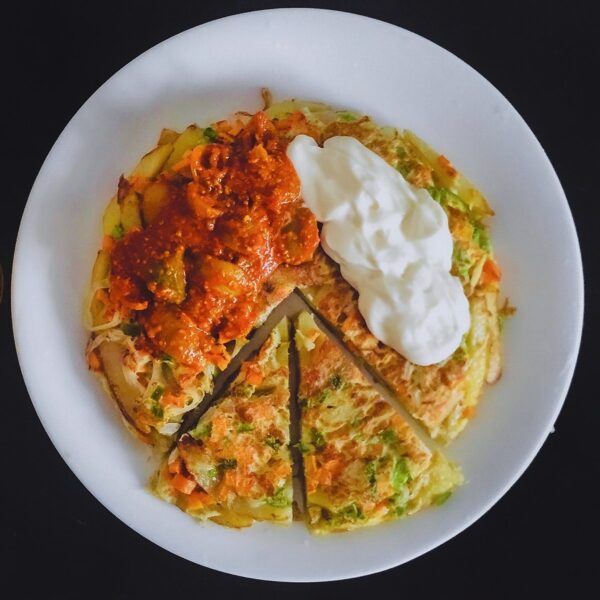
  • Atkilt (Ethiopian Cabbage and Potato)
  • Gomen Wat (Ethiopian Vegetables)
  • Berbere Spiced Chicken Breasts
  • Kik Wat (Ethiopian Red Lentil Stew)


2. Shiro

Ehtiopian dish Shiro
Image from justonegursha

Shiro, often called Shiro Wot, is an Ethiopian-Eritrean stew. Powdered chickpeas or wide bean meal are its main ingredients, which are frequently combined with minced onions, garlic, and, depending on regional preference, ground ginger or diced tomatoes and chili peppers, which makes this meal suitable for vegetarians and vegans.

In Ethiopia, Shiro is the most nourishing and affordable dish available. Sadly, people tend to consume less of the dish as they achieve higher economic and social success and status, preferring instead meat-based foods.

On the other hand, Tegabino Shiro is a type of Shiro made with heavily spiced legumes, chickpeas, field peas or fava beans, flour, oil or butter, and water brought to the boil, and then brought bubbling all the way to the table in a miniature clay pot.

Shiro can be cooked and added to shredded injera, kitcha (unleavened flatbread), or taita and eaten with a spoon; this version is called shiro fit-fit. Shiro is a vegan food, but there are non-vegan variations that use niter kibbeh (a spiced, clarified butter) or meat (in which case it is called bozena shiro).


3. Azifa

Ethiopaian dish Azifa
Image from seasaltgalleykat

Azifa is a green lentil salad that’s perfect on its own or mixed with injera.  It is also combined with lime juice, mildly hot peppers, spices, and usually goes well with any Ethiopian dish. It can be served cold as a snack and is often eaten a lot during the lent season when meat is prohibited.

To get a nice tasting pot of this Ethiopian dish, you’ll be needing; green lentils, finely chopped peppers, ginger, turmeric, lime juice, tomatoes, and some olive oil. What makes this Ethiopian dish especially great is that the ingredients are super easy to find at the food market, and most are ingredients you can easily pick up in your kitchen.

Like every other salad meal, this Ethiopian dish is very nutritious and has a lot of health benefits including; its role in easy bowel movement, reduces blood pressure, very beneficial to people looking to maintain a healthy diet and in weight loss, it contains essential nutrients the body needs to keep it healthy, and aids a lot in digestion. If you are a lover of salad dishes, then you should definitely try this Etiopand dish.


4. Tibs

Ethiopian dish tibs
Image from images.squarespace-cdn

Tibs is the name of one of the more unique Ethiopian foods. It’s a meaty, rich, and spicy-as-hell hybrid stir fry and stew that comes together in a flash. It is served with bread, rice, or, more accurately, injera flatbread.

This is one of the most popular Ethiopian dishes. It comes in a variety of forms, varying in type, size or shape of the cuts of meat used, and can be spicy or mild, with little to no vegetables. Shekla tibs, in which the strips of beef arrive at your table roasting on a clay pot heated with hot coals, is a particularly recommended variation.

Because tibs is a quick-cooking stir fry, better quality meat will make your dish taste better. If you are using any other meat cut other than the flank steak, make sure it is tender meat.

This dish is traditionally eaten with your hands, with injera serving as a “utensil” for scooping bites of food. If injera isn’t easy to make or find, rice can be used instead. Berebere is a flavoring that can be easily acquired online and is important to the recipe. It also adds a good deal of heat.


5. Doro Wat

doro-wat Ethiopian dishes
Image from ministryofcurry

Wat, Wot, and Tsebhi are Ethiopian and Eritrean stews made with chicken, beef, lamb, a variety of vegetables, spice blends including berbere, and niter kibbeh, seasoned clarified butter.

This Ethiopian dish is a celebratory chicken-based wat stew that is typically purchased from outdoor markets. To kill bacteria, the meat is soaked in water, salt, and lemon juice before being chopped into eight to twelve pieces. About five minutes before the stew is done, peeled hard-boiled eggs are added to absorb all of the savory spices and the delicate red color.

Doro wat is a must-have at any celebration, including Christmas and Easter, thanks to delicate meat, peppery eggs, and a creamy, savory sauce. Many Ethiopians abstain from eating meat for 43 days before Christmas, and on Christmas, the majority of people opt for doro wat as their favored and ultimately permitted meat-based dish.

The secret ingredient for Doro Wat is the spicy and tasty berbere. This is a blend of several other spices, they can be either whole or grounded spices.

The combination of these spices is then blended to give you the tasty, flavor-filled, and spicy seasoning that is then used to prepare this chicken dish.

The use of berbre is not just limited to the preparation of Doro Wat, you can also add some to varieties of dishes to give it a new and great taste. Who wouldn’t love to add a new spice to their collection of spices?

The process for the preparation of Doro Wat is quite a long process, this is mostly because you have to take your time to prepare the onions and some other spices together. The long cooking time does not stop Doro Wat from having a great and spicy taste.


6. Kitfo

Kitfo Ethiopian dish
Image from Wikipedia

Kitfo is a typical Ethiopian meal made with raw beef that has been freshly ground, Ethiopian butter (niter kibbeh), and spices like pepper and salt. The dish is served with a varieties of bread, with injera being a must-have at every kitfo eatery.

Kitfo leb leb refers to kitfo cooked lightly rare. Kitfo is frequently eaten with a mild cheese known as ayibe or cooked greens known as gomen, and is sometimes mixed with it. In many parts of Ethiopia, kitfo is eaten with injera, a teff-based flatbread, however kocho, a thick flatbread derived from the ensete plant, is used in traditional Gurage cuisine. As a garnish, an ensete leaf might be utilized. Kitfo is commonly regarded as a delicacy, despite the fact that it is not classified a delicacy.

Kitfo is eaten on special occasions, such as holidays; it is especially popular during Ethiopia’s annual “Finding of the True Cross” or “Meskel” celebration, which takes place on September 27.


7. Genfo

Genfo Ethiopian dish
Image from Enebla

Genfo, Ga’at, or Marca is a stiff porridge-like substance that is typically shaped into a round shape with a hole in the middle for the dipping sauce, a mixture of butter and red peppers, or pulses like sunflower, seed, nut, and flax. Barley or wheat flour is used to make gene

Thus Ethiopian dish is commonly eaten for breakfast and is made by adding dry-roasted barley flour to boiling water and stirring the concoction with a wooden utensil until it develops a smooth, yet extremely thick consistency.

After that, the porridge is moved to a bowl and a hole is made in the center, generally with a finjal (Ethiopian coffee cup). The well is stocked with berbere spices and clarified spicy butter. Although generally eaten plain, Genfo can be served with a scoop of yoghurt.

Like other Ethiopian dishes, it’s often shared and can be eaten with your hands, but it’s not uncommon to eat genfo with a fork or spoon as eating with hands can get messy. Bits of porridge from the exterior are dipped into the butter and spice mixture in the center in either case.


8. Fir-Fir (Sautéed Injera)

firfir Ethiopian dish
Image from Messy Vegan Cook

This is a typical Ethiopian breakfast. It is basically shredded leftover injera stir-fried with berbere and kibbe. The hot, carbohydrate-heavy breakfast dish could be combined with leftover shiro or meat stews. Even though injera is the main ingredient in fir-fir, it will almost certainly be served with more injera on the side.

Firfir is a meal created to reduce food waste. It’s either made with injera that’s past its prime but still edible, or it’s made with injera that’s been dried for longer storage. Every household cooks firfir slightly differently, but the key flavors of tomato base, onions, garlic, and berbere are all present (an Ethiopian spice).

This Ethiopian dish is very simple to make and can be eaten both cold and hot.


9. Kitcha

Kitch Ethiopian dish
Image from 196Flavors

Kitcha is an Ethiopian and Eritrean bread that is generally thin and unleavened (meaning it contains no yeast). Wheat flour, water, and salt are what it is mostly made with. It is cooked in a hot pan free-form until one side is cooked. This Ethiopian dish is best eaten lukewarm, and is often characterized by its chewy texture.

Then it’s taken up and turned over to fry the other side. Slight burning on both sides is common. Kitcha will take on the shape of the pan it’s cooked in (much like a pancake, though it bears no relation). It’s most commonly served in a meal known as kitcha fit-fit. The flatbread can be additionally spiced with chili and cardamom. It is usually served warm with melted butter, or used in a dish called fit-fit.

Kitcha fit-fit Ethiopian dish
Kitcha Fit-fit – Image from Taste Atlas

Fit-fit is made up of bits of kitcha, spices, and clarified butter blended into a mushy consistency. It’s sometimes served with yogurt or hot peppers and is eaten with a fork, as opposed to most Ethiopian dishes, which are eaten with the hands.


10. Beyaynetu

Beyaynetu Ethiopian dish
Image from petitworldcitizen

This is Ethiopia’s most popular vegetarian dish which translates as “a bit of every type,” hence Your injera will be buried in mounds of delectable and vibrant veggies, potatoes, curries, lentil soups, and more, creating a riot of hues and tastes.

Because of Ethiopia’s strong religious fasting and abstinence from meat on Wednesdays and Fridays, beyaynetu is widely available throughout the country and is served in everything from posh hotels to roadside food shacks. As a result, beyaynetu is a safe and simple option when traveling or confronted with a menu only printed in Amharic.

In Ethiopia, fasting doesn’t mean refraining from all food. Instead, one is to eliminate all animal products (meat, dairy, eggs, etc.) from the diet. Basically, they adhere to a vegan diet during fasting days.

Regardless of whether they are vegetarian or not, many travelers to Ethiopia declare beyaynetu to be their favorite dish.

Well, there you have it. top 10 Ethiopian dishes you should definitely try when visiting, happen to find yourself in an Ethiopian restaurant, or simply want to try a new dish at home. If you are a lover of meat and vegetables, then this should be one of your favorite articles yet.

Tuwon Masara (Corn Meal Swallow) Recipe

Cornmeal recipe (Tuwo masara) is a staple dish and a favorite fufu swallow in Nigeria’s northern states and is called by different names. This Tuwon Masara or corn fufu is also a very common meal in different parts of Africa and it is cooked in different ways depending on the country.
Cornmeal swallow (tuwon masara) is one of the world’s most popular current trending meals. Every day, millions of people enjoy it. It’s easy to make, quick to prepare, and delicious to eat.

What is Tuwon Masara Made From?

The term tuwon masara is formed from two Hausa words; tuwo (cooked cornmeal) and masara (maize). It is often called tuwon masara or tuwo. Cornmeal fufu is made from dried corn. The corn is ground into a medium consistency and then sieved to have a fine consistency.
Tuwon Masara or corn fufu is a bit similar to polenta as they both use corn.  While corn fufu is cooked plain without any seasoning, polenta is prepared and seasoned like a porridge.

Health Benefits of Tuwo Masara

Here are some health benefits of this delicious meal;

1. It is Nutritious and highly appetizing.

2. It Prevents constipation

3. Reduces stomach acidity.

4. It reduces the symptoms of certain cancers.

5. Reduces the risk of diabetes and heart diseases.

6. Boost immune system.

7. Boost production of red blood cells.

8. Good for the the eyes, contains vitamin A.

9. Prevents color cancer since it contains a lot of fibre.

10. Aids the digestive system

11. Helps reproductive health

Different Ways to Prepare Cornmeal Fufu (Tuwon Masara)

There are different ways of making cornmeal fufu. You can directly add the ground corn to a pot of boiling water while stirring continuously to create a dough-like mash.

However, you can still prepare your corn fufu or tuwo masara by mixing the cornflour into a thick paste and then add it into a pot of boiling water to make a smooth dough-like mash.


Tuwon Masara Corn meal swallow recipe
Image from Precious Core

What To Serve With Tuwon Masara?

Tuwo Masara (Tuwon Masara) can be eaten with any Nigerian soup, such as Ogbono soupEgusi soup or Okra soup. The Northerners enjoy it with Miyan Wake, Miyan Taushe , Miyan Zogale, Miyan Ridi, Miyan Tapasa, Miyan Shuaka and Miyan kuka.

Some suggestions for Amazon links to “Whole Foods Market, All Purpose Flour”.

Whole Foods Market All Purpose flour

Project Overview Docs Banner in Light Green Blue Vibrant Professional Style 1

However, cornmeal also pairs well with any type stews, and sauces.  Apart from tuwon Masara, there are other cornmeal recipes . Also see here how to make Tuwon Dawa Da Miyan Kuka.

Serve hot and ENJOY!

Tuwon Masara

Corn Meal Swallow
Servings 0

Ingredients
  

  • Corn meal (garin masara).
  • Oil
  • Water
  • Corn Flour

Instructions
 

  • Allow the maize dry and afterwards you grind or blend it.
  • Boil water in a pot.
  • Divide the corn meal into 2 and set aside.
  • Pour the one part in a bowl add water and mix until smooth and set aside.
  • Then gradually pour the second paste into the boiling water and use your turning stick to mix until smooth cover and allow to cook for 10min.
  • Then gradually pour the remaining corn meal into the paste and turn at the same time until smooth.
  • Add a little oil and continue to mix.
  • Add little water inside and cover the pot allow it to cook for some minutes.
  • Open the pot and turn the mixture until smooth.
  • Mould as desired and serve with soup of your choice.
  • Add lemon, stir or give the pot a little shake and turn off the heat.
Tried this recipe?Let us know how it was!

Have You Tried These 3 Amazing African Fruit Juices?

0

If you are a lover of fruits and you have been looking for different ways to have fun with some of these African fruits, you eat everyday around you, then you are in the right place, if you are just looking for a place to try something new with your fruits, you are also in the right place.

Are you not excited about this topic? Who does not love a fresh glass of fruit juice after a hectic day at work, or something sweet and healthy to give the kids after a long day from school, there are so many reasons to enjoy fruit juice, but before we look into that, let us take a little glance at what fruits are.

What Is A Fruit?

Fruits are easily described as the edible products of a plant that often come with seeds.

This is as simple as it can be described, but do you know why fruits are important and good for you?

Of course, you do, if you don’t, not to worry, we will give you the required information about the importance of fruits to you and your health.

Why Should You Enjoy Fruits? 
  • Fruits are healthy
  • Fruits are rich in vitamins which are required by the body for metabolism
  • Fruits are rich in fiber
  • Fruits are flavor-filled to nourish you
  • Fruits are rich in Vitamin C

This is just the shallow aspect of the reasons why you need fruits. We are here to talk about African fruit juice so let us get into it.

What would you say is fruit juice? In simple terms, fruit juice can easily be described as the juice extracts, or the liquid flavor aspects, gotten from a particular fruit and there are different types of African fruit juice, and we will get into that.

Now that you have the basic knowledge of what fruit juices might be, doesn’t it want to know the types of African fruit juice that we have?

The amount of African fruit juice that is existent is a lot to cover this article, so we are going to take a look at a few African fruit juice, carefully selected for you to have fun with and enjoy.

Let us take a look at the different types of African fruit juice

The Different Types Of African Fruit Juice

  • African Mango fruit juice
  • Banana fruit juice
  • Strawberry juice
  • Apple juice
  • Orange juice
  • Cucumber juice
  • Lemon juice (lemonade)
  • Cranberry juice
  • Grape juice

Are you familiar with any of these African fruit juice? Have you tried any of the African fruit juice on this list of the different types of African fruit juice? If you have let us know what your favorite African fruit juice is.

You know a little amount of the types of African fruit juice we have, this list is little compared to the hundreds of fruit juice that exists in the continent Africa.

Now that you know a few of these African fruit juices, let us take a closer look at a few of them.

The Different Types Of African Fruit Juice You Would Be Excited To Try: Tamarind Fruit Juice 

Tamarind is a fruit that is enjoyed in most countries in Africa and it can also be used to prepare some delicacies.

Tamarind is a fruit that is also native to Africa, but it can also be found in some other countries around the world.

Tamarind is grown on the tamarind tree, tamarind tree produces bean-like pods that are usually filled with seeds. So yes, tamarind is a fruit with seeds.

tamarind
image from: Pinterest.com

The pulp of tamarind is usually green and it tastes sour, but as time goes by and the fruit starts to ripen and the taste begins to develop into a sweet-sour taste.

Interestingly, apart from feeding, there are also other uses of this amazing fruit, and one of the uses includes some activities that occur in the household.

The pulp of this amazing fruit can be used to polish metal, this is due to the presence of tartaric acid in the fruit.

But we are here to talk about the fruit juice that is gotten from Tamarind, before we look into that, let us dive into the health benefits of Tamarind juice.

  • Tamarind juice is high in antioxidants and great for the health
  • Tamarind fruit juice is known to aid in weight loss
  • Tamarind juice is very rich in magnesium
  • Tamarind juice helps in the maintenance of blood pressure
  • Tamarind fruit juice will do wonders for your skin
  • Tamarind juice is anti-diabetic
  • Tamarind fruit juice helps in bone formation and it also helps to strengthen the bones
tamarind fruit juice pictures
image from: Pinterest.com

You know the health benefits of tamarind juice, and these health benefits are too amazing and good to ignore, what are you waiting for?

A recipe? There is always something to make your whole experience with African food, fruit, and drinks a special one, so you don’t need to get worried about the recipe for this amazing African fruit juice, all you need to do is check out the recipes for everything about African foods and drinks, here at African food network.

Just like you read earlier, tamarind is a special fruit that has so many great health benefits that you would not want to miss out on.

You already know the importance of fruits in your general health but let us take a quick look at the health benefits of tamarind on your health.

picture of tamarind
image from: Pinterest.com

Health Benefits of Tamarind

  • Tamarind consists of polyphenols, which are known to be high in antioxidants and are also anti-inflammatory.
  • The seeds of tamarinds are known to help lower blood sugar.
  • This African fruit is also known to help in the prevention of some major diseases like diabetes, cancer, and diseases of the heart.
  • This African fruit is also your friend for weight loss.

One of the ways of enjoying tamarind is by blending it up and having a sweet, amazing, and healthy experience with tamarind fruit juice.

You already know what you need to know about tamarind fruit juice, are you ready to give it a try? Of course, you are.

You can check out the recipe for this amazing African fruit juice here at the African food network.

The Second African Fruit Juice On This List Of 3 African Fruit Juice You Would Enjoy Is: Orange Juice 

It is impossible to make a list of African fruit juice without the mention of this special African juice.

Orange juice is one of the most popular fruit juice around the world and it is no surprise why it is so popular, the health benefits of orange alone would have you looking and feeling amazing.

The health benefits of Orange fruit juice are something everyone should get in on, understanding the health benefits of this African fruit juice would give you insight on why you should have orange fruit juice as part of your feeding routine.

There are a lot of reasons why you should have orange fruit juice in your life, and you are going to get familiar with the reasons but before we get into the reasons you should try orange fruit juice, don’t you want to know a little bit about the fruit, Orange?

What Is An Orange? 

Orange is a citrus fruit that is highly nutritious and rich in vitamins, there are different types of oranges and you should get familiar with them.

picture of orangesOrange is a very interesting fruit that you should get to know on a more personal level and what other way can you get to know more about your African fruits, if not through the African food network?

To know more about this amazing fruit, you can check out this article on fun facts about oranges here at the African food network.

Just like you read earlier, there are great health benefits of orange, wouldn’t you love to know more about the nutrient Jonah benefits of this amazing fruit? Of course, you do, let’s take a look at the health benefits of orange.

Health Benefits Of Orange 

  • Orange is known to be an amazing immune system booster.
  • Due to the vitamins present in oranges, oranges are known to aid in the production of collagen.
  • Oranges make it easier to absorb iron, which also aids in fighting anemia.
  • Oranges are known to aid in the body’s fight against germs, helps to protect you from certain diseases.

orange juicwNow you know the health benefits of this amazing fruit, are you ready to get familiar with the reasons why you should try the African orange fruit juice?

There are so many reasons why you should have a try at this amazing African fruit juice, but the first and major reason why you should be for your enjoyment.

Who doesn’t like a little enjoyment every here and there? Isn’t that what life is about? Making the most out of any little experience you can get.

That is what the African food network is about, enjoying this African fruit juice might seem like a little thing to do but your enjoyment is guaranteed, think of the last time you had a hectic day at work and all you wanted was something cold and refreshing to drink; Or the last time you were sitting at home, working and you needed something light to snack on, then you remember the cold glass of orange juice you prepared just after reading this article, you go get the fruits juice from the fridge, pour it into a cup then drink, think of that chill and the orange juice entering your body, making you feel relaxed and refreshed.

Who wouldn’t want to experience something like that? This experience might seem like a little piece of the other type of experience you can get from life, but just like they say “it’s the little things that matter”. If you get to feel this refreshment, then you got the opportunity to enjoy this amazing African fruit juice.

Did you enjoy this? Well, let’s take a glance at other reasons why you should give this amazing African fruit juice a try;

Why Should You Try African Orange Fruit Juice?

  • Oranges are rich in vitamin C.
  • Oranges are known to aid in the healing process of skin damage.
  • Oranges are known to aid in lowering cholesterol.
  • Oranges lower the risk of cancer.
  • Oranges help in the improvement of the health of the eyes.

Are these reasons enough for you? Do you now see why you just cannot miss out on this exciting experience with African fruit juice?

Don’t worry we have enough African juices for you to try and have fun with.

The Third African Fruit Juice On This List Of 3 African Juice You Would Enjoy Is: African Mango Fruit Juice 

If you have had mango fruit juice, then you would understand why it cannot just be missing from this list of African fruit juice you would enjoy.

We wouldn’t want to give off all the secrets and nutritional benefits of this amazing African fruit juice, so let us look a little deeper into the African fruit, mango.

African mango is an African fruit that is popular across several countries in Africa for its amazing nutritional benefits, they are also known to be rich in antioxidants and other nutrients that aid in some conditions like; obesity and diabetes.

Getting familiar with the nutritional benefits of this amazing African fruit is something everyone should be a part of and that is what we are here to help you with.

Don’t you want to know the nutritional benefits of African mango? Of course, you do, so let us take a look at a few.

Health Benefits Of African Mango

  • Mangoes are known to be very rich in fiber.
  • African mangoes are known to be rich in antioxidants.
  • African mangoes aids in the health of the eyes.
  • African mangoes help in the improvement of the skin and hair.

You are now familiar with the health benefits of this amazing fruit, now let us look into the African Mango fruit juice.

If you have had African mango before, you would have some idea of what the African mango fruit juice would taste like.

Mango is known to have one of the best flavors amongst other fruits in Africa; Take a moment to imagine what the African mango fruit juice would taste like.

If you are curious as to what the taste of this amazing African fruit juice would be like, why don’t you give it a try? A recipe would be needed to get you started, and that is why the African food network is here for you, giving you the recipes that you need to put you on the right track with your experience and journey with African food.

Are you interested in this amazing African mango fruit? You can check out other uses and delicacies with African mango, here at the African food network.

Are you doubting the magic of this African fruit juice? Well, you would need a little more convincing, so let us have a closer look at the health benefits of African mango fruit juice.

Health Benefits Of African Mango juice 

  • African mango fruit juice would keep you healthy and refreshed.
  • African mango fruit juice is known to be of great help when it comes to strengthening bones.
  • African mango fruit juice aids in the digestion processes.
  • African mango fruit juice can be of great help during pregnancy.
  • Do you want glowing skin? African mango fruit juice is the answer.

With the health benefits of this African fruit juice, it is impossible not to be interested in giving African mango juice a try.

Now, with having this knowledge about the great health benefits of this amazing African fruit juice, why wouldn’t you want to give it a try?

There are three different African fruit juices in this article, and each of the African fruit juices on this list of three African fruit juice has amazing health benefits that you would not want to miss out on.

On this list of 3 African fruit juice that you would enjoy, surely, you must have found one or two of the African fruit juice interesting, and you would not want to be left out of the amazing health benefits, of the African fruit juices.

Which of these African fruit juice did you find interesting? Did you try to imagine what these African fruit juices would taste like?

You were not satisfied with this list of African fruit juice? Don’t worry, the African food network is here again to help you, there is some other African fruit juice, enough for you to enjoy, that is the reason the African food network is here, to give you the best experience with your African food.


Other African Fruit Juice 

There is so much other African fruit juice for you to enjoy, and guess what? If you are looking for ways to mix things up and enjoy your African fruit juice even better, the African food network is here to guide you on the ways you can go about that.

Before we look at the different and fun ways to enjoy, have fun, and be creative with your African fruit juice, let us take a look at the different other types of African fruit juice we have.

image of blood orange juice
image from: Pinterest.com

The Other Types Of African Fruit Juice You Would Enjoy:

  • Pineapple fruit juice
  • Apple fruit juice
  • Banana fruit juice
  • Beetroot fruit juice
  • Dates fruit juice
  • Cucumber fruit juice
  • African dates fruit juice.
  • Tamarind fruit juice.
  • Watermelon fruit juice.
fruit juice
image from: Pinterest.com

Do you want to know more about these other nutrient-frilled African fruit juice? You don’t need to worry or look too far to understand more about these African fruit juice, all you need is your phone and African food network, and you would be getting all the information about these African fruit juice, and even more.

Just like you read earlier, there are different other ways for you to enjoy these African fruit juice, you can be creative with your African fruit juice, mix a few of the fruit juices, to get a mix of different amazing and delicious flavors.

Don’t you want to try this out? Don’t you want to get more out of these African fruit juice, not to worry, there is always something here for you on the African food network.

Before we get into the list of different ways to mix things up with your African fruit juice, you should check out other articles here at the African food network.

If you are looking for more information about healthy fruits, foods, and even vegetables, the African food network is always here for you, giving you the best articles about African foods and how beneficial they can be for general health.

You can check out other articles here at the African food network.

Let us take a look at other fun, exciting and creative ways to mix up your African fruit juice, to get new, exciting, and refreshing flavors out of these African fruit juices.

Other Ways Of Being Creative With Your African Fruit Juice

  • Pineapple juice and shrimp fried rice
  • Orange juice and cookies
  • Apple fruit juice and Jill of rice
  • Banana fruit juice and a sandwich
  • Tamarind juice and Koeksister

Don’t you want to try this out? You can check o it the recipe for these African fruit juice, here at the African food network.

Be sure to have an amazing day, drink some African fruit juice, wear a huge smile on your face, and be happy.


Alkubus

This is another traditional meal. “Alkubus” is a popular Nigerian cuisine cooked primarily by the Hausa people of Nigeria.
Every day, millions of people appreciate this lovely recipe. It’s simple, quick, and very delicious.
What is Alkubus?
It is a northern Nigerian delicacy composed of flour or wheat that goes well with stew, vegetables, or chili peppers. It’s often served in molds with Miyan taushe.

What is it Made From?

It is made from whole wheat or flour, or a combination of the two. It could also be served as a main course.

Is Alkubus Healthy?

Alkubus is a very nutritious food and is very good for diabetic patients.

How to Prepare Alkubus

This dish is really easy to prepare and will not take your time. The first preparation is for sole consumption while the second is for preparing to eat with stew.

Method 1

  • In a large mixing basin, combine the wheat, flour, and salt; in a small mixing bowl, activate the yeast.
  • Traditionally, you need to use your hand while mixing.
  • Pour in the oil, then add the yeast to the dry ingredients and make a dough.
  • Allow for some minutes for it to rise.
  • Place in a greased pan and top with carrots and onions.
  • Leave it to completely cool before cutting into desired shapes.

Method 2

  • In a bowl mix the yeast with warm water and allow it to stand until it forms bubbles this is to show how active the yeast is.
  • In another separate bowl mix the flour, salt and pour the yeast mixture into the flour bowl and mix properly.
  • Cover and allow to stand in a warm place for 30 minutes.
  • Bring it out after 30 minutes.
  • Scoop the mixture into nylon bags(this packaging is the same as packaging Moi Moi).
  • Start boiling some water in a pot and drop the nylon leather bags containing the batter into the boiling water. cook on medium heat.
  • Dip a knife or toothpick into it. When it’s done, the knife or toothpick will come out clean.
  • Serve with sauce of choice, stew, etc.

How to Serve Alkubus

It can be eaten with agushi [egusi]soup, vegetable soup, cabbage stew, or tomato sauce. One of the most popular way to serve is alkubus with vegetable soup.

Alkubus

Prep Time 10 minutes
Cook Time 15 minutes
Servings 0

Ingredients
  

  • 2 cups flour or wheat flour
  • 2 tsp dry active yeast.
  • A pinch of salt.
  • 1 cup warm water.

Instructions
 

  • In a bowl mix the yeast with warm water and allow to stand until it forms bubbles this is to show how active the yeast is.
  • In another separate bowl mix the flour, salt and pour in the yeast mixture into the flour bowl and mix properly.
  • Cover and allow to stand in a warm place for 30mins. After 30mins bring out.
  • Now start scooping the batter into nylon bags and for this recipe i divided the batter into four equal parts one nylon bag each (i used white nylon leather bags) this packaging is same as packaging moi moi.
  • Start boiling some water in a pot and drop the nylon leather bags containing the batter into the boiling water.
  • Cook on medium heat.
  • When a knife/toothpick comes out clean its done.
  • Serve with sauce of choice, stew etc.
Tried this recipe?Let us know how it was!

6 Nutrient-Filled African Cocktails Your Guests Would Love

0

To the African cocktail lovers out there, this might be the best thing you come across on the African food network today because you are about to learn and get more insight into the different types of African cocktails out there.

Are you bored of the regular and boring types of cocktails you have been making? Are you trying out new African cocktail recipes that you think might be fun and exciting for you and of course your friends and families? Guess what you are in the right place because this is the article about six African cocktails that should be on the menu.

You are planning your African beach party and you are looking for the perfect African cocktails to add to this list, that is what brings you here, guess what? You don’t have to search everywhere to find the perfect African cocktails that would go nicely with your African beach party, because the African food network is here to give you amazing, delicious, and sweet African cocktails that should be ok your menu.

All the African cocktails on this list of African cocktails that should be on the menu, would indeed make it to the menu, do you want to know why? Because they were all carefully and graciously selected to suit the mood of your African beach party. That is just what the African food network is about.

Before we look into the list of African cocktails, don’t you want to have a glance at what cocktails are, just to get a clearer picture for those who don’t have much of an idea.

What is a cocktail? 

In general terms, a cocktail can easily be described as an alcoholic drink that mainly consists of spirits and some other ingredients.

Guess what? Not all cocktails have to be alcoholic, you can make a simple cocktail and it’ll taste just as great, and that is why you are going to see a few African cocktails that should be on your menu.

Now you have a clear picture of what cocktails are, but why do cocktails? There have to be reasons for everything and a reason to enjoy a nice cocktail or general reasons why the need for the existence of cocktail, now let us take a look at that.

African cocktails
Image from: Pinterest.com

What are the health benefits of Cocktails? 

  • Health-wise, cocktails are a healthy option for low calories.
  • Cocktails are known to be a great source of vitamin C
  • African cocktails tend to add a little spice to the party, making everyone have something light and sweet to sip on while having some fun.

These are a few reasons why cocktails are a must, apart from the fun parts, you can see there are pretty much healthy parts of having a cocktail.

What are the different types of African cocktails?

Now you know the basics and you have a pretty good amount of information about African cocktail, so, you must be ready and prepared to get to know the African cocktails that just has to be on the menu, if you are not ready, then you should go back to the top and prepare yourself because it is about to be an amazing ride.

The First African Cocktail on this list of Six African Cocktails That Your Guests Would Love:

Ginger cocktail

Do you love ginger? Are you looking for new and interesting ways to enjoy ginger? Then you would feel right at home here with this tasty African cocktail.

ginger cocktail-African cocktails
Image from: Pinterest.com

The ginger cocktail is very common in Senegal but guess what? You don’t have to be in Senegal to try out this tasty and amazing African cocktail. You might be wondering how to allow us to tell you how.

African food network provides you with the recipes, allowing you have fun with your favorite African dishes, drinks, salads, fruits, and even cocktails wherever you are.

You don’t have to be in a particular country to give their local and traditional dishes a try. All you need is your phone and the African food network because you would be getting all the information about African food, drinks, juices, cocktails, fruits, and even spices. You don’t believe this? You can check it out for yourself, here at the African food network.

There is a pretty simple way to prepare this African cocktail, and it is by cutting up some ginger, blending it to some fine pulp, then mixing with hot water, after this is done, you leave it to sit for about an hour, then you separate the liquid, ensure you get out as much liquid as you can, then you can add a few lemons, some people prefer to add pineapple juice, feel free to be creative and make your flavor with this African cocktail.

Here are a few other ingredients you can add to this Ginger Cocktail;

  • Cloves
  • Cinnamon
  • Pineapple juice
  • Sugar
  • Lemons

After you are done adding your ingredients, all that’s left to do is mix! Mix it well, add some ice cubes, or you can keep it in the fridge to cool for some time.

African food network tries to give you the appropriate amount of information for whatever food, fruit, drink, and even cocktail you consume. Why is this important?

It is one thing to know what food you are taking in, and it is another to know the nutritional content of the food you are taking in.

It is important you understand the contents of the African food, African fruits, African salads, African drinks, African fruit juice, and African cocktails, you take in.

That is why we will always keep you informed on the health benefits of every African food, drink, juice, salad, and even cocktail you take into your body. That being said, don’t you want to know the health benefits of the Ginger cocktail?

Of course, there are health benefits of this African cocktail, don’t you want to know? Let us take a look at them.

What are the health benefits of ginger cocktails?
  • The ginger present in this African ginger cocktail is known to be rich in antioxidants.
  • The ginger content of this African cocktail helps in the improvement of health, especially in the heart.
  • Ginger is anti-inflammatory
  • Helps in digestion processes, which means ginger also helps in the breakdown of food for easier digestion, hence preventing constipation.

The Second African Cocktail On This List Of Six Nutrient-Filled African Cocktails That Your Guests Would Love Is:

Origin cocktail

Orijin cocktail is an African cocktail that is most commonly found in West Africa, in countries like Nigeria and Ghana.

Orijin is created by Guinness Nigeria PLC. If you are looking for an African cocktail that is deeply rooted in tradition and origin, then you would love this Orijin cocktail.

The product itself is loved by Nigerians who have had the opportunity to give it a try, but let us talk about the Orijin cocktail.

For every cocktail, dish, delicacy, juice, salad, there are ingredients that are required to get you going on the processes and preparation, Orijin cocktail is not left out on the African cocktails that require a few ingredients for the preparation process.

What ingredients are needed to make orijin cocktails?

To get you started on this African cocktail, you would need a few ingredients, and they are;

  • Freshly grated ginger
  • 2 shots of Orijin
  • Strawberries (crushed)
  • Sugar (often used to run the edge of the glass)
  • Pear slice
  • 1 oz of white Zinfandel
Malawi shandy 2
Image from: Pinterest.com

Now you know the ingredients required for the preparation of this amazing African cocktail, merely looking at the ingredients, you already want to know what it would taste like.

Well, you don’t have to wonder anymore, you can make this amazing cocktail anywhere you are, that is why the African food network is here.

Think of the flavor the strawberries would add to this mix, giving it a sweet and flavor-filled kind of taste, making it irresistible. You are going to just have to try out this amazing African cocktail for yourself, just to understand why it is on this list and the African roots and origin in this Africa cocktail.

The Third African Cocktail on This List of Six African Cocktails That Your Guests Would Love Is:

Summer breeze cocktail

For the preparation of this African cocktail, there is a secret ingredient required, and that secret ingredient is vodka.

Vodka being the secret ingredient for the preparation of the summer breeze cocktail, you would be sure of having what you might describe as the real kick.

There is a particular type of vodka used for the preparation of a summer breeze cocktail and that would be magic moments.

Magic moments would be considered to be one of the most popular vodkas in Africa, luckily, this brand of vodka is one of the major ingredients required for the preparation of a summer breeze cocktail.

What are the ingredients used to make a summer breeze cocktail?

There are other ingredients required for the preparation of this African cocktail and we’re going to look at a few of them.

A few ingredients are required for the preparation of the summer breeze cocktail;

  • Fresh mint leaves
  • Angostura bitters
  • Sugar
  • Ice cubes
  • Magic moments
  • Chunks of lime

Let us take a look at the simple procedures required for the preparation of a summer breeze cocktail.

The first step would be adding the lime chunks to a glass then two spoons of sugar, after the sugar has been added, you add the mint leaves and the ice cubes all into the glass.

After all the ingredients are added, 60ml Off magic moments vodka is then added to the mix, to add what you might describe as the icing on the cake, the last and final ingredient is then added and that would be the dash of angostura bitters.

Stir the mix, add a spiral of lemon and your delicious summer breeze cocktail is ready to be enjoyed.

Do you now see why the summer breeze African cocktail should be on the menu?

The next African cocktail on this list is the cocktail that everyone just has to try, if you haven’t had the cocktail before, then this is your sign to give it a try because you don’t want to miss out on all the flavors and nutritional benefits of this tasty African cocktail.

The Fourth African Cocktail On This List Of Six African Cocktails That Your Guests Would Love Is:

Malawi shandy

This African cocktail comes in very handy during the hot weather in Malawi, a subtle and nice to just cool yourself down and relax is to have a glass of cocktail.

Malawi Shandy African cocktail
Image from: Pinterest.com

Are you having a very friendly beach party and you’re looking for sweet African cocktails to add to the menu, something cool and nice for your friends to sip and have some fun with? This African cocktail is the best for you.

A Malawi shandy can easily be described as an African cocktail that is easily made from Raquel parts that include equal parts ginger ale and equal parts lemonade, then to finish it off with some extra flavor and taste, a few drops of Angostura bitters are added.

Don’t worry if this African cocktail doesn’t do it for you, there are several ways to prepare Malawi shandy and there are other different types of shandy and another popular one is Rock Shandy.

Rock Shandy is also known to consist of two equal parts of soda water and lemonade, and guess what, to finish off the flavor and add some flavor and spice to the African cocktail, a few drops of Angostura bitters is added to the mix.

The Fifth African Cocktail On This List Of Six African Cocktail That Your Guests Would Love Is:

Mkulumadzi iced tea, from Malawi

If you have not had this African Iced tea cocktail, go back and sip reading this because this section of this article about six African cocktails would be a spoiler, because it is amazing, and one of the best African cocktails you would have.

Your African party would be incomplete without Mkulumadzi Iced tea cocktail from Malawi, there is every reason why you should give Mkulumadzi African iced tea cocktail, from the taste to the nutritional benefits, to the general feeling of sipping on something tender, sweet, and amazing on a hot day at the beach with your friends, having a good time, with this African cocktail.

What are the ingredients used to make Mkulumadzi iced tea?
MKULUMADZI ICED TEA
Image from: Pinterest.com

To have a glance at what this African cocktail might taste like, or the ingredients that are required for the preparation of this African cocktail, here are a few ingredients:

  • 1.5 liters of hot water
  • A slice of lemon
  • 5 tablespoons of fresh lemon juice
  • 5 Rooibos teabags
  • 5 tablespoons of fresh sugar
  • All these ingredients are prepared and then added to 1.5 liters of hot water.

After the preparation process, this African cocktail is then left to cool, then served with ice cubes.

Guess what? You don’t need alcohol in your cocktails for it to taste amazing, and Mkulumadzi is one of those cocktails that don’t need alcohol to taste great.

The Sixth African Cocktail On This List Of Six African cocktails That Your Guests Would Love Is:

The Pumulani cocktail from Malawi

Are you on a beach in Malawi and you’re looking for something tender, sweet, cold, and nice to warm

You up and make you feel nice? Why are you looking too far for all that fun when you have an African food network?

Are you having an African-themed party and looking for some amazing African cocktails to complete your cocktail menu, guess what? Pumulani African cocktail is the best choice for you.

What are the ingredients used for the preparation of pumulani cocktail?

The preparation process for this African cocktail is simple and easy to execute, but we will

Be giving you a simple insight on the basics for the preparation process of this African cocktail.

There are only four major ingredients required for the preparation of this African cocktail and they are;

  • Malibu rum
  • Half a shot of blue curacao
  • Alcohol
  • Fresh ginger ale
  • Of course ice

The process for the preparation of this African cocktail is simple, all you need to do is; As seen on the ingredients required, you would need half a shot of blue curacao, then mix a shot of Malibu rum. Add this mix in a beer glass, fillers with iced cubes.

To finish off the flavor of this African cocktail, you can add some fresh, toasted, sweet, and desiccated coconut, to be sprinkled at the top. This African cocktail is what you might describe as paradise simply in a glass.

There is something about these African cocktails that you just cannot resist. Is it the taste? Is it the relaxing feeling of sipping some African cocktail after a stressful Friday night at work, and you are hanging out with your friends? Is it the feeling of fresh air blowing through your hair on a sunny day at the beach with your family and friends having an amazing time with a glass of African cocktail just sitting on your hand and with every sip you feel the refreshing feeling of some healthy and nutrient-filled African cocktail flowing down from your throat to your stomach?

Or is it the great feeling of having something incredibly amazing and healthy going down your body system? Whatever makes these African cocktails special to you is worth holding onto and trying out new and different ways of enjoying your African cocktail.

So get up from that comfort and boring zine, and create some of the magic in African cocktails that the African food network has given to you as a guide to help you explore your creative, amazing, talented, and beautiful side.

having these African cocktails at your party would be the highlight, these African cocktails would leave your guests smiling, healthy, nutrient-filled.

You have come to understand and get familiar with these African cocktails, not only Do you know these African cocktails, but you also know the ingredients required for the preparation process of these African cocktails, you know the health benefits, and best of all you have a recipe to guide you through the process of the preparation of these African cocktails, is this not exciting?

You have the recipes for the required preparation process of these African cocktails so you have no reason not to be intrigued by these African cocktails.

Everyone should give these African cocktails a try, you don’t have to try all the African cocktails on this list you just have to try at least two of the African cocktails on this list.

You don’t have to worry about what cocktails to have on the menu for your African themed party, this is because African Food Network is here to guide you and show you the easiest and fastest ways of having fun with your African dishes, fruits, salads, delicacies, and of course African cocktails.

You would not only be having the time of your life at your African party but you would be getting the required nutrients that your body needs to perform certain actions.

Did you have fun getting to know these African cocktails? Of course, you did, who wouldn’t?

Have you tried any of these African cocktails, how was the experience for you? if you have tried all these African cocktails on this list of six African cocktails to enjoy at your party which one of these African cocktails would you say is your favorite?

Having these African cocktails at your party is like trying something new and giving your friends and family something new and exciting to try who wouldn’t love an African cocktail at their party?

If you are yet to try any of these African cocktails, don’t worry, the African Food Network is always here for you, giving you the best recipes, food ideas, and so much more.

Did you have fun getting to know these African cocktails? if you did let us know what your favorite was. Remember to experiment and try out new recipes of your own, what’s life without creativity and fun?

Be sure to let us know how your African party went, have an amazing day. Wear a huge smile on your face, drink water and stay beautiful.


African Masa

Masa is a well-blended, slightly fermented rice mixed with other random ingredients. Typically, it is Northern Nigerian food. Northerners are known for their unique and tasty meals such as this one.

This northern staple resembles a pan-fried rice cake; the recipes vary slightly from household to household, but the core principle remains the same. This meal is traditionally shaped into an oval form. You can add onions and ginger to your Hausa rice cake, to make it a more interesting dish to behold.

What is Masa?

For many Africans who may not be familiar with it as food, they will first think about the tribe called Masa first.

Masana, Banana, and Yagoua are all names for a Chadic ethnic group in Cameroon and Chad. The Masa number between 266,000 and 469,000 people, with the majority living in Cameroon. The majority of them are Masana speakers.

It is a northern special food mostly sold and consumed by them northerners as well. It is also known as Waina or Sinasir. Instead of rice, you could also use millet, maize, or sorghum puff batter fermented and baked in a skillet with a concave shape.

Is Cornstarch And Masa The Same?

No. While “masa harina ” literally means corn flour in Spanish, when “corn flour” is written in English it is generally understood to mean corn starch . And ground non-nixtamalized maize is called cornmeal , not corn flour.

What is Masa Made Of ?

It is made with rice and just a few other ingredients, this dish is easy and inexpensive to prepare.

How To Make Masa

Also known as Hausa rice cake, it is another delectable Hausa dish. It is made with ‘tuwo rice,’ as it is known in Northern Nigeria. Tuwo rice is a type of rice used specifically for tuwo shinkafa. Tuwo rice has the advantage of sticking together with one another, as opposed to conventional rice grains that separate.

The preparation process is easy but tasking especially when blending your rice or substituting elements. Always get your ingredients ready and use a powerful blender when blending your rice.

In this case, you’d need the following ingredients in making this meal; Fermented Rice or its substitute (tuwon shinkafa), active dry yeast, sugar to your taste, water, some onions(if you don’t mind), baking soda, and oil.

How Do I Fix Sticky Masa?

If it’s too sticky, it probably needs more flour or masa harina. Add more ingredients accordingly, and be sure to knead the dough for a few minutes between additions to better facilitate absorption.

How Do You Know When Masa is Cooked?

If the masa sticks after 3 minutes, then it’s not ready. Carefully fold and return to pot. Cook 5 minutes longer, then re-test. If husk is easily removed, tamales are fully cooked!

Why is My Masa Not Cooking?

If your masa seems to be sticking and breaking to your husk or banana leaf, that’s a sign that they need more time to be steamed. What is this? If you have kept them in the steamer for long enough, and the masa is still sloppy, you may have used too much lard or oil in the masa recipe.

Important Notes

  • The Masa should be well blended so it’s advisable to use a very powerful blender.
  • Though your masa consistency will be creamy but you will still find some tiny grains of Rice in the Masa no matter how you blend it, it’s unavoidable.
  • The rice batter should not be too watery else the rice batter will get scattered in the pan. It should not be too thick as well else the resulting cake will be too hard.
  • Make sure you add the Water gradually while blending until you get a creamy consistency like custard or Pap – I usually start up using 1 Cup of Water for every 3 Cups of Dry Rice but it’s very likely you may need more. 
  • If you feel your masa needs more Water then It’s better to add that after proofing the Masa because Masa usually gets more liquidly after proofing so watch out.
  • If baking soda is added, the Masa will look more fluffier than when it’s not added.

What to eat with African Masa

It is basically a slightly fermented rice meal that is accompanied with a Nigerian soup like Miyan Taushe or Groundnut soup.


This recipe tastes so delicious and my family could not have enough of it. You definitely need to give this a try!

Prep Time 16 hours
Cook Time 10 minutes
Course Main Course
Cuisine South African
Servings 3 Large cakes

Ingredients
  

  • 3 Cups Rice - use The Tuwo Rice or Jasmine Rice
  • 3 Tablespoons Rice Pre-cooked
  • 2 Teaspoons Yeast Active dry
  • A little bit of potash or about a Teaspoon of Baking Soda
  • 4 Tablespoons Sugar more or less
  • 1 Cup Water a little more or less + 1/4 Cup for proofing the 
  • Yeast
  • Vegetable Oil
  • Pinch of salt

Instructions
 

  • Soak the Rice for at least 8 hours or better still leave overnight.
  • Rinse the Rice and blend it together with the pre-cooked Rice until creamy (remember to add the water before blending).
  • Proof the Yeast by mixing the Yeast, sugar and water and set aside.
  • Add the Salt, Sugar and proofed Yeast to the Rice batter and mix together.
  • Cover up the mixture for about 6 - 8 hours (you can as well leave overnight) - Use a very large bowl for this in order to save you from wasting your Rice and cleaning up your surface because the Rice mixture will rise so high before it collapses.
  • Add just a tiny bit of Oil in your Pan or skillet and fry.
  • Fry both side till golden brown and serve with Honey, Maple, Hot Sauce, Suya...And ENJOY!
Keyword African Masa
Tried this recipe?Let us know how it was!

11 Amazing Traditional Tanzanian Foods You Have To Try

In this article, we’re all about Tanzanian cuisines. There are a lot of amazing traditional Tanzanian foods you should definitely try when visiting the country, but not just that. There are also a lot of these dishes prepared internationally. Hang on tight, let’s take you on a ride.

What to Know About Tanzania

Geography

Tanzania is an East African country known for its vast wilderness areas. They include the plains of Serengeti National Park, a safari mecca populated by the “big five” game (elephant, lion, leopard, buffalo, rhino), and Kilimanjaro National Park, home to Africa’s highest mountain, and let me not get started on their cuisine.

The country is situated just south of the Equator. Tanzania was formed as a sovereign state in 1964 through the union of the theretofore separate states of Tanganyika and Zanzibar. Mainland Tanganyika covers more than 99 percent of the combined territories’ total area. Mafia Island is administered from the mainland, while Zanzibar and Pemba islands have a separate government administration.

Dodoma, city, the designated national capital of Tanzania since 1974 (pending complete transfer of official functions from Dar es Salaam), eastern Africa, about 300 miles (480 km) inland (west) from the Indian Ocean. Dar es Salaam is the largest city and port in the country.

The Tanzania mainland is bounded by Uganda, Lake Victoria, and Kenya to the north, by the Indian Ocean to the east, by Mozambique, Lake Nyasa, Malawi, and Zambia to the south and southwest, and by Lake Tanganyika, Burundi, and Rwanda to the west.

Tourism

Tanzania is home to some of Africa’s most famous national parks and natural wonders, including Mount Kilimanjaro, Africa’s highest peak. As a result, safaris and wildlife-related experiences are the most popular things to do in Tanzania and the reason many visitors visit the nation.

The majority of travelers will transit through Dar es Salaam on their way to the wilderness areas and other places. The magnificent beaches of Zanzibar lure visitors who want to spend some time soaking up the sun.

Scuba divers and snorkelers travel from all over the world to see the coral gardens, colorful fish, and crystal blue seas off the coasts of Pemba and Mafia Islands.

Culture

With over 120 tribes, Tanzanian culture is a wonderful combination of influences. Tanzania is one of the world’s most culturally diverse nations. From the towering graceful Maasai warriors to the Hadza bushmen’s traditional customs, the Wameru’s ingenious farming practices, the Makonde’s artistic talents, and the Chaga farmers and traders. Each of the 120 different tribes in Tanzania has its own distinct ways of life but together, they gracefully unite to form Tanzania.

Economy

Following two decades of sustained growth, Tanzania reached an important milestone in July 2020, when it formally graduated from a low-income country to lower-middle-income country status. Tanzania’s achievement reflects sustained macroeconomic stability that has supported growth, in addition to the country’s rich natural endowments and strategic geographic position.

Cuisine

Some typical mainland Tanzanian foods include wali (rice), ugali (maize porridge), nyama choma (grilled meat), mshikaki (marinated beef), samaki (fish), pilau (rice mixed with a variety of spices), biriyani, and ndizi-nyama (plantains with meat).

Vegetables commonly used in Tanzania include bamia (okra) which is mostly eaten as a stew or prepared into traditional stew called mlendamchicha (a kind of spinach), njegere (green peas), maharage (beans), and kisamvu (cassava leaves). Tanzania grows at least 17 different types of bananas which are used for soup, stew, and chips.

Some breakfast foods that you would typically see in Tanzania are maandazi (fried doughnut), chai (tea), chapati (a kind of flatbread), porridge, especially in rural areaschipsi mayai.

Famous Tanzanian snack foods include vishetikashata (coconut bars), kabaab (kebab), sambusa (samosa), mkate wa kumimina (Zanzibari rice bread), vilejavitumbua (rice patties), and bagia.

Tanzania has the largest livestock population in Africa, which makes meat very common in the local Tanzanian foods. Beef, goat, and chicken are the most common types of meats with which people cook traditional Tanzanian foods.

Tanzanian desserts are often simple, such as plain cakes or fruit combinations. There are a variety of pies available, such as the fruits of African pie, which is made with papaya, guava, apricot nectar, lemon juice, cornstarch, and whipped cream before being topped with coconut and peanuts.

Aside from the pies, there are pancakes, which are made with honey, sugar, and cinnamon and baked very thinly. Chapatti majis are small pancakes that are served as a treat or with tea or coffee. Fruit compotes are also frequently offered, and pineapple squash is virtually always included.

Tanzanian appetizers range from simple and fresh to elaborate and baked dinners, all with intricate recipes and flavors. Most of the salads include both fresh and boiled vegetables, sometimes mashed in a paste and they all have a vinegar dressing. A traditional Tanzanian salad is called salad va kamba na parachichi, also known as the avocado dream.

Tanzanian foods are pretty straightforward, satisfying, and flavorful; what it lacks in flair, it more than makes up for in delicious, substantial taste. During your stay in the country, keep an eye out for the following delicacies.

11 Amazing Traditional Tanzanian Foods You Have To Try

What is Tanzania’s National Dish?

Ugali is considered to be Tanzania’s national dish. It’s considered as one of the most eaten staple foods in not only Tanzania but in East Africa.

  1. Ugali (Maize Porridge)

ugali Tanzanian food
Image from Food And Meal

Considered Tanzania’s national dish, Ugali is a must-eat for anyone wanting to explore the culture. It is a stiff dough prepared with cornmeal, cassava flour, sorghum, or millet.

Ugali is a cornmeal or corn flour-based starch that resembles stiff polenta or a very thick cream of wheat. Most Tanzanian meals include a hearty amount of this Tanzanian food, which acts as a simple, filling complement to the main course, similar to fufu in West Africa or bread and pasta in the Western diet.

Tanzanians love this distinctive polenta-like side dish, which is traditionally served for breakfast, lunch, and dinner. This Tanzanian food is made by rolling a little amount of creamy, thick cornmeal paste (made from cooked white maize) in one’s hand until it forms a ball then indenting it with one’s thumb. It becomes an edible spoon that is often dipped into various stews and sauces.

The fact that it doesn’t stick to your fingers is an indication of an excellent ugali. The whole thing is frequently dipped in a savory sauce before being popped into one’s mouth.

Serve this dish with fish, meat, cooked vegetables, or bean sauce.

Click to view the Ugali recipe

Some suggestions for Amazon links to “White Corn Meal – Pre-cooked Gluten Free and Kosher Flour”.

White Corn Meal – Pre cooked Gluten Free and Kosher FlourProject Overview Docs Banner in Light Green Blue Vibrant Professional Style 1

2. Mshikaki (Marinated Beef)

mshikaki Tanzanian food
Image from Adventure Abroad

Mshikaki is a famous street food dish in Tanzania and Kenya. It is skewered marinated meat, such as beef, goat, or mutton. The meat is marinated in a combination of various herbs and spices that are popular along Africa’s eastern coast, that’s grilled slowly over hot coals.

This Tanzanian food is usually eaten for dinner and is prepared by marinating meat of choice in a bowl with ground coriander, paprika, ground cumin, chili powder, turmeric, freshly grated ginger, mashed cloves, tomato puree, oil, lemon juice Black pepper & salt, and then leaving the mixture in the refrigerator overnight for at least 4 hours.

Afterward, Skewer the meat on water-soaked wooden skewers. Grill the meat skewers on an open coal barbecue, basting with marinade until cooked. There are a number of meats available, but goat, beef, and mutton are the most popular. The grilling is not rushed, and you may have to wait a bit longer than usual, but the gradual cooking is what gives it its lovely flavor and makes it all worthwhile. Serve with pitta or wraps and salad leaves.

Order at least five or six, since if you only order one or two, you’ll soon find yourself back in line.

3. Wali (Rice)

wali Tanzanian food
Image from My Weku Tastes

Wali is a popular choice among members of the Swahili population living around the Indian Ocean’s coast. Wali means rice in Swahili often prepared with coconut milk, it is a creamy and highly delicious meal that can be served with meats, curries, poultry, and fish-based sauces.

There are different versions of this Tanzanian meal depending on what they are eaten with. For example; Wali na maharage is a Tanzanian dish made with red beans and rice. The rice is usually cooked with coconut milk or oil, while the beans are cooked until mushy. The dish is seasoned with a variety of spices such as pepper, cardamom, cinnamon, cloves, and cumin. It can be served as an accompaniment to vegetables, fish, or meat.

On the other hand, Wali wa nazi is the actual starchy side dish made from rice cooked in a coconut milk and water mixture. It’s normally merely seasoned with salt. This creamy dish is typically served as a side dish to curries and chicken, fish, and meat meals.

4. Nyama Choma (Grilled Meat)

nyama-choma Tanzanian food
Image from saudavelfrescogrocerystore

The nyama choma is a specialty of grilled goat meat or roasted meat. It is very popular in Tanzania and Kenya where it is considered the national dish. This Tanzanian dish is often made with goat meat but beef can also be used.

From the finest restaurants to roadside shacks, roast goat meat is served up as a kind of social lubricant, often aided by copious amounts of local beer. This Tanzanian food is always eaten with the hands, and common side dishes include kachumbari salad and ugali.

One can’t talk about this Tanzanian food without talking about the Nyama Choma festival. Nyama Choma Festival at Kijitonyama Postal Grounds, a two-day festival with lots of barbecue and music. The festival which is one of its kind in East Africa is going back to its roots with the event taking place at TTCL Kijitonyama Grounds.

Thi festival began June 4th, 2011. It is the only event in Dar es Salaam ( the largest city and business capital of Tanzania) that gives a once-in-a-lifetime experience every four months. Attend and be fed by the top bbq pitmasters from around Dar es Salaam in this one-of-a-kind bbq extravaganza that has different bbq pitmasters all styling their bbq techniques.

The Nyama Choma Festival Is Registered and Accredited By The Tanzania Meat Board. This festival has made this Tanzanian food very popular on international soil.

Click here to view the Nyama Choma recipe

5. Samaki (Fish)

samaki Tanzanian food
Image from whats4eats

Mtuzi wa samaki is a Tanzanian food made with onions, oil, garlic, curry powder, tomatoes, water, and lemon juice, and it’s made with fish. Freshly chopped coriander is frequently used to enhance the flavor of the dish. Mtuzi wa samaki is a very tasty fish curry meal that pioneered on the tiny island of Zanzibar. The presence of Indian-style curries in Zanzibar’s cuisine is a good evidence of its history as a crossroads of trade. Over time, mtuzi wa samaki has become popular throughout the coastal region of East Africa.

On the other hand, Samaki wa kupaka, a variant of this Tanzanian food, consists of grilled fish with coconut sauce over charcoal. Before being grilled, the fish is frequently marinated in garlic, ginger, salt, oil, and lime, and the sauce is made out of tamarind paste, tomato paste, chili peppers, curry powder, garlic, and coconut milk.

Here are the best Tanzanian samaki recipes:

6. Pilau

pilau Tanzanian food
Image from The Spruce Eats

Pilau Rice is a popular spicy rice dish informed by the country’s rich Indian inspirations. It simply refers to rice mixed with a variety of spices, but this Tanzanian food differs from jollof rice in that the result of the two is very different in terms of taste and color. The pilau is dark brown while the Jollof is red.

The pilau masala is made with five different spices in Tanzanian pilau recipes: black peppercorns, cloves, cumin, cardamom, and cinnamon. Tanzanians use more spices, particularly cloves, than other African countries for the preparation of Tanzanian foods. Cardamom is significantly more popular in the Horn of Africa.

This Tanzanian food can be made as a simple vegetable dish that can be coupled with beef, lamb, or chicken to make a complete one-pot supper. When prepared as a complete pot meal, with tomatoes added occasionally, the result is strikingly similar to the West African rice dish Jollof.

7. Ndizi Na Nyama

ndizi nyama Tanzanian food
Image from Face2Face Africa

Ndizi na nyama is a very popular Tanzanian food made with plantain or banana stew (Ndizi) and meat (Nyama) as the main ingredient. The stew can also be made with curry powder, cayenne pepper, oil, onions, tomatoes, tomato paste, and coconut milk, and then made to simmer. The greenest unripe, starchy bananas are used, which seemed both interesting and distinctly East African, making this dish an easy choice to feature.

This Tanzania food is very popular and quick to make as plantains are easily accessible due to Tanzanian’s high plantain production. Tanzania grows and exports about four million bananas and plantains each year. Bananas and plantains are a delicacy for many people in the country, as such, you will find them in many homes and restaurant menus.

This is one Tanzanian food you don’t want to miss out on.

8. Zanzibar Pizza

Zanzibar pizza Tanzanian food
Image from cuisinenoirmag

Tanzania’s special pizza is made with unleavened dough that is stretched thin and filled with various ingredients. When filled, the sides are wrapped, and this pancake-like creation is then fried in ghee until it is golden and crispy. Its popular savory combinations include ground beef, chicken, and mushrooms or—the vegetarian option—mayo, processed soft, white cheese, chopped veggies, and egg. Those with a great liking for sweet-tasting foods might prefer Zanzibar pizzas stuffed with Nutella or mango and cheese.

This Tanzanian food is related to Nairobi’s mkate wa nyama (meat bread) and Saudi Arabia, Iraq, Yemen, and India’s packed grilled pancakes (mutabbaq). But it’s the local sauce, the fusion of styles, and the inventive stuffing combinations that distinguish a Zanzibar pizza. It also looks a lot like Italian pizza but tastes nothing like it.

The origin of this Tanzanian food has not really been known, but travel research by BBC Travel suggests that a generation ago, a similar dish called mutabakia had gained some popularity in Zanzibar, but this version of the Zanzibar pizza was plain and duller as it was made using only meat and onion, but is now made like the Indian chapati.

Another study suggests that this Tanzanian food originated nearly 30 years ago when an inventive cook named Haji Hamisi traveled to Mombasa and was inspired by Kenyan’s famous egg chapati (a stuffed, pan-fried meat omelet).

Since the introduction of this Tanzanian food to the market, the Zanzibar pizzas have become the hottest-selling item. There are at least 30 Zanzibar pizza spots on Unguja and Pemba.

9. Mchicha

Mchicha Tanzanian food
Image from Tasteatlas

Tanzanian’s spinach and peanut curry is one Tanzanian food you wouldn’t want to miss out on.  This Tanzanian food is traditionally made with amaranth greens. Spinach has a similar flavor and is frequently used. It’s frequently served with ugali, an east African staple made from maize flour boiled into a smooth mush or porridge. This African food can also be served with rice.

In Swahili, Mchicha itself means spinach, a plant that belongs to the same family as amaranth. This East African country’s salad veggie is highly popular. It grows close to the ground and only reaches a height of 30 cm. Its green leaves are softer than kale’s and can withstand freezing temperatures. Because it is more difficult to come by than other greens, it has become a premium vegetable.

10. Chipsi Mayai

Chipsi_mayai_(zege) Tanzanian food
Image from Wikipedia

Chipsi mayai, commonly called zege, is a famous Tanzanian street snack. This Tanzanian food is a simple potato-egg omelet in its most basic form. It may be found in most parts of Tanzania, from the most rural communities to the largest cities. This Tanzanian food is prepared to order in both indoor and outdoor food stands.

This Tanzanian food is made using hand-cut potatoes that have been peeled and fried until crispy and golden, then combined with eggs and cooked into an omelet.
It can also be mixed with peppers and onions, and it’s usually served with a tangy kachumbari of tomatoes, onions, and chilies. Top it with a spray of ketchup and eat it with a toothpick, as the locals do.

11. Mchemsho

Mchemsho Tanzanian food
Image from Bebuzee

Mchemsho is a traditional Tanzanian dish made up of a variety of ingredients such as potatoes, green beans, carrots, bananas, and spices. This Tanzanian food is one of the most delectable local dishes and is known as exceptional Tanzanian cuisine. Although, due to the high cost of the ingredients required to prepare this dinner, it is not one that is consumed on a regular basis. It is often saved for special occasions instead.

Ingredients for a delectable recipe would be; carrots, potatoes, green beans, eggplant, cabbage, onions, bananas, tomatoes, ladies finger, sweet pepper, and spices to make this dish. Add either meat or fish for protein.

When it comes to Tanzanian foods there is so much to try. Whether you’re taking a trip to trying out something new in your kitchen. They are hearty meals that are perfect for families.

QUICK RECIPES