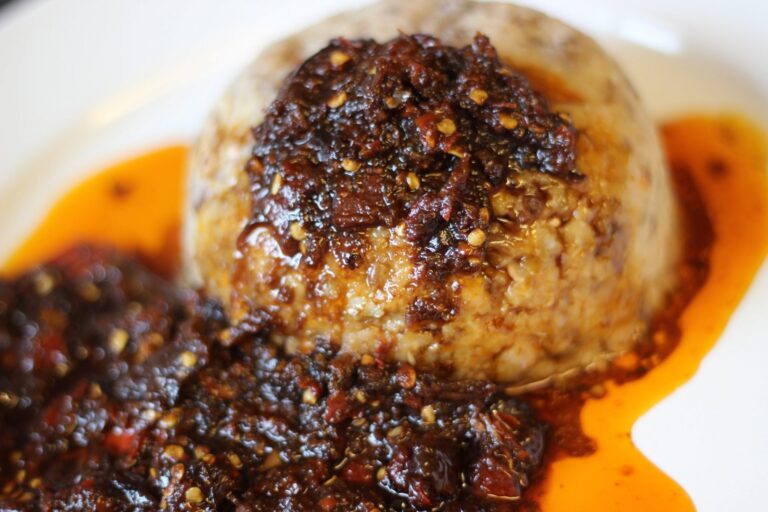
Ewa Agoyin

Ewa Agoyin simply translates to “boiled beans with pepper sauce.” This is the ideal method to eat beans for those who dislike them. This Yoruba dish is a staple for most people especially early in the morning or even in the afternoon.

They can’t just get enough of Ewa Agoyin and the love isn’t about to diminish. I’m not sure what it is about it that makes it so delicious. Perhaps it’s because of the caramelized onions. Well, I love it when I eat it and that’s enough motivation.

What is Ewa Agoyin?

It is originally known as Ewa Aganyin but is now widely mistaken and written as Ewa Agoyin. This is probably because of the way the original sounds when it is been pronounced.

It is a Nigerian street snack also eaten as a meal in many Yoruba households as a staple food. The beans are cooked to be exceedingly mushy or mashed. It is typically eaten with barely powdered pepper and hot, but peppery, tomato sauce.

‘Ewa G’ is the native name for it. Palm oil, onion, and crayfish are examples of additional components. Ewa Aganyin was popularized in Nigeria by the Republic of Benin bean sellers/hawkers. They are referred to as Egun or Aganyin people.

It’s usually served with bread, which makes it extremely filling. “Ewa G go block belle” is a typical slang phrase that means “Ewa again will fill your stomach.” It is a popular Nigerian dish since it is both tasty and filling.

True Origin of Ewa Agoyin

Ewa Agoyin is a phrase coined by Nigerians to refer to the Beninese and Togolese people. It is derived from Ewa, which means beans in Yoruba, and Agoyin, which is a tribe in the Benin Republic or a general term used by Nigerians to refer to Beninese and Togolese people.

As a result, the term was coined to designate the sort of beans prepared by these Togolese and Beninese people.

It was first introduced into Nigerian cuisine in the 1960s by the first generation of Agoyin migrants to the country. It grew in popularity in Lagos throughout the 1980s, and by the mid-nineties, it had swept across Africa like wildfire.

How To Make Ewa Agoyin Stew

The beans are cooked until they are quite soft, then mashed. On the other side, the sauce is made from palm oil, dried peppers, and onions.

If you want to make your ewa agoyin and the pepper sauce, follow the steps in the recipe below. It can be served with plantains and/or soft bread (agege).

Ewa agoyin

Ewa Agoyin

7db4f28817ba397a7689b8c25eb94630e3d89a21e8f417fc1545e760de5e5302?s=30&r=gAFN Snr Chef
Ewa Agoyin simply means plain boiled beans eaten with a pepper sauce.This is the perfect way for those who do not like beans to enjoy it.
Prep Time 20 minutes
Cook Time 1 hour
Total Time 1 hour 20 minutes
Course Breakfast, Main Course, Side Dish
Cuisine Nigerian
Servings 0

Ingredients
  

  • 2 cigar cups (approx. 500g) brown/black eyed beans
  • 5 cooking spoons red palm oil
  • 5 tomatoes big and plum
  • 1 handful crayfish
  • 1 onion big
  • pepper and salt
  • 2 stock cubes

Instructions
 

Before Preparation

  • Soak the beans in cold water for 5 hours. Boil the beans for 5 minutes and discard the water. Rinse the beans in cold water and set aside. This soaking and pre-cooking process will help reduce the gas inducing elements.
  • Chop the onions, grind the crayfish and pound the pepper.
  • Blend the tomatoes and boil the tomato puree till all the water has dried from it.
  • Pre-cook the diced onions without any added water. The aim is to get it to caramelize a bit so that it will take less time to fully caramelize during frying.

Directions

  • Cook the beans till done. For Ewa Agoyin, the beans needs to be very soft.
  • When the beans is done, add salt, leave to dry up all the water and set aside.
  • To cook the Agoyin, pour the palm oil into a separate dry pot. Allow to heat up till the oil starts smoking and the red color changes to clear. It is better to do this at medium heat so that the oil does not get too hot too quickly. Remember to turn off your smoke alarm before doing this.
  • Now add the precooked onions and stir continuously till the onions is fully caramelized. It should be very dark in color.
  • Add the parboiled tomato puree and stir continuously till you cannot tell the difference between the tomatoes and onions.
  • Add the pepper, crayfish, stock cubes and salt to taste.
  • You can also add a little water at this point if your want.
  • Stir very well and bring to boil. The Ewa Agoyin is ready
Notes

If you have a pressure cooker, beans is one of the staple foods you will want to use it for. It considerably reduces the cooking time. To keep the smoke to a minimum and still have the traditional taste of Ewa Agoyin, you can use vegetable oil and when it is very hot, add a small amount of palm oil. Also, when dishing the beans in a plate, you can add or spray some Agoyin Stew on it.
Ewa Agoyin Can be Served With Soft & stretchy bread (known as Ewa ati Bread/Agege Bread) OR With Fried Plantain
 
Keyword Beans, Ewa Agoyin
Tried this recipe?Let us know how it was!

Ekpang Nkwukwo

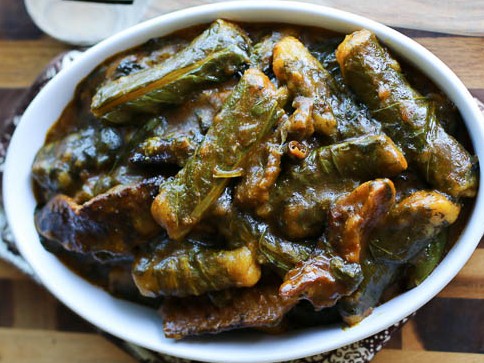
One of the Nigerian cocoyam dishes is Ekpang Nkwukwo, which is made with grated cocoyam, water yam, cocoyam leaves, and periwinkle. It’s a Nigerian dish from the states of Cross River and Akwa Ibom in the south-eastern part of the country.
Ekpang Nkwukwo is a one-of-a-kind dish that is only served on exceptional occasions.
Cocoyam is a starchy edible tuber with broad greenish leaves. It is grown in a variety of locations all over the world. We mainly eat the roots, tubers, or leaves, which are known as kontomire in the area.  Because the root and leaves are high in nutrients, they provide numerous health benefits to the body.

What Is Ekpang Nkwukwo?

Ekwang, also known as ekpang nkwukwo, is a traditional Nigerian cuisine from the Efiks and Ibibios tribes. It’s also popular in Cameroon, where it’s especially popular among the Bakweri tribe.

It’s carefully made with freshly grated cocoyam, wrapped in lush greens, and slowly simmered with various types of fresh or smoked meat, fish, crayfish, red oil, and other spices until cooked to perfection, depending on the cook’s desire.

How To Cook Ekpang Nkwukwo

It’s created with freshly grated cocoyam, wrapped in lush greens, and slowly simmered with various types of fresh or smoked meat, fish, crayfish, red oil, and other spices until cooked to perfection, depending on the cook’s desire.

There are many different types of cocoyam, but the red cocoyam is the best for this recipe. However, you can get fantastic results with white ones if you dry them off first. It’s best to buy it a few days ahead of time and allow it dry out before cleaning and using it.

Although cocoyam leaves or sweet bitter leaves are commonly used, you can use any fresh leafy greens you have on hand, such as collard greens, spinach, or even romaine lettuce, or a combination of them. What I use is determined by what I have on hand. Choose the ones that don’t have any holes or tears in them.

If you have a grater and are willing to use it, go ahead and do so. However, because most of us don’t have the time to grate the cocoyam, you can use a food processor to speed up the procedure. To keep the ekpang from turning mushy, keep stirring to a minimum.

Amongst other ingredients, fresh or smoked fish, pork, palm oil, crayfish, and seasoning are used.

Ekpang Nkwukwo

Prep Time 30 minutes
Cook Time 20 minutes
Servings 0

Ingredients
  

  • 500 g cocoyam
  • 250 g Water Yam Optional
  • Vegetables A big bunch of tender cocoyam leaves, Pumpkin leaves and Scent leaves (nchanwu, efirin)
  • Palm oil a generous quantity
  • A handful crayfish
  • 3 medium onions
  • 2 milk cups (300g shelled or 500g unshelled) Periwinkles
  • Assorted Beef & Offal
  • Dried Fish
  • Snail (Optional)
  • Pepper & Salt to taste
  • 2 stock cubes

Instructions
 

Before Preparation

  • Rinse and cook the beef, offals and dry fish with the seasoning till done.
  • Peel, wash and grate the cocoyam and water yam (if you will be using this).
  • Mix the two together and set aside.
  • Prepare the pot by rubbing a generous amount of red palm oil on the insides of the pot.
  • Rinse the tender cocoyam leaves and tear into medium pieces.
  • If using pumpkin leaves, wash these and set aside.
  • Blend the pepper and crayfish and set aside.
  • Wash the shelled or unshelled periwinkles.
  • Rinse and slice the scent leaves into tiny pieces.

Preparation Proper

  • If you will be using unshelled periwinkles, place these at the base of the well-oiled pot.
  • Scoop a small quantity of the grated cocoyam into a piece of the torn cocoyam leaf or one pumpkin leaf.
  • Wrap the cocoyam with the leaf and place in the pot.
  • Repeat this procedure till all the grated cocoyam (and water yam) is exhausted.
  • Add the pepper, crayfish, onions, shelled periwinkles and assorted beef.
  • Add hot water to the level of the pot contents and set to cook on medium heat for 20 minutes.
  • Now, add the scent leaves, a generous amount of palm oil and salt to taste.
  • Cook for more 5 minutes and the Ekpang Nkwukwo is done.
  • Leave to stand for 5 minutes and stir.
Tried this recipe?Let us know how it was!

Moi Moi/Moin Moin

Moi Moi (also Moin Moin) is a great dish accessory in Nigeria. It is a steamed bean pudding made from black-eyed peas, onions and a combination of freshly ground peppers.
It is a very nutritious and fairly versatile dish you can add some smoked fish, corned beef or boiled eggs to add to the flavour.
Moin moin remains one of my favourite beans dishes, I like it fluffy, light, hot and delicious. This recipe makes a delicious savoury moin moin.  I’m sure you will love it!

What is Moi Moi?

If you’re sitting there wondering what this is all about, Moi Moi, also pronounced as Moin Moin, Moyin Moyin, Moy Moy or Mai Mai is a traditional Nigerian food made with steamed ground beans and enriched with spices.

It is very common to see Moi Moi (Moin Moin) served at parties, wedding ceremonies and other festive occasions.

This delicious meal can be cooked in various ways. The most common method is cooking Moi Moi in bowls, Aluminium Foil Bags, Banana Leaves, Uma Leaves(Thaumatococcus Daniellii) or in heat-proof nylons.

Although moin moin is traditionally made with red oil, most people make it by cutting back on palm oil or completely omitting it in favor of fresh red pepper for its bright vibrant color and for other health reasons.

Moi Moi
Image Credit: Facebook

Ingredients for Moi Moi

  • Black-eyed Peas or Brown Beans
  • Red Bell pepper/tatashe Medium size
  • Habanero/Scotch Bonnet/Rodo
  • Diced onion
  • Crayfish
  • Vegetable Oil
  • Chicken bouillon Cubes
  • Fish – I like Mackerel or Salmon
  • Hard-boiled Eggs
  • Salt 

Notes On The Ingredients

  1. The tomato puree gives the Moi Moi its classic peachy colour. If you are in Nigeria, the best ingredient to use is tatashe pepper. I do not like the taste of red bell peppers in my Moi Moi hence I do not recommend it but you can try it and see if you like it.
  2. Nutmeg gives the Moi Moi its classic taste. If you’ve ever eaten Nigerian Moi Moi at a party and wondered why it tastes better than the ones you make, it is probably because you do not add nutmeg to your Moi Moi.
  3. 2 litres of water is the exact quantity of water that gives me the perfect texture of Moi Moi that I and my family love. Please note that this quantity includes the water used in blending the beans. If using bone marrow, the quantity of stock should be part of the 2 litres of liquid you will use in mixing the Moi Moi. If after using this quantity you are not happy with the texture, adjust the quantity of water accordingly.
  4. It is best to use cool or warm water when mixing Moi Moi. You do not want to use hot water for this purpose as it may cause the mix to be lumpy.
  5. Using the right amount of oil in your Moi Moi ensures that it has a good texture and rolls off the tongue when you eat it but feel free to use any amount of oil you want. And it is advisable to use tasteless and odorless oils in your Moi Moi so that rules out the olive oil.
Moi Moi Calories
Image Credit: Facebook

How To Make Moi Moi

Most people think the Nigerian Moin moin recipe is not an easy recipe because you have to mix everything together before the cooking starts. So if you get it all wrong from the beginning, it will surely affect the end result.

But practice makes perfect though. If this is your first time, just follow this Nigerian Moin moin recipe for a perfect result.

There are different ways in which it can be cooked, we can use banana leaves, foil cups and rubber cups. You can either use a steamer to steam the Moi moi, your oven or your cooking gas for the cooking.

But if you are a Moimoi lover and you cook this often, it’s advisable to invest in a steamer. A steamer does the job better, it doesn’t dry out the Moimoi but otherwise makes it softer and more fluffy.

Here is how to make in simple steps;

  1. Soak and peel the beans
  2. Blend with peppers and onions
  3. Season the batter
  4. Portion inside a heat safe container
  5. Steam

How To Prepare Moi Moi With Nylon

This method is one of the most popular of recent trending meals on earth. It is appreciated by millions every day. It’s easy, it’s quick, it tastes delicious. Moi Moi (Nylon bags Method) is something that I have loved my entire life. They are nice and they look wonderful.

Here is how to make it in simple steps; Soak and peel the beans, Add red peppers, scotch bonnet and onions. Blend all together. Heat the oil (you can either use palm oil, vegetable oil or both) and mix the seasonings in it. Now add to the mixture. You can also add extra salt to taste. Get your nylon bag and fill the mixture with it. Put the mixture into a pot, and pour medium water. Allow it to boil.

Tips For Making The Best Moin Moin

  • Save time by peeling your beans with a blender/food processor
  • Soak beans a day before so it is readily available to use on the day (keep refrigerated).
  • Moi moi batter is lighter than that of akara
  • I can’t stress this enough, always prep ahead in the kitchen so you have a stress free and fun cooking
  •  Prepare the nylon bag, if possible double it for durability. If you are using leaves, wash clean and set aside.

What To Serve With Moi Moi

There are also several different ways to serve up moin moin because it’s really versatile. It is usually eaten alone as a meal, but most times it is served with other Nigerian foods.

Moi-Moi Can Also be Served as a Side Dish to:

  1. Jollof Rice
  2. Fried Rice
  3. Fried Plantain
  4. Boiled white rice and stew and lots more

Moi-Moi Can be Served as Breakfast With:

  1. Custard
  2. Pap( Akamu ,Ogi)
  3. Bread
  4. Eko/Agidi
  5. Garri

If you like this recipe, you might also like:

Coconut Fried Rice

Best Efo Riro Recipe

Nigerian Chicken Suya Recipe

Thank you very much for your time, below is an easy to follow recipe. Enjoy! Let’s get cooking!

moi moinigeria

Moin Moin/Moi Moi

Moi Moi (also Moin Moin) is a great dish accessory in Nigeria. It is commonly seen accompanying Jollof Rice, Fried Rice, Fried Plantain, Custard, Akamu (Pap, Ogi) etc. It can even be eaten alone as a snack with a chilled soft drink to wash it down. Due to its popularity, Moi Moi is often served at parties, dinners and other special occasions.
Prep Time 30 minutes
Cook Time 1 hour
Total Time 1 hour 30 minutes
Course Breakfast, Dinner, Lunch
Cuisine African, Nigerian
Servings 5

Equipment

  • Cooker
  • Deep Pot
  • Chopping board
  • Blender
  • Knives

Ingredients
  

Containers For Moi-Moi

  • Aluminium foil
  • Plastic Bowls
  • Uma Leaves (Thaumatococcus Daniellii)
  • Jacket Moi-Moi

Ingredients

  • 3 cigar cups or 750g Beans (Brown/Black eyed)
  • 5 tablespoons ground crayfish
  • 4 big stock cubes
  • 1 habanero pepper
  • 2 teaspoons ground nutmeg
  • 3 tatashe peppers or 800g watery tomato puree (sold outside Nigeria)
  • 2 big onions
  • 20cl vegetable oil
  • 2 litres of cool or warm water
  • Salt (to taste)

Moi-Moi Accessories: Add any of the following to the Moi Moi

  • Hard boiled eggs: Cut the eggs into small pieces.
  • Bone Marrow: Cook the bone marrow with spices and herbs till done then add to the Moi Moi at the mixing stage.
  • Corned beef: separate into small chunks and add to the moi moi during mixing. You can also add to the moi moi after dishing then into cooking bowls or foil bags.

Instructions
 

Before Preparation

  • About three hours before cooking the moi moi, soak and wash the beans to remove the coat remove the coat. When the entire coat has been removed, place the beans in a bowl and pour enough water to cover it. Leave to soak for three hours. This is so that the best consistency will be achieved when you blend the beans.
  • It is advisable to use one of eggs, bone marrow or corned beef, not the three at the same time. If you will use eggs, cook till hard boiled, cut into small pieces and set aside. If you prefer bone marrow, cook it with salt and Maggi / Knorr cubes and set aside the stock. If it is corned beef you will go for, open the can and separate the beef into small lumps.
  • Now go ahead and prepare the moi moi containers.

Next Step...

  • Wash the tatashe pepper (if using it). Ensure you remove the tatashe seeds as they have a tendency to give meals a bitter taste.
  • Cut the onions into pieces, grind the crayfish with a dry mill. If using the heavy duty grinder in Nigerian markets, these won't be necessary.
  • Crush the stock cubes and set aside. Wash the habanero/scotch bonnet peppers and set aside.
  • Now that the beans is soaked (the bean seed is tender when you pinch it), it is time to blend it. It is very important that you use a very good blender for this purpose. The taste and feel of your Moi Moi depends so much on the consistency of the blend. If in doubt, put a small quantity of bean seeds in your home blender and grind to the best of its ability using as small quantity of water as possible. Feel the resulting paste with your fingers and if you notice any tiny pieces at all, then the blender is not good for Moi Moi. At this time, you may consider using the commercial heavy duty mills at your local market if you are in Nigeria. Yes, you have your health and hygiene concerns but most of the mill operators actually keep their mills clean. And they let you bring your own water and containers. So there you go!

Directions

  • Blend the beans, tatashe or tomato puree, onions, crayfish, habanero pepper and ground nutmeg together with some of the water and pour the mix into a big enough bowl.
  • Add the vegetable oil and the bone marrow stock (if this is what you have chosen to add to your moi moi). Slowly add the remaining water and stir the mixture at the same time till you get a good mix of all the ingredients.
  • Add salt to taste and stir very well.
  • Pad the base of a big pot, pour some water and set on the stove. The depth of the water should be at most 1 inch.
  • Dish the Moi moi mix into containers of your choice, add egg/bone marrow/corned beef to each container, seal/cover and set them in the pot.
  • Add as small quantity of water as possible at a time while cooking the Moi Moi as detailed in preparation and use of moi moi containers so that the moi moi will not become watery when done. This is the case especially when using aluminium foil or uma leaves.
  • The length of time you will cook your Moi Moi depends on the quantity and the Moi Moi container you used.
  • The Moi Moi that gets done quickest is the one wrapped in Uma or Banana leaves, followed by Moi Moi wrapped in aluminum foils then the one that takes the most time is Moi Moi cooked in aluminium or plastic plates.
  • But whatever Moi Moi container you use, it is advisable to cook your Moi Moi for at least 1 hour, before checking it. Confirm that it is done by putting a knife through it, if the knife is stained with Moi Moi paste, then the Moi Moi is not done, but if the knife just has a slight smear of Moi Moi, then it's done. Also, when you cut through the Moi Moi, the insides will be set and not watery.
  • If you are cooking a few wraps of Moi Moi in a small pot on high heat, then it will only take about 45 minutes to get done while when you are cooking a large pot of Moi Moi, it will definitely take more than one hour.

Notes

Notes on The Ingredients

  1. The tomato puree gives the Moi Moi its classic peachy colour. If you are in Nigeria, the best ingredient to use is tatashe pepper. I do not like the taste of red bell peppers in my Moi Moi hence I do not recommend it but you can try it and see if you like it.
  2. Nutmeg gives the Moi Moi its classic taste. If you've ever eaten Nigerian Moi Moi at a party and wondered why it tastes better than the ones you make, it is probably because you do not add nutmeg to your Moi Moi.
  3. 2 litres of water is the exact quantity of water that gives me the perfect texture of Moi Moi that I and my family love. Please note that this quantity includes the water used in blending the beans. If using bone marrow, the quantity of stock should be part of the 2 litres of liquid you will use in mixing the Moi Moi. If after using this quantity you are not happy with the texture, adjust the quantity of water accordingly.
  4. It is best to use cool or warm water when mixing Moi Moi. You do not want to use hot water for this purpose as it may cause the mix to be lumpy.
  5. Using the right amount of oil in your Moi Moi ensures that it has a good texture and rolls off the tongue when you eat it but feel free to use any amount of oil you want. And it is advisable to use tasteless and odourless oils in your Moi Moi so that rules out the olive oil.
Keyword Moi Moi
Tried this recipe?Let us know how it was!

African Salad (Abacha and Ugba)

African salad (Abacha food) is a delicious west African food that is native to the Ndi Igbo (people of Igbo), the native taste is so distinctive making it palatable to be enjoyed by all tribes in Nigeria.

Whenever there is a wedding in any Igbo land, African salad is usually reserved for the special guest. It is mostly served with Palm wine, a local Nigerian drink, but you can also enjoy it with any chilled drink.

Abacha Food

Abacha is cassava that has been dried and shredded. It is made by cooking cassava tubers which is chopped with a special grater. Once they are done, the cassava slices are then soaked in cold water overnight, carefully rinsed, and dried in the sun.

It’s important to emphasize that this is not the main meal. Even though it can be as satisfying as any other main course meal, African Salad is typically consumed as a snack.

How To Make Abacha

The process of preparing this dish is a relatively easy one. You can follow the steps below, just make sure all of the ingredients are thoroughly combined. There’s a lot of adding this, stir this, stir that, as you’ll see below.

You might question why you can’t just add everything and mix, but doing so will make getting a nice blend of all the ingredients very difficult.
Ugba, a fermented African oil bean seed is an essential component of any African salad. Oil bean seeds are used to make Ugba, also known as Ukpaka. These seeds are boiled for many hours before being sliced, rinsed, and fermented.
Please keep in mind that Abacha and Ugba are neither a stovetop nor an oven-cooked dishes, so don’t try them.

What To Serve With Abacha

It can be served over;

  • Chilled palm wine ( for a more satisfying effect).
  • Soft drinks.
  • Beer won’t be a bad idea.

Find out how to make traditional Abacha with this easy-to-follow guide below for preparing this popular African salad just the way you like it.

African Salad (Abacha and Ugba)

Prep Time 15 minutes
Cook Time 5 minutes
Servings 0

Ingredients
  

  • 3 handfuls Abacha
  • 2 cups ugba (ukpaka)
  • 30 cl red palm oil
  • 2 tbsps powdered potash (food tenderizer)
  • Fish | Mackerel/Dry Fish/Stockfish
  • 1 large Onion
  • Salt and dry pepper (to taste)
  • 4 tbsps ground crayfish
  • 2 stock cubes (Maggi/Knorr)
  • 1 tsp ground Ehu seeds  (Calabash Nutmeg)

Other Seasoning You Can Add

  • 1 tsp Ogiri / Iru (traditional Nigerian spice)

Meat and Vegetables For Abacha

  • 3 fresh Utazi leaves (Gongronema latifolium)
  • Ponmo / Kanda  (cow skin)
  • Garden Eggs | As much as you can eat
  • 1 medium bunch Garden Egg leaves
  • 1 medium onion (for serving)

Instructions
 

Before Preparation

  • Prepare the seeds by roasting, peeling, and grinding them with a dry mill.
  • If you will use Kanda (cow skin), cook, till done and cut into small pieces.
  • Depending on your choice of fish (you can also use all of them), fry or roast the mackerel, soak the stockfish in water, and debone the dry fish.
  • Wash and cut the vegetables into tiny pieces. Cut the big bulb of onion into tiny pieces and cut the medium one in circles.
  • Wash the garden eggs and set them aside, no need to cut these.
  • Grind the crayfish and pepper
  • Soak the Abacha in cold water and rinse the Ugba with lukewarm water.
  • Once the Abacha has softened, put it in a sieve to drain.
  • Put the powdered potash in a cup or bowl and pour about 1 cup of cold water.
  • Stir well and you are ready to start making the African Salad.

Directions

  • Pour the palm oil into a sizeable pot.
  • Yes, you need all that oil so that your Abacha will not have a dry feel in the mouth when done.
  • Pour the water from the potash mixture, making sure not to pour the sediments.
  • Stir very well and you'll see the oil turn into a yellow paste.
  • Add the ground pepper, ground Thu, crushed stock cubes, crayfish, diced onions, and ugba (ukpaka), then stir very well.
  • Please note that we are doing everything off the stove.
  • Add the iru/ogiri and make sure it is mixed very well.
  • Add the diced Kanda/pomo and stir very well.
  • Now add the soaked and drained Abacha and stir till it is well incorporated in the palm oil paste.
  • Add the sliced Utazi and salt to taste and stir well.
  • You can also use dry Utazi if the fresh one is not available where you live.
  • You must add salt last because after adding all that seasoning, your Abacha may not even need salt anymore.
  • I like my Abacha warm. If you like yours that way too, transfer to a stove at this point and heat it to your desired temperature at medium heat.
  • When done, turn off the heat and add the sliced garden egg leaves, stir very well and serve
  • If you like your Abacha cold, after step 6, add the sliced garden egg leaves, stir and serve with garden eggs, fish and onions.
Tried this recipe?Let us know how it was!

Red-Red Stew

Red-red stew is a popular dish in Ghana, and it is normally made vegetarian. This slow-cooked black-eyed peas stew is the ultimate belly warmer to keep you toasty and full. The dish is enjoyed widely throughout Ghana.

Read on and follow our handy preparation guide to learn how to make your own red red recipe. This delicious traditional Ghanaian beans stew recipe is easy to make.

What is Red Red Made Of?

Red-red is a Ghanaian dish composed of black-eyed peas, cooked in palm oil/vegetable oil. The dish derives its name from the red color it takes on from the red palm oil (zomi) that they use to prepare the stew, and in most places, it will also be prepared with tomato paste. It is most common to find it with black-eyed beans, but any beans will do.

Where Does Red-Red Stew Come From?

Ghana! Red red is a traditional Ghanaian dish made with West African beans, palm oil and tomatoes. A hearty and wholesome stew perfect for all the family.

How Do You Serve Red Red?

Red-Red Stew Can be Served Over:

  1. Fried Plantain
  2. Rice
  3. If you want to serve this as part of a larger West African meal, try it alongside my version of Senegalese mafe, which is a shank (lamb, deer, elk, veal, etc.)
  4. You can also serve with chilled soft drink.

Can’t find or don’t like Black eyed peas? No worries, you could make these with black, red or any other types of beans. Don’t forget to adjust cooking times and flavors. Enjoy!!!


Red Red (Ghanaian Beans Stew)

This is a wonderful dish of beans with tomatoes and a touch of chile and curry.
Prep Time 30 minutes
Cook Time 1 hour 30 minutes
Total Time 2 hours
Course Main Dish
Cuisine African, Ghanaian
Servings 0

Ingredients
  

Ingredients

  • 4 -4.5 ounce canned beans or 1 pound dried beans
  • 1/2 – ¾ cup palm oil or Canola oil
  • 1 medium Onions
  • 1 Tablespoon ginger
  • ½ tablespoon garlic
  • 2 Tomatoes
  • 2 Tablespoons tomato paste
  • 1 Tablespoon paprika
  • 1/3 cup crayfish optional
  • 2 cups – 3 cups stock/ water
  • 1-tablespoon bouillon powder vegetarian, chicken (optional)
  • 2-3 green onions chopped
  • Salt and pepper as needed
  • 1 habanero pepper or sub with hot pepper or sauce (optional)

Instructions
 

Directions

  • Rinse dry black-eyed pea beans and pick through and discard any foreign object. (I did not have to do this because I used the package beans,). Add beans to a large pot covering with 3-4 inches of cold water.
  • Cover and let sit overnight or 6 to 8 hours.
  • Drain the soaked beans, rinse, and place the beans in a Dutch oven or pressure cooker. Follow instructions for cooking beans in your pressure cooker. It takes roughly between 8 to 12 minutes to cook. If not using a pressure cook, cook the beans for about 50- 60 mins or until tender.
  • Drain the cooked beans and set aside
  • If using canned beans you should start from here.
  • Heat oil (palm and canola) in large saucepan over medium heat until hot. Sauté the onions in the oil for 3-4 minutes, stirring often and scraping any browned bits off the bottom of the pot.
  • Add tomatoes, tomatoes  paste , ginger, garlic, paprika and bouillon powder/ cubes. Cook while stirring for about 60 seconds.
  • Through in the Cray fish and let it simmer, for about 10-15 minutes, add water/ stock if needed to prevent burns. Continue to cook the sauce, stirring occasionally.
  • Finally add the beans, green onions and the remaining stock/water and bring to a boil and simmer for another 10-15 minutes.
  • Adjust for seasonings, and beans consistency with water and serve.
Tried this recipe?Let us know how it was!

Light Soup

Light soup is a very fast soup that can be made with readily available supplies. It’s often cooked in high heat. The soup is very nutritious and healthy as it is made from natural products (vegetables and natural spices).

This recipe is going to teach you how to make light soup the Ghanaian way.

Where Does Light Soup Come From?

Ghana! It is a traditional Ghanaian soup made by the GaDangme(or Ga) people of the Greater Accra Region.

Originally formulated as a ‘Tomatoes-Base Sea Fish Light Soup’ called ‘Aklo(or Aklor)’ for fishermen off the coast of Accra, but over time it evolved into a soup made with both fish and goat-meat, or fish and lamb-meat, or exclusively the meat of the livestock of choice.

Fufu and Light Soup

Fufu and Light soup is a spicy tomato-based soup. A hot bowl of light soup brings the best relief when you have a cold/ flu. The perfect dinner for a cold night and a comforting soup that will warm you up from the inside out.

Preparing the soup with Fufu as lunch on a weekend in Ghana is what a roast is to an English man on a Sunday. This healthy traditional soup can be made with beef, goat meat, pork, chicken, lamb, or mutton.

The soup is made by steaming fish or meat in a saucepan with herbs, onion, garlic, and ginger. After that, tomato paste is added. Boiling chili peppers, garden eggs, and tomatoes are mixed before being added to the saucepan. The soup is thinned with water until it reaches the desired consistency.

More onions and tomatoes are added, then blended, and the soup is left to simmer. It is then served with dishes like fufu, banku, or konkonte.

Ghanaian Fufu Facts:

Fufu is a local Ghanaian dish made from cassava and unripe plantain. It is traditionally eaten by hand instead of cutleries. Most often (others prefer cocoyam to plantain while others use yam instead of cassava).

In principle, it is the sauce/soup that gives the Fufu dish its unique identity. However, in Ghana, the common Fufu dishes are Fufu with Light Soup, Fufu with Groundnut Soup, and Fufu with Palm Nut Soup. For the step by step Fufu Recipe Click Here 

How To Prepare Light Soup

Ghanaian light soup is a hot and  spicy tomato based soup. There are different variations of the soup, it can be made with fish beef chicken or mushrooms. Traditionally, it is usually eaten with fufu, plain rice, omo tuo (rice balls) amongst others, but it’s also delicious on its own. Besides, this soup is very soothing when you have a cold.

Hint: There are many variations of this recipe: you can cook some eggplant or zucchini in a saucepan, then blend and add it near the end for a thicker soup; or you can add many other vegetables like okra or mushrooms, or other herbs or seasonings.

Here’s the recipe for light soup prepared the Ghanaian way. Happy Eating!

Light Soup

Light soup is a popular Ghanaian soup that goes along with several main meals. Learn how to prepare light soup
Prep Time 20 minutes
Cook Time 30 minutes
Total Time 50 minutes
Course Soup
Cuisine Ghanaian
Servings 3
Calories 355.6 kcal

Ingredients
  

INGREDIENTS

  • 4 pieces tomato
  • tomato paste
  • pepper powder
  • pepper
  • spices (garlic, ginger, seasoning)
  • okra
  • garden eggs
  • dry fish
  • cow meat
  • chicken
  • salt
  • water

Instructions
 

INSTRUCTIONS

  • Wash and clean your fish and meat thoroughly in a bowl of water. Remove bones if any
  • Wash pepper garlic, onion and ginger and blend together.
  • Season with garlic, ginger, pepper and onion mixture. Add a moderate amount of salt to taste.
  • Marinate for about 30 minutes.
  • Steam under medium heat for about 8 minutes. Take out the fish from the stock to prevent it from dissolving.
  • Peel and wash onions, tomatoes and peppers. Add to the stock and add fill 2/3 of the cooking pot or saucepan with water.
  • Boil under medium heat until the vegetables (onion, pepper and tomatoes) are soft.
  • Remove the vegetables, blend until smooth and pout it back into the saucepan.
  • Add a desirable amount of water.
  • Add the fish and little amount of salt to taste. Simmer over medium heat for about 10 minutes.
  • Your light soup is ready

Nutrition

Calories: 355.6kcal
Keyword light soup, Soup
Tried this recipe?Let us know how it was!
ligt
LIGHT-SOUP AFRICAN FOOD NETWORK


Nkwobi (Spicy Cow Foot)

0
Nkwobi is a spicy Nigerian dish made from cow feet. It is a popular eat-out meal usually ordered and enjoyed in exclusive restaurants and beer parlors that appears sophisticated but is very simple to cook with common components.
Get ready to learn how to prepare nkwobi, which is enjoyed by many around Nigeria, from the comfort of your own home.

About Nkwobi Recipe 

The majority of people I know confuse Nkwobi with Isi Ewu. However, they aren’t nearly the same. Yes, these are both Igbo recipes, but they have completely distinct meanings (from different animals in fact).

The former refers to a cow’s foot, whereas the latter refers to a goat’s head. So, if you’re looking up “How to cook Nkwobi Isi Ewu with Goat Head” on Google, please stop. You’ve learned your lesson.

This recipe is commonly refers to as cow foot pepper soup or cow leg stew, hence it is very rich and mouth watery if prepared well and it serve well during a cold weather.

How To Prepare Nkwobi

To make a tasty nkwobi, you need to have these basic ingredients such as cow foot or cow leg, ugba (ukpaka (oil bean), ehuru seeds (calabash nutmegs),edible potash (kauwu), utazi leaves(Gongronema latifolium) at home before embarking on your nkwobi journey.
Additionally, any kind of meat could be used to make this recipe; these include goat meat, cow tail, chicken, turkey. However, different kinds of bush meats could also be used to make this recipe, which include grass-cutter, rabbit and even squirrel depending on your preference.

Tips For Preparing Nkwobi

  • Cow foot comes with a thick bone, you can tell the butcher to help you remove the thick bone and scrape out excess hair and dirt from the meat, then cut into medium sizes before taking it home.
  • Cow foot is tougher than the usual meat you are used to, a pressure cooker can help you cook the meat in no time, to save time and your gas, but you can use charcoal fire to prepare this if you dont have a pressure cooker.
  • Edible potash, which is also called kanwa in Hausa,is a very special ingredient in nkwobi sauce, it is what helps to curdle and change the colour of palm oil and it helps to thicken the palm oil for a perfect coating of the meat.
  • If you add too much edible potash liquid to the sauce, it could change the taste of your nkwobi and alsoprevent the bitter taste of the utazi; use just a little portion of it to complement the taste.
  • Ehuru seed or calabash nutmeg is an important spice in this recipe; it adds some kind of earthen flavour to the dish. This should not be replaced with the normal nutmeg. The outer covering is tough and the easy way to peel them is by roasting them in a dry pan or in open flame for 3 minutes before cracking them with your teeth.
  • You will also need some greenish vegetables like utazi leaf to garnish your nkwobi. Utazi leaf has a very bitter taste, but you need to used it sparingly, you just need a little of it to complement the taste of your meal. If you cant tolerate its bitter taste, you can substitute it with Uziza leaf, but its not bad if you use it.
  • Your Nkwobi is delicious with or without Ugba, Ugba which is known as oil beans, contributes to the awesome flavour of nkwobi dish.
  • If you love spicy food then you are in the right company. But if you don’t, you can reduce the pepper to your taste

Nkwobi Can Be Best Served With:

  1. Chilled drinks
  2. Palm wine
  3. Beer or Stout &
  4. Soft drinks

Now that we’ve gotten all that out of the way, it’s time to show you exact steps in the recipe and Ingredients for how to prepare Nkwobi. Enjoy!

Nkwobi – Spicy Cow Foot Recipe

Nkwobi is a Nigerian delicacy that is usually ordered and enjoyed in exclusive restaurants. It is simply cooked cow foot mixed in spicy palm oil paste. Nkwobi is often mistaken for Isi Ewu but they are not the same.
Prep Time 25 minutes
Cook Time 30 minutes
Total Time 55 minutes
Servings 2

Ingredients
  

  • 2kg (4.4 lbs) cow foot (cut into sizeable pieces)
  • 20cl (200ml) Palm Oil
  • 1 tablespoon powdered edible potash (Akanwu/Kaun/Keun)
  • 1 teaspoon ground Ehu seeds (Calabash Nutmeg)
  • 2 tablespoons ground crayfish
  • 2 habanero peppers(or to your taste)
  • 1 medium onion
  • 2 big stock cubes
  • Salt (to taste)

To Garnish

  • 1 medium onion
  • 10 Utazi leaves (Gongronema latifolium)

Instructions
 

Before Preparation

  • Cut the cow foot into medium chunks.
  • Put the powdered potash into a bowl.
  • Add a small quantity of water (about 4 table spoons) and stir well.
  • Pass it through a fine sieve and set the liquid aside.
  • Cut 1 onion into 4 big chunks.
  • Pound the pepper with a mortar and pestle or blitz it.
  • Grind the crayfish.
  • Crack and remove the outer shell of the ehu then grind with a dry mill eg coffee grinder.

Instructions

  • Wash and put the cow foot chunks in a pot.
  • Add the stock cubes (crushed) and the chunks of onion.
  • Add a small quantity of water and start cooking at medium heat till well cooked.
  • Add just enough water to prevent burning as you cook. There should not be any stock (water) in the pot when the meat is done.
  • While the meat is cooking, pour the palm oil into a clean dry pot.
  • Pour in the potash mixture (sieved) into the oil.
  • Stir with a wooden spatula as you pour the potash. You'll notice the palm oil begin to curdle and turn yellow.
  • Keep stirring till all the oil has turned yellow.
  • Add the ground crayfish, pepper and ehu seeds.
  • Stir very well till they are all incorporated.
  • When the meat is done, add salt.stir and cook till all the water has dried.
  • Add the well done cow foot to the palm oil paste and stir very well with the wooden spatula.
  • Put it back on the stove/cooker and heat till the Nkwobi is piping hot, stirring all the time to make sure it does not burn.
  • To prepare the garnish, cut the onions into rings and cut the utazi into long thin slices.
  • Serve the Nkwobi in a wooden mortar.
  • Add the thin slices of utazi and onion rings on top for the full effects.

Notes

Notes For The Ingredients

  1. The 2kg of cow foot may sound like a lot but remember that cow foot is mostly bones so 2 people that love Nkwobi can finish that in no time.
  2. Cow foot is quite tough so if you have a pressure cooker, do use it for cooking it to save time and gas/electricity. You may be able to buy calf foot which is softer and cooks in less time.
  3. Ehu (Calabash Nutmeg) is a very traditional ingredient that is difficult to find outide Nigeria. If you can't buy it where you live, just prepare the Nkwobi without it. Ordinary nutmeg is not an alternative to this because they are not similar in any way. If you have friends or family in Nigeria, they will be able to buy ehu seeds and send to you, a small quantity goes a long way.
  4. Potash is what makes the palm oil curdle as you will see in the video below. An alternative I know is what we call Ngu in Igbo. Ngu is even more traditional than potash so if you can't find potash, chances are that you won't be able to get Ngu either.
  5. Utazi adds a nice bitter flavour to the Nkwobi. if you can't buy it where you live, use spinach (bold ones), it gives the same effect and actually tastes nice!
 
Tried this recipe?Let us know how it was!

Efo Riro

Efo riro (Nigerian Spinach Stew) is a mouthwatering, savory, African stew made with spinach and is oh so flavorful!
This is the best efo riro recipe you can find anywhere on the internet. If you are looking for how to make efo riro, look no further, you are at the right place. It is delicious and quick and it qualifies as low carb Nigerian food as it can be eaten on its own. 

What is Efo Riro?

It is a Yoruba word and it loosely means ‘stirred spinach’. Riro means “to mix” – so efo riro translates to a “mixed spinach” (sounds like every vegan’s dream, I know). In Nigeria, the vegetables used for this soup are ‘Efo Shoko’ (Lagos spinach) or ‘Efo Tete’ (African spinach).

These are the local spinach varieties that are very popular and easily available. In other parts of the world, any spinach greens will do.

This African stew is popular in some West African countries like Nigeria, Ghana, and Cameroon. The recipes are similar with only slight differences but my version is commonly made in Nigeria among the Yoruba tribe.

How To Cook Efo Riro

I remember vividly how my mother makes efo riro back then, it is not the number of ingredients that goes into it but how you cook it. It is also called efo elemi meje, as it can be cooked with any choice of protein. You can also cook it with the core ingredients available to you. The base is made with red bell peppers, habanero peppers, onions, and tomatoes, so I occasionally just use the African pepper sauce that I make in batches instead.

This recipe is an adaptation of the smoky spinach Stew. Built on a base of onions and ginger sautéed in palm oil, made fiery with habanero, and thickened with ground pumpkin seeds and tomatoes, the stew calls for African smoked, dried shrimp powder; its flavor is amazing. (Asian versions are typically unsmoked and chewier.) But smoked paprika and fish sauce make a serviceable substitute.

If you want to make efo riro the Yoruba way, you must use locust beans, smoked fish/dried fish, and palm oil. Every other thing you decide to add after the core ingredients just complements it. Also, you need coarsely blended pepper to make the vegetable soup.

Tips When Making Efo Riro

  • Only add the stock/water if using fresh spinach.
  • You can leave the spinach in for about 5 mins more on low heat if you want it softer and less chewy.
  • If you want the spinach stew to be less spicy, use only 1 tsp or 1/2 tsp of cayenne pepper.
  • I made my efo riro with goat meat and mushrooms. Even though efo riro does not traditionally use mushrooms, I wanted to show just how versatile this stew is and how it can be made vegan.

What To Eat With Efo Riro

  1. Rice
  2. Plantain
  3. Yam
  4. Pounded Yam

FAQS

Is Efo Riro Good For Weight Loss?

Yes, it is. Efo riro makes it a great choice as a Nigerian food for weight loss.

Can I Use Vegetable Oil?

If you can’t find palm oil where you live or you don’t use it for personal reasons, then yes, you can use it.

Is Locust Beans Compulsory in this Recipe?

Yes, it is but if for any reason you can’t source one, then omit it from the list of ingredients. Ensure the stew (base) is well fried and you should still achieve a delicious vegetable soup.


If you made this recipe, don’t forget to leave me feedback.

Efo Riro

This is the best efo riro recipe you can find anywhere on the internet. If you are looking for how to make efo riro, look no further, you are at the right place. 
Prep Time 20 minutes
Cook Time 30 minutes
Total Time 50 minutes
Course Side Dish
Cuisine African, Nigerian
Servings 0

Ingredients
  

Ingredients

  • ½ cup palm oil or vegetable oil
  • 1 medium red onion chopped
  • 4 cloves garlic minced
  • 3 tbsp minced ginger
  • 1 ounce habanero chile, seeds and ribs removed, minced (include seeds if you love heat)
  • tablespoon tomato paste
  • salt(to taste)
  • 1 tbsp tomato paste
  • 2 ½ pounds plum tomatoes, chopped
  • ¾ cup egusi or raw shelled pumpkin seeds
  • 4 teaspoons African smoked dried shrimp powder (or 2 1/2 teaspoons smoked paprika plus some fish sauce)
  • 1 pound spinach, washed, dried and roughly chopped
  • 3 large sweet (yellow) plantains, peeled and boiled in salted water until just tender

Instructions
 

Directions

  • In a Dutch oven, warm the palm oil over medium heat, and add the onions, garlic, ginger, chile and a couple pinches of salt.
  • Cook, stirring frequently, until the onions are golden brown and sweet, about 15 minutes.
  • Stir in the tomato paste, and cook for 3 minutes.
  • Add the tomatoes and a few generous pinches of salt. Bring to a boil, lower heat to a simmer and partly cover the pan.
  • Simmer, stirring occasionally, until the sauce has cooked to a rich tomato-soup consistency, about 25 minutes.
  • Meanwhile, pulse the egusi or pumpkin seeds in a food processor or blender to a fine powder, until it just starts to get clumpy. (Do not overprocess into a butter.) Remove to a bowl.
  • When the tomatoes have reduced, add the shrimp powder (or smoked paprika and fish sauce to taste), and simmer 2 minutes.
  • Stir in water, a tablespoon at a time, to the bowl of egusi powder until it is a loose paste. Add the egusi paste on top of the tomato sauce, and spread it out.Cover the pan, and cook 5 minutes.
  • Stir the sauce all together; it will look like a thick porridge.Add a few splashes of water, and increase heat to a boil.
  • Stir in the spinach, until wilted and tender.
  • Taste, season with salt (or more fish sauce, if using) and serve with boiled sweet plantains.
Keyword Efo Riro
Tried this recipe?Let us know how it was!

Okro Soup

Okro soup is made with okra vegetables cooked in a delicious mixture of palm oil, shrimps, goat meat, fish, and African spices and simmered to perfection!
If you are looking to learn how to cook okra soup, stay with me as my okro recipes are foolproof, quick, and delicious.

Where Did Okro Soup Originate From?

It originated from Southern Ethiopia. Related to cotton and other mallow family plants, okra is an ancient vegetable that originated in southern Ethiopia in far antiquity.
It provides thickness and savors in the one-pot stews that are the basis of many traditional African diets.

Okro Soup (Nigerian Okra Soup)

Okra Soup is one of the quickest and easiest Nigerian soups to prepare. Some argue that a lot of work goes into the cutting of the two vegetables used in preparing this recipe. Yes but once the vegetables are ready; it cooks in no time at all. This soup is known as Miyan Kubewa in Hausa.

Is Nigerian Okra Soup Healthy?

It’s rich in magnesium, folate, fiber, antioxidants, and vitamin C, K1, and A. Okra may benefit pregnant women, heart health, and blood sugar control. It may even have anti-cancer properties.

Does Okra Increase Fertility?

Okra water causes multiple eggs to be released during ovulation and increases the female’s chances of having twins or triplets. Some scientists have also suggested that apart from okra water, okra leaves also boost ovulation and fertility.

Does Okra Make You Gain Weight?

Additionally, okra is low in calories and carbs and contains some protein and fiber. Many fruits and vegetables lack protein, which makes okra somewhat unique. Eating enough protein is associated with benefits for weight management, blood sugar control, bone structure, and muscle mass ( 4, 5 ).

How To Cook Okro Soup

This soup is made with okra vegetables cooked in a delicious mixture of palm oil, shrimps, goat meat, fish, and African spices and simmered to perfection! This loaded okro soup is a staple in West Africa, including Nigeria, Ghana, and Cameroon.

Do I Need Potash to Make Okra Soup?

These days you necessarily don’t need potash (Kaun) to make okra soup draw. Some people are anti-potash in food. I sometimes blend my okra on a pulse for a coarse texture to make plain okra and it always turns out well without the need for potash.

Each time I make ila alasepo, I use potash maybe because my mum always says you must add potash to make it draw.

Well, either way, the use of potash works well for me but it also has to be used in moderation or it will kill the elasticity of the okra. Long story short, don’t use potash for this soup if you are not confident.

Tips & Variations

  • For a vegan option, you can substitute with mushrooms.
  • Be careful not to overcook it, or the okra might begin to turn brown.
  • You can add some habanero pepper for more heat.
  • If the okra soup is too thick, you can add a little water to dilute it.

Best Serves For Okro Soup

This soup can be served With:

  1. Eba (Garri)
  2. Cassava Fufu
  3. Semolina
  4. Amala
  5. Pounded Yam

Do you love cooking or do you know anyone who does? please share this post with them.

Some suggestions include links to Amazon affiliated with “Nutribullet Personal Blender for Shakes, Smoothies, Food Prep, and Frozen Blending”.

nutribullet Personal Blender for Shakes Smoothies Food Prep and Frozen Blending

Project Overview Docs Banner in Light Green Blue Vibrant Professional Style 1


Nigerian Okra Soup

Servings 0

Ingredients
  

Ingredients

  • 800g fresh Okro chopped
  • 200g beef washed
  • 800g Assorted beef & dried cod, washed and cut to small pieces (I used ponmo, shaki and panla)
  • Smoked fish
  • 2 Seasoning (I used Knorr beef cubes)
  • 2 tbsp Locust bean (iru)
  • Cayenne pepper (use according to your preference)
  • 2-3 tbsp palm oil (optional but I prefer it as it adds a bit of colour to the okra)
  • Salt
  • A tiny bit of Potash (Kaun)
  • 1 small onion
  • Water/ stock (1.5 to 2 cups)
  • 1 tbsp 1 tbsp Ground crayfish
  • â…“ cup Ukazi leaves (optional)
  • Ginger and garlic (optional)

Instructions
 

  • Chop okra and set aside
  • Place a pan on medium heat and add beef, assorted beef and dried cod, salt, seasoning, onion, ginger, garlic and little water (adjust salt and seasoning to your taste) bring all to boil until tender. You can use a pressure cooker for this as it is quicker.
  • Once beef and fish are tender as desired, separate the stock from it and sieve to achieve a clean stock. (Skip this step if you are ok with the bit and bob from stock)
  • Place a clean pan on medium heat then add the stock about (1.5 cups) the beef, assorted beef and dried fish and bring to boil for about 3-5 minutes, add potash then the chopped okro. Stir till all is well combined and cook for another minute
  • Add crayfish and cayenne pepper. Stir till well combined, add palm oil, stir and cook for about 2 minutes
  • Add seasoning and salt (adjust salt and seasoning to own taste especially if you are using stock) add ukazi leaves (if using) stir and add smoked mackerel then cook for another 2-3 minutes.
  • Plate up your Nigerian okro soup and accompany with your swallow of choice.
Tried this recipe?Let us know how it was!

Ewedu Soup

Ewedu soup is indigenous to the people of Yoruba, a very popular Nigerian ethnic group. If you are living outside Nigerian you might wanna start looking up easy-to-make Nigerian foods, I doubt you would find all the ingredients for preparing ewedu in your location, except of course you know where to look.

It is loved by the Yorubas and also by some other tribe that can lay their hands on it. To full surprise, most Foreigners that visit Nigeria often always love requesting the recipe.

What Is Ewedu Soup?

Ewedu soup is a savory soup commonly eaten by the Yoruba tribe in Nigeria. It is made using Jute leaves, a highly nutritious leafy green plant eaten in countries all around the world.

Ewedu has a mucilaginous (somewhat slimy) texture when cooked, similar to Egyptian molokhia or okra soup, making it a perfect dish to go with fufu.

Is Ewedu a Spinach?

Ewedu is also known as jute mallow/Egyptian spinach is an unsung hero in our kitchen. Ewedu is packed with nutrients our bodies can’t produce. It is also called “Ahingbara” by the Igbos and “Rama” in the Hausa language.

How Do You Preserve Ewedu Leaves?

Storing Ewedu Leaves is pretty simple. Remove the leaves from their stem, rinse and wrap in a kitchen towel. Keep in an airtight bag then store in your fridge; Never put it in the freezer, as this will reduce the potency of your ewedu. You are welcome!

What Are Benefits of Ewedu Leaves?

It contains vitamins that are very important as an antioxidant. Essential fatty acids in Ewedu can keep skin moist.
In the same way, it prevents the loss of water through the skin, thus reducing the wrinkles that are the main cause of aging.

Can a Pregnant Woman Eat Ewedu Soup?

It has been observed especially among the Yoruba-speaking community of Nigeria that pregnant women who eat ewedu soup made from ewedu leaves frequently experience quick, smooth, almost painless delivery. It is also good for prevention from 6 months of pregnancy.

Is Ewedu Good For Diabetics?

Vegetables are good sources of vitamins, minerals, and antioxidants. Eating more of this type of soup will help to effectively manage a diabetic condition. Among the vegetable soups that a diabetic patient can eat are water leave soup, Edikaikong, Afang Soup, Okra soup, Ewedu Soup, and a couple of others.

Can I Drink Ewedu Raw?

Now, people make it into smoothies and they drink it raw! The immature fruits are dried and ground into powder for the preparation of a slimy sauce. It has been demonstrated that anti-nutrient levels in the leaves are low, while zinc bioavailability is high. Ewedu leaves can be used to make face masks.

Ways to Prepare Ewedu Soup

Ewedu soup is traditionally prepared with a broom, a small bunch of broomsticks, known as ijabe is used to mashed until it dissolves in the liquid and forms a light slimy soup, however, your blender can save you the stress it takes to do this repeatedly which is what I used for this delicious soup.

There are more simple ways to prepare this soup without the use of the mashing broom. You can slice the leaves to tiny bits and commence cooking. One of the qualities of the ewedu leaf is the ability to draw, perhaps the reason you can not make this soup with any other leaf.

Can I Cook Ewedu Without Potash?

Yes, you can still prepare ewedu soup without potash if you love it the traditional way. 

Ewedu Soup Can be Served Over:

Ewedu is traditionally served with soups such as beef stew, chicken stew, fish stew, or buka stew and then accompanied with a swallow of choice. The popular swallow you can serve it with includes fufu, eba, or amala.

You can also serve this green soup with gbegiri for some abula experience.

Storing And Reheating

Ewedu soup can be stored in the fridge for up to 5 days but can be frozen for much longer. To reheat, you can use the microwave or reheat it on the stove.

If frozen, it is best to bring it out the night before and let it thaw overnight in the fridge.

Tips

  • Do not cook the ewedu soup for too long. You only need to bring it to a boil and simmer for about 3 minutes.
  • If your iru is frozen, soak in hot water for 10 minutes, then drain.
  • Traditionally, only ground crayfish is added to ewedu soup, since it is almost always paired with stew. I add more spices for flavor but you can omit the extra spices if you wish, and only add ground crayfish.

MORE NIGERIAN SOUP RECIPES

Efo riro

Egusi Soup

Okra Soup

Afang Soup

Ofe Nsala

If you made this recipe, don’t forget to leave me feedback

Ewedu Soup

Servings 0

Ingredients
  

  • Ewedu leaves (corchorus olitorius)
  • 1/2 teaspoon of powdered potash
  • 1.5 cups of water
  • Ewedu Broom or a blender
  • Stock Cubes (1 or 2 cubes)
  • 4-5 Spoons of ground crayfish
  • Salt to taste
  • Chilly Pepper to taste

Instructions
 

  • Directions
  • Nicely pick just the leaves (no stem allowed), then go ahead and wash properly with a lot of water to remove any sand left on it.
  • Pour 1.5 cups of water to a cooking pot and heat to boiling point, add the washed ewedu leaves, soak the half teaspoon of potash in half cup of water and filter into the pot (to soften the leaves), cook for 7-10 minutes.
  • Then use the cooking broom to mash (more like pound) continuously inside the pot, this will turn the leaves to tiny bits after mashing for about five minutes.
  • Alternatively, You can also transfer into a blender and pulse a couple of times, I think this way is easier and better.
  • That was how I made the soup above, couldn’t find the ewedu broom.Transfer back to the pot and add the ground crayfish, maggi, salt and pepper to taste.
  • Allow to simmer for just five minutes and you are done with making ewedu soup.
Tried this recipe?Let us know how it was!

QUICK RECIPES