What is ogbono? Ogbono, called bush mango seed or dika nut in English, is the dried kernel from inside the nut of the African bush mango tree. It's ground and cooked to make ogbono soup, the slippery, stretchy soup Nigerians call a "draw" soup, one of the many Nigerian soups eaten with a swallow. The trees are Irvingia gabonensis and Irvingia wombolu.
If you've ever wondered why one bag of ogbono draws beautifully and the next one barely moves, the kernel itself is often the reason, though cooking time matters too.
What is ogbono in English?
Ogbono doesn't have one fixed English name. A Nigerian farm extension bulletin from NAERLS calls the tree African mango or wild mango. PROTA, the reference work on the useful plants of tropical Africa, lists bush mango and dika nut tree among its English names. In shops abroad you'll most often see it sold as ogbono, dika nut or bush mango seed.
It has plenty of Nigerian names. The NAERLS bulletin gives these:
| Language | Name |
|---|---|
| Igbo | ogbono or ugiri, depending on the variety |
| Yoruba | apon (the kernel); oro (the tree) |
| Efik | uyo |
| Edo (Bini) | ogwi |
| Nupe | pekpeara |
PROTA adds the French names dika, odika and manguier sauvage, and notes that French speakers use the word ogbono too.
What is ogbono made of?
Ogbono is just the dried kernel of the bush mango nut, with nothing added.
Two closely related trees supply it. Irvingia gabonensis has sweet fruit that people eat. Irvingia wombolu has bitter, slimy pulp, and PROTA says its kernels are preferred for cooking. The two are hard to tell apart by eye, though PROTA notes that DNA work shows they're genetically distinct. Traders often sell kernels from both under the one name, so the bag in your hand may be either.
How ogbono gets from the tree to the market
A lot of ogbono is gathered from forest trees, though the tree is planted too. An FAO paper on Nigerian forest products says collecting in the forest is mainly the work of women and children. It calls this kind of gathering an old enterprise in Nigeria's forest areas.
The NAERLS bulletin describes the processing. The fruits are heaped and the pulp is left to ferment for about 7 to 10 days. Then the nuts are washed, dried in the sun or over a fire, and split open, and the flat white kernel inside, which splits into two halves, is dried again before it's sold. PROTA mentions drying on bamboo racks over the kitchen fire. Fresh ogbono reaches the market between June and August and is scarcest between March and April.
Why ogbono draws
How well ogbono draws depends mostly on the kernel, and a 2005 study found it isn't simply a matter of fat or protein. The study, in Food Chemistry, tested dika nut kernels from 151 trees in three villages in Cameroon and Nigeria. It found big differences from tree to tree in viscosity, drawability and fat content. Thickening wasn't directly linked to protein, and the fat didn't help once it had melted.
That explains the bag-to-bag lottery. The NAERLS bulletin adds a market detail cooks will recognise: the more the ground kernel draws in soup, the more acceptable it is, and one variety, which the bulletin calls Irvingia gabonensis var. excelsa, draws more and is preferred for soup. Plant databases don't agree on which of today's trees that older name belongs to, so we haven't matched it to either tree above. If a batch draws weakly, the kernel is a likely cause, and buying from a seller whose ogbono has worked for you before is your best fix. Okra makes a soup draw by a different route, as in our okro soup.
How AFN cooks ogbono soup
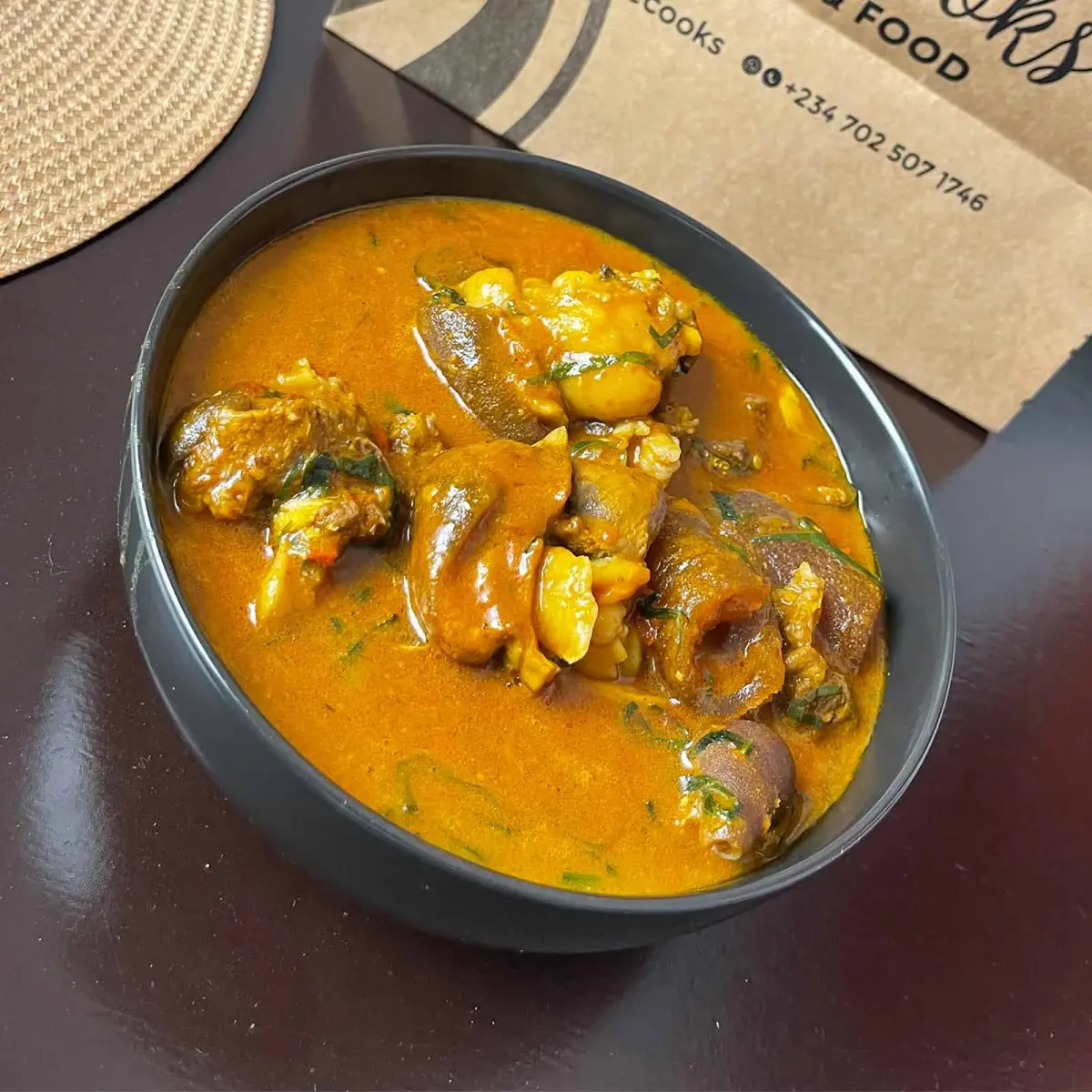
Ogbono goes in as a paste and needs proper cooking time. In our ogbono soup recipe, the peppers, crayfish, fish and meat cook together in palm oil, then four cups of water go in and come to a gentle boil. Half a cup of ground ogbono is mixed with a little water into a smooth paste and poured into the boiling broth bit by bit. The method gives it 10 to 15 minutes, until the ogbono is fully cooked and the soup has thickened, and the recipe's tips push that to at least twenty minutes on low heat, because under-cooked ogbono tastes bland and bitter. The protein is chicken, beef or assorted meat, with ponmo, smoked mackerel and smoked hake.
A handful each of uziza and ugwu leaves goes in at the end for three to five minutes, until wilted. The uziza adds a peppery bite at the end; our guide to what uziza is explains the leaf. Serve it hot with fufu, pounded yam or eba, or any of the popular Nigerian swallows.
Why does my ogbono taste like soap?
If your ogbono tastes like soap, the oil in it has most likely gone rancid. Our ogbono soup recipe's tip is plain about it: if ogbono smells off or tastes soapy, the oils have gone rancid, and no amount of cooking will fix it. Ogbono is very oily, so buy small amounts, store it airtight and check it before it goes in the pot.
Ogbono nutrition
Ogbono is high in fat. The NAERLS bulletin puts the kernels at 54% to 67% fatty matter, enough to call bush mango an oil crop. The Food Chemistry study found fat ranging from 37.5% to 75.5% between trees. PROTA says the main fatty acids are lauric and myristic acid.
A 2015 study in Food Science and Nutrition measured plain dika kernel powder at 10.40% protein, 56.41% fat and 1.52% crude fibre, with 6.20% moisture. The paper doesn't say whether those figures are on a dry or wet basis. The USDA's FoodData Central database has no entry for ogbono or dika nut.
How to store ogbono
Whole dry kernels keep longer than ground ogbono. The NAERLS bulletin says the seeds can be stored in calabashes, pots or sacks at room temperature for upward of six to eight months. PROTA warns that stored kernels can be attacked by beetle larvae and that avoiding cracks helps prevent infestation, so look after whole pieces. Because ground ogbono is so high in fat, keep it in an airtight jar in the fridge or freezer and grind only what you'll use.
Where to buy ogbono
You can buy ogbono whole or ground. Ground saves you a job, but whole kernels let you check what you're buying: look for dry, pale, unbroken pieces with no insect holes and no musty smell. Whichever you choose, our recipe's advice is to buy small amounts, because it doesn't keep well once opened.
Where ogbono comes from
The bush mango is a West and Central African forest tree. PROTA says Irvingia gabonensis is indigenous to the humid forest zone of the Gulf of Guinea, from western Nigeria east to the Central African Republic. It's also a trade crop. The FAO paper says the kernel became a major export to Europe and the USA, and PROTA names Cameroon as probably the main exporter and Nigeria as the main importer.
Ogbono questions people ask
What is ogbono in English?
Ogbono is called bush mango seed, African mango seed or dika nut in English. The trees are Irvingia gabonensis and Irvingia wombolu.
Is ogbono a fruit or a seed?
It's a seed kernel. The bush mango fruit has a nut inside, and ogbono is the white kernel from inside that nut, dried and ground.
Is ogbono the same as ugiri?
They're closely linked. The NAERLS bulletin says Igbo speakers call the kernel ogbono or ugiri depending on the variety, and markets often sell them as one.
Why didn't my ogbono soup draw?
Drawing power varies a lot from tree to tree, according to the Food Chemistry study, so the batch of ogbono is often the cause. Make sure the paste cooks long enough too. Our method says 10 to 15 minutes; the recipe's tips say at least twenty.
Why does my ogbono taste like soap?
A soapy taste or an off smell means the oil in the ogbono has gone rancid, and cooking won't fix it. Buy small amounts and store it airtight.