

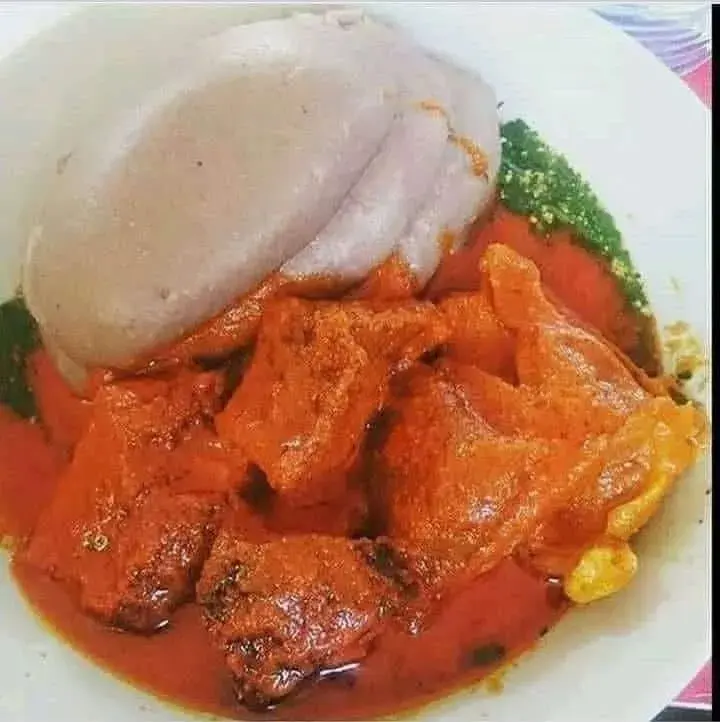
Preparation of White Amala and Ilasa Soup
Overview
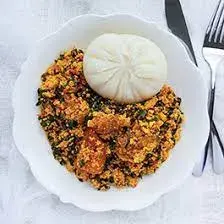
White amala and ilasa soup is a Yoruba pairing from southwestern Nigeria, and both halves of it are local specialities rather than national staples. The amala is white because it is made from cassava flour, known as lafun, rather than the dried yam flour that gives the more familiar dark amala its colour. Ilasa is okra leaf soup, and it is the more particular of the two. It is made from the leaves of the okra plant rather than the pods, whisked with a cooking broom until the soup draws into a light green mass with a texture close to ewedu. Ground melon seed goes in first to give it body. Ilasa is closely associated with Igbo-Ora in Oyo State, where it is a town speciality, and it is far less widely eaten than ewedu or okra pod soup even within Yorubaland. That local specificity is the point of the dish. Nigeria's food is often described nationally, and the reality underneath it is that towns and even quarters hold their own preparations. A visitor to Igbo-Ora would be served ilasa; a visitor to Ibadan would be served ewedu. Both are Yoruba, both are eaten with amala, and neither substitutes for the other.
AFN Heritage Note
Ilasa soup is documented as a speciality of Igbo-Ora in Oyo State, southwestern Nigeria, where it is prepared from okra leaves rather than the pods. The white amala it is eaten with is made from lafun, the flour of dried cassava, as distinct from the elubo of dried yam.
Ingredients
Dietary tags are provided by contributors as a guide, not verified by AFN, and they depend on the products you buy. If you have a serious allergy, check every ingredient yourself. Cooking, allergies and your own judgement
Directions
- 1
Put water in a pot and add the ground egusi. Boil for about 15 minutes.
- 2
Add the chopped okra leaves and whisk with a cooking broom. The result should look like ewedu.
- 3
Add the crayfish, one seasoning cube and salt to taste, then turn off the heat.
- 4
For the amala, boil two cups of water in a separate pot.
- 5
Over medium heat, pour in the cassava flour and turn with a wooden spatula. Keep turning until smooth and free of lumps.
- 6
Serve the white amala with the ilasa soup.
Africook’s Notes
 Personal notes from Taiwo Oladapo
- A cooking broom, or ijabe, is the correct tool for whisking ilasa and is what produces the fine drawn texture. A wire whisk is the closest substitute and a blender is not, since blending destroys the structure entirely.
- The egusi goes in first and boils before the leaves. It supplies the body that stops the soup being watery.
- Okra leaves are not okra pods. The leaves give a lighter, greener soup closer to ewedu, and substituting chopped pods gives you a different dish.
- Lafun is milled cassava, sold at Nigerian grocers. It behaves differently from yam elubo, so the water ratio may need adjusting on a first attempt.
- Keep the soup light. Ilasa is not meant to be thick, and over reducing it loses the character that distinguishes it from okra pod soup.
Reviews
2 reviews
You Might Also Like
Browse all Nigerian recipes →
Edo Black Soup
Nigerian Fisherman Soup
Igbo Yam Porridge
My grandma always used a short cooking broom to beat the okra leaves until it draws properly. I followed your timing for the ilasa and it turned out great, but for the 400g cassava flour I needed almost 3 cups of boiling water instead of 2 because it became too stiff to turn.
Boiling the egusi first for 15 minutes before adding the whisked okra leaves makes a huge difference. I used to just throw everything in together before and the egusi wouldnt cook properly. The lafun came out very smooth, no lumps at all. E sweet sha o.