Libyan Couscous

Libyan Couscous – This authentic Libyan couscous dish features your choice of chicken or beef, pumpkin, humus and other vegetables tossed in a spicy sauce.


What is Couscous?

Couscous is a staple in most Maghreb cuisines. It is known as the national dish in Libya, but also in Algeria and Morocco, as well as Mauritania and Tunisia.

The method of preparing it differs from one country to another.

In Libya, the way it is prepared is also different, as it is prepared with vegetables, meat and onions and cooked on steam.

The couscous meal in Libya is considered a folk heritage that is passed down from one generation to the next, so it preserves its distinctive flavor to this day.

Libyan Couscous Recipe

Couscous is fabulous. If you haven’t had it before, give it whirl and you’ll be glad you did. Many people mistakenly think of it as a grain.  It’s actually semolina, or granules of durum wheat – like tiny bits of pasta.  You can buy it in white and whole wheat varieties.

Another feature of this dish is Hararat, a special Libyan “Five Spice” seasoning blend commonly used in soups and stews.  Ohhhh, those wonderful Middle Eastern spice.

A predominant ingredient is cinnamon, which is used all around the world, but it’s especially popular in Libya.  Hararat is a flavorful, aromatic blend of cinnamon, coriander, cumin, red chilies and allspice.

To prepare the couscous, simply add the water to a medium saucepan along with the salt and olive oil, bring to a boil, add the couscous, immediately turn off the heat, cover, and let sit for 15 minutes.

After 15 minutes, fluff it with a fork.  That’s it! Any cut of stewing beef will do.  You’ll need about 3/4 pound or so which you’ll cut into 4 equal pieces.

Pumpkin is commonly used in Libyan couscous dishes.  If you don’t have access to fresh pumpkin, you can substitute yams or sweet potatoes.

See recipe box below for full recipe instructions.

Serving Libyan Couscous

Arrange in a deep plate serving, make a well in the center and arrange the meat, as well as the vegetables around. Sprinkle with sauce not too much you can add during the tasting.

For another great couscous dish, try these recipes!

Be sure to recreate this incredible delicacy. Enjoy your Libyan couscous!

LIBYAN COUSCOUS

LARA
This authentic Libyan couscous dish features your choice of chicken or beef, pumpkin, humus and other vegetables tossed in a spicy sauce.
Prep Time 25 minutes
Cook Time 1 hour 30 minutes
Course Main Course
Cuisine libyan
Servings 4

Ingredients
  

  • 1 Pack Couscous
  • 1 Cup Hot water
  • 1 TSP Salt
  • ½ Cup Olive Oil
  • Choice of 1 KG of meat or 1 Chicken
  • 50 grams butter
  • Orange Blossom Water Approximately the size of a Turkish coffee cup
  • 2 TSP Cinnamon
  • Sauce Ingredients
  • 1 KG Onions slivered
  • 1 TBSP Tomato Paste
  • 2 TBSP Red Chili Powder
  • 1 Green Onion deseeded
  • 3 TBSP Turmeric
  • 350 chick peas soaked overnight
  • Toppings
  • Boiled Eggs
  • Boiled Potatoes
  • Boiled Zucchini
  • Yellow Squash

Instructions
 

  • Soak chick peas overnight. Drain and wash.
  • Mix the couscous with salt, water, and olive oil, rub it well between the palms of your hands and let the mixture set aside for one hour.
  • For this recipe it is recommended to use a steamer pan as the couscous cooks over the steam and not in stock. If you don’t have one fill half a pot with water and top it with a colander but add the juice of half a lemon.
  • Bring the water to boil and then add the couscous and let it cook over steam for 45 minutes.
  • At this point fry your chicken or meat until cooked from the outside but still raw from the inside. Set aside.
  • Meanwhile, prepare your stock by cooking your onions in some vegetable oil, then add tomato paste, chili powder, green pepper, turmeric and the rinsed chicken peas. Add your chicken or meat and allow to cook until well done.
  • By now the 45 minutes of your couscous have elapsed. Take it out and place it in a bowl and add half a cup of the prepared stock. Make sure to scoop from the top of the stock pan not the bottom.
  • Mix well and return the couscous to the steamer pot to cook for another hour.
  • When it ’ready take out the now fully cooked couscous and mix in the flower water and cinnamon and butter and mix well until the butter melts.
  • Arrange in serving dish. Dip your side vegetables in the sauce and arrange on top or on the side of your couscous.
  • Serve the sauce on the side.
Tried this recipe?Let us know how it was!

Dawa

A perfect glassful of dawa would be perfect to warm you up not only today, but really any time of the year that you want something delicious, nutritious, warming, and soothing. There are countless ways of making dawa, and today’s recipe is my take.

What is Dawa?

Dawa means medicine in Swahili and it is used to cure absolutely everything. It is best enjoyed as a sundowner drink.

Dawa is commonly taken when one wants to soothe a sore throat, ease a cold and for most, just to warm themselves up and inject their body with a bucket load of vitamins.

You don’t have to wait till you have flu to enjoy this, you can just enjoy it any day, anytime honey!

Origin Of Dawa

The dawa (medicine) cocktail, invented at the Carnivore restaurant in the Langata suburb of Nairobi, was inspired by the Brazilian caipirinha, a cocktail made with the cane-sugar spirit cachaça.

Bartenders complained of morning-after headaches from the cachaça and started subbing in vodka. (Some Brazilians also prefer vodka with their muddled limes and sugar; the resulting drink is a caipivodka.)

Carnivore’s bartenders began testing their new drink on guests; and one of them, who happened to be their landlord, was a fan. He asked for another, referring to it as his dawa (medicine).

The name stuck and so did the cocktail, which is now found across Kenya.

Dawa Recipe

There are two variations of the dawa drink: the cocktail and the tea.

Typically, it is prepared using just plain water as the core carrier of all the other ingredients. While there is absolutely nothing wrong with that, it also wouldn’t hurt if we added some flavor.

For that, I always start with cold water, add some whole clove (karafuu) and cinnamon sticks and bring it to a boil.

Clove is not only warming but it is also an excellent maintainer of gut health and cinnamon is excellent in regulating blood sugar. They are amazing for your body and add flavor so it is a win-win!

You can opt for clove/cinnamon spice, however I find the whole spices a lot better for my dawa. You can find both in any well stocked supermarket across the country.

As your water simmers, it will get a mild brown hue, and that is because of our clove and the cinnamon stick.

The simmering will take a few minutes, and the time will vary according to the quantity of your water.

As that is going, you should have already prepped and juiced your lemon or prep it at this moment. Any variety of lemon will work for this.

Loaded with vitamin c, antioxidants, cancer- fighting properties and so much more, each mug of Dawa will not only do your body good, keep you healthy but it is the perfect partner to cozy up to on a cold night. Serve and Enjoy!

Be Sure to Try These Other Authentic Drinks Recipes!

Soothing, delicious and easy to make, Can’t wait for you all to try this out!

DAWA COCKTAIL

Tafi Mukunyadzi
Dawa means "medicine" or "magic potion" in Swahili. In other words, a dawa is said to be so potent that it will cure whatever ails you. The recipe is based on a famous Brazilian drink that was introduced to Kenya. It is now one of the most widely consumed cocktails in Kenya and has spread through out North and South Africa (especially in touristy regions). Enjoy!
Prep Time 5 minutes
Course Drinks
Cuisine Kenyan
Servings 1

Ingredients
  

  • 1 lime
  • 1 tablespoon sugar
  • 6 ice cubes
  • 2 ounces vodka
  • Honey to taste

Instructions
 

  • Cut the lime into quarters and place them inside a lowball glass. Add the tablespoon of sugar and muddle the mixture with a stick until the sugar is moist—but be gentle so you don’t extract too much bitterness from the peel of the lime.
  • Add at least 6 ice cubes to the glass. (According to one bartender, “Warm dawas are disgusting!”) Pour two tots of vodka over the ice. Dip the stirring stick in honey, then lightly stir it into the drink. Remember: Honey is a garnish in this cocktail. You don’t want the drink to become sickly sweet.
Tried this recipe?Let us know how it was!

Mazagran

Mazagran is known as the original ice coffee, it consists of strong coffee that is poured over ice.

The drink is usually served in a tall, narrow glass or an eponymous glass made from porcelain or clay.

We’ll show you what mazagran is and how to make it at home. Plus, keep reading to find brewing tips and tricks!

What is Mazagran (Lemon Coffee)?

Mazagran is a cold espresso drink that originally comes from Algeria, though it’s now much more popular in Portugal. It’s essentially coffee lemonade, combining citrusy acidity with the bold flavor of espresso.

The lemon juice was originally added to improve the flavor of low-end coffee beans. But don’t hesitate to use your pricier beans — this tasty drink won’t ruin their flavor.

Mazagran Recipe 

It’s essentially coffee lemonade, combining citrusy acidity with the bold flavor of espresso. The lemon juice was originally added to improve the flavor of low-end coffee beans.

But don’t hesitate to use your pricier beans — this tasty drink won’t ruin their flavor.

Here is how to make it in simple steps;

  • Pour ice into a tall glass.
  • Pull a shot of espresso
  • Add a sweetener
  • Add the espresso to the glass
  • Squeeze in fresh lemon juice
  • Garnish with a lemon slice and enjoy! If you’d like, add a slice of lemon as a garnish. Now you’re ready to enjoy your iced lemon coffee!

Variations of Mazagran 

Want to adjust this drink to your tastes? Here are some suggestions to personalize your unusual drink or take it over the top:

Sour or Sweet: If you’re a big fan of sour drinks, you may want to add more lemon juice and less sugar to your mazagran. You can always squeeze in another lemon or add a spoonful of honey at the end. And if you want to experiment a little, why not try substituting a lime? You may enjoy the sour twist!

Skip the lemon: Prefer a drink that’s closer to the original Algerian recipe? Skip the lemon and make a simple iced espresso. You can pull a shot of espresso directly over ice, or mix it with sugar and then add a few ice cubes.

Be Sure to Try These Other Authentic Drinks Recipes!

Alright, let’s get to the Mazagran (Lemon Coffee) recipes!

MAZAGRAN

Mazagran is a cold espresso drink that originally comes from Algeria, though it’s now much more popular in Portugal. It’s essentially coffee lemonade, combining citrusy acidity with the bold flavor of espresso. The lemon juice was originally added to improve the flavor of low-end coffee beans. But don’t hesitate to use your pricier beans — this tasty drink won’t ruin their flavor.
Prep Time 5 minutes
Course Drinks
Cuisine Algerian
Servings 4

Ingredients
  

  • 1 Nespresso Envivo Lungo or Vivalto Lungo capsule
  • 4 tsp Lemon juice
  • 3 ice cubes
  • 4 tsp of cane sugar syrup

Instructions
 

  • Pour 4 tsp of cane sugar syrup in a glass
  • Mix it with 4 tsp of water and pour it delicately on the cane sugar syrup so that it does not mix
  • Add 3 ice cubes in the glass
  • Extract Envivo Lungo or Vivalto Lungo in a jug
  • Pour the coffee delicately on the ice
  • Optional: add some zest on it
  • Mix it all and enjoy
Tried this recipe?Let us know how it was!

Sahlab

Sahlab is a drink made of orchid bulbs, orange blossom water, and rose water.  The orchid bulbs are then crushed and dissolved in milk to thicken the drink and flavored with either rose water or orange blossom water.

Some versions use vanilla extract to flavor and cinnamon to sweeten. The luxurious versions are topped with cinnamon, crushed pistachios, and a dash of sliced almonds.

It’s quick and easy to make, and it’s delicious! Sahlab will warm you up during the cold winter days.

What is Sahlab?

Sahlab is a milk pudding, usually served to warm you up on a cold day. In the same way that you might enjoy hot chocolate as a winter drink.

Sometimes nuts and raisins are incorporated along with rose water, or orange blossom water, giving it a rich complex flavor.

The powder sahlab is like magic, it turns your milk and cream into a yummy thick, and nutritious pudding.

This is all thanks to a flower that is a real beauty in itself; the wild orchid.

The powder comes from tubers of the orchid roots which are dried and ground into flour.

The Romans used to make a drink from grinding up orchid bulbs that they used as an aphrodisiac.

The drink became popular in the Ottoman times and then spread to Europe and the Middle East. It is served in the breakfast meal.

Sahlab Recipe

It is very similar to making pudding but even easier.

  • Start by heating milk and cream over medium heat until warm.
  • Combine the sugar and the sahlab, then add to the milk and cream.
  • Using a whisk, stir constantly until it comes to a gentle boil.
  • Turn down the heat, and add the rose water.
  • Remove it from the heat and allow it to cool. (Depending on how much of the thickener you put in you will have either a thick custard drink or a lovely pudding.)
  • Then, pour the mixture into small bowls, and chill in the fridge for an hour. Or pour it into cups and drink it warm. A nice twist on this dessert is to add coffee or chocolate into the mix to get a super flavored sweet snack.

And it doesn’t have to stop there. There are all kinds of options like putting fruit at the bottom or sprinkling it with raisins.

Slivered almonds also make a nice addition, or molasses, honey, or even peanut butter, pralines, or salted toffee.

This pudding is a great launching pad for your favorite flavors and tasty treats.

Tips For Making

  • If making it as a drink, pour the custard into mugs, or glass cups for an authentic look.
  • Sprinkle toppings, using as much or as little as you like.
  • If making as a pudding, stir in whatever flavoring, fruit,  chocolate chips, or pralines as you remove from the heat.

Tajine el Bey

Tajine el Bey is a very elegant and refined variant of the Tunisian tajine, although it is very simple to prepare. It has the distinction of being made of 3 separately assembled mixtures to form a layer of meat, a layer of spinach, and a layer made of ricotta.

This tajine has a very original texture, which melts in the mouth.

It is presented in the same way as the baklawa el Bey, a pastry made with tricolor almond paste, cut in diamond shapes. The colors that make up these dishes, red and green, are those of the Bey of Tunis.

Tunisian Tajine Vs Moroccan Tajine

Tunisian tajine should not be confused with Moroccan tajine which is more familiar to most people and is cooked and presented in the dish of the same name.

Tunisian tajine is more like a thick omelet, often made with meat stewed in a sauce, cheese, and eggs, cooked in an oven.

Tajine el Bey Recipe

It has the distinction of being made of 3 separately assembled mixtures to form a layer of meat, a layer of spinach, and a layer made of ricotta.

Beys: The Beys were famous for being gourmets, very demanding in terms of gastronomy. It is used to indicate the finesse and elegance in a recipe.

Rigouta: It may seem surprising to see ricotta among the ingredients of a Tunisian dish. However, Tunisia produces rigouta, an artisanal whey cheese, very similar to ricotta.

Tabel: or tabil is a spice blend used in Tunisia and Algeria, that is used in the preparation of tajine el Bey, but which can also be used in many other traditional recipes.

Depending on the cooks who prepare it, other ingredients can be added such as dried mint, bay leaves, dried rosebuds, salt, cumin, turmeric, and cloves.

The tabel perfectly elevates the meat and spinach in this recipe. The presence of coriander seeds and their citrus scent brings a very pleasant freshness.

Below is the step-by-step recipe on how to make Tajine el Bey. Enjoy!

Tajine el Bey

Sabrina Gérard
Tajine el Bey is a delicious and refined variant of Tunisian tajine. It consists of 3 layers of stuffing's mounted separately to compose a layer of meat, spinach base and ricotta, representing the 3 colors of the Bey of Tunis.
Prep Time 30 minutes
Cook Time 1 hour
Course Appetizer, Main Course
Cuisine north african, Tunisian
Servings 8
Calories 559 kcal

Equipment

  • Baking dish (13 x 9 inches)

Ingredients
  

  • For the meat layer
  • 1 lb beef ground
  • 2 onions grated
  • 3 cloves garlic pressed
  • 2 oz. cheese e.g. mozzarella, grated
  • 4 eggs beaten
  • ½ teaspoon ground cumin
  • ½ teaspoon tabel Tunisian spice blend
  • 3 tablespoons olive oil
  • For the spinach layer
  • 10 oz. fresh spinach rinsed, drained and finely chopped,
  • 2 tablespoons butter
  • 2 egg yolks
  • 2 whole eggs
  • 2 oz. cheese e.g. mozzarella, grated
  • ½ teaspoon tabel
  • Salt
  • Black pepper
  • For the ricotta layer
  • 10 oz. ricotta
  • 2 oz. cheese e.g. mozzarella, grated
  • 3 egg whites lightly beaten
  • Black pepper
  • For the mold
  • 3 tablespoons butter
  • For the decor
  • 3 oz. walnuts or pistachios, slightly roasted, crushed

Instructions
 

  • For the meat layer
  • In a large skillet, heat the olive oil over medium heat and brown the onions for a few minutes.
  • Add the ground meat and garlic and stir well.
  • Add the cumin and the tabel. Add salt, black pepper and mix well.
  • Cook the meat over medium heat, uncovered, for 15 minutes, stirring regularly.
  • Remove the meat from the heat and let it cool for 15 minutes.
  • Add the grated cheese and eggs and mix well.
  • Gently mix this preparation to obtain a smooth and even layer.
  • Preheat the oven to 350F (180˚C).
  • Butter a baking dish and pour all the ground meat mixture.
  • Using a spatula, even out the surface.
  • Bake for 10 minutes. The surface must harden a little.
  • For the spinach layer
  • In a large skillet, heat the butter over medium heat. Sauté the spinach, stirring regularly until all the liquid is reduced.
  • Let cool completely then add the egg yolks, the whole eggs, and the tabel.
  • Season with salt, pepper and stir well.
  • Pour the spinach stuffing in the oven dish, on top of the meat layer, then sprinkle with grated cheese.
  • Bake for 10 minutes.
  • For the ricotta layer
  • Mix the ricotta, grated cheese, and egg whites.
  • Add the ricotta mixture to the spinach layer and bake again for 10 minutes.
  • Let cool and cut small diamond-shaped slices.
  • Sprinkle each with crushed nuts or pistachios or a mixture of both.

Nutrition

Calories: 559kcal
Tried this recipe?Let us know how it was!

Baklawa

Baklawa is an Ottoman heritage that Algerians prepare for festive occasions. The tasty pastry is made up of puff pastry filled with almonds, and chopped walnuts, and drizzled with natural honey.

What is Baklawa?

Baklawa or Baklava is a sweet dessert made of layers of flaky phyllo pastry filled with crushed nuts and sweetened with honey syrup.

Traditional baklawa, also known as fistikli baklawa or pistachio baklava is typically made of phyllo dough, finely crushed pistachios, butter, and a simple syrup made of sugar, water, and lemon juice.

Baklawa Recipe

You’ll find many variations of this beautiful dessert from Middle Eastern baklava, where the  simple syrup is scented with rosewater, to Greek baklava with walnuts and a generous sprinkle of cinnamon within.

When making this baklava recipe, it helps to think of the ingredients list in three different components:

  1. Phyllo pastry
  2. Nut mixture- pistachios, walnuts, hazelnut, sugar, ground cinnamon, pinch of ground cloves. You can change the nut mixture according to what you have. For example, you can use just walnuts or pistachios, but be sure to have enough of whichever nut you use. And if you’re not a fan of cinnamon, you can omit that.
  3. Honey syrup- water, sugar, honey, and lemon juice. To infuse the syrup with more flavor, I add two more completely optional items, orange extract and whole cloves.

Tips for Making the Best Baklava

  1. Prepare your honey syrup ahead. It’s important that the honey syrup is cool when it hits the freshly-baked hot baklava. This way, the hot baklava layers will absorb as much of the syrup as possible and you’ll have perfectly honeyed baklava. You have enough time to make the syrup while the baklava is baking, but be sure you take it off heat and set it in a cool place.
  2. Chop the nuts well, but don’t grind them too finely into a paste or powder. Obviously you don’t want the nuts nestled in the baklava to be too big or make it hard to bite on the beautiful pastry. But be sure not to grind the nuts too finely that you end up with dust for your filling. You want to still be able to taste the nuts and enjoy their texture.
  3. Cut the assembled baklava into pieces before baking. So important, before you bake it, use a sharp knife to cut the pastry into pieces (I cut my baklava into larger diamond shaped pieces.  You can usually get about 24 up to 36 pieces depending on their size). Why cut it before you bake it? Because once phyllo pastry is baked, it’s super crunchy and if you try to cut through it then, it’ll break into a mess.
  4. Make your baklava one night in advance!  Hooray for the perfect make-ahead dessert! Baklava is even better the next day when it’s had a chance to completely soak in the honey syrup. You can store it covered at room temperature for one night. Be sure it is completely cooled before you cover it (so important).

Storage

Baklawa is one of the few desserts you can make a few days ahead. It will keep well for up to 2 weeks stored in an air-tight glass container at room temperature or in the fridge.

You can freeze already baked baklava for up to 4 months, if you like. It’s good to store it in small batches so you don’t have to thaw out the entire pan when you need a treat. Thaw in the fridge overnight or at room temperature for a few hours.

Be Sure to Try These Other Authentic Algerian dishes!

Be sure to recreate this incredible Algerian dessert . Bon appétit! 

Baklawa Recipe

Natasha
This baklawa is flaky, crisp, tender and perfectly balanced with the honey-lemon syrup. This homemade baklava is so much better than any store-bought version.
Prep Time 1 hour
Cook Time 1 hour 15 minutes
Course Dessert
Cuisine Algerian
Servings 30
Calories 255 kcal

Ingredients
  

  • 16 oz phyllo dough thawed by package instructions
  • 1 1/4 cups unsalted butter 10 oz or 2 1/2 sticks, melted
  • 1 lb walnuts finely chopped, (about 4 cups)
  • 1 tsp ground cinnamon
  • 1 cup granulated sugar
  • 2 Tbsp lemon juice juice of 1/2 lemon
  • 3/4 cup water
  • 1/2 cup honey
  • Melted chocolate chips & chopped walnuts for garnish optional

Instructions
 

  • Thaw phyllo dough by package instructions (this is best done overnight in the fridge, then place it on the counter for 1 hr before starting your recipe to bring it to room temp).
  • Trim phyllo dough to fit your baking dish. My phyllo package had 2 rolls with a total of 40 sheets that measured 9x14 so I had to trim them slightly. You can trim one stack at a time then cover with a damp towel to keep from drying out.
  • Butter the bottom and sides of a 13x9 non-stick baking pan.
  • Start with your honey sauce (which needs time to cool as baklawa bakes).
  • In a medium saucepan, combine 1 cup sugar, 1/2 cup honey, 2 Tbsp lemon juice, and 3/4 cup water. Bring to a boil over med/high heat, stirring until sugar is dissolved, then reduce heat to med/low and boil additional 4 min without stirring. Remove from heat and let syrup cool while preparing baklawa.
  • How to make Baklawa: Preheat Oven to 325˚F.
  • Pulse walnuts 10 times in a food process or until coarsely ground/ finely chopped. In a medium bowl, stir together: 4 cups finely chopped walnuts and 1 tsp cinnamon.
  • Place 10 phyllo sheets into baking pan one at a time, brushing each sheet with butter once it's in the pan before adding the next (i.e. place phyllo sheet into pan, brush the top with butter, place next phyllo sheet in pan, butter the top, etc. etc.). Keep remaining phyllo covered with a damp towel at all times. Spread about 1/5 of nut mixture (about 3/4 cup) over phyllo dough.
  • Add 5 buttered sheets of phyllo, then another layer of nuts. Repeat x 4. Finish off with 10 layers of buttered phyllo sheets. Brush the very top with butter.
  • Cut pastry into 1 1/2" wide strips, then cut diagonally to form diamond shapes. Bake at 325˚F for 1 hour and 15 min or until tops are golden brown.
  • Remove from oven and immediately spoon cooled syrup evenly over the hot baklawa (you'll hear it sizzle). This will ensure that it stays crisp rather than soggy. Let baklawa cool completely, uncovered and at room temp. For best results, let baklava sit 4-6 hours or overnight at room temperature for the syrup to penetrate and soften the layers. Garnish baklawa with finely chopped nuts or drizzle with melted chocolate. Store at room temp, covered with a tea towel for 1 to 2 weeks.

Notes

Here's the order of the Baklava Layers:
10 buttered phyllo sheets, 3/4 cup nut mixture,
5 buttered phyllo sheets, 3/4 cup nut mixture,
5 buttered phyllo sheets, 3/4 cup nut mixture
10 buttered phyllo sheets and butter the top.

Nutrition

Calories: 255kcal
Tried this recipe?Let us know how it was!

Kenyan Maharagwe (Spiced Coconut Bean Soup)

0

Maharagwe is swahili’s name for beans and it is a famous meal served with ugali that comprises of red beans and onions cooked in a silky coconut milk sauce. Tomatoes add just the proper amount of acidity, and rich spices elevate this simple bean stew to a memorable flavor.

This Kenyan red bean soup, Maharagwe is hearty, tasty, and anti-inflammatory. While it contains a lot of spices and peppers, it’s not as spicy as you might imagine. The coconut milk significantly reduces the heat while also giving some healthy fat to aid in the absorption of fat-soluble vitamins and antioxidant-rich turmeric.

Maharagwe has an incredible flavor! Buttery beans float in a thick, creamy, spice-laden coconut milk and tomato broth. Serve the saucy beans with rice, flatbreads, or ugali, a Kenyan staple. If you keep the ingredients for maharagwe in your pantry, you can put a delicious supper on the table in under 30 minutes.


Kenyan Maharagwe

Kitchen Frau
Servings 4

Ingredients
  

  • cups cooked red kidney beans or other red beans 350 grams/1½ cups raw beans, soaked and cooked until tender or two 19 oz/540 gram cans of beans or three 14 oz/400 gram cans of beans*see below for how to cook the beans
  • 2 tablespoons oil peanut oil to be authentic
  • 2 medium onions chopped (2-2½ cups)
  • 1 jalapeño or other hot pepper seeded and minced (seeds left in if you prefer it spicy) or ¼-½ teaspoon ground cayenne pepper, to taste
  • 2 cloves garlic minced
  • 1 teaspoon mild curry powder
  • ½ teaspoon ground cumin
  • ½ teaspoon ground turmeric
  • ½ teaspoon ground cardamom
  • ½ teaspoon ground coriander
  • 1 teaspoon salt + more to taste you may need more if using cooked beans
  • 1 can 14 oz/400ml diced tomatoes (or 2 cups diced fresh tomatoes)
  • 1 can 14oz/400ml full-fat premium coconut milk (not light)
  • chopped cilantro for garnish optional
  • cooked rice flatbreads, or ugali (see recipe below) as an accompaniment to the beans

Instructions
 

To cook raw beans

  • Pick the beans over to remove any bits of rock and broken beans. Cover with two inches of water and soak for 6 to 8 hours or longer. Drain the soaking water, place the beans in a large saucepan and cover with two inches of fresh water. Cook for 1 to 2 hours, or until the beans are tender and soft inside. The time will depend on the age and size of your beans. Allow the beans to cool in the cooking liquid to avoid split skins. Drain.
  • Drain and rinse the beans if using canned beans.

To make the Maharagwe

  • Heat the oil in a large heavy-bottomed pot or skillet. Add the diced onions and hot pepper and cook for five minutes, until the onions are translucent. Add the garlic, curry powder, cumin, turmeric, cardamom, and salt, and cook for one minute more.
  • Add the drained beans to the onions, along with the tomatoes and their juices and the coconut milk. Bring to a boil, then reduce the heat to low and cook for about 15 minutes, until the coconut milk thickens a bit and the flavours meld. The level of the sauce should come up to just cover the beans. If there’s not enough liquid, add a bit of water and cook another minute or two. Taste the maharagwe, and add more salt if it needs it or more cayenne pepper if you’d like it spicier. The sauce will thicken more as it cools.
  • Serve maharagwe hot with cooked rice, ugali (recipe below), or with the flatbread of your choice (naan, pita, chapati, roti, tortillas, etc.) to scoop up the beans.
Tried this recipe?Let us know how it was!

Tomato Soup

0

Tomato soup is a soup that contains tomatoes as the main ingredient. It can be served warm or cold and prepared in a variety of ways. It can have a silky texture, and there are versions that contain tomato chunks, cream, chicken or vegetable stock, vermicelli, other vegetable pieces, and meatballs.

One thing is sure anyway, this fresh tomato soup dish will remind you of your mother’s wonderful cuisine and nothing compares the exquisite flavors of a soup made from scratch with fresh ingredients.


Tomato Soup

Servings 0

Ingredients
  

  • 4 cups chopped fresh tomatoes
  • 1 slice onion
  • 4 whole cloves
  • 2 cups chicken broth
  • 2 tablespoons butter
  • 2 tablespoons all-purpose flour
  • 1 teaspoon salt
  • 2 teaspoons white sugar or to taste

Instructions
 

  • In a stockpot, over medium heat, combine the tomatoes, onion, cloves and chicken broth. Bring to a boil, and gently boil for about 20 minutes to blend all of the flavors. Remove from heat and run the mixture through a food mill into a large bowl, or pan. Discard any stuff left over in the food mill.
  • In the now empty stockpot, melt the butter over medium heat. Stir in the flour to make a roux, cooking until the roux is a medium brown. Gradually whisk in a bit of the tomato mixture, so that no lumps form, then stir in the rest. Season with sugar and salt, and adjust to taste.
Tried this recipe?Let us know how it was!

Tunisian Sabayon

Tunisian Sabayon is a delectable North African specialty. It’s frequently served as a dessert, with fresh fruits or pastries on the side.
Although the Tunisian version resembles the Italian version in terms of preparation and ingredients, it is a custard in which the oil replaces the alcohol in the original version.
Tunisian version is also flavored with orange blossom water and served ice cold with crushed pistachios or almonds as a garnish.

Origin of Sabayon

Sabayon (from Italian zabaione) is a recipe of Italian origin. The word appears in 1803 in the original French form of sabaillon.

It is believed that the soldiers brought it back to France during the Italian and Swiss expedition of 1799-1800. Several stories, some probably legendary, give the sabayon an older origin.

It is believed that Catherine de Medici introduced it to the court of France in 1533.

Other sources attribute its paternity to Turin. According to these sources, Franciscan Brother Paschal of Baylon (1540-1592), canonized in 1690 under the pontificate of Alexander VIII, would have invented the original sabayon recipe.

An incredible legend tells that this Spanish churchman, also a very good cook, was visiting a parish in Turin on a pilgrimage to Europe and recommended a recipe with eggs and wine to the women who were complaining about the lack of sexual stamina of their spouse.

This recipe, nicknamed San-Bayon in the local dialect, would eventually take the name of sabajone.

The history of the Tunisian version is much more recent. It seems that the Italian version was imported into Tunisia by a newly opened glacier “Chez Salem” (now called “Le Petit Salem”) in 1936 at La Marsa, the chic suburb north-east of Tunis.

We owe the ice cream adaptation of the famous Italian dessert to Salem Hafi, and his Tunisian Jewish friend Bébert.

Tunisian Sabayon recipe

To make this recipe, dry white wine (Chardonnay, Champagne) or fruity wine (Marsala, Sauternes, Muscat) can be used.

The white wine is occasionally replaced by sweeter or digestive wine such as port, or by liquor such as rum, kirch, grappa, Grand Marnier, or Cointreau.

It must be prepared just before serving. Depending on the proportion of sabayon compared to other ingredients, it can be considered a sauce or a custard in its own right.

Recipe Variant

There are different versions of sweet and even savory sabayons. For example, sweet sabayon with sweet wine is often prepared to accompany diced fruits.

The savory sabayon with lemon, meanwhile, is more intended to accompany scallops.

Sweet sabayon is also often used as a base for mousse or other desserts.

Eggnog is a type of sabayon with milk, cream, spice, and liqueur that is prepared like the Italian recipe. Custard preparations are often used as a dessert or beverage base. Examples, suspiro limeño from Peru, coquito, this popular alcoholic drink from Puerto Rico prepared for Christmas, or the English trifle.

Storage and Serving Suggestions

Sabayon is also often served for dessert in Tunisian restaurants, served with bouscoutou (a kind of sponge cake), harissa hloua (or aricha), a delicious almond, and semolina cake, or just red berries.

Tunisian sabayon can be prepared fairly quickly. However, it is necessary to wait for at least 8 good hours so that it has time to firm up in the freezer before tasting it.

Be Sure to Try These Other Authentic Tunisian Dishes!

Be sure to recreate this incredible delicacy. Bon appétit!

Tunisian sabayon

Mike Benayoun
Tunisian sabayon is a delicious egg-based ice cream, flavored with orange blossom water, that is an adaptation of the original Italian version.
Prep Time 20 minutes
Course Dessert
Cuisine north african, Tunisian
Servings 10

Equipment

  • Stand mixer
  • Ramekins

Ingredients
  

  • 6 eggs
  • cup sugar
  • ½ teaspoon vanilla extract
  • ½ cup oil
  • 2 tablespoons orange blossom water
  • Pistachios or almonds crushed

Instructions
 

  • Separate the eggs.
  • Whisk the yolks with 5 tablespoons of sugar and the vanilla extract, until the mixture becomes pale and frothy.
  • Add the oil slowly, and continue whisking to obtain a smooth and homogeneous mixture.
  • Add the orange blossom water and mix.
  • Separately, beat the egg whites with the remaining sugar until stiff.
  • Fold one third of the egg whites into the yolks gently, then gradually combine the remaining egg whites by folding without stirring.
  • Pour the mixture into individual ramekins or into a large pan and place in the freezer for at least 8 hours.
  • Decorate with pistachios or crushed almonds.
  • Serve by itself, or with red berries, harissa hloua or bouscoutou (sponge cake).
Tried this recipe?Let us know how it was!

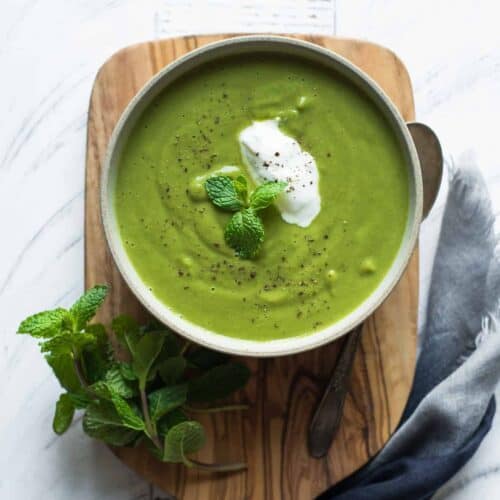
Pea and Mint Soup

0

Pea and mint soup is not just your typical soup. The peas’ beautiful color is preserved by short cooking them, and the addition of fresh herbs keeps the finished soup appearing and smelling fresh. It’s a springtime favorite that’s delicious warm or cooled.


Pea and Mint Soup

Good Food
Prep Time 10 minutes
Cook Time 20 minutes
Servings 4

Ingredients
  

  • 1 bunch spring onions trimmed and roughly chopped
  • 1 medium potato peeled and diced
  • 1 garlic clove crushed
  • 850 ml vegetable or chicken stock
  • 900 g young pea in the pod to give about 250g/9oz shelled peas
  • 4 tbsp chopped fresh mint
  • large pinch caster sugar
  • 1 tbsp fresh lemon or lime juice
  • 150 ml buttermilk or soured cream

Instructions
 

  • Put the spring onions into a large pan with the potato, garlic and stock. Bring to the boil, turn down the heat and simmer for 15 minutes or until the potato is very soft. For the garnish, blanch 3 tbsp of the shelled peas in boiling water for 2-3 minutes, drain, put in a bowl of cold water and set aside. Add the remaining peas to the soup base and simmer for 5 minutes – no longer, or you will lose the lovely fresh flavour of the peas.
  • Stir in the mint, sugar and lemon or lime juice, cool slightly then pour into a food processor or liquidiser and whizz until as smooth as you like. Stir in half the buttermilk or soured cream, taste and season with salt and pepper.
  • To serve the soup cold, cool quickly, then chill – you may need to add more stock to the soup before serving as it will thicken as it cools. To serve hot, return the soup to the rinsed-out pan and reheat without boiling (to prevent the buttermilk or soured cream from curdling).
  • Serve the soup in bowls, garnished with the remaining buttermilk and the drained peas.
Tried this recipe?Let us know how it was!

QUICK RECIPES