
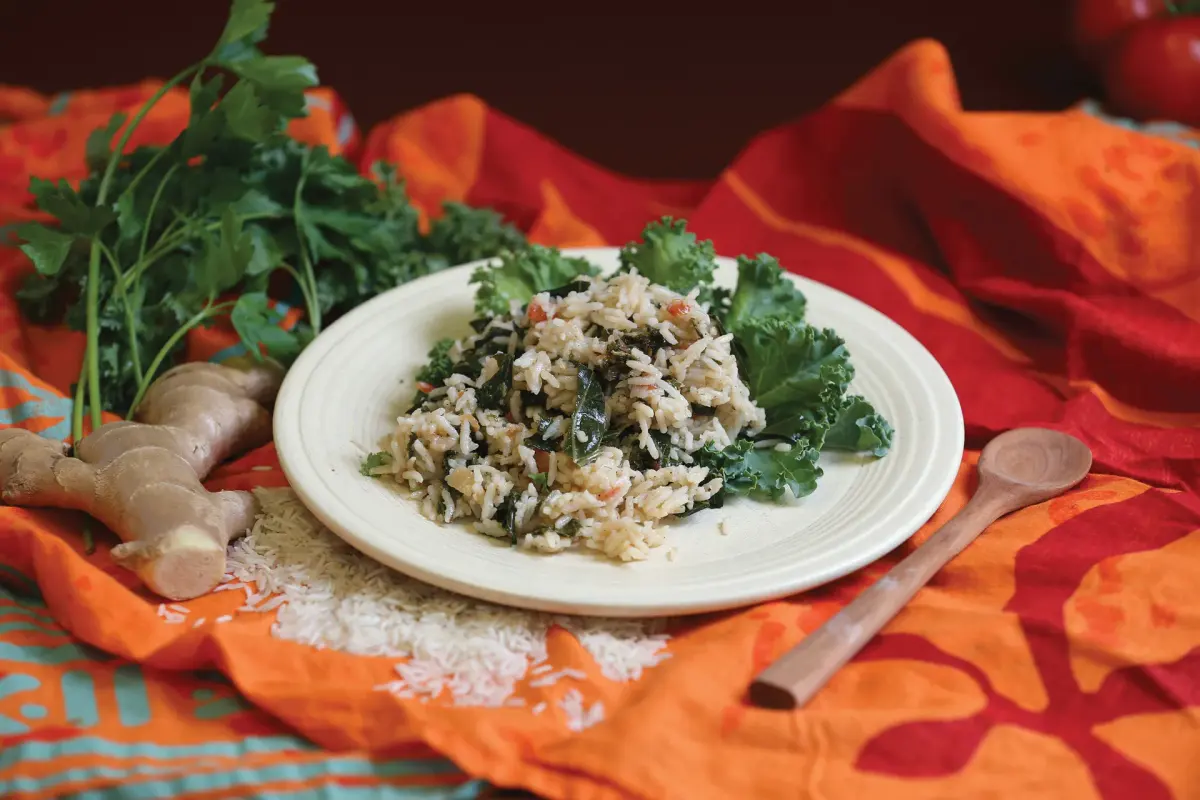
Vary Amin'anana (Malagasy Greens and Rice)
Overview
Vary amin'anana is rice cooked together with greens, tomatoes, onion and ginger until it becomes a thick, soupy porridge. It is Malagasy, and the name says exactly what it is: vary is rice, anana is greens. It is everyday food in the most literal sense. Rice is eaten at nearly every meal in Madagascar, and vary amin'anana is one of the most common ways of preparing it, cheap, filling, made from whatever leaves are available, and eaten at any hour including breakfast. Brèdes is the Malagasy term for the family of edible greens it uses, which covers everything from mustard greens to watercress to cassava leaves depending on the season. Ginger is the note that makes it Malagasy rather than generically green. It goes in early with the tomatoes and onions and runs through the whole dish. Two things about this particular version. It uses brown rice, which is unusual, white rice is standard in Madagascar, and it has been converted to a slow cooker, which is not a Malagasy method. The source explains why: it was adapted so it could be transported to a fundraiser. That provenance is worth recording, since it explains both oddities. The proportions are worth reading: twelve cups of water to five cups of rice gives something soupy rather than fluffy, which is correct.
AFN Heritage Note
Vary amin'anana is a Malagasy dish of rice cooked with greens into a thick porridge. Vary means rice and anana means greens; brèdes is the Malagasy term for the range of edible leaves used. Rice is eaten at nearly every meal in Madagascar and this is among the most common preparations.
Ingredients
Dietary tags are provided by contributors as a guide, not verified by AFN, and they depend on the products you buy. If you have a serious allergy, check every ingredient yourself. Cooking, allergies and your own judgement
Directions
- 1
Warm the olive oil in a large skillet.
- 2
Cook the tomatoes, onions and ginger in the hot oil until the tomatoes are just beginning to soften, 2 to 3 minutes.
- 3
Mix the torn collard green pieces into the tomato mixture and cook until the greens begin to soften, about a minute more.
- 4
Transfer the mixture to a slow cooker and add the water, rice and salt.
- 5
Cook on medium until the water has been completely absorbed, about 4 hours.
- 6
Season with salt and freshly ground black pepper to taste.
Africook’s Notes
- It is meant to be soupy. Twelve cups of water to five of rice gives a porridge rather than fluffy rice, and that is correct.
- Cook the tomatoes, onions and ginger before they go in the pot. Raw aromatics tipped into a slow cooker never develop properly.
- Ginger is what makes it Malagasy. Do not reduce it.
- Almost any leafy green works, collards, mustard greens, watercress, spinach, cassava leaves. Brèdes covers the lot.
- White rice is standard in Madagascar and cooks far faster than the brown rice this version uses.
- On a hob rather than a slow cooker it takes 30 to 40 minutes with white rice, which is how it is normally made.
Questions cooks ask
What does vary amin'anana mean?
Rice with greens, literally, vary is rice and anana is greens in Malagasy. The name is entirely descriptive, which suits a dish that is among the most everyday things eaten in Madagascar. Brèdes is the related Malagasy term for the whole family of edible leaves used in cooking, which covers mustard greens, watercress, cassava leaves and a great deal else depending on the season and the region.
Why is it made in a slow cooker?
It is not, traditionally, and the source explains why this version is. It was adapted for a slow cooker so it could be transported to a fundraiser, which also explains the unusual choice of brown rice. In Madagascar it is made on a hob in 30 to 40 minutes with white rice. The slow cooker method works and produces a good result; it is simply a conversion rather than the original technique.
What greens should I use?
Almost any leafy green. This version uses collard greens; in Madagascar it would be whatever brèdes are available, mustard greens, watercress, amaranth leaves, cassava leaves, or a mixture. Spinach works and cooks fastest. The dish is designed around availability rather than a specific leaf, which is much of why it is so widely eaten.
Should it be soupy?
Yes. Twelve cups of water to five cups of rice produces a thick porridge rather than separate fluffy grains, and that is what vary amin'anana should be, somewhere between a rice dish and a soup, eaten with a spoon. If it comes out dry, add more water. It is often eaten at breakfast in Madagascar, where that porridge consistency makes more sense than it might at dinner.
Reviews
Be the first to rate this recipe
Cooked it? Your rating helps the next person decide whether to try it.
No reviews on this one yet. If you have cooked it, yours would be the first.
You Might Also Like
Browse all Malagasy recipes →
Romazava
Henakisoa sy Ravitoto (Malagasy Pork with Cassava Leaves)
Tsaramaso Malagasy (White Bean and Tomato Stew)