

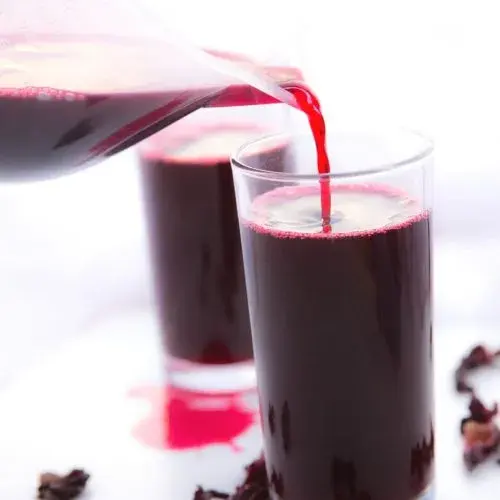
Bissap
Overview
Bissap is the Wolof name for Hibiscus sabdariffa and for the deep red drink made from its dried calyces. It is the most widely drunk thing in Senegal after water, sold from every restaurant, supermarket and street corner, and made at home by buying the dried flowers at the market and steeping them in hot water with sugar. Its position has something to do with religion. Senegal is overwhelmingly Muslim, alcohol plays almost no part in social life, and the result is a genuinely developed culture of non alcoholic drinks: bissap alongside ginger, tamarind and bouye, made from the fruit of the baobab. These are not soft drinks in the Western sense of an afterthought. They are what people offer guests and what they drink at any hour. The same flower is drunk across a great deal of the world under other names: zobo in Nigeria, sorrel in the Caribbean, karkade in Egypt and Sudan, agua de jamaica in Mexico. What varies is the flavouring. Senegalese bissap commonly carries mint, and ginger, pineapple, passion fruit and lime all appear. Ginger divides opinion, since a heavy hand overpowers the hibiscus. It is served very cold and generally over ice, which is not a preference but a requirement in the climate it belongs to.
AFN Heritage Note
Bissap is the Wolof name for Hibiscus sabdariffa, also known as Guinean sorrel, whose dried calyces are steeped to make the drink. The same preparation is documented across West Africa, North Africa, the Caribbean and Latin America under names including zobo, karkade, sorrel and agua de jamaica.
Ingredients
Dietary tags are provided by contributors as a guide, not verified by AFN, and they depend on the products you buy. If you have a serious allergy, check every ingredient yourself. Cooking, allergies and your own judgement
Directions
- 1
Make the syrup. In a small saucepan, combine the water and sugar and bring to a simmer over high heat, stirring to dissolve the sugar.
- 2
Remove the pan from the heat and add the hibiscus. Leave to steep for 10 minutes, then strain it out and discard.
- 3
Stir in the ginger and orange blossom water and let the ginger steep for five minutes.
- 4
Strain the hibiscus syrup through a fine sieve into a glass measuring cup and leave to cool completely.
- 5
To serve, fill a glass one third with ice, then pour over about 1 ounce of hibiscus syrup.
- 6
Bruise 4 mint leaves by clapping them between your palms, add them to the glass and stir.
- 7
Top up with still or sparkling water, stir and serve.
Africook’s Notes
- Use dried hibiscus calyces from a West African or Caribbean grocer rather than tea bags where you can. The flavour is considerably deeper and it is what Senegalese households actually use.
- Go carefully with the ginger. It overpowers hibiscus quickly, and plenty of Senegalese leave it out entirely for that reason.
- Serve it genuinely cold and over ice. Bissap at room temperature is a different and much less appealing drink.
- Bruise the mint by clapping it rather than tearing or muddling it. That releases the oils without the bitterness that comes from crushing the leaf.
- The syrup keeps in an airtight container in the fridge for up to a month, which makes this practical to have on hand.
Questions cooks ask
What is bissap made from?
The dried calyces of Hibiscus sabdariffa, known in Wolof as bissap and in English as Guinean sorrel or roselle. They are the fleshy red parts that surround the seed pod rather than the petals. They are sold dried in bags at West African, Caribbean and Middle Eastern grocers, and steeped in hot water they give a deep red, tart liquid.
Is bissap the same as zobo or sorrel?
Yes, they are the same plant and the same basic drink. Zobo is the Nigerian name, sorrel the Caribbean one, karkade in Egypt and Sudan, and agua de jamaica in Mexico. What differs is the flavouring: Nigerian zobo often carries pineapple and ginger, Caribbean sorrel is spiced with clove and cinnamon at Christmas, and Senegalese bissap commonly uses mint.
Can I make bissap without sugar?
You can, but expect it to be sharply tart, since hibiscus is genuinely sour on its own. Honey and agave both work as substitutes. Most Senegalese bissap is quite sweet, which balances the acidity. If you are reducing the sugar, adding more mint or a little pineapple juice helps carry it.
How long does bissap keep?
The concentrated syrup keeps up to a month in an airtight container in the fridge, which is why this recipe makes it that way. Bissap already diluted and ready to drink should be finished within three or four days. It also freezes well, either as syrup or as ice cubes for chilling without watering it down.
Reviews
2 reviews
Chale this is very close to how we make sobolo in Ghana, but that orange blossom water gives it that real Francophone Senegalese touch. In Tema we usually load it with heavy cloves and black pepper, so this syrup is much lighter and perfumed oo. I made it yesterday and poured 1 oz over cold sparkling water with fresh mint leaves from my garden. Very refreshing paa, though next time I will add a bit more ginger for heat.
Orange blossom water in zobo syrup? I was skeptical o, because back home in Nigeria we usually boil pineapple peels with the dried hibiscus and ginger. But I could not find good pineapples at my local grocery here in Chicago so I tried this exact method with the orange blossom water from the Middle Eastern shop nearby. E sweet no be small thing! Steeping the grated ginger for just five minutes at the end gives it that sharp bite without making it bitter.