
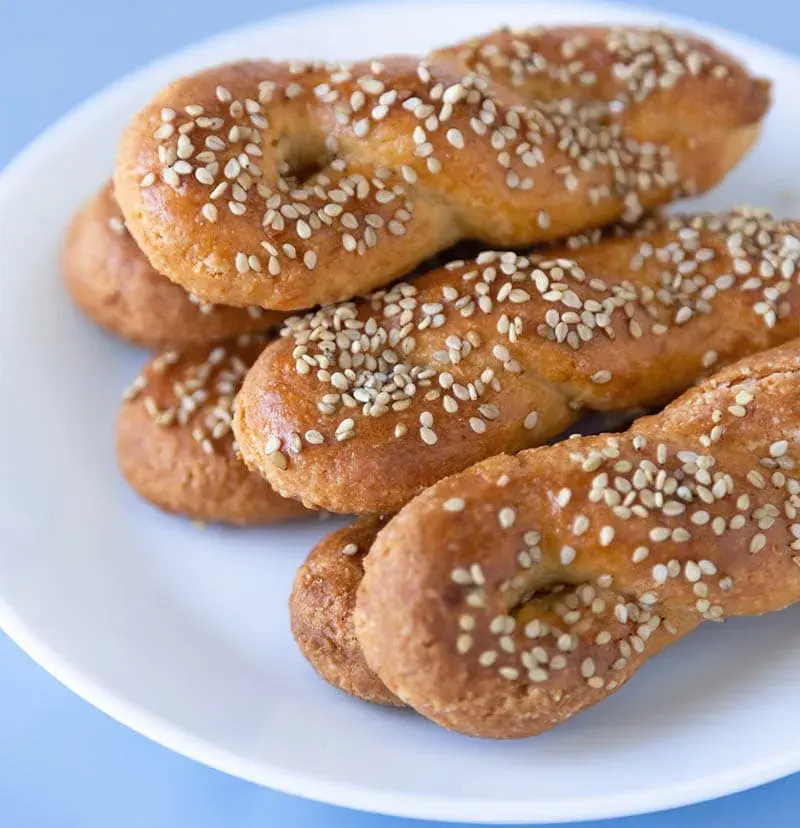
Ka'ak (Libyan Ring Bread)
Abuja, Nigeria · View all recipes
Overview
Ka'ak is a ring-shaped bread, crisp outside and soft within, scattered with sesame seeds. It is Libyan in this version, and made across a wide stretch of the Arabic-speaking world, Egypt, Iraq, Iran, Jordan, Lebanon, Palestine and Syria all have their own. The shape is what defines it. Ka'ak is formed into a large ring, bigger and thinner than a bagel, which is why street vendors across the region can carry stacks of them on a pole or a cart. In Libya it is eaten at breakfast alongside hummus and falafel, and it comes in savoury and sweet versions. The name travels further than the shape does. Ka'ak, sometimes kahk or kahqa, covers a whole family of baked goods across the Arabic-speaking world, from this ring bread to the small filled Egyptian cookies eaten at Eid, which are a completely different thing. The word means something closer to "baked good" than to any specific item. One technique in this recipe is worth borrowing for other breads. A tray of water is placed in the bottom of the oven while it heats, so the loaves bake in a steamy environment. Steam keeps the crust soft for the first minutes, letting the bread rise fully before the surface sets, and then produces a thin, crisp finish.
AFN Heritage Note
Ka'ak is a ring-shaped bread, also spelt kahk or kahqa, baked across Libya, Egypt, Iraq, Iran, Jordan, Lebanon, Palestine and Syria. It is sold by street vendors and eaten in both savoury and sweet forms. The name covers a broad family of Arabic baked goods rather than a single item.
Ingredients
Dietary tags are provided by contributors as a guide, not verified by AFN, and they depend on the products you buy. If you have a serious allergy, check every ingredient yourself. Cooking, allergies and your own judgement
Directions
- 1
Warm the milk just enough to proof the yeast. Mix in the sugar and yeast, cover the bowl and leave for 10 minutes. It should be frothy; if it is not, the yeast is dead and you need a fresh batch.
- 2
Combine the flours, salt, oil and the yeast mixture in a mixer bowl. Using a dough hook, mix until it comes together, adding a little more warm water if needed.
- 3
The dough should be quite soft but not sticky. Knead for 7 to 8 minutes, then transfer to a greased bowl to rise, covered, until doubled in volume.
- 4
Turn it out, knead gently for a minute, form it into a ball and return it to a greased bowl for a second rise.
- 5
After the second rise, divide the dough into 4 equal balls on a floured surface.
- 6
Line two baking sheets with parchment.
- 7
Working with one ball at a time, flatten it and roll it into a teardrop shape about half an inch thick and roughly 6 inches long.
- 8
Cut a ring out of the narrow part with a cookie cutter, pull the dough gently to elongate the shape, and set it on the sheet. Repeat, keeping two per tray.
- 9
Cover the trays and let the shaped breads prove for about 30 minutes, until slightly puffy.
- 10
Meanwhile heat the oven to 425°F / 220°C, placing a foil tray half filled with water on the bottom shelf as it heats so the oven fills with steam.
- 11
Brush the risen breads with milk or egg wash, scatter generously with sesame seeds, and bake until golden.
Africook’s Notes
- Check the yeast foams before you commit the flour. Ten minutes of waiting saves a wasted batch.
- The tray of water in the oven is worth the trouble. Steam lets the bread rise fully before the crust sets, then gives a thin crisp finish.
- Keep the dough soft. A stiff ka'ak dough gives a hard, dense ring rather than a light one.
- Two rises rather than one. It is what gives the bread its structure and its flavour.
- Press the sesame seeds on gently after brushing, so they stay put rather than falling off in the oven.
- It is at its best the day it is baked, and stales quickly like most lean breads.
Questions cooks ask
What is ka'ak?
A ring-shaped bread, crisp outside and soft within, usually topped with sesame seeds, made across Libya, Egypt and much of the Levant and Middle East. It is larger and thinner than a bagel, with a wide opening, which is why street vendors can carry stacks of them on a pole. In Libya it is a breakfast bread eaten with hummus and falafel, and it comes in both savoury and sweet forms.
Is this the same as the Egyptian ka'ak eaten at Eid?
No, and the shared name causes real confusion. Egyptian kahk el-Eid are small, round, crumbly shortbread-type cookies filled with dates or nuts and dusted with icing sugar. This ka'ak is a yeasted ring bread. The Arabic word covers a broad family of baked goods rather than one item, closer in scope to the English word bake than to any specific recipe.
Why put water in the oven?
To create steam. In a steamy oven the surface of the bread stays soft for the first few minutes, which lets it expand fully before the crust sets, bread baked in a dry oven forms a crust early and cannot rise as far. As the steam clears, the crust then dries into a thin, crisp finish. Professional bakeries have steam-injected ovens; a tray of water on the bottom shelf is the domestic version.
How long does the dough take?
Longer than the source's stated prep time suggests. Between proofing the yeast, two full rises and a further 30 minutes proving after shaping, you should allow around two and a half hours before it goes into the oven, though almost all of that is waiting rather than work. Rising times vary considerably with the temperature of the room, so judge by the dough doubling rather than by the clock.
Reviews
Be the first to rate this recipe
Cooked it? Your rating helps the next person decide whether to try it.
No reviews on this one yet. If you have cooked it, yours would be the first.
You Might Also Like
Browse all Libyan recipes →
Mbakbaka (Libyan Pasta Stew)
Aslooz (Libyan Couscous-Based Dish)