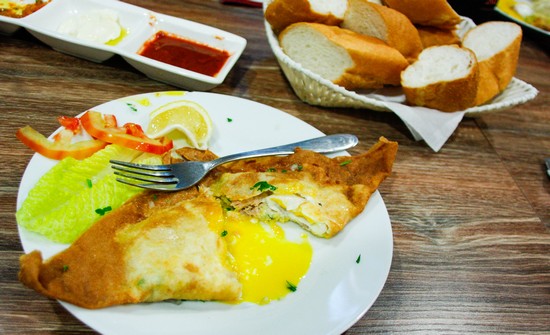
Tunisian Brik

A hand-me-down from Ottoman times, the Brik in Tunisia is a thin pastry wrapped around egg filling and fried.

This dish has survived in other parts of the former Ottoman Empire in the form of bourek (in Algeria) and burek (in the Balkans), though the egg version is the most specifically Tunisian variety.

Other potential fillings in Tunisia include tuna, chicken, anchovies, capers, and cheese.

This is a great breakfast, though it can be eaten at any time of day. It’s also a great Tunisian street food if you happen to be traveling in the country.

What is Brik?

These tuna briks are an iconic recipe of traditional Tunisian cuisine. The other name is malsoukaMalsouka is of Tunisian origin.

It is a very fine sheet of dough that is partially cooked. It is very easy to get in France but they are not easy to find outside of Europe and North Africa.

There are dozens of briks recipes, some of them often seen on the tables of iftar, the first meal after sunset during the month of Ramadan.

Briks Recipe

The most famous versions of this recipe are prepared with beef, turkey, chicken, chicken liver, as well as tuna.

The two most common shapes are the triangles and the cigars. I chose the triangle shape for mine as this is the one used most often for the tuna briks.

They often appear in the “assiettes anglaises” (dish with various snacks) during celebrations. These assiettes anglaises included minina (omelet), pickled vegetables, fava beans, and other dishes served as appetizers during these festivities.

The addition of cheese in the  recipe is fairly contemporary and has gained in popularity in recent years.

Be sure to recreate this incredible delicacy. Bon appétit!

Tunisian Brik

A recipe from the Arabic cuisine, also allowed in a nut free diet
One of the best Tunisian dishes comes in the form of a crispy, delicious brik. What is this brik? It is a thin pastry, wrapped around a filling, and usually deep-fried. Fillings usually consist of tuna, meat, egg, and cheese. We’ve made ours with tuna, and we’ve flavored it with onion, parsley, and some Gouda!
Prep Time 5 minutes
Cook Time 20 minutes
Course Appetizer
Cuisine Tunisian
Servings 2
Calories 394 kcal

Ingredients
  

  • 3.5 ounces of canned tuna
  • 1 onion, chopped
  • ½ cup fresh parsley, chopped
  • salt
  • pepper
  • 2 phyllo sheets
  • 2.5 ounces of gouda
  • 2 eggs
  • ¼ cup parmesan, shredded
  • vegetable oil for frying

Instructions
 

  • Add the canned tuna in a large bowl. Add onion, parsley, and season with salt and pepper. Stir.
  • Slice the phyllo pastry in 2 squares, around 10 inches (25 cm) long.
  • Add half of the mixture on one side of the pastry and fold it using the other side.
  • Top with half of the Gouda, one egg, and half of the parmesan.
  • Do the same with the rest of your ingredients, in order to make one more brik.
  • Heat the vegetable oil in a skillet over medium heat. Cook each brik until golden and crispy, around 1-2 minutes total time.

Nutrition

Calories: 394kcal
Tried this recipe?Let us know how it was!

Ojja (Shakshuka)

Ojja (Shakshuka) is a delicious tomato and egg dish, a popular Tunisian breakfast. While it’s eaten across North Africa, it’s believed to have been created in either Tunisia or Yemen. The name comes from the Tunisian Arabic slang for “mixture.”

The tomato sauce is flavored with garlic, chili peppers, and spices, and the eggs are poached. You will typically find it served in either a skillet or in a tagine.

What is Ojja (Shakshuka)?

Some call it ojja, others call it shakshukashakshoukashakshoukehjazz-mazz, or makhlama. Here is a dish that appears in the hit parade of Tunisian cuisine.

The basis of this recipe is simple: tomato, peppers, onion, garlic, and spices, all topped with eggs that will be, according to taste, poached, well-cooked, or in between. Some bake it in the oven. Others cook it on the stove.

So, Ojja Or Shakshuka?

Some Tunisian purists will say that ojja is prepared only with garlic and without onion and that shakshuka is prepared with both. And others will say that it’s the same thing.

In her book “The New Mediterranean Jewish Table: Old world recipes for the modern home”, the author, Joyce Goldstein, suggests that the difference between ojja and shakshuka is that in the ojja, the eggs are mixed with the tomato sauce, while in the shakshuka, they are poached on the surface. This would make ojja the twin of the Turkish dish called menemen.

Shakshuka has become one of the most delicious dishes of traditional Israeli cuisine today, and even a mainstay of this cuisine. It is consumed for breakfast, lunch, or dinner and many consider it one of the tastiest dishes.

In Israel, it has become wildly popular in the last 20 years. There are also several restaurants in the country where it can be found in all its forms.

This rise is partly thanks to Mr. Bino Gabso, also known as “Dr. Shakshouka”.

Bino Gabso / בינו גבסו (born in 1952) is an Israeli restaurateur known to the public as “Dr. Shakshouka” and the owner of the famous restaurant chain of the same name. Gabso is from Tripoli, Libya.

Dr. Shakshuka is an institution in Israel. Bino Gabso started with the Tripolitan version of shakshuka and has been serving it for more than 20 years. In the traditional Tripolitan version, there is no onion but just garlic and cumin as only spices.

Yotham Ottolonghi, the famous Israeli-British chef also put shakshuka on the map in the late 2000s.

Where Does Shakshuka Come From?

Everyone will try to claim the paternity of this widely popular dish. However, the majority of food historians seem to agree that shakshuka is a North African dish, originating from Tunisia, Libya, Morocco, and Algeria.

Even though shakshuka is ubiquitous in Israel, it was introduced to Israeli cuisine by North African Jews who immigrated to the Holy Land.

The Tunisian Jews brought with them their deliciously spicy egg dish. And the Algerian, Libyan and Moroccan Jews did it too, but in a less spicy version. This is surely what explains the many versions of this dish in Israel.

Another version of the story says that it may come from the Ottoman Empire and spread to Spain and the Middle East. This version is corroborated by a Turkish dish called menamen, which looks very similar to shakshuka.

In Israel, people prepare shakshuka of all kinds. Some add eggplants, or mushrooms, others mix sausages and merguez or serve it on a bed of hummus, a version of the dish that is very famous in the country, and that is called hmsokh.

There is also the version with feta which is called “shakshuka of the Balkans”, and is pretty much the same as Bulgarian mish-mash.

The Italians also have their version of this recipe. Indeed, in the south of Italy, a dish called “eggs in hell” (uova all’inferno) or “eggs in purgatory” (uova al purgatorio) is very similar to shakshuka is prepared with a spicy tomato sauce seasoned with basil with eggs also placed and cooked on top.

Ojja (Shakshuka) Recipe

The essential ingredient of the this recipe is tomato and, of course, it is recommended to use fresh ones.

It seems that the Tunisians have more appetite when they “see red” on their plate! This explains the presence of tomato and/or tomato paste and harissa on a number of their plates.

The traditional preparation is to spread the tomatoes on wooden boards all summer to get the concentrate by evaporation.

6 lb (3 kg) of fresh tomatoes are required to obtain 1 lb (500 g) of double concentrate and 9 lb (4 kg) of fresh tomatoes for the triple concentrate.

Moroccans call it tchouktchouka. However, the Moroccan tchouktchouka is prepared without pepper and only with garlic.

The tomato sauce is flavored with paprika in Morocco. usually, only a pinch of cumin is placed on each egg yolk. As for the chili pepper, it’s according to your taste. The traditional Moroccan tchouktchouka may be spicy or not.

IF you love this dish, you might also love my Tajin Sibnekh Recipe. Be sure to recreate this incredible delicacy. Bon appétit!

TUNISIAN OJJA

Tunisian Ojja is a spicy, garlicky, tomato and pepper sauce and eggs breakfast dish. It's often called shakshuka. Ojja Merguez adds spicy harissa-spiked merguez sausages to the mix.
Prep Time 15 minutes
Cook Time 30 minutes
Course Main Course
Cuisine Tunisian
Servings 4
Calories 376 kcal

Ingredients
  

  • ½ Teaspoon Coriander Seeds
  • ½ Teaspoon Caraway Seeds
  • ½ Teaspoon Cumin Seeds
  • 3 Tablespoons Extra Virgin Olive Oil
  • 1 Medium Yellow Onion, diced
  • 1 Red Bell Pepper, stem and seeds removed and diced
  • 5 Cloves Garlic, peeled and minced
  • 3 Medium Whole Tomatoes, coarsely chopped
  • 2 Tablespoons Tomato Paste
  • 2 Tablespoons Harissa
  • 1 Teaspoon Ground Cayenne Pepper (more or less to taste)
  • 5 Merguez Sausages, precooked, cut into bite size pieces
  • Salt and Pepper to taste
  • 4 EggsChopped Parsley for garnish

Instructions
 

  • Toast the coriander, caraway, and cumin in a dry skillet over medium heat until fragrant. Grind the spices in a spice grinder or a mortar and pestle. Set aside.
  • Saute the onion and pepper in olive oil and a pinch of salt in a large skillet over medium heat until the onion is soft and translucent.
  • Add the garlic and cook a few minutes more until the garlic is fragrant.
  • Add the tomatoes, tomato paste, harissa, cayenne, and sausages. Bring to a simmer and simmer for a few minutes.
  • You can either mix the eggs into the sauce or cook them whole on the surface for an attractive presentation. Both methods are used in Tunisia. I prefer leaving them whole with soft yolks. To do so, create four small indentations in the surface of the ojja with a large ladle. Crack an egg into each. Reduce heat to low and cover with a lid. Allow to eggs to cook until whites are set but yolks are still soft. Garnish with parsley.

Nutrition

Calories: 376kcal
Tried this recipe?Let us know how it was!

Chicken Soup

0

Chicken soup is a soup made from chicken that has been cooked in water with various other ingredients including vegetables. Without blinking, the ultimate comfort dish can be said to be chicken soup.

Chicken soup has earned a reputation as a folk treatment for colds and influenza, and it is considered a comfort dish in many nations. This broth can be consumed on its own or in a variety of recipes, ranging from chicken noodle soup to a creamy chicken casserole.

There are also hundreds of different kinds of chicken broth and thousands of handmade recipes. Whatever way you like it, chicken broth is a low-calorie option that’s high in nutrients and health benefits.

Other Names For Chicken Soup

  • Chicken Broth: This is originally the liquid component of this dish. The broth can be served on its own, as stock, or as a soup with noodles. Broth is gentler than stock, requires less time to cook, and can be created using meatier chicken pieces.
  • Chicken bouillon: This is the French phrase for chicken broth. It is also referred to as  bouillon de Poulet.
  • Chicken consommé is a refined version of chicken broth. It is often strained to achieve ideal clarity and then lowered to concentrate it.
  • Chicken stew is a more substantial dish with a higher solids-to-broth ratio. The broth can also be thickened by adding flour-based dumplings to get a gravy-like consistency.
  • Chicken stock: A liquid that has been boiled with chicken bones and vegetables to be used as an ingredient in more sophisticated cuisines.

How Nutritious Is Chicken Soup?

Chicken broth is high in protein and vital fatty acids that help your body in the formation and repair of healthy muscle, bone, skin, and blood cells. Chicken broth is also high in minerals like iron. Selenium is also found in chicken broth. This aids in the prevention and management of cardiovascular illnesses and consequences, such as strokes and excessive cholesterol.

How To Prepare Chicken Soup

There are so much variations to this recipe and you can decide to make yours using the following preparation tips;

  • Add root vegetables like parsnip, potato, sweet potato, and celery root; herbs like parsley and dill; other veggies like zucchini, whole garlic cloves, lettuce, or tomatoes; and black pepper to change up the flavor.
  • The soup should be slowly brought to a boil and then cooked for one to three hours in a covered saucepan on a very low burner, adding water as needed.
  • As a yellow colorant, saffron or turmeric are sometimes used.

After preparing, you can serve with thecommon additions including spaghetti, noodles, dumplings, or grains such as rice and barley.

Chicken Soup

Television Food Network
Prep Time 5 minutes
Cook Time 50 minutes
Servings 4

Ingredients
  

  • Carcass and bones from one 4- to 5-pound roast chicken or a mild-flavored rotisserie chicken
  • 4 cups low-sodium chicken broth
  • 2 medium carrots sliced into 1/4-inch-thick rounds
  • 2 celery stalks sliced into 1/4-inch-thick slices
  • 1 medium onion chopped
  • 1 bay leaf
  • 1/2 cup white rice
  • 2 tablespoons chopped parsley
  • Kosher salt

Instructions
 

  • Put the bones and carcass from a leftover chicken (they can be in pieces) in a large pot. Cover with the broth and 4 cups water. Bring to a boil over medium-high heat, reduce to a simmer and cook for 20 minutes. Skim any foam or fat from the broth with a ladle as necessary.
  • Remove the bones and carcass with tongs or a slotted spoon; set aside to cool. Add the carrots, celery, onion and bay leaf to the broth, bring back to a simmer and cook until the vegetables are about half cooked (they will still have resistance when tested with a knife but be somewhat pliable when bent), about 10 minutes. Stir in the rice (to keep it from sticking to the bottom), and cook until the grains are just al dente, 10 to 12 minutes.
  • Meanwhile, when the carcass and bones are cool enough to handle, pick off the meat, and shred it into bite-size pieces.
  • When the rice is done, add the meat to the broth and simmer until warmed through, about 1 minute. Stir in the parsley, and season with 1/2 teaspoon salt or more to taste. Serve hot.
Tried this recipe?Let us know how it was!

Roasted Potatoes

0

Roasted potatoes are an easy potato recipe that has been deeply roasted in an oven or an open fire. The great thing about making roasted potatoes is that you can roast them at pretty much any temperature and they’re much quicker to get done than Baked Potatoes.

What Is The Best Potato For Roasting?

They say that the first step to making great roasted potatoes is choosing the right potato variety but in sincerity, you can use any kind of potatoes you want or are available. These potatoes may include; red-skinned, russets, Yukon gold, and even sweet potatoes.

How To Make Roasted Potatoes

Boiling your potatoes for a little bit before roasting helps make sure that you get that beautiful crisp crust on the outside. If you don’t parboil your spuds, the outside skin will remain quite tough, meaning that whatever fat you use will not be able to get inside the cracks.

To parboil your potatoes to perfection, cut them into large chunks and put them in a pot of boiling water for around ten minutes, depending on the size. Once the outside is soft but the inside still raw and firm, you’re ready to roast.

Make sure your potatoes are really dry before roasting, to ensure the skin is ready to be cracked and crisp. It also helps to give them a bit of a shake in whatever container they are in, to roughen up the soft surfaces more and create space for the fat to get in and crisp them up

Roasted Potatoes

Food Network
Prep Time 10 minutes
Cook Time 1 hour
Servings 8

Ingredients
  

  • 3 pounds small red or white potatoes
  • ¼ cup good olive oil
  • teaspoons kosher salt
  • 1 teaspoon freshly ground black pepper
  • 2 tablespoons minced garlic 6 cloves
  • 2 tablespoons minced fresh parsley

Instructions
 

  • Preheat the oven to 400 degrees F.
  • Cut the potatoes in half or quarters and place in a bowl with the olive oil, salt, pepper, and garlic; toss until the potatoes are well coated. Transfer the potatoes to a sheet pan and spread out into 1 layer. Roast in the oven for 45 minutes to 1 hour or until browned and crisp. Flip twice with a spatula during cooking in order to ensure even browning.
  • Remove the potatoes from the oven, toss with parsley, season to taste, and serve hot.
Tried this recipe?Let us know how it was!

Seffa Medfouna

Seffa Medfouna is a steamed couscous-like dish. It may be vermicelli, rice, or any type of pastry. As for Saffa with chicken, each dish is prepared separately from the other.

It is cooked as usual, while the chicken is prepared with spices and aromas. When served, the chicken is buried under Saffa. The dish is decorated with powdered sugar and cinnamon.

What is Seffa Medfouna?

Seffa Medfouna is a famous Moroccan dish that features saffron chicken, lamb, or beef hidden within a dome of steamed couscous or broken vermicelli (chaariya).

The couscous or vermicelli is sweetened with raisins, butter, and powdered sugar and decorated with ground fried almonds, cinnamon, and additional powdered sugar.

Seffa Medfouna Recipe

Seffa Medfouna is a variation of seffa, a well-loved Moroccan dish of steamed and sweetened couscous or broken vermicelli (chaariya) which is mounded on a platter and garnished with powdered sugar, ground fried almonds, raisins and cinnamon.

In the case of medfouna, which means “buried,” saffron chicken, beef, or lamb is hidden within the decorated dome.

Presented that way, seffa medfouna is an impressive sweet and savory dish most likely to show up as one of several entrees at a special occasion or holiday meal.

In Casablancameatless seffa is frequently served as side dish to main course. In  Meknes and Fez, however, vegetarian, nut-free variant known as seffa touba is offered as a light meal.
It’s served with cold or warm milk and sprinkling of orange flower water. Milk is either  drunk to wash down spoonful’s of seffa or mixed with seffa in separate bowls to form 
quick soup or thick porridge.
Whether you make seffa medfouna with couscous or broken vermicelli, steaming in couscoussier is the best way to get authentic results. 
Steaming couscous or pasta plumps and tenderizes it without making it sticky, soggy, or  heavy.
The saffron chicken or pork sauce is simple to make and will cook while the couscous or  pasta is steaming.

How To Serve Seffa Medfouna

  • Gently toss the steamed broken vermicelli or couscous with the butter and powdered sugar. Place about 1/3 of this mixture on a very large serving dish.

  • Arrange the chicken or meat in the center, and cover with the sauce. Pile the rest of the couscous or vermicelli on top of the meat, using your hands to shape a dome.

  • Decorate the mound of seffa in a vertical pattern with the cinnamon, ground almonds and powdered sugar. Serve immediately, with small bowls of powdered sugar, ground almonds, and cinnamon on the side.

  • It’s Moroccan tradition to gather around a single plate of Seffa Medfouna, with each person eating from his own side of the dish and adding additional almonds, cinnamon or sugar as desired.

Be Sure to Try These Other Authentic Moroccan Dishes!

Be sure to recreate this incredible famous Moroccan dish. Enjoy!

Seffa Medfouna Recipe

CHRISTINE BENLAFQUIH
A classic Moroccan dish of steamed, sweetened couscous or broken vermicelli. Chicken, lamb or beef is cooked in a butter and saffron sauce and buried within a mound of the couscous or pasta. 
Prep Time 30 minutes
Cook Time 2 hours 30 minutes
Course Main Course
Cuisine Moroccan
Servings 8
Calories 793 kcal

Equipment

  • Couscoussier | Large Steaming Pot
  • Extra large mixing bowl

Ingredients
  

For the Couscous or Chaariya

  • 2.2 lbs dry broken vermicelli, angel hair pasta or couscous
  • 3 tbsp vegetable or olive oil - (for steaming)
  • 2 tsp salt - (for steaming)
  • 4 tbsp unsalted butter, - room temperature (for sweetening after final steaming)
  • 1/2 cup powdered sugar, - or to taste (for sweetening after final steaming)

Optional - If Including Raisins

  • 1 cup raisins, - soaked in water for 20 minutes
  • 1 tbsp butter - (optional; for caramelizing)
  • 1 tbsp sugar - or honey (optional; for caramelizing)

For the Saffron Chicken or Meat

  • 1 whole chicken, cut into pieces and skin removed - (or 2 lbs. cubed lamb or beef)
  • 2 large sweet onions, - chopped medium
  • 1 tbsp ground ginger
  • 1 1/2 tsp salt, - or to taste
  • 1 tsp white pepper
  • 1/2 tsp black pepper
  • 2 small pieces (2 to 3") of cinnamon stick
  • 1 tsp saffron threads, - crumbled
  • 4 tbsp unsalted butter
  • 1/4 cup olive oil
  • 1/4 cup chopped fresh cilantro
  • 1 tsp turmeric

For Decorating and Serving the Seffa

  • 1 cup almonds - (blanched, fried and ground)
  • 1 cup powdered sugar
  • 2 tbsp ground cinnamon
  • caramelized raisins - (optional, if you didn't steam the raisins with the couscous or vermicelli)

Instructions
 

Steam the Couscous or Broken Vermicelli (Chaariya)

  • Fill the base of a couscoussier with ample salted water, and bring to a boil over high heat. Reduce to a simmer, and proceed with steaming the couscous or broken vermicelli. 

Prepare the Raisins

  • Raisins are a traditional but optional addition to seffa. If using them, add the soaked, drained raisins to the final steaming of the couscous or the fourth steaming of the vermicelli. 
  • Instead of steaming, you can caramelize the raisins to use as a garnish or to offer on the side. To do this, place the raisins in a small pot and add 1 tablespoon of butter and 1 tablespoon of sugar or honey. Add enough water to cover the raisins and simmer until the liquids are absorbed. Set the raisins aside until needed.

Cook the Saffron Chicken, Lamb or Beef

  • While the seffa is steaming, cook the saffron chicken or meat. 
  • In a Dutch oven or heavy-bottomed pot, mix the chicken, lamb or beef with the onions, spices, butter, oil and cilantro. Cook gently over medium heat for about 10 minutes, stirring frequently to brown the chicken or meat on all sides.
  • If cooking chicken, don't add water unless absolutely necessary as the chicken will braise in its own juices. If preparing lamb or beef, add enough water to just cover the meat. Bring the liquids to a simmer.
  • Cover and cook over medium heat, stirring occasionally, until very tender. This will take about 1 hour for the chicken, but beef or lamb will take longer. Be careful not to burn the chicken or meat as it will ruin the sauce, and add only small amounts of water to the lamb or beef as necessary. 
  • When the chicken or meat is tender, reduce the liquids until a thick sauce has formed. Discard the cinnamon stick, adjust seasoning and remove from the heat. 

To Serve Seffa Medfouna

  • If the chicken or meat has cooled, reheat it over medium-low heat. 
  • After its final steaming, sweeten the hot broken vermicelli or couscous by tossing it with the butter and powdered sugar to taste. 
  • Layer 1/4 to 1/3 of the steamed vermicelli mixture on a very large serving dish. Arrange the chicken or meat in the center and cover with the sauce. 
  • Arrange the remaining couscous or vermicelli on top of the meat, using your hands to shape a dome. 
  • Decorate the mound of seffa in with the cinnamon, ground almonds and optionally the raisins. Powdered sugar can be sifted over the top, arranged as a garnish, or simply offered on the side.
  • Serve immediately, with small bowls of powdered sugar, ground almonds and cinnamon on the side. (Caramelized raisins can also be offered on the side instead of as a garnish.) 
  • It's Moroccan tradition to gather around the seffa, with each person eating from his own side of the dish.

Notes

  • For an extra rich sauce, replace the olive oil with additional butter. 
  • You can remove the chicken from the bones before arranging it in the seffa, but I don't usually bother. 
  • If preparing the seffa with lamb or beef, select tender, boneless cuts for best results. 
  • I originally learned to make seffa with raisins steamed directly with the couscous or pasta. However, caramelizing the raisins allows them to be served on the side or easily avoided by those who don't like them. 
  • I usually grind the fried almonds with a tablespoon or two of powdered sugar and a teaspoon or two of orange flower water. They're very good that way!
  • You can toast blanched almonds instead of frying. Spread them in a single layer on a baking sheet and toast in a 350° F (180° C), stirring occasionally, for about 10 minutes or until golden brown.

Nutrition

Calories: 793kcal
Tried this recipe?Let us know how it was!

Moroccan Bissara

The Bissara is dried crushed fava beans. It is peeled and cooked in water with some vegetables, spices, and olive oil. It is served hot with barley or wheat bread, at lunch, dinner, and for breakfast, in some regions.

If you are having a case of the winter blues, you will love this soup!

What is Bisara?

The name “Bissara” is derived from “bees-oro” which means cooked beans. It’s a traditional North-African dish that is usually made with dried fava beans and/or split peas.

There are many varieties of it. For instance, Egyptian Bissara includes leafy greens such as spinach and fresh herbs like mint and dill.

Bissara Recipe

The first thing to know is that you can make Bissara with either dried fava beans or dried split peas (yellow or green) or a combination of both. You don’t have to soak your beans, but they will cook faster if you do.

If you want to cook them faster, you can do so by using an Instant pot or any other kind of pressure cooker you like. There are 2 main steps to this recipe.

The first step: Bring to a boil your peas/beans in a large pot of water. Add your garlic cloves, olive oil, salt, turmeric and cumin. Lower the heat and cook until your beans get very soft. This should take about 30 to 35 minutes.

Second step: Let your soup cool down, and blend it. You can use an immersion blender or a regular one. If you find that your soup is too thick then add a little more water to it, if not, enjoy as is.

As far as garnish goes, I like to garnish my soup with some flaky salt, hot cayenne, cumin and a drizzle of olive oil. And of course some crispy bread.

Be Sure to Try These Other Authentic Moroccan Dishes!

Moroccan Bissara Recipe | Fava Bean and Split Peas Soup

Idriss
Made with Fava Beans and Split Peas, this Moroccan classic is the classic winter dish you've never heard of.
Prep Time 5 minutes
Cook Time 35 minutes
Course Side Dish, Soup
Cuisine Moroccan
Servings 8
Calories 197 kcal

Ingredients
  

  • 1 cup dry fava beans
  • 1 cup dry split peas
  • 1 tsp cumin
  • 1 tsp paprika
  • 1 tsp turmeric powder
  • 3 tbsp olive oil
  • 3 cloves of garlic
  • Salt to taste

Instructions
 

  • Add your dry fava beans and split peas to a large pot. Add 4 to 6 cups of water or just add enough to completely submerge your beans/peas. Place your pot on your stove at medium-high heat and add cumin, paprika, turmeric powder, salt and olive oil. Using the palm of your hand, crush your garlic cloves, peel and add them to the pot.
  • Bring your pot to a boil, cover and lower the heat to medium-low. Let cook for 30-35 minutes. Once your beans are broken down turn the heat off and let your pot cool down for about 10 minutes. Using an immersion blender, blend the soup until you get a smooth texture.
  • To garnish, add a drizzle of olive oil, some cumin and some hot cayenne powder if you're feeling bold. Serve with a slice of bread and enjoy!

Nutrition

Calories: 197kcal
Tried this recipe?Let us know how it was!

Yorkshire pudding

0

Yorkshire pudding is a baked pudding prepared from an egg, flour, milk, or water batter.  It is a versatile delicacy that can be served in a variety of ways based on the ingredients, size, and associated components of the meal.

It can be served as the first dish with onion gravy. It is traditionally served with meat and gravy as part of a Sunday roast, but it can also be filled with items such as bangers and mash to complete a meal. Toad in the hole can be made using sausages.

Yorkshire puddings are related to popovers, an American light roll created from the same fundamental recipe, as well as Dutch baby pancakes.

Origin Of Yorkshire Pudding

Yorkshire pudding is a delicacy whose roots have yet to be fully revealed, and its history is sometimes described as a mystery. Perhaps the ambiguity is part of what makes this dish so enthralling.

As much as this recipe has spread across the world and even to Africa, it can still be traced back to British origins.

One interesting fact about this meal: National Yorkshire Pudding Day has been commemorated in the United Kingdom on the first Sunday of February since 2007. It is also observed on October 13th in the United States.

How To Make Yorkshire Pudding

Yorkshire pudding is produced by pouring a batter of milk, flour, and eggs into oiled and preheated baking pans. Note the following:

  • To ensure a crisp result of your Yorkshire puddings, you should have both the tin and the fat heated. When you pour the batter into the hot oil, it should sizzle. The batter will begin to cook quickly, resulting in higher and crispier puds. Because the pan is hot, your pudding will be less likely to stick to it when you remove them later.
  • A basic recipe calls for 200ml flour, 200ml milk, and four eggs. Using water instead of milk results in a lighter, sharper, but less sweet pudding.
  • They can also be baked in cast-iron skillets or similar pans.
  • A 1926 recipe calls for steaming the pudding with greaseproof paper before serving it with jam, butter, and sugar.

Yorkshire Pudding

Serious Eats
Prep Time 5 minutes
Cook Time 30 minutes
Servings 8

Equipment

  • Two 8-inch cast iron skillets, popover pan or muffin tin (optional)

Ingredients
  

  • 4 large eggs 200g; 7 ounces
  • 150 g all-purpose flour 5.25 ounces; about 1 cup plus 2 teaspoons
  • 175 g whole milk 6 ounces; 3/4 cup (see notes)
  • 2 g kosher salt about 1/2 teaspoon
  • 25 g water 0.85 ounces; 1 tablespoon plus 2 teaspoons (see notes)
  • 100 ml beef drippings lard, shortening, or vegetable oil (about 1/2 cup)

Instructions
 

  • Combine eggs, flour, milk, water, and salt in a medium bowl and whisk until a smooth batter is formed. Let batter rest at room temperature for at least 30 minutes. Alternatively, for best results, transfer to an airtight container and refrigerate batter overnight or for up to 3 days. Remove from refrigerator while you preheat the oven.
  • Adjust oven rack to center position and preheat oven to 450°F (230°C). Divide drippings (or other fat) evenly between two 8-inch cast iron or oven-safe non-stick skillets, two 6-well popover tins (see notes), one 12-well standard muffin tin, or one 24-well mini muffin tin. Preheat in the oven until the fat is smoking hot, about 10 minutes.
  • Transfer the pans or tins to a heat-proof surface (such as an aluminum baking sheet on your stovetop), and divide the batter evenly between every well (or between the two pans if using pans). The wells should be filled between 1/2 and 3/4 of the way (if using pans, they should be filled about 1/4 of the way). Immediately return to oven. Bake until the yorkshire puddings have just about quadrupled in volume, are deep brown all over, crisp to the touch, and sound hollow when tapped. Smaller ones will take about 15 minutes, popover- or skillet-sized ones will take around 25 minutes.
  • Serve immediately, or cool completely, transfer to a zipper-lock freezer bag, and freeze for up to 3 months. Reheat in a hot toaster oven before serving.

Notes

Yorkshire puddings come out best when the batter has been rested for at least one night; however, they can be cooked immediately after forming the batter if time requires it. Form the batter as directed in step 1 and immediately proceed to step 2 without refrigerating it. The quantity of batter doesn't divide easily into standard 6-well popover pans, but you can scale up the recipe by 50% in order to make a full 12 popovers instead of 8. If using skim or low-fat milk, omit the water and increase amount of milk to 200g (7 ounces; 1 cup minus 2 tablespoons).
Tried this recipe?Let us know how it was!

Mashed Potatoes

0

Mashed potatoes is a dish prepared by mashing cooked potatoes with milk, butter, salt, and pepper. It is typically served with meat or vegetables as a side dish.

It is not the same as smashed potatoes. On the other hand, smashed potatoes refer to potatoes that have just been roughly mashed.

There are varieties of this potato dish available including the frozen and dehydrated. Other  potatoes of this particular variety include dumplings and gnocchi.

This comfort dish is commonly eaten as a side dish with sausages in the British Isles, where they are known as bangers and mash. To mash the potatoes, use a potato masher.

What Is The Difference Between Mashed Potatoes and Smashed Potatoes?

The method by which the potatoes are split up distinguishes these two potato varieties.

Most recipes advocate for hand mashing with a fork or a portable masher. In contrast, mashed potatoes are frequently produced with a handheld masher and then whipped with an electric mixer.

The potatoes will be chunkier and not have a creamy, whipped texture if you use a hand masher, and it may also cut the preparation time.

How To Cook Mashed Potatoes

If you want to learn how to make this potato based meal, here’s a wonderful recipe to get you started.

Most chefs and cook book / recipe authors prefer “floury” potatoes, while “waxy” potatoes can be used for a different texture or appearance.

Typically, butter, milk or cream, salt, and pepper are added in this recipe. Many different flavors, such as herbs, spices (particularly nutmeg), garlic, cheese, bacon, sour cream, crisp onion or spring onion, caramelized onion, and mustard, may also be used.

Before prepping this dish, You might try soaking the uncooked potatoes. They can be stored in the refrigerator without risks of contaminations for many hours after being soaked in water. As long as the potatoes are kept in the refrigerator, they can be soaked overnight.

Washing parboiled or steamed potato pieces eliminates a lot more amylose—the starch molecule in potatoes—and is well worth the effort. The end product is fluffy potatoes.

Mashed Potatoes

All Recipes
Prep Time 15 minutes
Cook Time 20 minutes
Servings 4

Equipment

  • Potato Masher

Ingredients
  

  • 2 pounds baking potatoes peeled and quartered
  • 2 tablespoons butter
  • 1 cup milk
  • salt and pepper to taste.

Instructions
 

  • Bring a pot of salted water to a boil. Add potatoes and cook until tender but still firm, about 15 minutes; drain.
  • In a small saucepan heat butter and milk over low heat until butter is melted. Using a potato masher or electric beater, slowly blend milk mixture into potatoes until smooth and creamy. Season with salt and pepper to taste.
Tried this recipe?Let us know how it was!


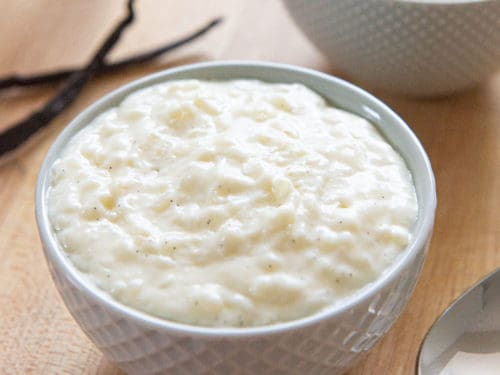
Rice Pudding

0

Rice pudding is a meal cooked from rice, water, or milk, and other ingredients including cinnamon, vanilla, and raisins.

The sweet, rich, and creamy concoction is absolutely delicious. It’s got to be the fact that it’s created with simple components like rice, milk, sugar, and eggs.

While this is a dessert, it does have some nutritional advantages, including proteins and calcium.

How To Make Rice Pudding

Rice puddings can be found almost anywhere in the world. Even within a single country, recipes can differ widely. The dessert can be prepared either boiled or baked.

Rice Pudding Ingredients

Depending on the technique of preparation and the ingredients used, different types of pudding exist. Rice puddings often contain the following ingredients:

  • White rice: Any variety of rice will do.
  • The heavy whipping cream  adds to the creamy flavor of the pudding as well as the thickening process.
  • Spices like cardamom, nutmeg, cinnamon, ginger, or other
  • Flavorings and toppings eg vanilla, orange, lemon, rose water; pistachio, almond, cashew, raisin, walnut, etc.
  • Sweetener eg sugar, brown sugar, honey, sweetened condensed milk, dates, fruit or syrups.
  • Eggs (optional)

Variations Of Rice Pudding

The variations of this dish are used for desserts or dinners. It is usually paired with a sweetener like as sugar when consumed as a dessert. These treats can be found on many continents, particularly in Asia, where rice is a staple. Some versions are merely thickened with rice starch; others incorporate eggs, making them a type of custard.

Rice Pudding

Holly Nilsson (Spend With Pennies)
Prep Time 15 minutes
Cook Time 20 minutes
Servings 4

Ingredients
  

  • 1 ½ cups white rice cooked
  • 2 cups milk divided
  • cup sugar
  • pinch salt
  • 1 egg
  • cup raisins
  • 1 tablespoon butter
  • ½ teaspoon vanilla
  • cinnamon
  • nutmeg

Instructions
 

  • Mix the cooked rice, 1 ½ cups milk, sugar and salt. Cook uncovered over medium heat for about 15-20 minutes.
  • Whisk egg and remaining milk in a bowl. Add about 1 cup of the hot rice mixture to the egg while stirring.
  • Stir the egg mixture and raisins into the rice. Cook 2 minutes more.
  • Remove from heat and stir in butter and vanilla.
  • Serve warm and garnish with whipped cream and a sprinkle of nutmeg and cinnamon
Tried this recipe?Let us know how it was!


Mealie Pap

0

In South Africa, mealie pap is pap or porridge is a breakfast meal made from milled white maize that is enjoyed by people of all ages. When the household can afford it, it is eaten simply with sugar and milk, or with golden syrup and butter.

Children love this maize porridge a lot. In fact, you can tag this dish ‘children’s favorite’ with a lovely maple butter sauce to spread on top, elevating nursery food to a whole new level.

This porridge can also be served as a savory dish, similar to congee, with chopped spring onions and sliced cooked eggs.

Is Mealie Pap Good For You?

South African mielie meal porridge or pap contains important micronutrients and they include;

  • Iron – aids in the prevention of iron deficient anaemia.
  • Vitamin A – aids in the health of the eyes, mouth, intestines, and lungs, as well as in the fight against infections.
  • B vitamins – aid in the regulation of metabolism and the release of energy

How To Make Mealie Pap

This Creamy Breakfast Mielie pap, is the South African equivalent of creamy polenta porridge, cornmeal porridge, or creamy breakfast grits. Ugali, Sadza, and Nsima are some of these varieties in other African countries.

It is one of the greatest first porridges for your infant. The smooth texture makes it easy to swallow, and the bland flavor is well accepted and tolerated by most babies.

It is custom prepared using dried white maize, which the Portuguese introduced to Africa from South America. It is available in coarse or fine varieties depending on its application and is not as fine as cornflour / cornstarch.

To serve, room temperature or lukewarm porridge is required and the leftover porridge can be stored in an airtight jar in the fridge for up to 5 days.

Mealie Pap

Ishay Govender-Ypma
Servings 0

Ingredients
  

  • 1 liter water
  • 1 cup white maize meal Tip: You can find maize or mealie meal at South African stores, or you can substitute with grits, cornmeal or polenta.
  • ½ teaspoon sea salt
  • 1 cup whole or low fat milk warm, plus extra if needed
  • Brown sugar to taste

Instructions
 

  • Boil the water in a kettle. Add the water and maize meal to a large cast iron or heavy-bottomed pot, and heat slowly bringing to the boil while stirring continuously with a wooden spoon so no lumps form, for about 10 minutes. It will make little “plop” sounds as it thickens and cooks. The porridge should be smooth.
  • Lower the heat and cover the pot with a lid and allow the porridge to simmer for 40 minutes. You’ll need to lift the lid and stir frequently to ensure it doesn’t catch or burn at the bottom.
  • While the porridge is cooking, add maple syrup to a small saucepan and heat on medium. It will immediately start to bubble. Be careful not to let it burn. Once it starts to bubble a little, remove from the heat. Add the butter and stir slowly with a spatula until it melts. Set aside.
  • The porridge should be very smooth and thick now, but not stiff (expect a “gloopy” consistency). Grits, if using, will retain a characteristic grainy feel, but should also be plump and smooth. Stir in the milk. The consistency will depend on your preference—some prefer a thicker porridge and others a runnier version.
  • Serve hot with sprinkle of sugar and a drizzle of maple butter syrup.
Tried this recipe?Let us know how it was!

QUICK RECIPES