Akod

Akod is the epitome of Tunisian Jewish cuisine. It is prepared with tripe skillfully scented with cumin, garlic, tomato paste, and harissa.

What is Akod?

Akod or akoud is an ancestral dish and the epitome of Tunisian Jewish cuisine. No Tunisian Jew will receive at his table for a royal kemia without banatagesbriksfricassésminina, or akod!

Akod is tripe dish that is fragrant with cumin, garlic, tomato sauce, and harissa.
Poor tripe and offal, which have had rocky road in recent years! Eating cow’s offals or heart is not pleasant experience for everyone.

While, on the one hand, older generations have never ceased to appreciate them, on the other hand, the youngest has seriously been shying away from these delicacies.

Yet, despite initial hesitation, often even the pickiest eaters are conquered after the first spoon. A number of them are irreversibly converted to the wonderful taste and texture of tripe.

Akod Recipe

For the akod, add some large intestine, as well as the genitals and the penis.

Most of the time, butchers offer washed and bleached tripe. So they say they are “half-cooked”. Less often, they are sold raw, so it will be necessary to scald them for at least 3 hours by changing the water many times. To prepare this recipe, beef tripe is generally used.

Recipe Variations

Many recipes identical to the Tunisian Jewish recipe can be found in Morocco, Algeria, and Tunisia, each with its unique flavor.

In Morocco, it is called douara (dwara) or t’qualia. It is sometimes also called kercha. Douara is prepared with mutton tripe, rarely with beef tripe, and it is cooked more or less with the same spices and ingredients as akod.

In Algeria, it is called bakbouka or also douara (or dowara). It is also mutton tripe, but vegetables such as carrots, zucchini, and chickpeas are added to the Algerian bakbouka.

In Oran, in the Northwest of Algeria, people make chkamba (or chkembey), a tripe dish with cumin, paprika, thyme, cilantro, and bay leaves.

Tunisians call it chmenka. Chmenka is prepared with lamb tripe too. To prepare it, people use the same ingredients as akod but also add lamb’s heart, lamb liver, potato, and chickpeas.

The Jewish community in Morocco also has its akod. It is called tajine al guezar, which means “the butcher’s pot”. This delicious version is also prepared with cumin and paprika but without tomato paste.

In some regions of Morocco, tiny beef dumplings are added to the tripe and in others, pieces of liver and heart, or even both, sometimes in addition to the beef dumplings.

In Morocco, it is a popular dish during Pesach (Passover) when it is generally cooked for nearly 10 hours, over low heat on hot coals.

Be brave and try this sumptuous delicacy! Akod is a dish for connoisseurs and epicureans! Just give it a try and you will be very pleasantly surprised! Enjoy!

Akod (Akoud)

Vera Abitbol
Akod is the epitome of Tunisian Jewish cuisine. It is prepared with tripe skillfully scented with cumin, garlic, tomato paste and harissa.
Prep Time 30 minutes
Cook Time 6 hours
Course Main Course
Cuisine north african, Tunisian
Servings 8

Equipment

  • Dutch oven

Ingredients
  

  • 4 lb tripe abomasum, bonnet, leaf tripe, large intestine, penis and genitals
  • 1 cow's trotter
  • 1 head garlic peeled and chopped
  • 2 tablespoons tomato paste
  • 1 tablespoon paprika
  • 2 tablespoons harissa
  • 3 teaspoons ground cumin
  • ½ cup olive oil
  • Salt
  • Pepper

Instructions
 

  • Thoroughly rinse the tripe and cow's trotter, and rub vigorously between both hands. Drain and cut into pieces.
  • Cook the tripe and the cow's trotter in a large volume of boiling salted water for 1h30 by changing 3 times the cooking water (the water must always be boiling).
  • Reserve the last cooking water and drain the tripe and cow's trotter.
  • In a cast iron pot or Dutch oven, pour the olive oil and heat it over medium heat. Fry the tripe and cow's trotter in this oil for 5 minutes, stirring regularly.
  • Add garlic, paprika, tomato paste, salt, pepper, harissa and half of the cumin. Stir well.
  • Pour the reserved cooking liquid at a height of 1 inch (3 cm) above the tripe. Reserve the rest of the cooking juices.
  • Cover and cook for 30 minutes over low/medium heat.
  • Then reduce the heat and cook covered and over very low heat for 4 hours.
  • During cooking, if the sauce is lacking in the pot, add some of the reserved (boiling) cooking water in small amounts each time.
  • If there is no sauce and no more cooking juices, add boiling water, always in small amounts.
  • Ten minutes before the end of cooking, add the other half of the cumin.
  • Serve very hot by placing a few pieces of mixed tripe in a dish on a generous bed of sauce.
Tried this recipe?Let us know how it was!

Droewors

0

Droewors is a dried jerky sausage from South Africa that is modeled on the iconic boerewors sausage. It is cooked with beef or mutton, sheep tail fat, coriander, vinegar, and a variety of spices. It is occasionally flavored with garlic or chili peppers. These thin sausages are swiftly dried to simulate the hot South African weather.


Droewors

St. Marcus
Servings 0

Ingredients
  

  • 3 kg of lean beef or lamb
  • 300 g of fat
  • natural sheep casings
  • coriander cloves, nutmeg and black pepper in any proportion you like.

Instructions
 

  • Mix together the meat and the fat. The less fat you use, the leaner wors will be. Note: if you use too little fat, the droëwors could become dry.
  • Pre-cool the mixture at 2 C.
  • Mince the meat and add spices to the mix. Put it in the fridge for 3 hours so the spices can sink in.
  • Mix again and then mince again this time through 4.5 mm plate on mincer.
  • Fill the sheep casings with the mixture without letting any air in.
  • Dry the droëwors at 30 C with UV light for 24 hours. Then switch off the light.
  • Hang droëwors to dry on a plastic or metal hook. Do not allow contact between the raw meat and wood.South African droewors on a cutting board with herb garnish
  • Dry droëwors for 5 days.
Tried this recipe?Let us know how it was!

Garantita

Garantita is a popular Algerian street food that is consumed as a snack and prepared as a kind of cake or tart.

Garantita has become this popular food with a special place in everyone’s heart, due to its taste and ease of preparation.

Origin of Garantita

La Garantita, or more commonly known as Calentica in Oran, originates from this city but was invented by the Spaniards.

The legend says that it would be a preparation resulting from a chance. Spanish soldiers, present at the fort of Santa Cruz in the 18th century, would one day have run out of provisions.

All they had left was chickpea flour, water and oil. Faced with this situation, the cook had the idea to mix these foods, which resulted in a hot dish hence the name given to it.

It is the poor man’s sandwich or as called in Algiers el kebda el beida (white liver) it is eaten with harissa and powdered cumin.

The recipe is relatively simple and very easy to prepare, a gluten-free dish that can be enjoyed all year round.

Garantita Recipe

Prepared from ground chickpeas and eggs, this recipe is among the most famous dishes in Algeria, as you will not find a “fast” restaurant in Algiers that does not offer it to customers.

The dough is made with a combination of chickpea flour, oil, spices, and water. It is then covered with a beaten egg and baked in the oven until golden brown. It is typically served hot, dressed with harissa and cumin.

Depending on the region, its name differs, we find it under the name of Garantita (Algerian), karantita, calentica, karen, or el hami (western Algeria).

Algerians like to taste it in half a baguette, sprinkled with salt, pepper and cumin. For lovers of the spicy taste, they add Harissa (mashed red peppers).

The rule is that this recipe is always eaten hot and never cold! For a complete menu, a good lemonade made in Algeria would be ideal!

Be Sure to Try These Other Authentic Algerian dishes!

Be sure to recreate this incredible Algerian street food. Bon appétit!

GARANTITA (ALGERIAN CHICKPEA PIE)

Cookie16
Total Time 1 hour 15 minutes
Course Main Course
Cuisine Algerian
Servings 10

Ingredients
  

  • 2 cups chickpea flour
  • 4 cups water
  • 1 ⁄2 cup oil not olive oil
  • 1 tablespoon salt
  • 1 ⁄4 teaspoon black pepper
  • 1 egg beaten
  • ground cumin for sprinkling
  • harissa optional

Instructions
 

  • Combine flour, water, oil, salt and pepper in food processor until mixture is smooth.
  • Pour into glass or metal pan at least 6x10-inch.
  • Pour the beaten egg over.
  • Bake 375° for 1 hour or until top becomes golden.
  • Sprinkle with cumin.
  • Slice and serve on baguette with harissa or other hot sauce.
Tried this recipe?Let us know how it was!

Mtewem

Mtewem is a traditional Algerian dish, present during the holy month of Ramadan or on great occasions such as weddings.

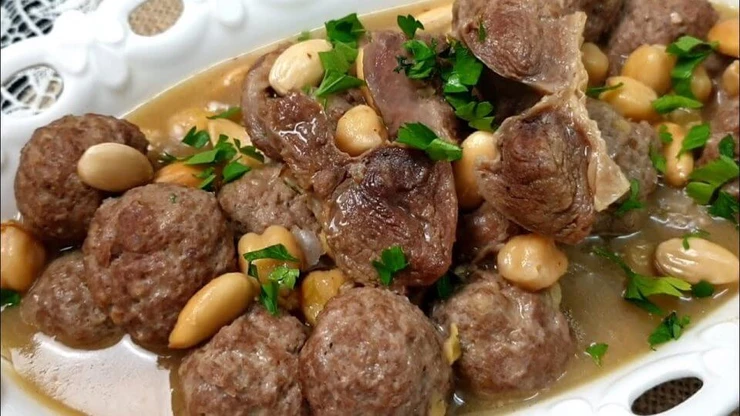
Most families always make this dish with a spicy red sauce. This dish consists of meatballs filled with garlic and cumin, extremely aromatic.

What is Mthawem?

Mtewem or Mthawem  (Arabic مثوم ) is an Arabic word that means “ with garlic” It is mainly made of meat ( lamb, beef, or even chicken), meatballs ( lamb or beef), and garlic ( Arabic ثوم ). This dish is fragrant with cumin.

This dish is originally from the capital city of Algiers and the original recipe is made with white sauce.

Mtewem Recipe

This delicious dish is made from a large amount of garlic. The dish is also used to add flavor to the meat and cut into medium-sized pieces alongside some salad scented with spices.

Mtewem can be prepared with red sauce or white sauce. I added turmeric to the white sauce as in my opinion it looks and tastes better ( personal choice).

First, prepare the meatballs by mixing all the ingredients and forming walnut-size meatballs. Cover with plastic wrap and refrigerate.

Prepare the meat sauce: Put oil and ghee in a large saucepan. Add the minced onion, garlic, meat, chickpeas, cumin, salt, and pepper and cook for 2 to 3 minutes on medium heat, then lower the heat and let cook for a good 10 minutes. Make sure to stir from time to time.

Add boiled water to cover the meat. Increase the heat until the sauce boil then decrease it again to medium.

Let cook for about 30 minutes or until the meat and chickpeas are cooked. Add the meatballs to the sauce and let cook for 15 to 20 minutes on medium-low.

Storage and Reheating

Mthawem can be refrigerated for up to 4 days. Reheat in the microwave on full power (covered) or on the stovetop over medium-low to medium heat, stirring occasionally.

Be Sure to Try These Other Authentic Algerian dishes!

Be sure to recreate this incredible delicacy that is not only delicious but also full of proteins, fiber, and tons of vitamins like iron and calcium needed for your body. Bon appétit!

Algerian Meatballs in a Chickpea Sauce – Mtewem

LDS’s Mom
Meatballs with chickpea sauce
Prep Time 20 minutes
Cook Time 1 hour 10 minutes
Course Main Course
Cuisine Algerian
Servings 4

Ingredients
  

For the meat sauce

  • 1 lb beef
  • 2 cups chickpeas
  • 6 cloves garlic minced
  • 1 small onion minced
  • 1/2 tsp turmeric
  • 1/4 tsp cumin
  • 1 tsp salt or to taste
  • 1/4 tsp black pepper
  • 1 tbsp olive oil
  • 1 tbsp ghee
  • Chopped parsley for garnish I like to use cilantro

For the meatballs

  • 1 lb ground beef
  • 3 cloves garlic minced
  • 1/4 tsp garlic powder
  • 1/4 tsp cumin
  • 1/4 tsp black pepper
  • 1/2 tsp salt
  • 1 egg white

Instructions
 

  • First, mix the meatballs ingredients (you may not need to use the whole egg white but the mixture should be very soft) and form walnuts size meatballs. Set aside.
  • Prepare the meat sauce: put oil and ghee in a large saucepan over medium heat.
  • Add the meat pieces, the minced onion, garlic, chickpeas, cumin, turmeric, salt and pepper.
  • Let cook for a good 10 minutes. Make sure to stir from time to time.
  • Cover the meat with boiled water.
  • Let cook covered until the chickpeas and meat are cooked (on medium heat).
  • Reduce the heat to low and add the meatballs.
  • Let cook for about 15 to 20 minutes on low. Adjust the seasoning and add salt if needed. The sauce should be reduced and thickened.
  • Garnish with chopped parsley (I like to use cilantro too).
  • Serve.

Notes

You can place a whole almond (blanched) in each meatball, then put the garnished meatballs in the sauce (optional).
Some recipes calls for cinnamon ( I don’t like it in this recipe). You can add cinnamon powder to the meatballs and cinnamon stick to the sauce if you like it.
Tried this recipe?Let us know how it was!

Chtitha Batata

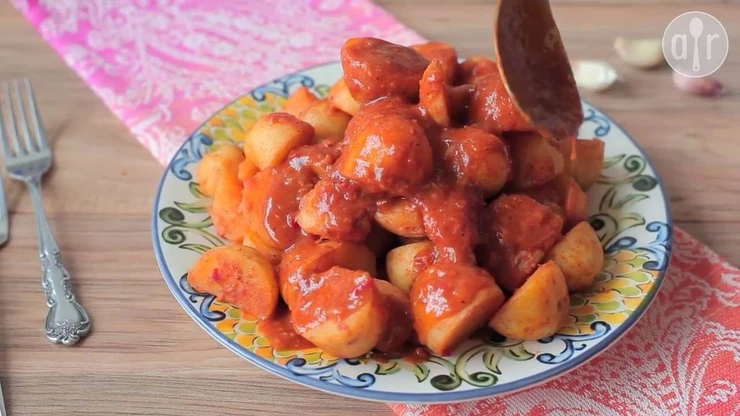
Chtitha Batata is an authentic Algerian potato stew made with dersa, spicy chile, and garlic paste.

It’s delicious on its own as a vegan or vegetarian main or served as a side to meat or fish. An easy way to enjoy North African cuisine at home with easy-to-find ingredients!

Chtitha Batata Recipe

Chtitha Batata consists of a base of potatoes cooked in a red sauce of onions, tomato puree, paprika, and chickpeas.

Meat can also be used in the sauce. Seasoned with salt, pepper, and cummin, the broth is cooked until thick and then poured over the potatoes.

The steps to make this recipe are very easy!

  1. Mix garlic, hot pepper, cumin, paprika, black pepper, cayenne, and salt into the mortar; grind with a pestle until it forms a paste.
  2. Add the olive oil and mix the dersa well.
  3. Heat a large saucepan over medium heat and stir-fry dersa until fragrant, 2 to 4 minutes. Add the potato halves and stir to combine with the dersa.
  4. Add the tomato paste. Pour in enough water to cover the potatoes and bring to a boil. Reduce heat and simmer until potatoes are soft, about 40 minutes.
  5. Serve the potatoes in a serving bowl. Put the rest of the sauce over the potatoes.

Storage and Reheating

Chtitha Batata can be refrigerated for up to 4 days. Reheat in the microwave on full power (covered) or on the stovetop over medium-low to medium heat, stirring occasionally.

Be Sure to Try These Other Authentic Algerian dishes!

Be sure to recreate this incredible delicacy! Bon appétit!

Chtitha Batata (Algerian Potato Stew)

This authentic Algerian potato stew is made with dersa, a spicy chile and garlic paste. It's delicious on its own as a vegan or vegetarian main, or served as a side to meat or fish. An easy way to enjoy North African cuisine at home with easy-to-find ingredients!
Prep Time 10 minutes
Cook Time 45 minutes
Course Dinner, Lunch
Cuisine Algerian
Servings 4

Ingredients
  

  • 4 cloves garlic peeled and halved
  • 1 small fresh red chile pepper seeded and chopped
  • 1 teaspoon ground cumin
  • 1 teaspoon paprika
  • ½ teaspoon black pepper
  • ½ teaspoon cayenne pepper
  • ½ teaspoon salt
  • 2 tablespoons olive oil
  • 1 ½ pounds new potatoes halved
  • 1 tablespoon tomato paste
  • water to cover
  • salt to taste

Instructions
 

  • Combine garlic, chile pepper, cumin, paprika, black pepper, cayenne, and salt in a mortar; grind with a pestle until it forms a paste. Add olive oil and mix dersa well.
  • Heat a large saucepan over medium heat and stir-fry dersa until fragrant, 2 to 4 minutes. Add potato halves and stir to combine with the dersa. Stir in tomato paste. Pour in enough water to just cover the potatoes and bring to a boil. Reduce heat and simmer until potatoes are tender, about 40 minutes.
  • Ladle potatoes into a serving bowl. Spoon any remaining sauce over the potatoes.
Tried this recipe?Let us know how it was!

Dolma (Stuffed Grape Leaves)

This recipe is all you need to make the best dolmas/ stuffed grape leaves! These flavor-packed grape leaves are stuffed with a tantalizing mixture of rice; meat; and loads of fresh herbs and warm spices, then cooked in a bright lemony broth

What is Dolma?

It derives its name from the Turkish word dolmak, meaning to be stuffed.

Dolma is stuffed vegetables such as zucchini, tomato, pepper, onion, garlic, eggplant grapes, or cabbage leaves, stuffed with minced meat, and cooked in a white sauce flavored with cinnamon.

However, many other vegetables can be used too, including carrots, peppers, and tomatoes. Grape or cabbage leaves are mostly used for wrapping this delicacy.

Stuffed Grape Leaves (Dolmas)Recipe

Now, you’ll find many variations of stuffed grape leaves recipes, from Turkey and Greece to Lebanon, and Egypt where it’s called Warak Enab (Grape Vine Paper.)

Some recipes contain meat, others vegetarian. Some contain tomato sauce, and others are cooked in a lemony broth.

Our recipe is so easy to make and can be made in these easy steps:

  • Prepare the Grape Leaves
  • Prepare the stuffing
  • Stuff and roll grape leaves
  • Assembles grape leaves in the cooking pot
  • Cook grape leaves

Tips for Making the Best Dolma Recipe

Here are a few important tips for making grape leaves:

1. Soak The Rice in Water Before Using in the Stuffing. Two important ingredients of our grape leave stuffing here are cooked ground beef and rice.

It’s important to rinse the rice well to get rid of excess starch which causes the rice to be sticky. Then soak the rice for 20 minutes or until you can break one grain of rice by pressing it between your index finger and your thumb.

This way, your rice cooks evenly as the interior of the grain cooks before the exterior loses its shape.

2. Do NOT Over Stuff the Grape Leaves! Don’t over-stuff the grape leaves, remember that the filling is mostly of rice and it will expand as it cooks.

3. Roll tightly BUT allow for room for expansion.  Roll the grape leaves tightly enough so that they don’t unravel or become undone while cooking, but again remember rice will expand as it cooks so don’t fold too tightly or the rice won’t cook properly.

4. Keep the Grape Leaves from Floating or Unraveling While Cooking. To do this, make sure the grape leaves are assembled in your pot with the seam-side down.

Then, add a small inverted plate on top of the assembled grape leaves in the pot to help keep them intact and prevent them from floating while cooking. Once the liquid has been absorbed, you can remove the plate to finish cooking as instructed.

5. Let Cooked Grape Leaves Rest for 30 minutes before serving. I know, it’s so hard not to immediately dig into those tasty grape leaves! But for best results, allow them to rest for 20 to 30 minutes so that any remaining liquids are absorbed and the leaves set nicely, plus they just taste better.

Storage

Once cooled, the cooked dolmas can be stored in the refrigerator for five days, or frozen for three months.

You can also form the dolmas and freeze them before cooking; just be sure to wrap them well before freezing.


Tajine Zitoun

Tajine zitoun is a traditional Algerian dish made with a combination of chicken pieces, olives, onions, carrots, mushrooms, thyme, bay leaves, lemon juice, and saffron or turmeric, flour, and lemon juice are mixed at the end of the cooking process.

The dish is usually cooked in a tagine and garnished with cilantro, and served hot with saffron rice on the side.

If you are looking for something different for iftar, this Tajine Zitoun recipe makes the deal.

Tajine Zitoun Recipe

This traditional Algerian chicken stew is very easy to prepare. By the look of the dish, you will be forgiven if you mistake it for Moroccan Tagine. However, just like Moroccans, Algerians mostly use earth-ware pots to prepare food.

What makes Algerian cuisine unique is its creativity when mixing the spices, and this Zitoune recipe is not an exception. The meal boasts of its vibrant and pleasant flavor enough to invigorate your taste buds.

Today, this post brings this amazing delicacy right to your kitchen, so get cooking!

Algerian Tajine Zitoune Recipe

Tajine Zitoune or Algerian Tagine Zaytoun is a delicious main course meal from Algerian cuisine. It is often served with iftar as well as on various occasions. Imagine you are going to enjoy boneless chicken with essencethe of olives and bones of the chicken. It makes it simply amazing.
Prep Time 15 minutes
Cook Time 40 minutes
Course Main Course
Cuisine Algerian
Servings 4

Ingredients
  

  • 1 pcs onion chopped
  • 1 pcs carrot sliced
  • 2 tbsp vegetable oil
  • 2 cups green olives without seeds wash it very well before using to reduce the amount of salt
  • 1 tsp black pepper
  • as per taste salt
  • Ingredients for Cooking Chicken
  • 1 whole chicken chest
  • 1/2 tsp black pepper
  • 2 tbsp parsley
  • 1 tbsp butter
  • 2 cloves garlic
  • as per taste salt

Instructions
 

  • Before starting, remove the bone from the chest of chicken, and make thin slices.
  • In a simple pot, put the vegetable oil, the shopped onion, carrots, salt, black pepper, the bone of the chicken and the green olive and stir very well on a low heat for about 3 minutes.
  • Then put 3 glasses of water, and let it boil till the olives are cooked.
  • After that, in a pan put one tablespoon of butter and put the slices of chicken, salt, half teaspoon of black pepper, 2 cloves of garlic, 2 tablespoons of parsley and stir till the chicken get the color of gold.
  • After that put the mixture in the pot in to the pan with the chicken and let them boil for about 5 minutes.
  • When the Tagine is ready remove the bone and serve.
Tried this recipe?Let us know how it was!


Beghrir Pancakes

Beghrirs are Moroccan pancakes served with honey-butter sauce. Best during Ramadan for breaking the fast or pre-dawn, but certainly great anytime.

What is Beghrir?

Beghrir or baghrir is a tender, spongy, melt-in-your-mouth Moroccan pancake made from semolina.

Yeast in the crepe-like batter causes hundreds of bubbles to form and break on the surface of each pancake as it cooks. This gives baghrir its unique texture and appearance.

Beghrir Recipe

Beghrir is usually cooked only on one side. Although baghrir are normally cooked only on one side, in some regions of Morocco, they are flipped over for just a moment to help dry out the top.

Prepared this way, they might be referred to as khringos, although in Casablanca that term is the name for tiny fritter-like Moroccan churros.

A very similar pancake is used to make Arab qattayef or atayef, which utilizes the lacy pancakes as a wrap for various fillings. Although not traditional, Moroccan baghrir can certainly be used in the same way.

Fine semolina or durum flour is usually regarded as the key to a good baghrir. You’ll find recipes that use all semolina or part semolina, but all should have the yellow color associated with the semolina.

The smaller the ratio of semolina to other flours, the less yellow the result will be.

Years ago, beghrir batter needed to rest quite a while before it was ready to use. The introduction of baking powder to the batter sped things up considerably, so you’ll sometimes see recipes using it labeled as “instant beghrir.” Some versions include eggs and milk; others do not.

How To Serve Beghrir

Beghrir is rarely eaten plain. Instead, a sweet topping transforms them into a special breakfast or tea time treat.

Moroccans are most likely to enjoy them dipped in a syrup made from butter and honey; or they might be served with butter, honey, and preserves or jam on the side.

Storage

Leftover baghrir are best stored in the freezer, with a small piece of plastic wrap or wax paper between each pancake.

Be Sure to Try These Other Authentic Moroccan dishes!

Be sure to recreate this incredible delicacy that is not only delicious but also full of proteins, fiber, and tons of vitamins like iron and calcium needed for your body. Bon appétit!

Beghrir (Moroccan Pancakes)

rie1975
Moroccan pancakes are served with honey-butter sauce. Best during Ramadan for breaking the fast or pre-dawn, but certainly great anytime.
Prep Time 10 minutes
Cook Time 35 minutes
Course bread, Breakfast
Cuisine Moroccan
Servings 6
Calories 354 kcal

Ingredients
  

  • 1 cup warm water 115 degrees F/46 degrees C
  • ½ teaspoon active dry yeast
  • ½ teaspoon white sugar
  • 1 cup milk
  • 1 cup all-purpose flour
  • 1 cup semolina flour
  • 2 eggs
  • 2 teaspoons baking powder
  • 1 teaspoon salt
  • 6 tablespoons butter
  • ¾ cup honey
  • 1 teaspoon orange-flower water or to taste (Optional)

Instructions
 

  • Place the water, yeast, and sugar in a blender, and let stand without blending for 5 minutes, until the yeast softens and begins to form a creamy foam. Add the milk, flour, semolina flour, eggs, baking powder, and salt. Blend until the mixture is smooth, about 1 minute. Leave the mixture in the blender to rest for about 30 minutes.
  • Heat a 5-inch nonstick skillet over medium-low heat. Blend the pancake mixture for about 10 seconds, to remix, and scoop 1/4 to 1/3 cup of batter into the heated skillet. Cook the beghrir until bubbles have formed and popped, and the top of the pancake is no longer shiny, about 3 minutes. Do not flip. Adjust the heat as necessary so that the bottoms of the pancakes are just starting to brown when the tops are dry. Blend the batter for 10 seconds or so after cooking 3 or 4 pancakes, to keep the batter fluffy.
  • To make the sauce, place the butter, honey, and flower-water flavoring in a microwave-safe bowl, and microwave on High setting until the butter is melted and the honey is hot, about 1 1/2 minutes. Stir the sauce, and drizzle about 1 tablespoon over each warm pancake to serve.

Nutrition

Calories: 354kcal
Tried this recipe?Let us know how it was!

Msemen

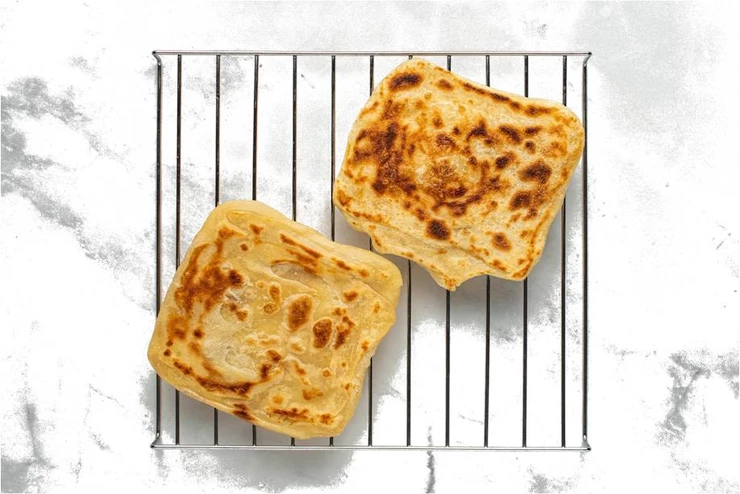
Msemen is a traditional flatbread made with a combination of flour, semolina, sugar, salt, yeast, warm water, oil, and clarified butter. The dough is kneaded until it becomes smooth, and pieces of it are then flattened and shaped into squares, and stuffed with various meats and vegetables or plain.

It is best served with coffee or tea. They are honestly one of the favorite things to eat!

What is Msemen?

Msemen is a fairly flaky, crispy Moroccan pancake (Rghaif) or flatbread that’s made from a combination of plain wheat flour and semolina.

The word Msemen means “oiled” in Arabic and you’ll see that it fits perfectly here, as we do use quite a bit of oil in the preparing and the cooking.

It very closely resembles a South Indian flatbread which is called Roti Prata.

The sweet version is topped with melted butter and honey. It’s sometimes called the Moroccan breakfast bread because it regularly makes an appearance on morning tables. Other people call them Moroccan pancakes but I think that title belongs to beghrir!

Moroccan Msemen Recipe

You usually hear me remark that taste is highly personal. To begin with, the amount of semolina used is a personal choice.

I only use a small amount for a touch of bite and texture, but you can experiment with the ratio after the first time. In reality, I know several Moroccans who just use semolina for sprinkling and not in the dough.

Msemen tastes best when served hot or warm. When it’s warm, it’s a little flaky, warm, it’s a little flaky, but when it’s cold, it’s chewy. Simply reheat on skillet or griddle with little oil for minute on each side to warm up.

Butter and semolina between the layers help keep the layers distinct, much like in a croissant. The butter is optional, I don’t always use it but the semolina is a must, it adds a lovely texture.

The more oil you use when cooking, the fluffier the msemen because it rises during cooking. Less oil gives a stiffer bread/pancake. We’re talking 2 Tbsp compared to say just 2 tsp.

Shall we get our aprons on?

Moroccan Msemen Recipe - Square Laminated Pancakes

CHRISTINE BENLAFQUIH
Msemen are a flat, square-shaped Moroccan pancakes usually served for breakfast or tea time. They're made by flattening rghaif dough on an oiled surface until paper thin, dotting it with butter and semolina, then folding it into thirds (twice) to shape a layered pancake. You can make the msemen ahead of time and keep in the freezer until needed. Measures for butter and oil are approximate quantities. Be prepared to use more or less for folding the msemen.
Prep Time 40 minutes
Cook Time 15 minutes
Course bread, Breakfast
Cuisine Moroccan
Servings 4
Calories 158 kcal

Equipment

  • Extra large mixing bowl
  • Stand mixer
  • Double griddle

Ingredients
  

  • 3 1/2 cups white flour - all purpose or bread
  • 1/2 cup fine semolina or durum flour
  • 2 tsp sugar
  • 2 tsp salt
  • 1/4 tsp dry yeast - less in very warm weather
  • 1 1/2 cups warm water - not hot

For Folding the Msemen

  • 1 cup vegetable oil - more if needed
  • 1/2 cup fine semolina - can use coarser caliber if you like
  • 1/4 cup very soft unsalted butter - more if needed

Instructions
 

Make the Msemen Dough

  • Mix the dry ingredients in a large bowl. Add the water and combine to make a dough.
  • Knead the dough by hand (or with a mixer and dough hook) until very smooth, soft and elastic but not sticky. Adjust water or flour as necessary to achieve that texture.
  • Divide the dough into balls the size of small plums. Be sure the top and sides of the balls are smooth. Transfer the balls of dough on an oiled tray, cover loosely with plastic and leave to rest for 10 to 15 minutes.
  • While the dough is resting, set up a work area. You'll need a large flat surface for spreading and folding the dough. Set out bowls of vegetable oil, semolina and very soft butter. Set your griddle or large frying pan on the stove, ready to heat up.

Shape the Msemen

  • Generously oil your work surface and your hands. Dip a ball of dough in the oil and place it in the center of your work space. Using a light touch and quick sweeping motion from the center outward, gently spread the dough into a paper-thin, roughly shaped circle. Oil your hands as often as needed so that they slide easily over the dough.
  • Dot the flattened dough with butter and sprinkle with semolina. Fold the dough into thirds like a letter to form an elongated rectangle. Dot again with butter, sprinkle with semolina, and fold again into thirds to form a square.
  • Transfer the folded dough to the oiled tray and repeat with the remaining balls of dough. Keep track of the order in which you folded the squares.

Cooking the Msemen

  • Heat your griddle or frying pan over medium heat until quite hot. Starting with the first msemen you folded, take a square of dough and place on your oiled work surface. Oil your hands and pat the dough firmly to flatten it to double its original size.
  • Transfer the flattened square to the hot griddle and cook, turning several times, until cooked through, crispy on the exterior and golden in color. Transfer to a rack.
  • Repeat with the remaining squares, working with them in the order in which they were folded. You can flatten and cook several at a time if your pan or griddle can accommodate them.
  • When each msemen has cooled for a minute or two, pick it up from opposite ends and gently flex it for a few seconds with a quick back and forth, see-saw motion. This helps separate the laminated layers from each other.
  • Serve the msemen immediately, or allow to cool completely before freezing.

Notes

  • You can make msemen as small or as large as you like. I prefer to keep them small as described here.
  • If you don't have a double griddle, use two or three frying pans on different burners for more efficient cooking.
  • Instead of all vegetable oil, you can use a mix of oil and melted butter. 
  • Some of the white flour can be replaced by whole wheat flour. Adds nice flavor, but the final product might not be as crispy.
  • You can also use a mix of half white flour and half semolina. It yields msemen with coarser texture. It's my preferred mix when making meloui, a round, coiled cousin of msemen.

Nutrition

Calories: 158kcal
Tried this recipe?Let us know how it was!

Tcharek M’saker

Tcharek M’saker is an occasional pastry that is prepared in Algeria for weddings. It is popular in Algiers, the capital of the country.

It consists of white flour, icing sugar (powdered sugar), and a pinch of salt; it is one of the tastiest pastries.

These cookies are a splendor on any celebratory table.

What is Tcharek M’saker?

Tcharek ( Arabic تشاراك ) means crescent and Msaker is the pronunciation of the Algerian Arabic word which means coated with sugar.

It is a crescent coated with sugar. They are also called “Cornes de Gazelle” in the French language ( English – Gazelle’s horns).

This Algerian traditional cookies are prepared for special occasions such as religious celebrations and weddings. They are served with tea or coffee.

There is a variety of the Algerian crescents or Tcherek such as Tcherek El Aryan, Tcherak M’aassel and Tcherek Nekkache. 

Tcharek M’saker Recipe

The basic dough for this recipe can be used to make several different variations (Tcherek bel  kawkaw – Tcherek with peanuts, Tcherek Masaker, Tcherek el Talia ( Icing covered horns), Tcherek m’assel (honeyed horns), but abut also Araïche (starfish), Kaakettes (crowns).

All these varations are simply delightfully delicious dainty little cookies. Filled with pulverized almonds made into a paste by adding fragant maz’har (orange blossom water) and sugar.

In traditional Algerian cooking, they use real honey and real butter for these desserts reserving them only for special occasions, but nowadays economics are made by using margarine and assila which is a sugar suryp.

Be Sure to Try These Other Authentic Algerian dishes!

Tcharek M’saker, Algerian Gazelle Horns

petitepaniere
Tcharek is an occasional pastry that is prepared in Algeria in weddings. It is popular in Algiers, the capital of the country. It consists of white flour, icing sugar (powdered sugar), and a pinch of salt; Tcharek is one of the tastiest pastries.
Prep Time 30 minutes
Cook Time 20 minutes
Course Appetizer
Cuisine Algerian
Servings 15

Ingredients
  

For the dough:

  • 300 g of all purpose flour/plain flour
  • 150 g of ghee or melted butter
  • 100 ml of water and orange blossom water mix 50ml each, mixed together
  • Pinch of salt
  • 8 g vanilla sugar

For the filling:

  • 300 g of almond powder
  • 150 g of caster sugar
  • Pinch of cinnamon powder
  • 1 tsp of soft butter
  • Orange blossom water

Instructions
 

Method for the dough:

  • In a large bowl, add the flour, the vanilla sugar, the salt and the ghee.
  • Start mixing all the ingredients together.
  • Slowly pour water+orange blossom water mix and continue to mix until you form a soft dough.
  • Refrigerate the dough for 30 minutes.

For the filling:

  • In a shallow bowl, add the almond powder, the sugar, the soft butter and the cinnamon.
  • Mix the ingredients with your fingers.
  • Add slowly the orange blossom water (spoon by spoon).
  • Mix until you obtain a paste.
  • Refrigerate for 30 minutes.
  • Remove from the refrigerator and roll small balls (12 grams each).
  • Proceed the same way for the rest of the dough.
  • Roll each small ball into a small log of 10 centimeters and set aside.

Method for the Gazelle Horns:

  • Line a large baking sheet with parchment paper.
  • Flour a clean surface.
  • Remove the dough from the refrigerator.
  • Flatten the dough with a rolling pin (very thin).
  • Make circle with a round cookie cutter (12 centimeters).
  • Place the stuffing on the edge of the circle.
  • Roll with your fingers to make a log, and then bend the sides to make the shape of a crescent (the edges should be thin, see as the picture).
  • Proceed the same way with all the circles.
  • Bake at 180C degrees for 30 minutes or until the bottom is gold.
  • Remove from the oven and allow to cool.

Method for the coating:

  • In a large bowl add 500ml of orange blossom water.
  • Dip each crescent into the orange blossom water and put them into a colander.
  • Proceed the same way for all the crescents.
  • In another bowl add icing sugar.
  • Coat each crescent into the icing sugar.
  • Repeat this procedure two times for a nice coating (wait one hour between the two coatings).
  • Serve these succulent pastries with coffee or a fragrant mint tea.
Tried this recipe?Let us know how it was!


QUICK RECIPES