Beghrir (Moroccan Thousand-Hole Pancakes)
Abuja, Nigeria · View all recipes
Overview
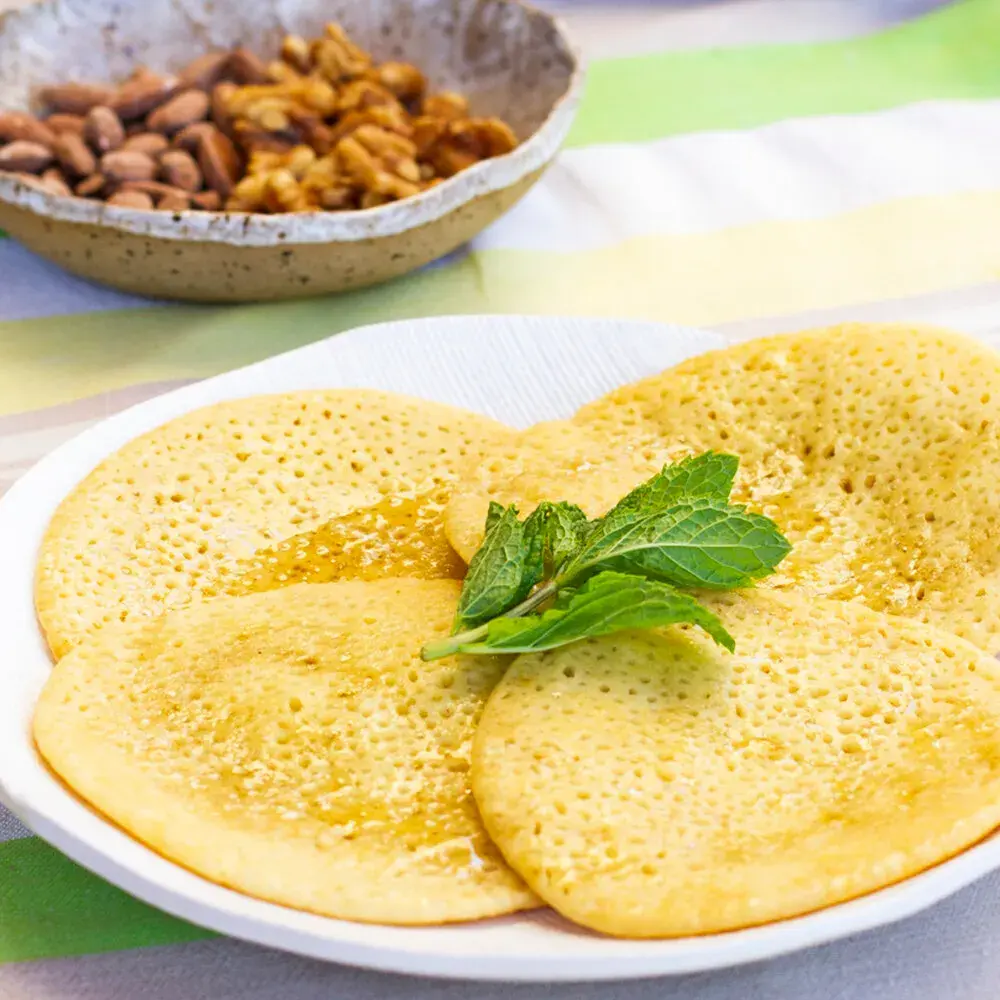
Beghrir are Moroccan semolina pancakes, cooked on one side only, whose entire surface opens into hundreds of small holes as they cook. They are served warm with a honey and butter sauce, and they are strongly associated with Ramadan, eaten at iftar to break the fast and at suhoor before dawn. The holes are the whole thing, and they are not decoration. Yeast in a thin, blended batter produces carbon dioxide; as the pancake sets on the hot pan, the bubbles rise and burst through the surface, leaving an open honeycomb that absorbs the sauce like a sponge. That is why beghrir is never turned over, flipping it would seal the holes shut and defeat the purpose. Some regions do flip them briefly to dry the top, and those are sometimes called khringos, though in Casablanca that word means something else entirely. Fine semolina is what makes it work, and it is also what gives beghrir its pale yellow colour. Recipes vary in how much they cut it with plain flour; the more semolina, the yellower and more characteristic the result. The batter is very similar to that used for Arab qatayef, the lacy pancakes folded around fillings. Beghrir can be used the same way, though it is not traditional.
AFN Heritage Note
Beghrir, also spelt baghrir, is a Moroccan semolina pancake cooked on one side so that bubbles from the yeasted batter open across its surface. It is served with honey and butter and is closely associated with Ramadan, eaten at iftar and suhoor.
Ingredients
Dietary tags are provided by contributors as a guide, not verified by AFN, and they depend on the products you buy. If you have a serious allergy, check every ingredient yourself. Cooking, allergies and your own judgement
Directions
- 1
Put the water, yeast and sugar in a blender and leave them to stand without blending for 5 minutes, until the yeast softens and foams.
- 2
Pour in the milk, flour, semolina, eggs, baking powder and salt, and blend until completely smooth, about a minute.
- 3
Leave the batter in the blender to rest for about 30 minutes.
- 4
Warm a 5-inch non-stick skillet over medium-low heat.
- 5
Blend the batter for about 10 seconds to remix it, then ladle 1/4 to 1/3 cup into the hot pan.
- 6
Cook until bubbles have formed and burst across the whole surface and the top is no longer shiny, about 3 minutes. Do not turn it over.
- 7
Adjust the heat so the base is just beginning to colour by the time the top is dry. Blend the batter again briefly after every three or four pancakes to keep it aerated.
- 8
For the sauce, warm the butter, honey and orange flower water together until the butter has melted and the honey is hot.
- 9
Spoon about a tablespoon of the sauce over each warm pancake and serve.
Africook’s Notes
 Personal notes from Amarachi Irobi
- Never turn them. Flipping seals the holes, and the holes are the entire point of beghrir.
- Blend the batter properly and re-blend as you go. Thin, well-aerated batter is what produces the honeycomb; a thick or settled batter gives you a plain pancake.
- Keep the heat medium-low. Too hot and the base burns before the bubbles have finished breaking through.
- Use fine semolina rather than coarse. Coarse semolina does not hydrate fully in the resting time and leaves a gritty texture.
- If the holes are not opening, the batter is too thick, thin it with a little more milk or water and try again.
- They are best warm from the pan. Stack them on a plate rather than a rack, since drying out is the enemy here rather than sogginess.
Questions cooks ask
Why are they full of holes?
Yeast in a very thin batter produces carbon dioxide, and as the pancake sets on the hot pan those bubbles rise and burst through the surface rather than being trapped inside. What is left is an open honeycomb across the whole top. It is not decorative, the holes are what let beghrir absorb the honey and butter sauce like a sponge, which is why the pancake is only ever cooked on one side.
Why don't you flip them?
Because flipping seals the surface and closes the holes, which removes the entire reason for making beghrir rather than an ordinary pancake. The top is cooked by the heat rising through the batter, which is why the method waits for it to lose its shine rather than turning it. Some Moroccan regions do flip them for a moment just to dry the top, and prepared that way they are sometimes called khringos.
What kind of semolina should I use?
Fine semolina, sometimes sold as semolina flour or durum flour. Coarse semolina will not hydrate fully in the resting time and leaves a gritty texture through the pancake. The semolina is also what gives beghrir its characteristic pale yellow colour, so the higher the proportion of semolina to plain flour, the more yellow and more traditional the result. This recipe uses equal parts of each.
When are beghrir eaten?
Most strongly during Ramadan, at iftar to break the fast and at suhoor before dawn, when something sweet, filling and quick to eat is wanted. They are also served at breakfast and with afternoon tea throughout the year. The honey and butter sauce is the standard accompaniment; some households serve them with jam or with amlou, the Moroccan almond and argan oil spread.
Reviews
Be the first to rate this recipe
Cooked it? Your rating helps the next person decide whether to try it.
No reviews on this one yet. If you have cooked it, yours would be the first.
You Might Also Like
Browse all Moroccan recipes →
Moroccan Chicken Rfissa
Tanjia Marrakchia
Chebakia (Moroccan Sesame Cookies)