
Koeksister (South African Syrup Doughnut)
Lagos, Nigeria · View all recipes
Overview
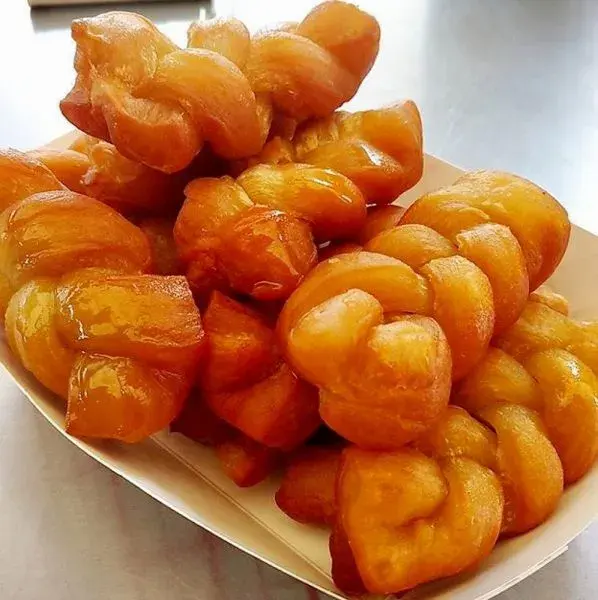
To make koeksisters, you plait strips of a simple baking powder dough, deep-fry them until dark golden, then drop them straight from the oil into ice-cold syrup. The cold syrup rushes into the hot pastry, so you get a crisp outside and a sticky middle. This koeksister recipe needs no yeast, just a simple baking powder dough. The hot-into-cold step is the whole technique, and you can't skip it. Warm syrup soaks the outside and leaves you with something soggy and limp. That's why the recipe splits the syrup in two, one half chilling over ice and the other in the fridge, and you swap them when the first lot warms up. It looks fussy, but the syrup warms up fast once you start dipping. Koeksisters are an Afrikaner sweet, and one of the best known in South Africa. Koek is the Dutch and Afrikaans word for a cake or pastry made from wheat flour; where the sister part comes from has never been settled. In Afrikaner communities they're traditionally baked to raise money for building churches and schools, and there's even a koeksister monument in Orania. Don't confuse them with the Cape Malay koesister, a softer, spiced ball of dough rolled in desiccated coconut.
AFN Heritage Note
Koeksisters are a South African Afrikaner confection of plaited dough deep-fried and immediately immersed in ice-cold syrup. The name derives from the Dutch koek, meaning cake. A separate Cape Malay koesister, spiced and rolled in coconut, is a distinct preparation.
Ingredients
Dietary tags are provided by contributors as a guide, not verified by AFN, and they depend on the products you buy. If you have a serious allergy, check every ingredient yourself. Cooking, allergies and your own judgement
Directions
- 1
Put the water, sugar and cream of tartar in a saucepan and bring to the boil. Mix in the lemon juice, along with the dried ginger and cinnamon stick if using, and keep it at a gentle boil for 10 minutes.
- 2
Let the syrup cool to room temperature. Pour half into a bowl and set it over ice to chill rapidly; put the rest in the fridge. Both halves need to be genuinely cold.
- 3
For the dough, sift the flour and baking powder into a bowl and rub in the margarine with your fingertips.
- 4
Beat the half egg into water and whisk to combine.
- 5
Make a well in the flour, pour in the egg and water, and mix to a smooth dough. Knead thoroughly.
- 6
Cover with cling film and rest for at least 15 minutes, or up to 5 hours.
- 7
Bring the oil to 160°C.
- 8
Roll the dough out on an oiled surface with an oiled rolling pin to 5 mm thick. Cut it into rectangles of 6 x 15 cm, then cut each rectangle lengthways into three strips, leaving one end uncut. Plait the strips and press the ends together firmly.
- 9
Fry in batches of six for 6 to 7 minutes, until dark golden brown. Drain briefly on paper towels and keep the unfried dough covered so it does not dry out.
- 10
Dip each koeksister into the ice-cold syrup while it is still hot from the fryer. Lift it out with a slotted spoon onto a wire rack.
- 11
The syrup warms up as you work, so swap in the batch from the fridge when the first has lost its chill.
Africook’s Notes
 Personal notes from Jennifer Ezeokoli
- Hot pastry into ice-cold syrup. This is the entire technique and warm syrup ruins it, you get soggy instead of crisp.
- Keep two batches of syrup going, one in use and one chilling. Swapping them is not fussiness; the syrup warms fast.
- Press the plaited ends together firmly. Koeksisters unravel in the oil otherwise.
- Keep the oil at 160°C, cooler than most deep frying, so the inside cooks through in the 6 to 7 minutes the outside needs.
- Oil the rolling pin and the work surface rather than flouring them. Flour on the dough burns in the oil.
- Keep unfried dough covered. It dries out quickly and dried edges will not plait or seal.
Questions cooks ask
Do you need yeast to make koeksisters?
You don't need yeast for this koeksister recipe: it uses baking powder, so there's no proving. You mix the dough, knead it, and rest it under cling film for at least 15 minutes or up to 5 hours.
How do you make koeksister syrup?
Boil 1.4 litres of water with 1.5 kg sugar and 12.5 ml cream of tartar, then add 40 ml lemon juice, plus a piece of dried ginger and a cinnamon stick if you like. Keep it at a gentle boil for 10 minutes and let it cool. Put half over ice and the rest in the fridge, because both need to be properly cold before you start frying.
Why does koeksister syrup have to be ice-cold?
Because the temperature difference is what makes a koeksister work. Hot pastry going into ice-cold syrup draws the syrup deep inside while the outside stays crisp. Warm syrup softens the outside, and you end up with something sticky and limp instead of crunchy with a syrupy centre.
What is koeksister in English?
There isn't really an English name; people just call them koeksisters, and you say it close to cook sister. Koek is the Dutch and Afrikaans word for a cake or pastry made from wheat flour; where the sister part comes from has never been settled.
What is the difference between a koeksister and a koesister?
They're two different sweets that get mixed up because of the names. The Afrikaner koeksister is plaited, crisp and soaked in cold syrup. The Cape Malay koesister is a softer, spiced ball of dough rolled in desiccated coconut.
Can you make koeksisters ahead?
Partly. The dough can rest for up to 5 hours before frying, and the syrup can be made a day or two early and kept in the fridge, which helps since it needs to be cold anyway. The finished koeksisters are best on the day: they stay crisp for several hours, then soften as the syrup moves outward.
Reviews
Be the first to rate this recipe
Cooked it? Your rating helps the next person decide whether to try it.
No reviews on this one yet. If you have cooked it, yours would be the first.
You Might Also Like
Browse all South African recipes →
Dombolo (Dumplings or Steamed Bread)
Boeber (Cape Malay Sweet Milk Drink)