

Afang Soup
Overview
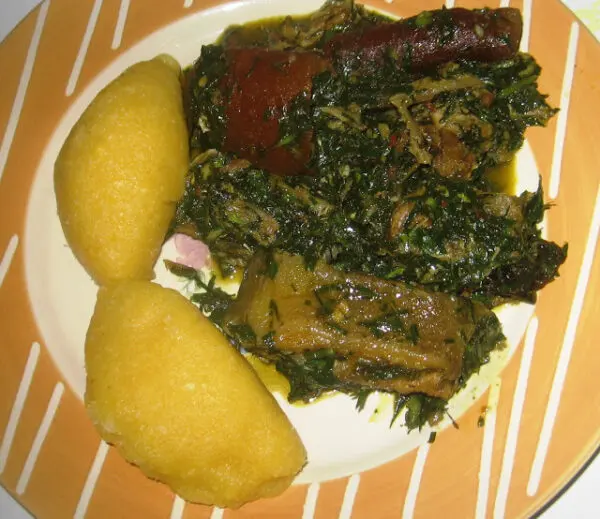
Afang soup belongs to the Efik and Ibibio people of Cross River and Akwa Ibom in southeastern Nigeria, and it is built on two vegetables that do quite different jobs. Afang, okazi to the Igbo, and known botanically as Gnetum africanum, is a tough, wiry forest leaf with a faintly bitter edge. It is sliced extremely finely, almost shredded, because whole it would be unpleasant to eat. Waterleaf is the counterweight: soft, quick to wilt, and full of moisture, which is what gives the soup its body without much added liquid. The pairing is the point, and it is what separates afang from edikang ikong, the other great vegetable soup of the same region. Edikang ikong uses waterleaf and ugu, the pumpkin leaf, and reads as sweeter and greener. Afang uses waterleaf and okazi, and carries that characteristic bitterness. People from the region can tell them apart instantly, and the leaf is the whole distinction. Around the vegetables sits an assortment that scales with the household budget, beef, shaki, dried and fresh fish, periwinkle, crayfish, palm oil, pepper. It is a soup that has long been read as a marker of a generous table, and it is served with any of the swallows.
AFN Heritage Note
Afang soup is documented as a dish of the Efik and Ibibio peoples of Cross River and Akwa Ibom States. The defining leaf, Gnetum africanum, is known as afang in Efik and okazi in Igbo, and its harvest from forest margins ties the dish to a specific ecology.
Ingredients
Dietary tags are provided by contributors as a guide, not verified by AFN, and they depend on the products you buy. If you have a serious allergy, check every ingredient yourself. Cooking, allergies and your own judgement
Directions
- 1
Slice the water leaves and set aside, slice Afang leaves, pound or blend it and set aside too, if you are using dry leaves it might be tougher than the fresh leaves, so try to grind it as fine as you can.
- 2
Cook the assorted meat and stock fish with onions, seasoning cubes and salt, cook until tender.
- 3
Remove the bones in the dry fish and add to the pot of cooked meat.
- 4
Add palm oil, pepper, ground crayfish and seasoning cubes to the pot.
- 5
Add the periwinkles that if you are using it, cover the pot and leave to boil for about 10 minutes.
- 6
Add the Afang leaves, leave to simmer for 5 minutes and then add water leaves.
- 7
Add salt and leave for 2 minutes.
- 8
Serve with any Nigeria swallow.
Africook’s Notes
 Personal notes from Jennifer Ezeokoli
- Slice the afang as finely as you possibly can. This is the single step that decides whether the soup is pleasant to eat, the leaf is fibrous and does not soften much in cooking.
- Add the waterleaf before the afang. Waterleaf releases moisture as it collapses, and the afang softens in that liquid rather than in added water.
- Go easy on added water. Between the waterleaf and the palm oil there is usually enough, and afang should be thick rather than soupy.
- Pound or blend the afang briefly if slicing by hand is not getting it fine enough, a few pulses is enough, more turns it to paste.
- The periwinkle is traditional and worth including if you can get it, but the soup works without it.
Questions cooks ask
What is the difference between afang soup and edikang ikong?
They come from the same region and look similar, but they use different leaves. Edikang ikong is made with waterleaf and ugu, the fluted pumpkin leaf, which gives a sweeter, greener soup. Afang is made with waterleaf and afang leaf, okazi in Igbo, which is tougher and slightly bitter. Both use the same kind of assorted meat and fish. If you have eaten both, the bitterness is what tells you which one is in front of you.
Can I use a different leaf if I cannot find afang?
Not really, if you want the dish rather than something like it. Afang, or okazi, is what gives the soup its identity. It is sold frozen and pre-shredded in African grocers outside Nigeria, which is usually the most practical route. Ugu will make you a perfectly good soup, but it will be closer to edikang ikong.
Why is my afang soup tough?
Almost always because the leaf was not sliced finely enough. Afang does not break down much during cooking, it is a forest leaf and it stays fibrous. It needs to be shredded very fine before it goes in. Cooking it longer will not fix it and will dull the colour of the rest of the soup.
What is it eaten with?
Any of the Nigerian swallows, eba, pounded yam, fufu, semo or amala. In its home region it is most often eaten with pounded yam or eba. It is a thick soup rather than a drinking soup, so it is not usually served on its own.
Reviews
4 reviews
You Might Also Like
Browse all Nigerian recipes →
Edo Black Soup
Nigerian Fisherman Soup
Igbo Yam Porridge
I bought dried okazi leaves from an African grocer near me, but my food processor couldn't get them ground finely enough. The soup ended up pretty chewy and fibrous even after boiling for 10 minutes with the water leaves. Should I soak the dried leaves in warm water first?
chale finding fresh afang in accra is not easy paa so I had to use the dry okazi leaves from Makola market. pounded it fine fine as you directed so it won't be tough in the mouth. it turned out very nice oo though my Nigerian housemate said my palm oil was too small haha
Used roughly 150ml of red palm oil and simmered the tripe and beef stock for about 45 mins until soft before adding the crayfish. The smoked fish gives it a lekker depth of flavor. Had to leave out the periwinkles as I couldn't source them in Durban.
Afang soup without plenty stockfish and shelled periwinkle is incomplete abeg! Made a big pot on Sunday with shaki and cow skin. The ratio of waterleaf to afang was spot on, e sweet no be small thing o.