Kuindiong (Dinka Sweetened Semolina)
London, United Kingdom · View all recipes
Overview
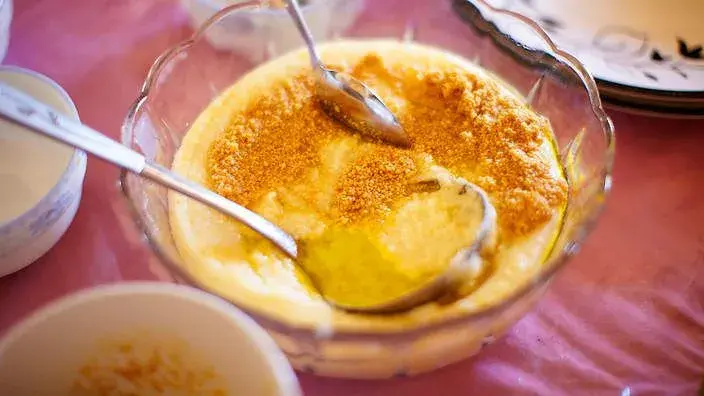
Kuindiong is semolina cooked with water, yoghurt, milk and sugar into a thick sweet porridge, served under miok, butter and yoghurt cooked together until they separate. It is a Dinka dish, made in South Sudan and southern Sudan, and it is served to welcome guests. The miok is the part worth paying attention to, because it is a technique rather than a topping. Butter and yoghurt cooked together and stirred constantly eventually break: the fat separates from the milk solids, and those solids brown into pale golden granules. What you pour over the semolina is browned butter with toasted dairy solids suspended in it, which is why it tastes nutty rather than simply of butter. Twenty minutes of constant stirring is what it takes, and taking it off the heat at the right moment, as soon as the granules turn a pale nutty colour, is the whole skill. The Dinka are a cattle-keeping people, and the quantity of dairy in this dish reflects that directly. Over a kilo of yoghurt and half a kilo of butter between the two components is a lot by most standards and entirely unremarkable in that context. The source appears to come from an Australian publication, its notes reference Australian cup measures, which is worth recording.
AFN Heritage Note
Kuindiong is a dessert of sweetened semolina made by the Dinka people of South Sudan and southern Sudan, served as a welcome dish for guests. It is topped with miok, a mixture of butter and yoghurt cooked until the two separate.
Ingredients
Dietary tags are provided by contributors as a guide, not verified by AFN, and they depend on the products you buy. If you have a serious allergy, check every ingredient yourself. Cooking, allergies and your own judgement
Directions
- 1
Bring the water to the boil in a saucepan and mix in the natural yoghurt.
- 2
Lower the heat, then work in the milk, semolina and sugar.
- 3
Keep turning the mixture until it thickens.
- 4
For the miok, melt the butter in a small saucepan over medium heat, then mix in the yoghurt.
- 5
Bring it to the boil, turning it constantly, and cook for 20 minutes or until the butter and yoghurt separate.
- 6
Take it off the heat the moment the yoghurt granules turn a pale, nutty colour. This is the point at which it is done, and it goes past it quickly.
- 7
Serve the kuindiong topped with the miok.
Africook’s Notes
 Personal notes from Nympha Nzeribe
- Do not stop stirring the miok. Twenty minutes of constant movement is what makes the butter and yoghurt separate cleanly rather than catch.
- Take the miok off the heat as soon as the granules turn pale gold. A minute longer and they burn, and burnt dairy solids are bitter throughout.
- Work the semolina in gradually. Tipped in all at once it lumps and the lumps do not disperse.
- The semolina thickens further as it stands, so take it off slightly looser than you want it.
- Full-fat yoghurt for both parts. Low-fat yoghurt splits badly and gives a thin miok.
- Make the miok while the semolina cooks, so both are ready together, neither reheats especially well.
Questions cooks ask
What is miok?
Butter and yoghurt cooked together until they separate, the fat splitting from the milk solids, which then brown into pale golden granules. What you pour over the kuindiong is essentially browned butter with toasted dairy solids suspended in it, which is why it tastes nutty rather than simply rich. It takes about twenty minutes of constant stirring, and the moment to stop is as soon as the granules turn pale gold.
Who are the Dinka?
The largest ethnic group in South Sudan, a cattle-keeping people of the Nile basin. That pastoral context explains this dish directly: over a kilo of yoghurt and half a kilo of butter across the two components is a great deal of dairy by most standards, and entirely ordinary in a culture built around cattle. Milk, yoghurt and butter run through Dinka cooking generally.
When is kuindiong served?
As a welcome dish for guests, which is how the source describes it. That framing matters, it is a dish of hospitality rather than an everyday dessert, and the quantity of butter and yoghurt involved is part of the message being sent. It is served as a dessert or a sweet course rather than as a breakfast porridge, despite the semolina base.
Can I use low-fat yoghurt?
Not really, and particularly not for the miok. The whole technique depends on there being enough fat present for the mixture to separate cleanly into browned butter and toasted solids; low-fat yoghurt splits messily and gives a thin, watery result. Full-fat natural yoghurt is what the recipe assumes throughout, and it is what makes both the semolina base and the topping work.
Reviews
Be the first to rate this recipe
Cooked it? Your rating helps the next person decide whether to try it.
No reviews on this one yet. If you have cooked it, yours would be the first.
You Might Also Like
Browse all South Sudanese recipes →
Papaya Smoothie for Weight Loss
Mozambique Matapa Recipe
Isombe