

Buttermilk Rusks
Aperçu
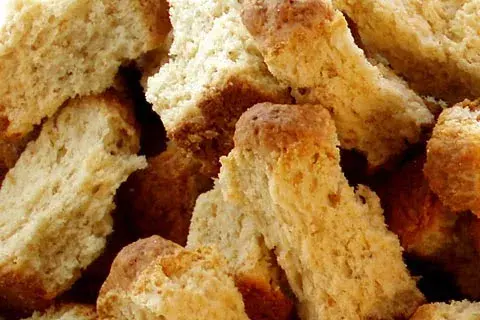
Rusks are twice-baked South African biscuits, dried until hard and dunked in coffee or tea. Dipping is not optional and not a matter of taste: a properly made rusk is too hard to bite comfortably, and softening it in a hot drink is how it is eaten. The method is what makes them. A soft dough, closer to a scone than a biscuit, is baked into rectangles, broken apart and then returned to a very low oven for around twelve hours to dry out completely. That second drying is the whole thing, and it is why rusks keep for weeks in an airtight tin. Buttermilk gives the characteristic tang and reacts with the raising agents to keep the crumb open enough to dry through. The most famous South African rusk brand began in 1939 in Molteno in the north-eastern Cape, where a woman baked rusks from a family recipe during the Depression and sold them to local farming families. It grew into a national brand and a household name. **This recipe is a generic buttermilk rusk recipe, not that company's recipe**, and it is titled here as buttermilk rusks for that reason. The slug and URL are unchanged.
Note de Patrimoine AFN
Rusks are twice-baked South African biscuits, dried in a low oven for many hours and conventionally dunked in coffee or tea. Commercial rusk baking in South Africa dates to the late 1930s in the north-eastern Cape.
Ingrédients
Les mentions alimentaires sont fournies par les contributeurs à titre indicatif. Elles ne sont pas vérifiées par AFN et dépendent des produits que vous achetez. En cas d’allergie grave, vérifiez vous-même chaque ingrédient. Cuisine, allergies et votre propre jugement
Préparation
- 1
Preheat the oven to 200°C.
- 2
In a large mixing bowl, thoroughly mix the dry ingredients.
- 3
Combine all the wet ingredients, pour them into the dry and stir until you have a soft dough, similar to biscuit dough.
- 4
Turn the dough onto a well floured surface and roll or pat it out to about 1cm thick.
- 5
Cut the dough into rectangles about 5cm by 10cm.
- 6
Bake on a buttered baking sheet, spaced about 5cm apart, for about 25 minutes, until the tops are crisping and lightly browned.
- 7
Pile the rusks loosely on a baking sheet and keep them in a very low oven, around 95°C, for about 12 hours to dry out completely.
- 8
The finished rusks should be very dry and hard. Cool and store in an airtight container.
Notes de l’Africook
 Notes personnelles de Nympha Nzeribe
- The twelve hour drying is the whole point and cannot be shortened. Rusks that are not dried through will go mouldy within days rather than keeping for weeks.
- Pile them loosely rather than laying them flat, so air circulates around every surface during the drying.
- Break them apart before the second bake rather than after. The cut faces need to dry too.
- They should be genuinely hard when done. If there is any give in the middle they need longer.
- Cool completely before storing. Any residual warmth becomes condensation in the tin and undoes the drying.
- Variations: replace some white flour with rolled oats and currants; add chopped almonds and drop the cinnamon; or use anise extract in place of the almond.
Questions fréquentes
What is a rusk?
A twice-baked South African biscuit. A soft dough is baked into rectangles, broken apart, then returned to a very low oven for around twelve hours until completely dry and hard. The drying is what makes it a rusk rather than a biscuit, and it is why they keep for weeks in an airtight tin.
Why do rusks need to be dunked?
Because a properly made rusk is genuinely too hard to bite comfortably. Dunking in coffee or tea softens the outside while the centre holds together, which is how it is meant to be eaten. A rusk soft enough to bite straight from the tin has not been dried long enough and will not keep.
Can I use ordinary milk instead of buttermilk?
You can, but buttermilk is doing two jobs: its acidity reacts with the raising agent and it gives the characteristic tang. If you have none, add a tablespoon of lemon juice or vinegar to three quarters of a cup of milk and let it stand for ten minutes. The result is close.
How long do they keep?
Several weeks in an airtight container, provided they were dried through completely. Incomplete drying is the only real risk: a rusk with any moisture left in the centre will go mouldy. If they soften over time, a spell in a low oven crisps them up again.
Avis
4 avis
Vous Aimerez Aussi
Voir toutes les recettes South Africa →
Dombolo (Dumplings or Steamed Bread)
Boeber (Cape Malay Sweet Milk Drink)
I was curious about combining almond extract with cinnamon since back home in Ethiopia we lean towards cardamom for dry spiced bakes. Couldn't find coarse whole wheat flour at the PCC here in Seattle so I used standard whole wheat and added a handful of bran. The dough came together nicely like a soft biscuit dough. Dried them overnight on low heat and the texture for dipping in morning tea is perfect.
chale 745 minutes drying time is no joke oo! I bought the buttermilk from Tesco here in Croydon but couldn't get coarsely ground whole wheat, so just used normal brown flour. The cinnamon aroma in the house was top tier paa, but I think 1cm thickness was a bit too thick once the baking powder did its work. Next time I will roll it thinner before cutting the 5cm by 10cm rectangles.
My South African neighbour in Garland brought these over last winter and I finally made them myself. I ran out of buttermilk so I used whole milk with lemon juice from the Fiesta market down the street. That mix of vanilla and almond extract gives the exact same rich aroma her batch had. Great crunch for dunking into coffee o.
745 minutes cooking time almost scared me off abeg! But I realized most of it is just for drying the rusks in the oven so they turn properly hard for dunking. The smell of the vanilla and almond extract together while baking at 200C was so nice o. My children ate half the tray before they even finished drying sha.