

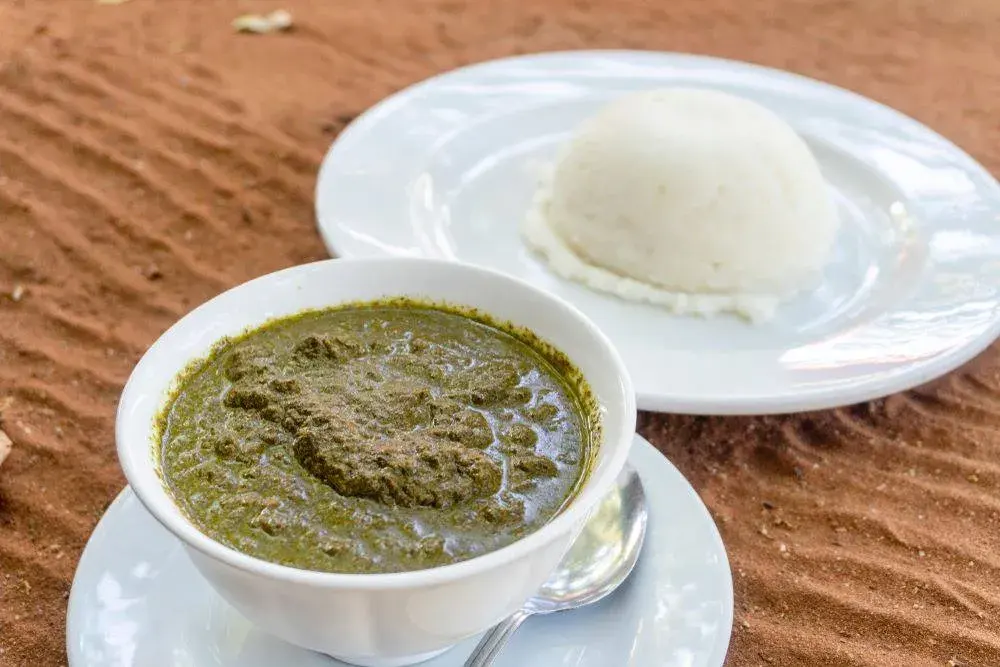
Mozambique Matapa Recipe
Aperçu
Matapa is Mozambique's cassava leaf dish, and it is where the country's two food geographies meet. Cassava leaves and groundnuts belong to the interior; coconut milk and dried shrimp belong to the Indian Ocean coast. Matapa puts all four in one pot, and the result tastes like nowhere else on the continent. It is most common in the south of the country, where the ingredients are close at hand and inexpensive, and it is everyday food rather than occasion food. Mozambican households eat it with rice or bread. The dish is also known as matata in some accounts, and the naming shifts across regions in the way that dishes carried by many communities usually do. The cassava leaves are what make it. They are finely chopped and cooked long enough to lose their fibre and their raw edge, and the groundnuts thicken the coconut milk around them into something dense and savoury. Cooks substitute spinach, kale, collard greens or pumpkin leaves where cassava leaves are hard to come by, and every Mozambican will tell you the substitution is not the same dish.
Note de Patrimoine AFN
Matapa combines cassava leaves and groundnuts of the Mozambican interior with the coconut and dried seafood of the Indian Ocean coast, a pairing that reflects the coastal trade networks that shaped Mozambican foodways. Cassava itself reached the region through Portuguese Atlantic trade routes from the 16th century.
Ingrédients
Les mentions alimentaires sont fournies par les contributeurs à titre indicatif. Elles ne sont pas vérifiées par AFN et dépendent des produits que vous achetez. En cas d’allergie grave, vérifiez vous-même chaque ingrédient. Cuisine, allergies et votre propre jugement
Préparation
- 1
Wash the cassava leaves thoroughly and remove any tough stems.
- 2
Chop the leaves finely and set aside.
- 3
Roast the raw peanuts in a dry pan until golden brown, then leave to cool and grind them to a paste in a food processor or with a mortar and pestle.
- 4
Cook the shrimp in a little oil until pink and fully cooked. Remove and set aside.
- 5
Add the coconut milk, ground garlic and ground pepper to the pan. Stir well and simmer for a few minutes.
- 6
Gradually add the ground peanut paste to the coconut milk, stirring constantly.
- 7
Add the finely chopped cassava leaves and mix so the leaves are well coated.
- 8
Simmer on low heat for 15 to 20 minutes, stirring occasionally, until the leaves soften.
- 9
Add the cooked shrimp, salt and seasoning.
- 10
Once the leaves are tender and the flavours have come together, serve warm with rice.
Notes de l’Africook
 Notes personnelles de Deborah Olayiwola
- Roasting the peanuts before grinding is what separates a good matapa from a flat one. Raw ground peanuts give a chalky sweetness where roasted ones give depth.
- Cassava leaves need longer than most greens. Fifteen to twenty minutes is a minimum, and undercooked leaves are both fibrous and slightly bitter.
- Frozen pounded cassava leaves from an African grocer are a far better substitute than fresh spinach, because they carry the right texture as well as the flavour.
- Dried shrimp can be used in place of fresh and is closer to what many Mozambican households use. Soak it briefly and add it with the coconut milk rather than at the end.
Questions fréquentes
What can I use instead of cassava leaves in matapa?
Spinach, kale, collard greens and pumpkin leaves are all used where cassava leaves are unavailable, and collard greens come closest on texture because they hold up to the long cook. What you lose is the specific slightly bitter, grassy flavour that defines the dish. Frozen pounded cassava leaves are stocked by most African grocers in diaspora cities and are the substitution worth seeking out.
Can matapa be made without shrimp?
Yes. Cook it with the coconut milk and groundnuts alone and it becomes a vegan dish that still has real depth, because the savouriness comes largely from the roasted peanuts. If you want to keep a seafood note without shrimp, dried fish works. Mozambican households vary the protein by what the coast has delivered.
Is matapa the same as Angolan kizaca or Rwandan isombe?
They are cousins built on the same base of pounded or chopped cassava leaves with groundnuts, but the finishing separates them. Matapa uses coconut milk and dried seafood, which comes from Mozambique's Indian Ocean coast. Kizaca in Angola uses palm oil. Isombe in Rwanda uses palm oil and groundnuts without coconut. Each tastes distinctly of its own coast or interior.
How long does matapa keep?
Three to four days refrigerated in a sealed container, and it freezes for up to three months. Like most groundnut based stews it thickens further as it sits and the flavour improves overnight. Reheat gently and loosen with a splash of water or coconut milk, because the peanuts will have tightened.
Avis
4 avis
Vous Aimerez Aussi
Voir toutes les recettes Mozambique →
Peri Peri Chicken Sauce
Boeber (Cape Malay Sweet Milk Drink)
Liberian Jollof Rice
Can I make matapa without coconut milk?
You can, but it becomes a different dish. The coconut milk is not just richness; it softens the cassava leaves and carries the peanut. Without it you get something closer to a plain greens stew. If you are avoiding coconut, more ground peanut and a little oil will give body, though the flavour will be nuttier and less rounded.
Herh, getting fresh cassava leaves in Tottenham is not easy at all oo! I had to buy the frozen ones from the Afro-Caribbean shop by Seven Sisters station. Worked well chale, but matapa takes real patience to simmer so the leaves lose that raw bite. The coconut milk and groundnut paste combination was so rich paa, just needed a bit more ground pepper for my taste.
Roasting and grinding the peanuts into a paste before adding to the coconut milk is so similar to how we make the masala base for Maharashtrian curries. I got cassava leaves from Belgrave Road, chopped them very fine. Next time ill add a bit more garlic but the creamy texture with the cooked shrimp was wonderful.