
Dukkah (Egyptian Nut and Spice Blend)
Aperçu
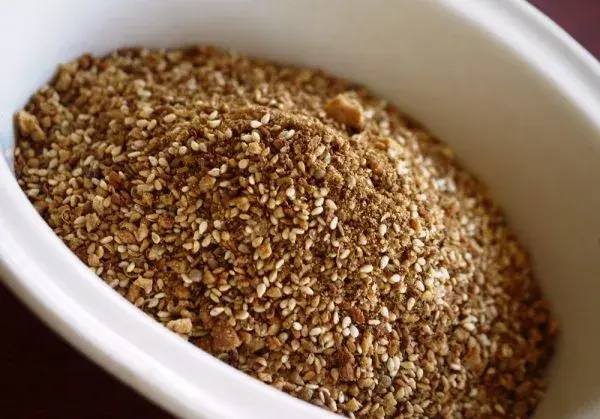
Dukkah is a dry Egyptian blend of toasted nuts, seeds and spices, pounded to a coarse crumb and eaten by dipping bread into olive oil and then into the dukkah. It is sold in cones of paper in Cairo's spice markets and made at home to family recipes. **It contains hazelnuts, which is not obvious from the name.** The name explains the texture. Duqqa comes from the Arabic for to pound, and the defining characteristic is that the mixture is crushed to a state that is neither a powder nor a paste, coarse enough to have texture in the mouth, fine enough to stick to oiled bread. Grind it too far and the nut oils release and it turns into a paste, which is the one thing it must not be. There is no fixed formula. Sesame, coriander, cumin, salt and pepper are near-universal; beyond that it varies by household and by vendor. A nineteenth-century account mentions marjoram, mint, za'atar and chickpeas; a 1978 report names nigella, millet flour and dried cheese; pine nuts, pumpkin seeds and sunflower seeds are more recent. The simplest market version is nothing but crushed mint, salt and pepper. Dry-toasting each element separately, as the method does, is not fussiness, nuts, sesame and whole spices all reach their best at different rates.
Note de Patrimoine AFN
Dukkah, also spelt duqqa, is an Egyptian and Middle Eastern blend of toasted nuts, seeds and spices crushed to a coarse texture. The name derives from the Arabic verb meaning to pound. Its composition varies by household and vendor, and it is sold in paper cones in Egyptian spice markets.
Ingrédients
Les mentions alimentaires sont fournies par les contributeurs à titre indicatif. Elles ne sont pas vérifiées par AFN et dépendent des produits que vous achetez. En cas d’allergie grave, vérifiez vous-même chaque ingrédient. Cuisine, allergies et votre propre jugement
Préparation
- 1
Set the oven to 350°F / 175°C.
- 2
Spread the hazelnuts on a baking sheet and roast them for about 5 minutes, until fragrant.
- 3
Tip the hot nuts onto a tea towel, fold it over them and rub vigorously to loosen the skins. Set them aside to cool.
- 4
In a dry skillet over medium heat, toast the sesame seeds until light golden.
- 5
Tip them into a bowl the moment they are done, left in the hot pan they carry on toasting and will burn.
- 6
In the same skillet, toast the coriander and cumin seeds, shaking the pan, until they begin to pop.
- 7
Transfer the spices to a food processor and grind them finely, then combine with the sesame seeds.
- 8
Grind the cooled hazelnuts in the processor. Pulse rather than run it, ground too far, the oils release and you get paste instead of crumb.
- 9
Mix the nuts through the spices and sesame, season with the salt and pepper, and combine well.
- 10
Serve with bread and a bowl of olive oil for dipping.
Notes de l’Africook
- This contains hazelnuts. Nothing in the name says so, and it is worth mentioning when you put it on a table.
- Pulse the nuts, do not blitz them. Over-grinding releases the oils and turns dukkah into a paste, which is the one texture it should never have.
- Toast each element separately. Nuts, sesame and whole spices all need different times and toasting them together guarantees some are burnt.
- Get the sesame out of the pan the instant it colours. Residual heat will take it from golden to burnt in seconds.
- Grind the spices before the nuts, so the processor is dry when the fine work happens.
- It keeps for a few weeks in a sealed jar, though the nuts lose their crispness, make it in small batches.
Questions fréquentes
Does dukkah contain nuts?
Yes, this version is built on hazelnuts, which are the traditional choice, and nothing in the name indicates it. Other versions use almonds, pistachios, pine nuts or chickpeas instead, and some market versions contain no nuts at all, being simply crushed mint, salt and pepper. If you are serving it to people whose allergies you do not know, say what is in it, since dukkah is exactly the kind of thing eaten casually from a shared bowl.
How is dukkah eaten?
Bread is torn, dipped first in good olive oil and then pressed into the dukkah, so the oil makes the crumb stick. That is the classic way and it is why the texture matters so much. It is also scattered over roasted vegetables, salads, hummus, labneh, eggs and grilled meat, and used as a coating for fish or chicken. In Egypt it is bought loose from spice markets in paper cones.
What goes into dukkah?
There is no fixed recipe, and that is characteristic rather than vague. Sesame, coriander, cumin, salt and pepper appear in nearly every version; beyond that it varies by household and by vendor. Historical accounts mention marjoram, mint, za'atar and chickpeas; later reports add nigella, millet flour and dried cheese; pine nuts, pumpkin seeds and sunflower seeds are modern additions. Hazelnut is the most common nut.
Why must it not be ground smooth?
Because the name means to pound, and the coarse crumb is the definition of the thing. Ground too finely, the oils in the nuts release and the mixture binds into a paste, at which point it will not cling to oiled bread and has lost its texture in the mouth entirely. Pulsing in short bursts, and grinding the spices before the nuts, keeps it where it should be, neither powder nor paste.
Avis
Soyez le premier à noter cette recette
Vous l’avez cuisinée ? Votre note aide la personne suivante à se décider.
Aucun avis sur cette recette pour le moment. Si vous l’avez cuisinée, le vôtre serait le premier.
Vous Aimerez Aussi
Voir toutes les recettes Egypt →
Tarb (Grilled Kofta Wrapped in Lamb Fat)
Egyptian Meshabek