

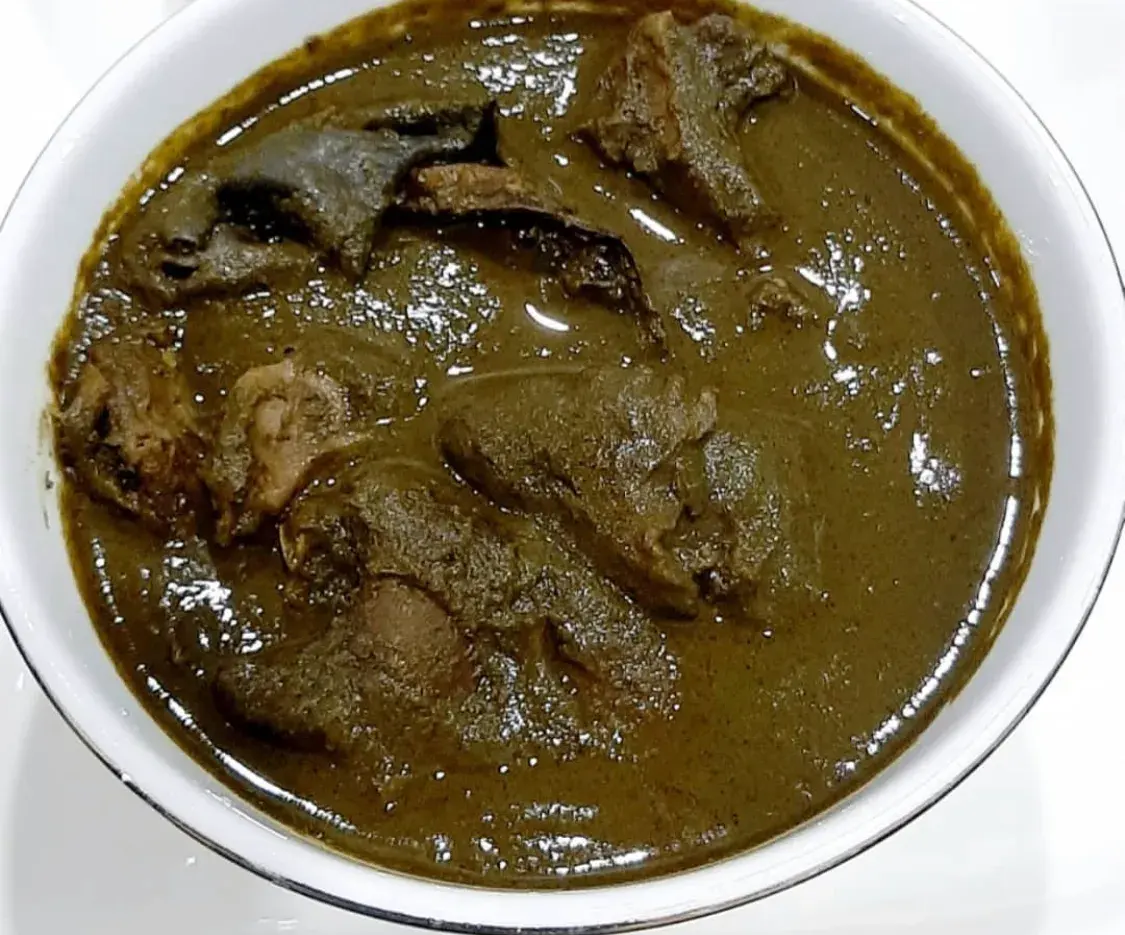
Edo Black Soup
Aperçu
Edo black soup takes its name from its colour, and the colour comes entirely from its leaves. Bitter leaf, scent leaf and uziza are ground together until they release a dark green so deep it reads as black in the bowl, and that grinding is the whole architecture of the dish: the leaves are the thickener, the flavour and the appearance at once. It belongs to Edo State in southern Nigeria and is particularly associated with the Esan people. Within Nigeria's enormous catalogue of soups, black soup is distinguished by how little palm oil it uses. Most southern Nigerian soups are built on a generous quantity of it; this one uses enough to round the leaves and no more, which leaves the bitterness and the aromatic sharpness of the greens in the foreground rather than behind a screen of oil. The three leaves are argued about. Some Edo cooks hold that two are sufficient, others that all three are necessary for balance, and the ratio between them is a matter of household preference. Black soup is eaten with fufu or pounded yam, and the pairing of a dense swallow against a soup this concentrated is the point of both.
Note de Patrimoine AFN
Edo black soup is documented as a dish of Edo State in southern Nigeria and is particularly associated with the Esan people, among whom the grinding of bitter leaf, scent leaf and uziza on a stone was the established preparation before mechanical blending. Its earliest documented date is uncertain.
Ingrédients
Les mentions alimentaires sont fournies par les contributeurs à titre indicatif. Elles ne sont pas vérifiées par AFN et dépendent des produits que vous achetez. En cas d’allergie grave, vérifiez vous-même chaque ingrédient. Cuisine, allergies et votre propre jugement
Préparation
- 1
Grind the bitter leaf, scent leaf and uziza together until smooth. These ground leaves are both the thickener and the source of the soup's dark colour.
- 2
If using a blender, add a very little water to help the blades move. The soup should not be loose.
- 3
Wash the assorted meat and boil it with half a cup of onions, one seasoning cube and a pinch of salt for 30 to 45 minutes, until tender. Add a little water if it threatens to catch.
- 4
Add the roasted fish, washed in hot water, the stockfish, the crayfish and the palm fruit sauce. Cook for up to 15 minutes until the mixture thickens.
- 5
Add the ground leaves, then the remaining seasoning cubes and salt to taste. Simmer for a further 5 minutes.
- 6
If cow liver is included, parboil it with the rest of the meat but remove it after 20 minutes and return it once the soup is almost done.
Notes de l’Africook
 Notes personnelles de Taiwo Oladapo
- A grinding stone needs no water and gives a thicker, more robust result than a blender. If using a blender, add water a spoonful at a time, because a loose black soup cannot be brought back.
- Bitter leaf is sold both washed and unwashed. Unwashed leaves need repeated squeezing under running water until the bitterness drops to a level you want, and how far to take that is a matter of taste.
- Buy the leaves fresh from a market where the turnover is high. Tired greens make a dull soup, and no amount of seasoning compensates.
- Cook it low and slow at the end. Rushing the final simmer leaves the three leaves tasting like three separate things rather than one.
- Some households make it with bitter leaf and scent leaf alone. This is a recognised version rather than an incomplete one.
Questions fréquentes
What are the three leaves in Edo black soup?
Bitter leaf, scent leaf, known in Yoruba as efirin, and uziza. Bitter leaf supplies the bitterness and much of the colour, scent leaf the aromatic top note, and uziza a peppery heat. All three are sold fresh and frozen at African grocers. Some Edo cooks use only bitter leaf and scent leaf, which is an accepted variation.
Why is my black soup not black?
Not enough leaf, or the leaves were not ground finely enough. The colour comes from the volume of ground greens rather than from any other ingredient, so a soup that reads green rather than near black usually needs more leaf and a finer grind. Adding too much water at the blending stage also dilutes the colour.
Can I make Edo black soup without palm fruit sauce?
You can, and the soup will still work, but it will be thinner and lack the body the palm fruit gives. Note that black soup already uses far less palm oil than most southern Nigerian soups, so what is there is doing specific work. Tinned palm fruit concentrate is widely stocked by African grocers and is the practical substitute for fresh.
What is the difference between Edo black soup and bitter leaf soup?
Bitter leaf soup is built on bitter leaf alone, thickened separately with egusi or cocoyam, and it is generally a lighter colour. Edo black soup grinds three leaves together and uses them as the thickener, which produces both the near black colour and a much denser texture. They are different dishes that share an ingredient.
Avis
4 avis
Vous Aimerez Aussi
Voir toutes les recettes Nigeria →
Nigerian Fisherman Soup
Igbo Yam Porridge
Semovita

What makes black soup black, and why is mine green?
The colour comes from the leaves being cooked down for a long time, not from any one ingredient. Bitter leaf and scent leaf darken as they break down; stopping early leaves them green. Give it longer over a low heat and let the liquid reduce. Grinding the leaves rather than only chopping them also helps them collapse into the soup.
I made this for my partner last night! I had a little trouble blending the 2 cups of bitter leaves and uziza without adding too much water, my blender blades kept seizing up. I added about a quarter cup of water and was worried, but after simmering the palm fruit sauce for 15 minutes it thickened back up perfectly. The stockfish has a strong aroma while boiling but the final flavor is incredible.
had to drive past two robots in north end to find a shop with real uziza and bitter leaf! used the full 4 cups of palm fruit sauce and 1kg of beef and shaki. blending the leaves smooth really made it pitch black and so thick, totally lekker with some swallow.