

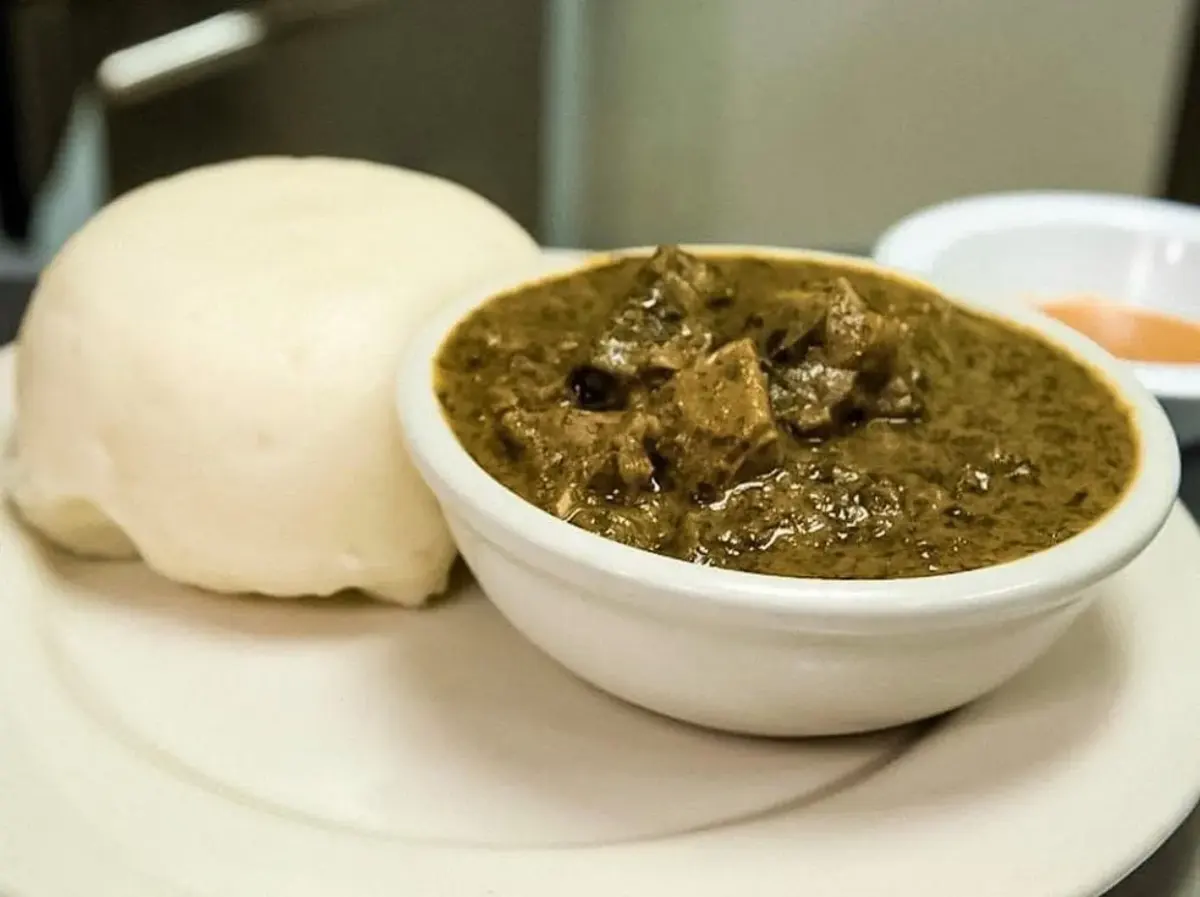
Isombe
Aperçu
Isombe is pounded cassava leaves cooked down with groundnuts, palm oil and aromatics into a dense green stew. It is a Rwandan household staple, and the version most cooks make carries a meaty depth that has nothing to do with meat: the groundnuts and the long cook supply it. The dish belongs to a wider Great Lakes tradition. It is documented as originating in the Democratic Republic of Congo and travelling south into Burundi and Rwanda, and the three countries cook recognisably the same dish under names that shift with the language. Cassava leaves are the constant. They are pounded rather than chopped, which breaks down the fibre in a way a knife cannot, and that texture is what distinguishes isombe from any other leaf stew. Isombe is served with rice or beans, and in Rwanda commonly with ubugari. It is everyday food rather than occasion food, which is the harder thing for a dish to be: it has to be worth cooking on a Tuesday. Cassava leaves are grown, gathered and sold across the region, and the greens that make isombe come from the same plant that provides the starch on the other side of the plate.
Note de Patrimoine AFN
Isombe is documented as originating in the Democratic Republic of Congo and spreading south into Burundi and Rwanda, where it became an established household dish. Cassava, from whose leaves it is made, reached Central Africa through Portuguese Atlantic trade routes from the 16th century.
Ingrédients
Les mentions alimentaires sont fournies par les contributeurs à titre indicatif. Elles ne sont pas vérifiées par AFN et dépendent des produits que vous achetez. En cas d’allergie grave, vérifiez vous-même chaque ingrédient. Cuisine, allergies et votre propre jugement
Préparation
- 1
Cover the cassava leaves with cold water in a pot and bring to the boil. Strain the water out, return the leaves to the pot and boil for 45 minutes to 1 hour.
- 2
Cut the spinach, spring onions and green peppers into small pieces, add to the pot, mix and boil for a further 15 minutes.
- 3
Add the palm oil and the ground groundnuts, stirring to stop the mixture catching on the base of the pot.
- 4
Season with salt and the stock cubes.
- 5
Reduce the heat to minimum and simmer for 30 minutes to 1 hour.
- 6
Serve over rice, ubugari or your preferred main dish.
Notes de l’Africook
- Raw and undercooked cassava leaves contain naturally occurring cyanogenic compounds. The first long boil, with the water discarded, is a safety step and not a flavour step. Do not shorten it.
- The spinach is not padding. It balances the bitterness of the cassava leaves, and leaving it out gives a noticeably harsher stew.
- Check the quality of the leaves at the market. Bundles often include tough stalk that will not soften and will add cooking time without adding anything else.
- Shake the palm oil before measuring. The solids settle, and pouring only the clear oil from the top gives a paler, thinner stew.
- For a fish version, cook captain fish fillet or mackerel separately with spices and fold it in for the final 20 minutes.
Questions fréquentes
Can I use spinach instead of cassava leaves for isombe?
You can make a good green stew that way, but it will not be isombe. Cassava leaves have a fibrous structure and a distinct slightly bitter flavour that spinach does not have, and pounding them is what gives the dish its texture. Frozen pounded cassava leaves are sold by African grocers and are much closer to the real thing than any fresh substitute.
Is it safe to eat cassava leaves?
Yes, once properly cooked. Raw cassava leaves contain naturally occurring cyanogenic compounds, which is why the method boils them, discards that water, and then boils them again for at least 45 minutes. Prepared this way they are a staple food across Central Africa. What is not safe is shortcutting the boiling.
Can isombe be made without meat or fish?
Yes, and this version already is. The savoury depth comes from the groundnuts and the long cook rather than from meat, which makes isombe unusually well suited to a vegan table if you use vegetable stock cubes in place of the beef ones. Many Rwandan households cook it this way as a matter of course.
How long does isombe keep?
Three to four days refrigerated in a sealed container, and it freezes well for up to three months. Like most long cooked leaf stews it improves on the second day as the groundnut and palm oil settle into the leaves. Reheat gently over low heat with a splash of water.
Avis
4 avis
Do I have to pound the cassava leaves, or can I use a blender?
A blender works and most people use one now. What matters is that the leaves end up finely broken down rather than chopped, because the texture of isombe depends on it. Pulse rather than run it continuously, and add a splash of water to keep things moving. Frozen ground cassava leaves are also widely sold and are a genuine shortcut rather than a compromise.
You really have to be careful when stirring after adding the groundnuts o. That paste will catch the bottom of the pot fast if your fire is not on absolute minimum. Good dish, the spinach and green peppers gave it a nice freshness.
boiling the pounded cassava leaves for over an hour takes patience sha, but the moment that ground groundnut paste hits the palm oil and leeks, the aroma is something else. e sweet well well, ate mine with boiled plantain.