

Akod
Aperçu
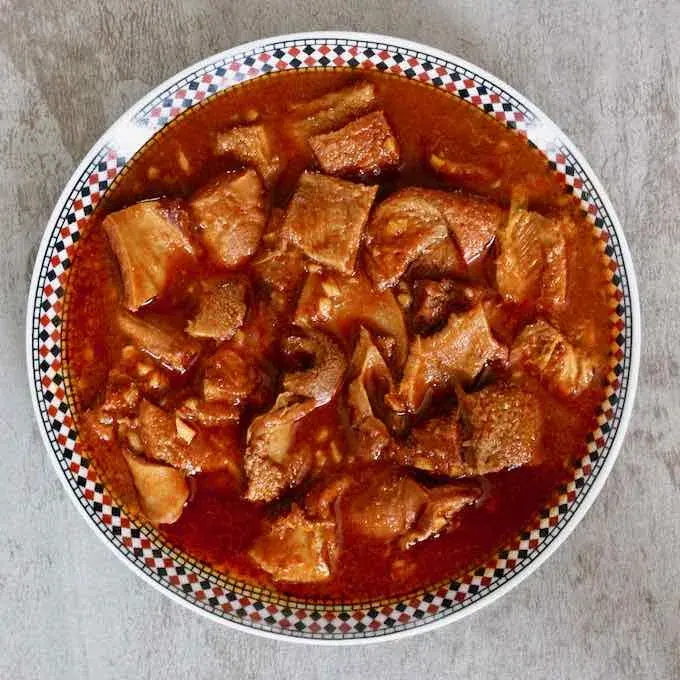
Akod is a tripe dish and it is the emblematic dish of Tunisian Jewish cooking. Beef tripe and a cow's trotter are cleaned, blanched through several changes of water, then cooked for hours with garlic, cumin, tomato paste and harissa until the sauce is thick and the tripe has surrendered completely. Its place is at the kemia, the Tunisian Jewish spread of small dishes that opens a meal, alongside banatages, briks, fricassés and minina. A host laying out a proper kemia would be expected to have made it. Tunisian Jewish cooking developed over centuries in Tunisia and has since largely relocated to France and Israel with the community, which makes recording dishes like this more urgent than recording better travelled ones. The wider family is large and worth knowing. Moroccan douara, also called t'qualia or kercha, uses mutton tripe. Algerian bakbouka includes carrots, courgette and chickpeas. Chkamba in Oran and chmenka in Tunisia are seasoned differently again, and the Moroccan Jewish version, tajine al guezar, meaning the butcher's pot, uses cumin and paprika without tomato paste and is cooked for close to ten hours over coals at Pesach. Offal has fallen out of favour with younger generations across the region, which the source for this recipe notes with some regret.
Note de Patrimoine AFN
Akod is documented as an emblematic dish of Tunisian Jewish cuisine, served as part of the kemia, the spread of small dishes that opens a meal. Closely related tripe preparations are documented across the Maghreb as Moroccan douara and t'qualia, Algerian bakbouka and chkamba, and Tunisian chmenka, and among Moroccan Jews as tajine al guezar, cooked for Pesach.
Ingrédients
Les mentions alimentaires sont fournies par les contributeurs à titre indicatif. Elles ne sont pas vérifiées par AFN et dépendent des produits que vous achetez. En cas d’allergie grave, vérifiez vous-même chaque ingrédient. Cuisine, allergies et votre propre jugement
Préparation
- 1
Rinse the tripe and cow's trotter thoroughly, rubbing vigorously between both hands. Drain and cut into pieces.
- 2
Cook the tripe and trotter in a large volume of boiling salted water for 1 hour 30 minutes, changing the water three times. The water must always be boiling when it goes back in.
- 3
Reserve the last cooking water and drain the tripe and trotter.
- 4
In a cast iron pot or Dutch oven, heat the olive oil over medium heat. Fry the tripe and trotter for 5 minutes, stirring regularly.
- 5
Add the garlic, paprika, tomato paste, salt, pepper, harissa and half the cumin. Stir well.
- 6
Pour in the reserved cooking liquid to about 3cm above the tripe. Reserve the rest.
- 7
Cover and cook for 30 minutes over low to medium heat.
- 8
Reduce the heat and cook covered over very low heat for 4 hours.
- 9
If the sauce runs low during cooking, add small amounts of the reserved boiling liquid. If that runs out, use boiling water, always in small amounts.
- 10
Ten minutes before the end, add the remaining cumin.
- 11
Serve very hot, with pieces of tripe on a generous bed of sauce.
Notes de l’Africook
- Change the boiling water three times during the first stage. This is the step that decides whether akod is clean tasting or not, and it cannot be shortened.
- Butchers usually sell tripe washed and blanched, described as half cooked. If yours is raw, it needs scalding for at least three hours with many changes of water before you even start.
- Add the cumin in two stages, half at the beginning and half ten minutes before the end. The early cumin cooks into the sauce; the late cumin stays aromatic.
- Top up with boiling liquid rather than cold. Cold water added to a long slow braise stalls the cooking and toughens the tripe.
- Four hours at very low heat is the working minimum. Longer does no harm and Moroccan Jewish versions run to nearly ten.
Questions fréquentes
What kind of tripe should I use for akod?
Beef tripe is standard for the Tunisian version, and mixed cuts are used together. Most butchers sell it already washed and blanched, which they describe as half cooked, and that is what you want. Raw tripe needs three hours of scalding with repeated water changes before the recipe proper begins.
How do I get rid of the smell?
Boil it through three complete changes of water in the first stage, always returning it to water that is already boiling. That removes most of it. Rubbing the tripe vigorously between your hands during the initial rinse also matters. Buying tripe that has already been cleaned by a butcher makes the whole job considerably easier.
What is kemia?
Kemia is the Tunisian spread of small dishes served at the start of a meal, comparable to mezze. In Tunisian Jewish households it includes banatages, briks, fricassés and minina alongside akod. A host laying out a full kemia is making a statement about hospitality, and akod is one of the dishes that signals the effort was made.
What are the regional versions of this dish?
Moroccan douara, also called t'qualia or kercha, uses mutton tripe. Algerian bakbouka adds carrots, courgette and chickpeas. Chkamba in Oran uses cumin, paprika, thyme, coriander and bay. Tunisian chmenka adds lamb heart, liver, potato and chickpeas. Moroccan Jewish tajine al guezar omits tomato paste and cooks for nearly ten hours at Pesach.
Avis
2 avis

got the cow trotter and beef tripe from my local halal butcher on Stapleton Road. changing the boiling water three times took ages but it really gets rid of that harsh smell before you add the harissa and garlic. turned out so tender in the end.
Herh 6 hours on the stove is no joke oo! We make cow foot and tripe stew back home in Tema, but adding cumin and harissa like this gives it a very nice heat. The trotter came out so soft chale.