

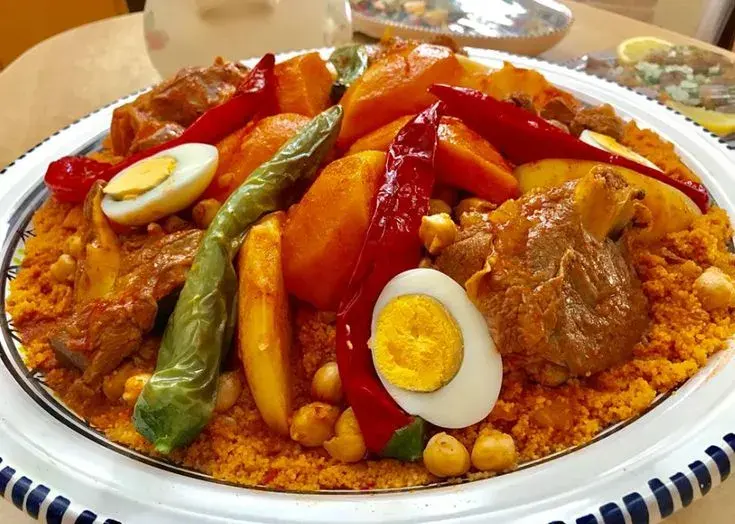
Tunisian Couscous
Aperçu
Couscous is the national dish of Tunisia, and it is also the national dish of Algeria, Morocco, Mauritania and Libya, which tells you something about how the Maghreb understands itself. The same steamed semolina appears across all five countries under names that shift with the language: kousksi in Tunisia, taam or kesksu in Algeria, seksu in Morocco, and cuscusu in Sicily, where it crossed the water. The Tunisian version is distinguished by its heat and its colour. Harissa goes into the broth rather than being offered alongside it, and the finished couscous runs orange to deep red depending on how much broth and harissa it has taken up. Caraway is the other Tunisian signature, appearing in a quantity that Moroccan and Algerian couscous would not use. What goes with it depends on the coast. In Sfax and the other coastal cities, couscous is made with fish. Inland it more often carries lamb, sometimes with dried fruit. Turnip, carrot, courgette, potato, pumpkin and chickpeas are the usual vegetables, cooked in the broth and removed as each becomes ready. The word itself is traced either to the Arabic kaskasa, to pound small, or the Amazigh seksu, meaning rounded or well rolled, and both derivations describe the grain rather than the dish.
Note de Patrimoine AFN
Couscous is documented as the national dish of Tunisia, Algeria, Morocco, Mauritania and Libya, and UNESCO inscribed the knowledge, know how and practices pertaining to the production and consumption of couscous on the Representative List of the Intangible Cultural Heritage of Humanity in 2020, in a joint submission by Algeria, Mauritania, Morocco and Tunisia. Its name is traced to the Arabic kaskasa, meaning to pound into small pieces, or the Amazigh seksu, meaning rounded or well rolled.
Ingrédients
Les mentions alimentaires sont fournies par les contributeurs à titre indicatif. Elles ne sont pas vérifiées par AFN et dépendent des produits que vous achetez. En cas d’allergie grave, vérifiez vous-même chaque ingrédient. Cuisine, allergies et votre propre jugement
Préparation
- 1
Add half a cup of oil to a large pan. Fry the onion over medium heat for 2 minutes.
- 2
Add the garlic, tomato paste and harissa and continue frying for 2 minutes.
- 3
Add the caraway, coriander and chilli powder. Mix and cook for another 2 minutes.
- 4
Add the lamb and mix well so the pieces are covered with the sauce. Cook for 5 minutes, stirring regularly.
- 5
Cover with water. Add the turnips and carrots and cook over low to medium heat for 45 minutes.
- 6
Meanwhile, prepare the couscous semolina as indicated on the package, with boiling water, salt and oil.
- 7
After 45 minutes, add the courgettes, potatoes and chickpeas.
- 8
Cook for at least another 30 to 40 minutes over low to medium heat. Watch the vegetables, and as each becomes done, lift it out onto a serving platter so it does not overcook.
- 9
Ten minutes before the end, take ladles of broth one at a time and moisten the couscous semolina, mixing well after each addition.
- 10
Arrange the semolina in a tajine dish. Set the vegetables and meat around it and garnish with the fried green peppers if using.
Notes de l’Africook
- Lift each vegetable out as it becomes done rather than waiting for the meat. Turnip, carrot, courgette and potato all cook at different rates, and leaving them all in gives you a platter of collapsed vegetables around a piece of lamb.
- Moisten the couscous with the broth a ladle at a time, mixing between each. Tipping it all in at once gives you wet semolina in some places and dry in others.
- Harissa varies enormously in heat between brands. Two tablespoons is a Tunisian quantity; start with one if you do not know the jar.
- Caraway in this quantity is what makes it read as Tunisian rather than Moroccan or Algerian. Do not substitute cumin, which is a different flavour entirely.
- Coastal Tunisian cooking, particularly in Sfax, makes this with fish instead of lamb. Inland versions sometimes add dried fruit.
Questions fréquentes
What makes Tunisian couscous different from Moroccan or Algerian couscous?
Heat and caraway. Tunisian couscous puts harissa into the broth rather than serving it alongside, which colours the grain orange to deep red and makes it noticeably hotter. Ground caraway is used in a quantity the other traditions do not. Moroccan couscous tends sweeter, often with dried fruit, and Algerian versions sit between the two.
Can I use instant couscous?
Yes, and the recipe assumes it, since it directs you to follow the package. The traditional method steams the semolina over the broth in a couscoussier in three separate stages, which produces a lighter, more separate grain. If you have a couscoussier it is worth the effort; if not, instant couscous moistened with the broth works well.
What is harissa and can I substitute it?
Harissa is the Tunisian chilli paste, made from dried red chillies with garlic, caraway, coriander and olive oil. It is hot and deeply aromatic rather than simply spicy. There is no close substitute: chilli paste alone gives heat without the caraway and coriander that make it Tunisian. It is now widely sold in supermarkets.
What meat is used in Tunisian couscous?
Lamb is the most common inland, and fish is standard in the coastal cities, particularly Sfax. Chicken and beef are both used. The method is the same regardless: the protein goes in early and cooks in the broth that the couscous will later absorb, so whatever you choose should suit a long simmer.
Avis
2 avis
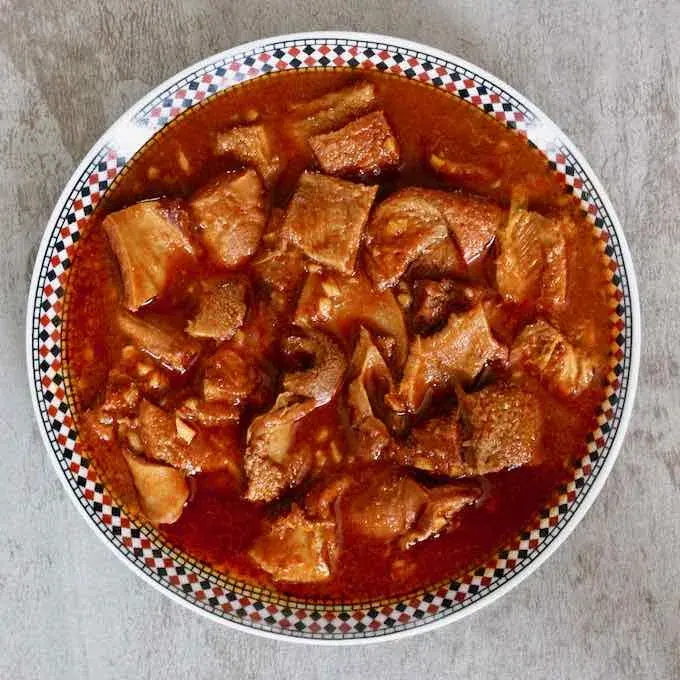
Frying the tomato paste, harissa and caraway in oil right at the start is so similar to how we build a masala base for lamb curry. I was a bit skeptical about 2 tablespoons of ground caraway as I thought it might dominate, but it gave the sauce such an earthy, warm fragrance after simmering the meat for 45 minutes. Turnips soaked up all that spice beautifully.
couldnt find turnips at my local jewel-osco here in chicago so i just doubled the carrots and stripped the courgettes like the recipe says. that fry up of harissa and tomato paste with the lamb braising on low heat made the whole house smell amazing, e sweet o! next time i will go down to devon avenue to get proper turnips sha.