

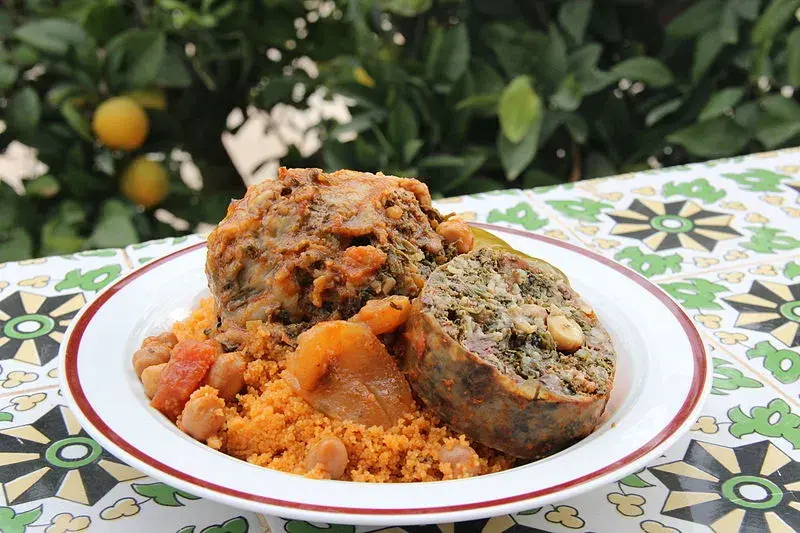
Usban
Aperçu
Usban is a North African sausage made from the parts of a sheep that a whole animal butchery yields and nothing else does: the stomach, the liver, the lungs and the heart, chopped and mixed with rice, herbs and spices, sewn into pouches and cooked in a sauce. It is eaten in Tunisia, Algeria and Libya, and it is written both usban and osban. Its occasion is Eid al-Adha, and the connection is structural rather than customary. The festival involves the sacrifice of an animal and the use of all of it, and usban is what the offal becomes. It cannot be made casually because it requires a quantity of organ meat that only arrives when a whole sheep is broken down at home. Tunisian households make it on the day of Eid despite the considerable labour, and the effort is part of what the dish means. The work is real. The stomach must be scrubbed, blanched, scraped of its lining until it turns white, cut and sewn into pouches by hand with a needle and butcher's twine, then filled and sewn shut. Usban is documented in Tunisian references as far back as the 13th century, and it is held up as a demonstration of skill: proof that a cook can use every part of the sacrifice properly. It is served alongside rice or couscous.
Note de Patrimoine AFN
Usban is documented in Tunisian historical references from the 13th century, and is prepared in Tunisia, Algeria and Libya from the offal and stomach of a sheep. Its preparation is tied to Eid al-Adha, the festival of sacrifice, which supplies the organ meat it requires.
Ingrédients
Les mentions alimentaires sont fournies par les contributeurs à titre indicatif. Elles ne sont pas vérifiées par AFN et dépendent des produits que vous achetez. En cas d’allergie grave, vérifiez vous-même chaque ingrédient. Cuisine, allergies et votre propre jugement
Préparation
- 1
Bring a large pot of water to the boil over medium high heat.
- 2
Wash the lamb stomach thoroughly in cold water, removing any debris.
- 3
Once the water boils, dip the stomach into it briefly several times. This firms it up and makes it easier to cut.
- 4
Scrape the inner part of the stomach, removing the grey lining, and keep dipping and scraping until the stomach turns white.
- 5
Cut the stomach into the sizes you want.
- 6
Using a needle and butcher's twine, sew each piece into the shape of a pouch.
- 7
Cut the liver and lungs into small pieces, and finely chop the onion and garlic.
- 8
Chop the herbs finely.
- 9
Place all the filling ingredients in a large bowl and mix thoroughly.
- 10
Wearing gloves, fill each pouch, making sure it is well packed.
- 11
Sew each pouch closed.
- 12
For the sauce, fry the garlic and onion in the oil.
- 13
Add the spices, tomato paste, chickpeas and the pouches.
- 14
Add enough water to cover the pouches.
- 15
Cover and cook until everything is tender, about 30 to 35 minutes. A pressure cooker is better for this.
- 16
Serve garnished with chopped parsley and coriander.
Notes de l’Africook
- The stomach must be scraped until it is genuinely white. Any grey lining left behind carries a strong flavour that no amount of spice will cover, and this is the step that decides whether usban is good.
- Do not overfill the pouches. Rice expands as it cooks, and a tightly packed pouch will burst its seams in the pot.
- Sew properly with a needle and butcher's twine rather than trying to tie the pouches. Filling that escapes into the sauce is the second most common failure.
- A pressure cooker takes this from over an hour to about half that, which matters when you are making many pouches at once on Eid.
- Use rice that is already cooked, as the method specifies. Raw rice will swell too much inside the pouch.
Questions fréquentes
What is usban made of?
Sheep offal and stomach. The liver, lungs and heart are chopped and mixed with rice, chickpeas, onion, garlic, parsley, coriander, dried mint and a spice blend, then packed into pouches sewn from the cleaned stomach. Some versions use sheep intestines or commercial sausage casings instead of the stomach.
Why is usban made at Eid al-Adha?
Because that is when the ingredients exist. Eid al-Adha involves the sacrifice of an animal and the use of all of it, which is what puts a stomach, liver, lungs and heart into a household kitchen at the same time. Usban cannot be made without that, which ties it to the festival more firmly than custom alone would.
Can I use sausage casings instead of the stomach?
Yes, and it is a recognised approach rather than a shortcut. Sheep intestines or commercial sausage casings are used in many versions, and the sausages are then simmered for about an hour and browned in a pan or oven. It removes the longest and least pleasant part of the preparation, which is cleaning the stomach.
What is usban served with?
Rice or couscous, as part of a larger Eid meal rather than as a dish on its own. It is rich and heavily spiced, so what accompanies it is plain. The sauce it cooks in is served over the accompanying grain.
Avis
9 avis
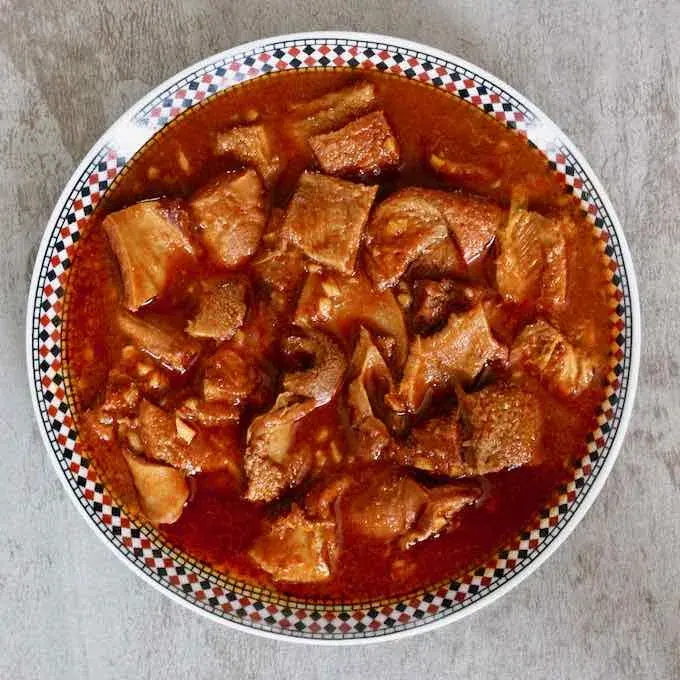
Had to drive down to the halal butcher on City Road to source the lamb stomach and liver, as none of the supermarkets near me stock offal like this. The scraping and dipping part took me well over an hour on its own to get the grey lining off properly: 60 mins total prep is a bit generous! Tasted amazing with the mint and coriander through the rice stuffing though.
Herh, Gareth! Cleaning tripe is no joke at all, 60 minutes prep for Usban is way too small paa. You really have to work hard to get that grey lining clean, so you tried! Next time, soak it in warm water with plenty lime juice before scraping, it makes the work easier oo. But chale, once you taste that herbal rice stuffing, all the stress just vanishes.
Used exactly 500g minced beef and two sachets of All Gold tomato paste because I could not find enough lamb mince. The stomach scraping process takes at least 45 minutes by itself before you even touch the parsley and garlic, so plan ahead. Turned out tasty, 3 stars only because the prep time listed is way too short.
Ah Bongani, cleaning stomach no be small thing at all o, you really tried! 45 minutes is even fast if you ask me. These recipe websites always understate prep time sha. Glad the beef swap still turned out tasty for you!
My ouma used to clean sheep stomach like this when we slaughtered on the farm, so dipping it quick in the boiling water to scrape the grey off brought back memories. We cooked it in the swartpot over the braai coals instead of a pot inside. Baie lekker with the chickpeas and liver filling.
I wish I could cook it over coals like that, but a standard hob in Cardiff had to do! That boiling water scraping trick was a proper lifesaver though. I had to track down a local halal butcher over in Riverside just to source the sheep stomach, but the chickpea and liver stuffing made the whole effort well worth it.
reminded me so much of the stuffed tripe my auntie makes back home, though the dried mint inside was new to me. I managed to get fresh lamb stomach at the Somali halal market on Lake St. cleaning that lining took patience o! but once you scrape it white and boil it down, e sweet die.
Cleaning tripe is no be small thing at all! My mother used to make us scrape it with hot water and lime back in the day, so I know the patience you needed. That dried mint surprised me too, but it really cuts through the richness nicely.
do you freeze these before boiling or stuff them straight away? I bought 1kg lamb stomach from the butcher today and prepped 2 teaspoons of Rajah sweet paprika like it said, but I am worried the stomach pockets will burst if I pack the rice and chickpeas too tight.