

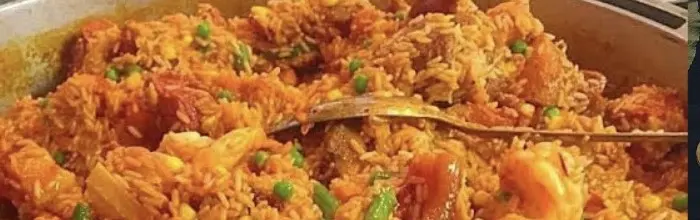
Liberian Jollof Rice
Abuja, Nigeria · Voir toutes les recettes
Aperçu
Jollof rice belongs to the whole of West Africa, and every country that claims it claims it as its own. The Liberian version sits inside that family without being anyone's copy. It is a tomato rice, built on long grain parboiled grains, sweetened by onion and sweet pepper, sharpened with garlic and ginger, and carrying a smokiness that Liberian cooks treat as the mark of a pot done properly. Rice is the centre of the Liberian diet rather than an accompaniment to it, and a one pot rice that can be built around whatever protein a household has, or around no protein at all, earns its place in an everyday kitchen as readily as at a gathering. It feeds a room from a single vessel, which is part of why it survives. Across West Africa the jollof pot is argued over with genuine feeling, and the loudest of those arguments runs between Nigeria and Ghana. Liberia is rarely named in that particular fight. That says less about the quality of the Liberian pot than about who is holding the microphone.
Note de Patrimoine AFN
Jollof rice traces to the Senegambian rice tradition of the Wolof, and moved east and south along the West African coast through trade and migration, acquiring a distinct national form in each country that took it up. Liberia's variation belongs to that eastward spread.
Ingrédients
Préparation
- 1
Heat the vegetable oil in a large pot over medium heat.
- 2
Add the chopped onion, bell pepper, garlic and ginger. Fry until the onion is translucent and the vegetables have softened.
- 3
Add the tomato sauce and stir well. Cook for 5 to 7 minutes.
- 4
Stir in the smoked paprika, cayenne pepper, thyme, curry powder, salt and black pepper. Adjust the seasoning to taste.
- 5
Add the parboiled rice and stir until every grain is coated in the tomato and spice mixture.
- 6
Pour in the broth and bring to a boil.
- 7
Reduce the heat to low, cover the pot and simmer for 25 to 30 minutes, until the rice is cooked and the liquid absorbed. Add the cooked protein at this stage if using.
- 8
Fluff the rice gently with a fork, cover again and leave to steam for a few minutes before serving.
Notes de l’Africook
 Notes personnelles de Laila Yetunde
- The smokiness the dish is known for comes from the final stage. Keep the heat as low as it will go once the liquid is in, use a heavy bottomed pot, and resist stirring while the rice finishes.
- Parboiled rice holds its grain under a long covered cook. Basmati and jasmine break down and turn the pot to porridge.
- The heat level is carried entirely by the cayenne. Halve it for a mild pot and serve extra pepper at the table rather than committing the whole pot to one heat level.
- Fried plantain, coleslaw or a fresh salad are the usual plate companions.
Questions fréquentes
What makes Liberian jollof rice different from Nigerian or Ghanaian jollof?
The differences are in the base and the seasoning rather than the technique. The Liberian pot leans on smoked paprika, curry powder and thyme together, and takes its smokiness from the long low finish rather than from smoked ingredients. Nigerian jollof builds a deeper, longer reduced tomato base and prizes the caramelised crust at the bottom of the pot. Ghanaian jollof commonly uses aromatic rice and a lighter tomato hand. All three are jollof and all three are correct within their own tradition.
Can I make Liberian jollof rice without meat or seafood?
Yes. The protein is added at the end and is not structural to the dish. Use vegetable broth in place of chicken broth and the pot works as a complete vegan dish. If you want the savoury depth the meat would have given, increase the smoked paprika slightly and add a little more thyme.
Why is my jollof rice mushy?
Almost always too much liquid or the wrong rice. The ratio here is four cups of broth to two cups of rice, and the tomato sauce adds more liquid on top of that, so the rice must be a parboiled long grain that can absorb it without collapsing. If the pot looks wet at the 25 minute mark, take the lid off and let the last of the liquid go before fluffing.
How long does jollof rice keep, and does it freeze?
It keeps three to four days refrigerated in a sealed container and freezes well for up to three months. Reheat with a splash of water or broth over low heat, or in a covered dish in the oven, so the grains steam back rather than drying out. Many cooks think the flavour is better on the second day.
Avis
Soyez le premier à noter cette recette
Vous l’avez cuisinée ? Votre note aide la personne suivante à se décider.
2 avis
My jollof turns out mushy every time. What am I doing wrong?
Almost always too much liquid, and stirring. Rice keeps absorbing after you take it off the heat, so the pot should look slightly underdone when you stop, not perfect. Use a little less stock than you think, keep the lid on, and leave it alone once the rice is in. Every stir breaks grains and releases starch, which is what makes it claggy. If it has already gone soft, spread it on a tray to let the steam escape rather than trying to cook it drier.