

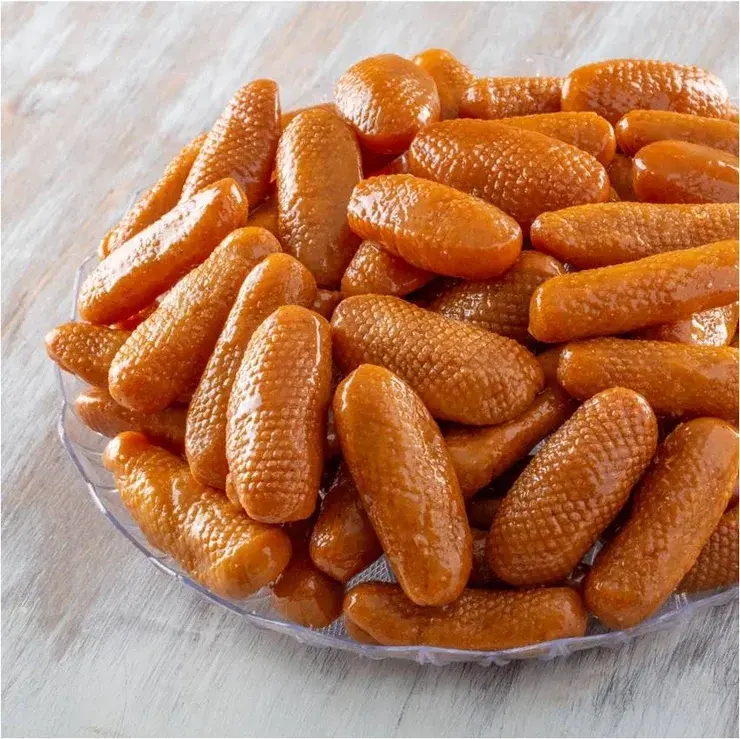
Swabaa Zainab
Aperçu
Swabaa Zainab means Zainab's fingers, and the name is the dish. Ridged fingers of semolina and flour dough are fried until crisp and dropped into cold sugar syrup, coming out crunchy outside and soft within. Two stories attach to the name and Egyptians tell both. In one, a clever girl invented the sweet and guests praised it by saying teslam sawabe' Zainab, may God bless Zainab's fingers. In the other, it is named for Sayyida Zainab, granddaughter of the Prophet, who is deeply venerated in Egypt and after whom one of Cairo's central districts is named. Neither account can be verified and both are held affectionately. Its occasions are Ramadan and Eid al-Fitr above all, and it appears at popular celebrations through the year. It belongs to the family of Arab syrup sweets that also produces meshabek and basbousa, and it is described as among the oldest of them, mastered by Arab cooks and carried outward from there. Egyptian households share the recipe between families rather than from books, which is why the proportions shift from one kitchen to the next. It is eaten in the morning as readily as in the evening, with tea, coffee or juice.
Note de Patrimoine AFN
Swabaa Zainab, meaning Zainab's fingers, is documented as an Egyptian sweet associated with Ramadan and Eid al-Fitr, and belongs to the family of Arab fried pastries soaked in sugar syrup. Two accounts of its name circulate, one attributing it to a cook named Zainab and the other to Sayyida Zainab, and neither is confirmed.
Ingrédients
Les mentions alimentaires sont fournies par les contributeurs à titre indicatif. Elles ne sont pas vérifiées par AFN et dépendent des produits que vous achetez. En cas d’allergie grave, vérifiez vous-même chaque ingrédient. Cuisine, allergies et votre propre jugement
Préparation
- 1
Make the syrup first. In a medium saucepan, combine the sugar and half a litre of water.
- 2
Add a small amount of saffron if using.
- 3
When the syrup begins to boil, add the lemon juice.
- 4
Leave the syrup to cool completely for at least 3 or 4 hours.
- 5
For the dough, combine the flour and semolina in a medium bowl.
- 6
Add the yeast, salt and sugar and mix everything together.
- 7
Heat the ghee over medium heat, then add it to the dry ingredients.
- 8
Mix a little with a spoon, then work the mixture well by hand until the ghee is fully incorporated.
- 9
Add the water and knead only until the ingredients come together, about a minute and a half. Do not overwork it.
- 10
Cover the dough and rest for 10 minutes.
- 11
Cut the dough into pieces of about 10 grams.
- 12
Roll each piece against a grater or ridged surface into a hollow ridged finger.
- 13
Fry the fingers immediately in hot oil. Do not let them sit after shaping or they will ferment and lose their texture.
- 14
Once golden, lift them out into a strainer to rest briefly.
- 15
Soak the fingers in the cold syrup for 15 minutes until the syrup is absorbed, then drain.
Notes de l’Africook
- The syrup must be completely cold and it needs three to four hours to get there. Make it first, before you touch the dough.
- Fry the fingers as soon as they are shaped. Dough left standing after rolling starts to ferment and the texture collapses in the oil.
- Do not overknead. A minute and a half is enough, and working the dough further makes the fingers tough rather than short.
- You can tell the dough is right when the fingers float on the surface of the oil.
- Ridging against a grater is what gives the surface that holds the syrup. A smooth finger takes up much less.
Questions fréquentes
Why is it called Zainab's fingers?
Two stories circulate and neither is confirmed. One holds that a clever girl invented the sweet and guests praised it with the phrase teslam sawabe' Zainab, may God bless Zainab's fingers. The other holds that it is named for Sayyida Zainab, granddaughter of the Prophet, who is deeply venerated in Egypt. Both are told affectionately.
Why does the syrup need to be cold?
Because the sweet has to stay crisp. Fingers fried until brittle and dropped into cold syrup absorb it quickly at the surface without softening all the way through. Warm syrup soaks in slowly and turns the whole thing limp. This is the same principle as meshabek and most Arab fried syrup sweets.
How do I get the ridged shape?
Roll each small piece of dough against the back of a box grater, or against a gnocchi board or any ridged surface, pressing lightly and rolling so it curls into a hollow tube with ridges on the outside. Those ridges are what hold the syrup. It takes a few attempts to get consistent.
How long does swabaa Zainab keep?
Two to three days at room temperature in a loosely covered container, softening as it goes. It is best within a few hours of being made. Do not refrigerate it, since the cold makes the syrup weep and the pastry go soggy.
Avis
2 avis
Vous Aimerez Aussi
Voir toutes les recettes Egypt →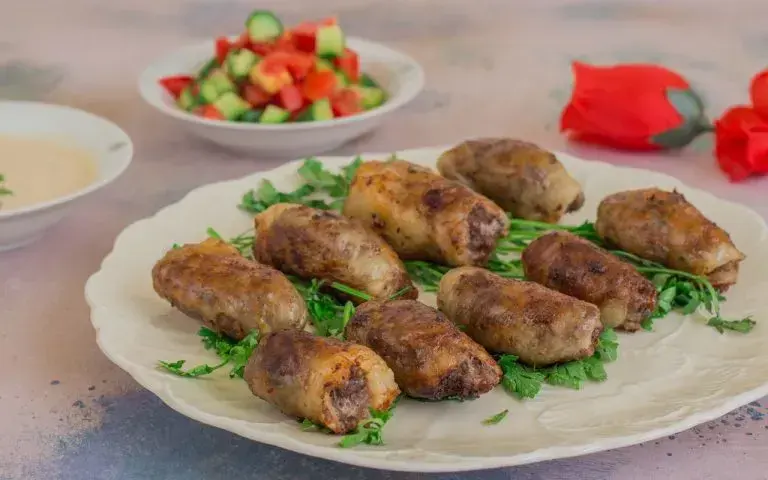
Tarb (Grilled Kofta Wrapped in Lamb Fat)
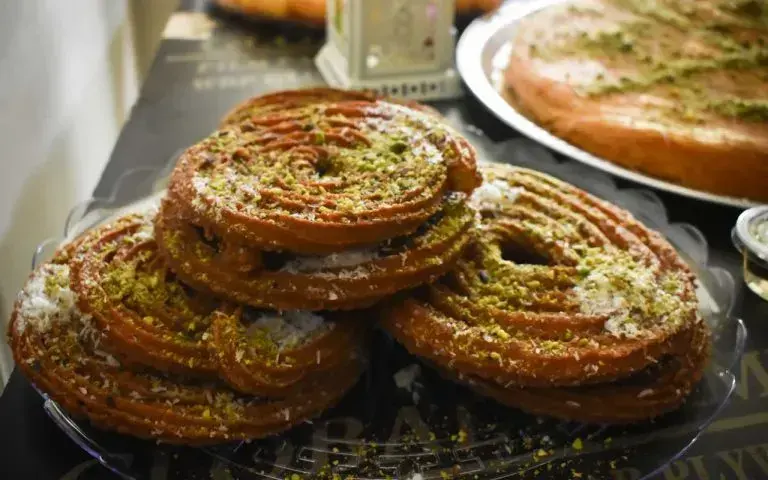
Egyptian Meshabek

Made these last night and my family loved them, though I panicked a bit when I saw a full kilogram of sugar for the syrup! I didn't have saffron so I skipped it, but the lemon flavor came through nicely. Quick question, is the dough supposed to feel pretty stiff before adding the water, or did I pack my flour too much?
managed to get proper fine semolina from the halal shop on st marks road here in bristol and these came out so good. you really cannot skip letting the lemon syrup cool for the full 4 hours though or the fingers lose that crunch when you dunk them straight from the hot oil.