

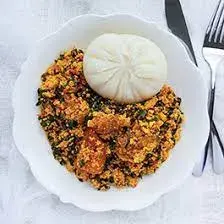
Semovita
Aperçu
Semovita is one of Nigeria's swallows: the family of smooth, firm starch preparations that are pinched off by hand, rolled between the fingers and used to lift soup from a bowl. The swallow is not a side dish. In Nigerian eating it is the vehicle and the soup is the flavour, and a meal is understood as the pairing of the two. It is made from semolina, the coarse milling of durum wheat, and it belongs to the wheat based end of the swallow spectrum rather than the cassava, yam or maize end. That places it alongside amala, eba, fufu, pounded yam and starch as one option among several, chosen by household preference and by what the soup is. Semovita is smoother and milder than most of the alternatives, which is a large part of its appeal. Its status is worth stating plainly: Semovita is a brand name that has become the general term for the product, in the way a number of household names have. The dish is Nigerian, industrially produced and comparatively recent, and it earned its place at the table on texture rather than on history. It is eaten with ogbono, okra, efo riro, egusi and every other Nigerian soup.
Note de Patrimoine AFN
Semovita is a trademarked wheat semolina product manufactured in Nigeria, and belongs to the industrial era of Nigerian food rather than to a pre industrial preparation. It sits within the much older Nigerian tradition of swallow, in which a smooth starch mass is used by hand to lift soup.
Ingrédients
Les mentions alimentaires sont fournies par les contributeurs à titre indicatif. Elles ne sont pas vérifiées par AFN et dépendent des produits que vous achetez. En cas d’allergie grave, vérifiez vous-même chaque ingrédient. Cuisine, allergies et votre propre jugement
Préparation
- 1
Pour about 500ml of water into a clean pot and bring it to the boil over high heat.
- 2
Put a cup of semovita in a bowl and add some cool water.
- 3
Stir the water and semovita continuously with a wooden spatula until the mixture is smooth.
- 4
When the water in the pot boils, reduce the heat to medium and pour in the mixed semovita.
- 5
Stir for 1 to 2 minutes, then leave to cook on low heat for about a minute.
- 6
Stir again, turning and pressing the mixture, until the texture is neither too hard nor too soft. Turn off the heat.
- 7
Serve directly onto a plate, or wrap in cling film.
Notes de l’Africook
- Mixing the semovita with cool water in a separate bowl before it meets the boiling water is the only reliable way to get a lump free swallow. Tipping the dry powder into boiling water guarantees lumps.
- Judge doneness by feel rather than by time. The mass should be firm enough to hold a pinched shape and soft enough to yield without resistance, and that is a texture you learn by hand.
- Dip the serving spoon in cold water before portioning. The mixture releases cleanly from a wet spoon and sticks stubbornly to a dry one.
- Wrapping portions in cling film while hot keeps them warm and holds their shape, which is how it is served at most Nigerian tables.
- Ogbono, okra, efo riro and egusi are the standard soups it is eaten with.
Questions fréquentes
What is the difference between semovita and semolina?
Semolina is the coarse milled endosperm of durum wheat, the raw ingredient. Semovita is a Nigerian branded product made from wheat and formulated specifically to be prepared as a swallow. In practice Nigerians use the words for two slightly different textures, with semolina swallow being marginally coarser, but the two are prepared identically.
How do I get lumps out of semovita?
Prevent them rather than fix them. Mix the semovita with cool water in a bowl until completely smooth before it goes into the boiling pot, then stir continuously as you pour. If lumps have formed, press them against the side of the pot with a wooden spatula while the mixture is still hot and loose, because once it stiffens they are permanent.
What soups are eaten with semovita?
Any Nigerian soup, and that breadth is part of why it is so widely used. Ogbono, okra, efo riro and egusi are the most common pairings, and the mildness of semovita means it never competes with a strongly flavoured soup the way a fermented swallow such as amala or fufu can. Household preference decides far more than any rule does, and most Nigerian families settle on one or two swallows they keep in the house regardless of what soup is being made.
Is semovita gluten free?
No. Semovita is made from durum wheat and contains gluten, so it is not suitable for anyone with coeliac disease or gluten intolerance. The gluten free swallows in the same family are those based on cassava, yam or maize: fufu, pounded yam, eba made from garri, and amala made from yam flour.
Avis
8 avis
Vous Aimerez Aussi
Voir toutes les recettes Nigeria →
Edo Black Soup
Nigerian Fisherman Soup
Igbo Yam Porridge
Couldn't get to the West Green Road shop so I bought standard fine semolina from Sainsbury's instead. Ratio of 500ml water was slightly too much for the supermarket brand so it took longer than 15 mins to firm up, but making the cold paste first saved it from being lumpy.
Chale, that cold paste trick is what saved you oo! Herh, these standard supermarket semolinas need less water paa compared to the ones from the African store. I experience the same thing here in Ohio with the store brands. Next time try reducing the water small, it will firm up fast.
Mixing the semovita with cool water before pouring into the hot pot is the best way oo. If you throw the dry powder straight into boiling water you will just get lumps paa. Worked so smooth for my okra soup today.
My sister, this cool water trick is the absolute truth! When I first moved to Berlin, I was always fighting with lumps until I started doing it this way. Smooth semo with fresh okra soup is unbeatable sha.
Herh 1 cup to 500ml came out way too soft for me oo. I like my swallow very firm so I had to sprinkle more semovita inside while stirring over medium heat, which made it hard work on the arm paa.
Yaw, adding dry semo into hot swallow is proper arm exercise, no be small thing! Next time abeg just start with about 350ml of water to 1 cup. That 500ml ratio is always way too soft if you want firm swallow o.
chale when you reduce the heat and leave it for that last minute, do you cover the pot with a lid? I stirred continuously with my banku taa but I feel like it needs a bit of steam at the end to cook out the raw wheat taste properly.
Yes o, you definitely need to cover it! What I do is sprinkle just a tiny bit of water on top, put the lid on, and leave it on very low heat for about three minutes. That steam is what cooks out that raw wheat taste completely and makes it smooth. If you don't let it steam, it won't settle well sha.