
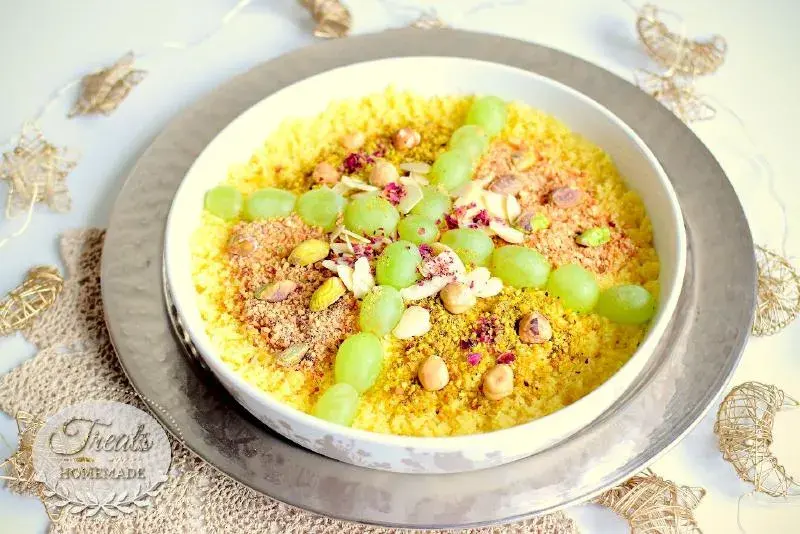
Masfouf (Tunisian Sweet Couscous)
Abuja, Nigeria · Voir toutes les recettes
Aperçu
Masfouf is steamed couscous sweetened with milk and honey and mixed with dates, raisins, nuts and banana, layered with a vanilla custard. It is Tunisian and it belongs to Ramadan. It is the sweet counterpart to Tunisian couscous, which is otherwise a savoury dish, and that inversion is the whole idea, the same grain, the same steaming technique, turned into a dessert or a breakfast. During Ramadan it appears at suhoor, the meal before dawn, because it is filling and sustaining, and at iftar as a sweet. Geranium water is the ingredient that places it. Distilled from scented geranium leaves, it is used across Tunisian sweets in the way rose water and orange blossom water are used further east, and it has a green, faintly citrus perfume that neither of those reproduces. Middle Eastern and North African grocers stock it. Steaming the couscous properly rather than pouring boiling water over it is what the recipe asks for, and it is the difference between light separate grains and a claggy mass. This is a dessert made from properly cooked couscous rather than instant. **It contains almonds and walnuts, which the title gives no indication of.** The source's ingredient list repeats milk, honey and geranium water without indicating that the second set belongs to the custard.
Note de Patrimoine AFN
Masfouf is a Tunisian sweet couscous made with milk, honey, dried fruit and nuts, eaten particularly during Ramadan at suhoor and iftar. It is the sweet counterpart to savoury Tunisian couscous, and is scented with geranium water, which is characteristic of Tunisian sweets.
Ingrédients
Les mentions alimentaires sont fournies par les contributeurs à titre indicatif. Elles ne sont pas vérifiées par AFN et dépendent des produits que vous achetez. En cas d’allergie grave, vérifiez vous-même chaque ingrédient. Cuisine, allergies et votre propre jugement
Préparation
- 1
Prepare the couscous with the olive oil and water, working the oil through the grains. Put it in a steamer and steam for 30 minutes, this is what keeps the grains light and separate.
- 2
Meanwhile, wash and chop the dates and the nuts, and leave the raisins to soak in geranium water mixed with a little water.
- 3
Warm the milk with the honey until the milk is hot and the honey has dissolved.
- 4
Take the couscous off the heat and pour the hot milk over it. Mix gently with a fork and cover for 5 minutes, until the couscous has absorbed the liquid.
- 5
Mix in the dates, nuts and the soaked raisins with their geranium water, then the sliced banana. Mix gently and set aside.
- 6
For the cream, mix the custard powder with cold milk and the honey or sugar. Cook over heat, stirring, until it thickens into a vanilla custard. Take it off the heat and mix in a splash of geranium water.
- 7
To assemble, spoon masfouf into individual bowls, leaving room for a layer of the cream and then a further layer of masfouf.
- 8
Decorate with sliced banana and more nuts, and serve at breakfast or as a dessert.
Notes de l’Africook
- This contains almonds and walnuts. Nothing in the name says so, so mention it when serving.
- Steam the couscous properly rather than pouring boiling water over it. Thirty minutes is what gives you separate grains rather than a mass.
- Work the oil through the couscous before steaming. It coats the grains and keeps them apart.
- Add the banana last and serve promptly, or it browns and softens into the couscous.
- Geranium water is the Tunisian note here. Rose or orange blossom water will substitute but they taste noticeably different.
- Soak the raisins properly. They plump up and carry the geranium water through the dish.
Questions fréquentes
What is masfouf?
Sweet couscous, the same grain and the same steaming technique as savoury Tunisian couscous, turned into a dessert or breakfast dish with milk, honey, dried fruit and nuts. It is closely associated with Ramadan, appearing at suhoor before dawn because it is filling and sustaining, and at iftar as a sweet. The inversion of a savoury staple into something sweet is the whole idea of the dish.
What is geranium water?
A distillate of scented geranium leaves, used widely in Tunisian sweets in the way rose water and orange blossom water are used across the Levant and Egypt. It has a green, faintly citrus, distinctly floral perfume that neither of those reproduces. It is the ingredient that most clearly places a sweet as Tunisian. Middle Eastern and North African grocers stock it, and rose or orange blossom water will substitute at the cost of the specific character.
Can I use instant couscous?
You can, but you lose most of what makes this good. Steaming for thirty minutes with oil worked through the grains produces light, separate couscous that carries the milk and honey without going claggy. Instant couscous rehydrated with hot liquid is denser and clumps more, which matters much more in a wet sweet dish than in a savoury one where a broth is doing the work.
When is it eaten?
Mostly during Ramadan, at suhoor, the meal eaten before dawn, where its combination of grain, milk, dried fruit and nuts is genuinely sustaining for a day of fasting, and at iftar as something sweet to break the fast. Outside Ramadan it is eaten at breakfast or as a dessert. The source suggests either, and both are normal in Tunisian households.
Avis
Soyez le premier à noter cette recette
Vous l’avez cuisinée ? Votre note aide la personne suivante à se décider.
Aucun avis sur cette recette pour le moment. Si vous l’avez cuisinée, le vôtre serait le premier.