Red palm oil is the orange-red oil pressed from the soft flesh of the oil palm fruit, Elaeis guineensis, a tree native to West and western Central Africa. It's the cooking fat behind egusi, eru, kontomire and muamba de galinha, and its colour comes from carotenoids, which refining largely removes.
Pour it into a hot pot and you'll know it straight away: the pot goes orange, and a nutty, slightly earthy smell comes up before the onions even go in. Below, we sort it from the three other palm products on the shelf, explain why ayamase wants it bleached, and show you how to stop a bottle going stale.
What is red palm oil?
Red palm oil is unrefined oil from the fleshy outer layer of the palm fruit, the part botanists call the mesocarp. The tree actually gives two different oils. PROTA, the plant database for tropical Africa, explains that you get palm oil from the mesocarp and palm-kernel oil from the endosperm, the seed inside the nut, in a ratio of roughly nine to one.
Four palm products often get mixed up in shops and recipes, so here's how to tell them apart.
| Product | Made from | What it's like |
|---|---|---|
| Red palm oil | Fruit flesh, unrefined | Orange-red, strong flavour, rich in carotenoids |
| Refined palm oil | Fruit flesh, refined | Pale and neutral; refining removes the carotenoids |
| Palm kernel oil | The seed inside the nut | Pale; similar to coconut oil |
| Palm fruit extract (banga) | Boiled, pounded whole fruit | A thick cream of pulp and oil for soup, not a pure oil |
PROTA says palm-kernel oil is similar in composition and properties to coconut oil, which is why it behaves so differently in the pot. In West African recipes, plain "palm oil" means the red one, unless the recipe says bleached.
From palm oil fruit to bottle: how red palm oil is made
In the traditional village method, the fruit is cooked, then pounded in large wooden or concrete mortars with a wooden pestle, or trampled underfoot. FAO's guide to small-scale processing calls this pounding stage, which breaks open the oil cells, the most labour-intensive part of the job. The mash is then steeped in water, the fibre and nuts are squeezed out by hand, and the oil is boiled and skimmed off the top.
In a 2021 community commentary for London's Horniman Museum, Ajetunmobi describes the same process in Yoruba land, where palm oil is mostly made by women. The note adds a detail many grandmothers would recognise. Palm oil, known as epo pupa in Yoruba, settles into layers, and the lightest, purest layer on top is called ogere. For more on the fruit itself, read our guide to palm nut in traditional African dishes. If you want the whole pulp rather than the oil, our palm fruit juice recipe shows how the extract for banga and ofe akwu is made from the same palm oil fruit.
How to cook with red palm oil
In many stews red palm oil is the first thing in the pot, but not in every soup. In our Ghanaian vegetable palm oil stew, it's heated over medium heat for about two minutes before the onions go in. In muamba de galinha from Angola, the chicken is browned first and the palm oil is heated in the same pan. Eru does it the other way round: the palm oil goes in near the end with the cooking liquid, and the greens cook gently in it for 15 minutes.
PROTA calls unrefined red palm oil an essential ingredient of the West African diet, and you can see why in any pot of egusi: it carries the heat of the peppers, colours the whole pot and gives soups like egusi their gloss. Banga soup and ofe akwu go a step further and use the pulp of the fruit itself.
Bleached palm oil for ayamase and ofada stew
Some dishes want palm oil that's been heated until it turns pale and smoky. That's bleached palm oil, and it's the base of ayamase and ofada stew. Our ofada stew recipe bleaches the oil for seven minutes in a covered pot. The lid then stays on for at least 20 minutes, so the oil cools completely before you open it.
The colour disappears because carotenoids are sensitive to heat, light, and oxygen, and strong heat breaks them down. You trade the red colour, and the carotenoids that carry it, for a toasted, smoky flavour those stews can't do without. Keep the lid on, open a window and never leave the pot. Our step-by-step guide covers it in detail: tips for bleaching red palm oil like an expert.
Recipes that use red palm oil
Palm oil runs through dozens of AFN recipes. These are good places to start, along with our egusi soup, ofada stew and Ghanaian kontomire stew.
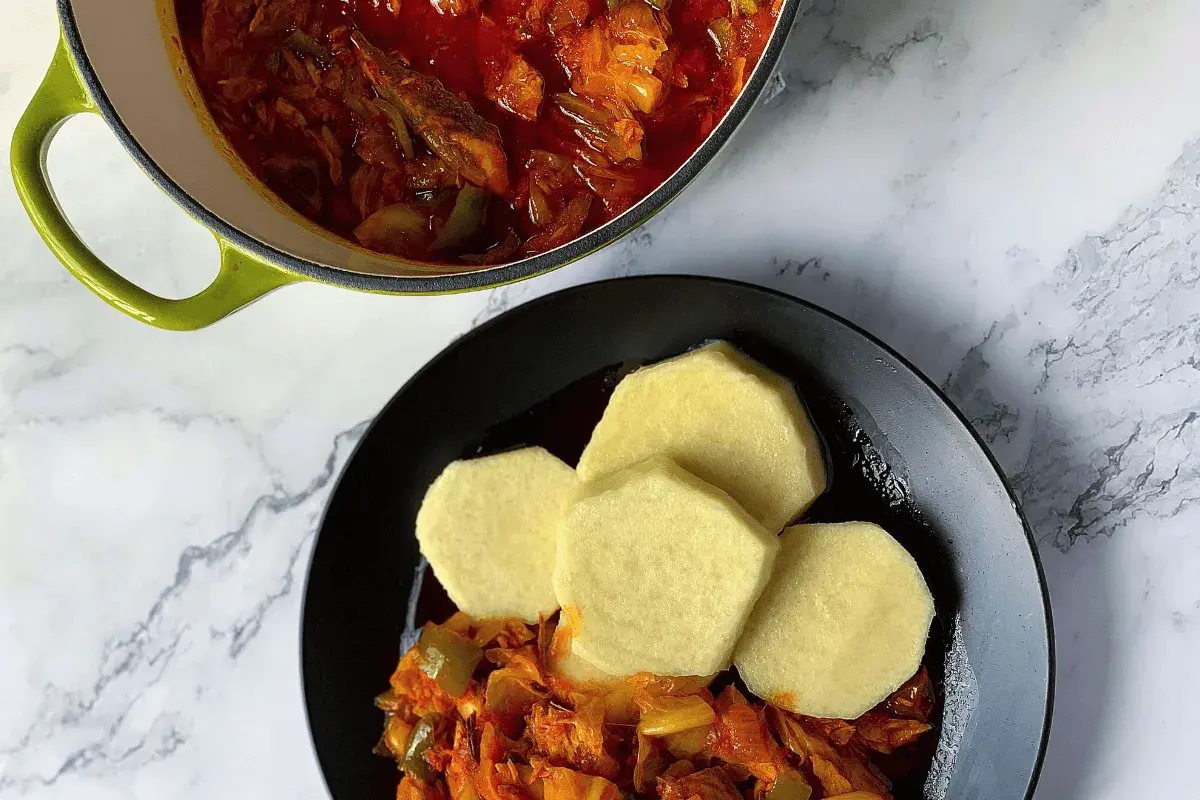
Vegetable palm oil stew
This Ghanaian vegetable stew is built on 200 ml of red palm oil, softened onions and smoked fish. Cook it with our vegetable palm oil stew recipe.
Ayamase sauce
Ayamase, the green pepper stew, uses two-thirds of a cup of bleached palm oil with iru and onions. Make it with our ayamase sauce recipe.
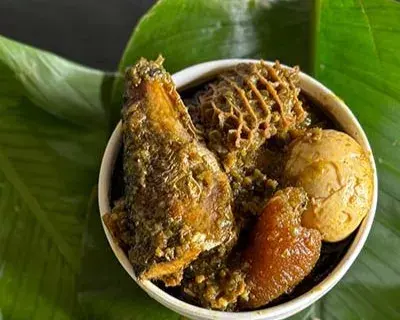
Eru soup, Cameroon's wild vegetable soup
Eru is generous with its oil: 500 ml of red palm oil for a big pot of wild greens. Follow our eru soup recipe.
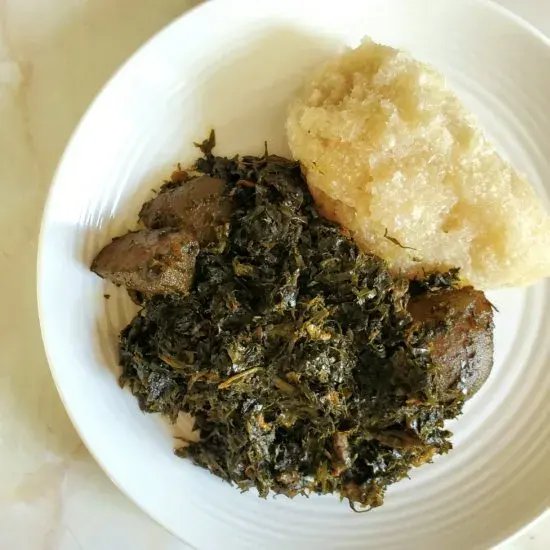
Muamba de galinha (Angolan chicken stew)
Angola's chicken stew uses three tablespoons of red palm oil, proof that palm oil cooking reaches well beyond West Africa. See our muamba de galinha recipe.
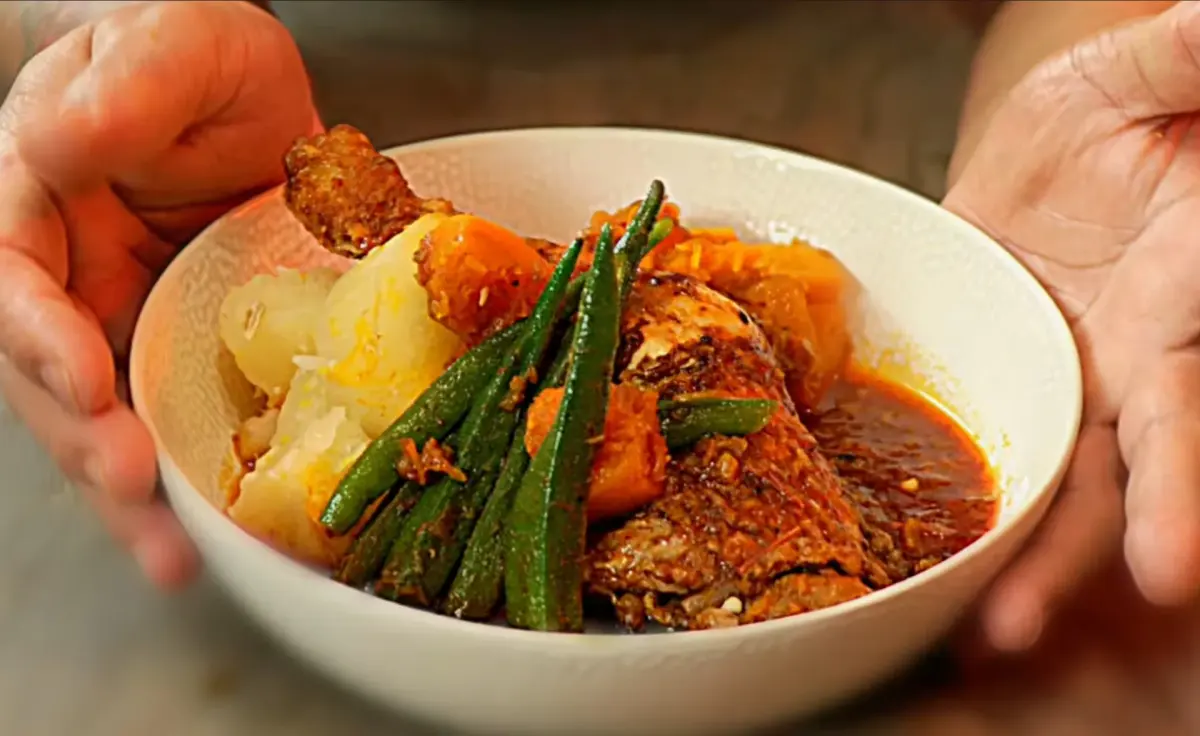
Ofe akwu
This Igbo soup is made with half a cup of palm fruit extract rather than bottled oil. Try our ofe akwu recipe.
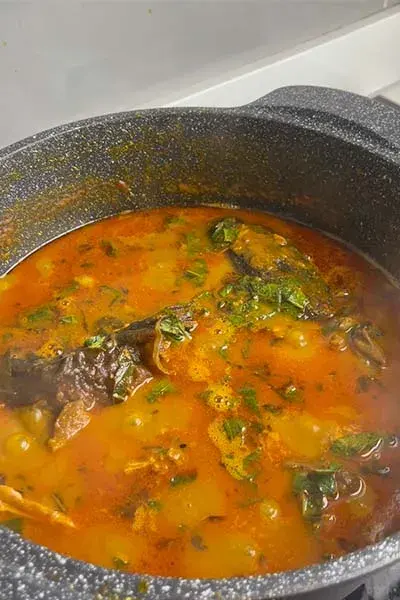
Red palm oil nutrition
Palm oil is almost pure fat. PROTA gives its energy as 884 kcal per 100 g, with palmitic acid making up 43 to 50% of its fatty acids and oleic acid 34 to 41%. PROTA puts crude palm oil at about 50% saturated fatty acids.
What sets red palm oil apart is its carotenoids, which the body can turn into vitamin A. PROTA puts them at 800 to 2,000 mg per kg in the orange-red oil of West Africa, against 400 to 600 mg per kg in the lighter oil from Malaysia and Indonesia. A 2025 review in Molecules gives a lower range for crude red palm oil, 500 to 700 mg/kg. It also lists tocotrienols, a form of vitamin E, at 200 to 400 mg per kg. The two sources disagree on refining, too. PROTA says carotenoids fall to zero, while the review says refining can cut them by up to 70%.
Why palm oil goes solid, and how to store it
Palm oil often sets in a cool kitchen, and that's normal. Its melting point ranges from 25°C to 40°C, so it's liquid in a hot West African afternoon and solid in a UK winter. Stand the bottle in warm water and it'll melt again.
To keep the colour and goodness, store it closed, cool and out of the light. The Molecules review found that carotenoids can fall by 20 to 50% over 3 to 6 months at room temperature. Use a dry spoon so no water gets in.
Where palm oil comes from
The oil palm is African. PROTA says it's indigenous to the tropical rainforest belt of West and western Central Africa, between Guinea and northern Angola. Its greatest genetic variety is in south-eastern Nigeria and western Cameroon, and fossil evidence points to the Niger delta as its most likely centre of origin.
You may have read that palm oil was found in an ancient Egyptian tomb. Historian Jonathan Robins traced that claim back to an 1897 analysis and found it doesn't hold up. Later testing identified date palm oil in a cosmetic jar from the same Abydos excavations. Today the oil palm grows across the tropics. IUCN notes that it yields up to nine times more oil per unit area than other major oil crops, but that it needs to be grown without clearing forest.
Red palm oil questions
Is red palm oil the same as palm kernel oil?
No. Red palm oil comes from the fruit flesh and is orange-red. Palm kernel oil comes from the seed and is pale, more like coconut oil.
What is palm oil called in Yoruba?
Palm oil is epo pupa in Yoruba. The lightest top layer of the oil is called ogere.
Why does palm oil go solid?
Palm oil melts between 25°C and 40°C, so it sets at cooler room temperatures. Warm it gently and it turns liquid again.
How do you make palm oil stew?
Heat red palm oil, soften onions in it, then add blended tomatoes and peppers, smoked fish and vegetables. Our vegetable palm oil stew walks you through it.