
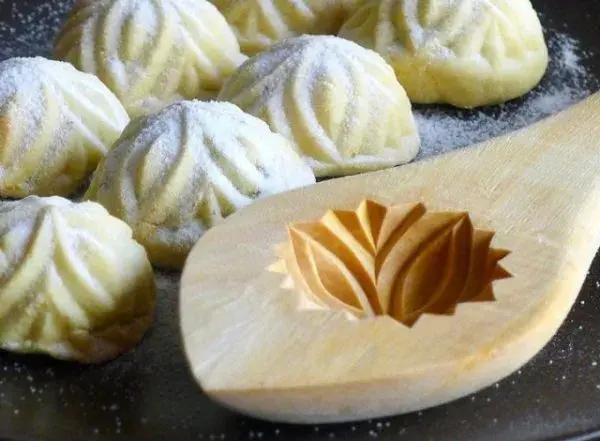
Maamoul (Filled Semolina Cookies)
Overview
Maamoul are semolina cookies filled with a sweet paste, walnuts here, though dates and pistachios are equally traditional, pressed into a carved mould and dusted with icing sugar. They are Levantine in origin, strongly associated with Lebanon, and eaten across the Middle East and North Africa. **They contain walnuts, which the title gives no indication of.** **This page had no recipe card in the source.** The ingredients and method below are reconstructed from its article, and that is flagged. Two things distinguish maamoul from an ordinary filled cookie. The dough is semolina rather than flour, worked with boiling water and fat, and then rested for at least an hour, often overnight. That rest lets the semolina hydrate fully, and without it the cookies are gritty. The second is the mould: carved wooden moulds called tabi press a pattern into each cookie, and traditionally the pattern indicates the filling, so you can tell dates from walnuts from pistachios without breaking one open. They are festival food. Maamoul is made for Eid al-Fitr, for Easter and for Purim, by Muslim, Christian and Jewish families respectively across the Levant, one of the more striking examples of a single food crossing all three. The source's method contains a typo, calling for groundnuts where the ingredient list specifies walnuts.
AFN Heritage Note
Maamoul are filled semolina cookies of Levantine origin, particularly associated with Lebanon and eaten across the Middle East and North Africa. They are shaped in carved wooden moulds whose patterns traditionally indicate the filling, and are made for Eid al-Fitr, Easter and Purim.
Ingredients
Dietary tags are provided by contributors as a guide, not verified by AFN, and they depend on the products you buy. If you have a serious allergy, check every ingredient yourself. Cooking, allergies and your own judgement
Directions
- 1
Put the semolina flour into a medium bowl and cut in the shortening with a pastry blender or a fork until evenly distributed.
- 2
Pour in the boiling water and mix to a solid dough.
- 3
Turn it out onto a lightly floured surface and knead for a minute or two until well blended.
- 4
Cover the dough and leave it to stand for at least an hour, or overnight. This rest lets the semolina hydrate fully and is what stops the cookies being gritty.
- 5
Mix the sugar, ground walnuts and rose water together in a bowl until uniform. Set aside.
- 6
Set the oven to 350°F / 175°C and grease baking sheets or line them with parchment.
- 7
Knead the dough briefly again and form it into walnut-sized balls.
- 8
Make a hole in the centre of each ball with your finger, fill it with the nut mixture, and seal the dough over it.
- 9
Press each filled ball into a carved maamoul mould if you have one, then tap it out onto the sheet; otherwise flatten gently and mark the top with a fork.
- 10
Bake for around 20 to 25 minutes, until set and only just beginning to colour. Maamoul should stay pale.
- 11
Cool completely, then dust generously with icing sugar.
Africook’s Notes
- These contain walnuts. Nothing in the name says so, so mention it when you serve them.
- Rest the dough for at least an hour. Semolina needs time to absorb the water and unrested dough gives gritty cookies.
- Keep them pale. Maamoul are baked until set rather than browned, and a golden maamoul is an overbaked one.
- Seal the dough carefully around the filling. A cookie that splits in the oven loses its filling entirely.
- Dust with icing sugar only once completely cool, or it dissolves into the surface.
- Dates and pistachios are equally traditional fillings, and in a carved mould the pattern traditionally tells you which is which.
Questions cooks ask
What are maamoul filled with?
Traditionally dates, walnuts or pistachios, and all three are equally authentic. This version uses walnuts with rose water. In households that make several kinds at once, the carved wooden mould does double duty: different patterns indicate different fillings, so you can tell a date maamoul from a pistachio one without breaking it open. Fig and almond fillings also appear regionally.
Why semolina rather than flour?
Because it gives maamoul their characteristic texture, slightly sandy and crumbly rather than smooth and short. Semolina is coarser than flour and takes considerably longer to hydrate, which is why the dough is made with boiling water and then rested for an hour or more. Skipping that rest is the most common reason home-made maamoul come out unpleasantly gritty rather than tender.
What is a maamoul mould?
A carved wooden mould, called tabi, into which the filled ball of dough is pressed before being tapped out onto the baking sheet. It shapes the cookie and stamps a pattern into the top. Traditional families own several, and the different patterns are used to distinguish fillings. Plastic versions are widely sold now. Without one, flattening gently and marking the top with a fork works perfectly well.
When are maamoul eaten?
At festivals, and unusually across three religions. Muslim families make them for Eid al-Fitr at the end of Ramadan; Christian families across the Levant make them for Easter; and Jewish families make them for Purim. That a single cookie belongs to all three is one of the more striking things about Levantine food culture. They are made in large batches and given as gifts between households.
Reviews
Be the first to rate this recipe
Cooked it? Your rating helps the next person decide whether to try it.
No reviews on this one yet. If you have cooked it, yours would be the first.