

Otong Soup
Aperçu
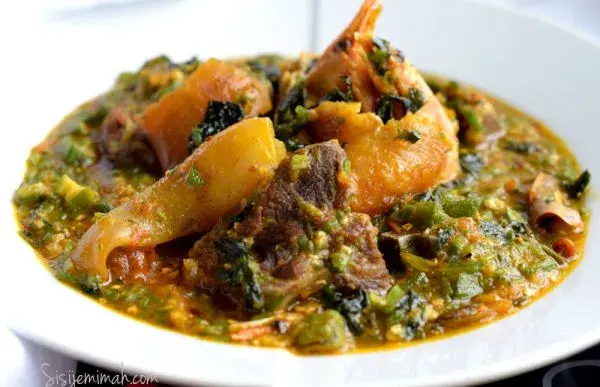
Otong soup is the Efik okra soup of Cross River State in south eastern Nigeria, and what separates it from every other okra soup in the country is the pairing of two vegetables rather than one. Okra provides the draw; ikong ubong, the pumpkin leaf known elsewhere as ugwu, provides the body and the green. Uziza leaf goes in for aroma. Okra soup is made across Nigeria and the names shift with the language: ila asepo among the Yoruba, okwuru among the Igbo, miyan kubewa in Hausa, and otong among the Efik. Each has its own emphasis, and the two vegetable combination is what marks this one as Efik rather than anything else. The technique is short and the timing is unforgiving. Okra goes in near the end, the pot is never covered after that point, and the soup comes off the heat while the okra is still green and resilient, because the retained heat keeps cooking it for another couple of minutes. Covered or overcooked, okra goes brown and loses its texture entirely. The Efik version is generous with seafood, taking in prawns, crab, mussels and smoked catfish alongside the assorted meat, which reflects a state built around water. It is eaten with ayan ekpang, the grated steamed cocoyam, or with any swallow.
Note de Patrimoine AFN
Otong is documented as the okra soup of the Efik people of Cross River State, south eastern Nigeria, distinguished by the combination of okra with ikong ubong, the pumpkin leaf. Okra is native to Africa, with its origin generally placed in the Ethiopian highlands, and is eaten across the continent.
Ingrédients
Les mentions alimentaires sont fournies par les contributeurs à titre indicatif. Elles ne sont pas vérifiées par AFN et dépendent des produits que vous achetez. En cas d’allergie grave, vérifiez vous-même chaque ingrédient. Cuisine, allergies et votre propre jugement
Préparation
- 1
Put the seafood and meat in a bowl of lukewarm water, add salt and wash vigorously. Rinse and repeat three times. Hand wash the mussels and remove any impurities.
- 2
Boil and season the meat and seafood with salt and seasoning cubes.
- 3
Wash the okra under running water in a sieve and chop to the size you want.
- 4
Roughly chop the habanero and red bell pepper and add them to the pot with the crayfish. Add the palm oil and cook for about 5 minutes.
- 5
At this point the prawns should be pink, the crabs coral, and the mussels open. Discard any mussel that has not opened.
- 6
Add the okra, the pumpkin leaves and the uziza and stir. Add a little water if the soup is too thick. Check the seasoning and cook uncovered for another 5 minutes.
- 7
Remove from the heat and cover. The trapped heat will finish cooking the okra.
- 8
Serve with ayan ekpang, fufu or any swallow.
Notes de l’Africook
 Notes personnelles de Jennifer Ezeokoli
- Do not cover the pot once the okra is in. Covering it turns the okra brown and destroys both the colour and the texture.
- Take it off the heat while the okra still looks underdone. It keeps cooking for about two more minutes in the residual heat, which is exactly the amount it needs.
- Discard any mussel that does not open during cooking. This is a food safety rule, not a preference.
- Spinach, waterleaf or kale will stand in for ugu. Ground uziza seed substitutes for uziza leaf, which is optional in any case.
- Ayan ekpang, grated steamed cocoyam, is the Efik pairing. Pounded yam, eba, semo and amala all work.
Questions fréquentes
What makes otong different from other Nigerian okra soups?
Two vegetables rather than one. Otong combines okra with ikong ubong, the pumpkin leaf known elsewhere as ugwu, and often uziza leaf as well. Most other okra soups use okra alone or with a single green. That combination is what marks it as Efik. Yoruba ila asepo, Igbo okwuru and Hausa miyan kubewa are the equivalents elsewhere.
How do I stop okra going brown?
Do not cover the pot after the okra goes in, and take the soup off the heat while the okra still looks slightly underdone. Covering traps steam and turns the okra brown and slimy in the wrong way, and overcooking does the same. The residual heat finishes it in about two minutes off the stove.
What can I use instead of ugu leaves?
Spinach is the most widely available substitute, and waterleaf and kale both work. Use mature spinach rather than baby leaves, which wilt to almost nothing. Frozen ugu is stocked by Nigerian grocers and is closer to the real thing than any fresh alternative.
Can I make otong soup without seafood?
Yes, and it will still be a good okra soup, though the Efik character comes substantially from the range of seafood. If you are dropping the prawns, crab and mussels, keep the smoked catfish and stockfish if you can, since the smoked element is doing a lot of the flavour work that the fresh seafood alone does not.
Avis
5 avis
Vous Aimerez Aussi
Voir toutes les recettes Nigeria →
Edo Black Soup

Nigerian Fisherman Soup
Igbo Yam Porridge

Finding fresh whole crabs here in Houston was a whole issue so I had to settle for frozen blue crabs from H-Mart, but abeg this soup still tasted like home. The cow tripe took almost an hour to get tender before I even started the step for the seafood, so prepare your meat well in advance! The smell of the ground crayfish and palm oil cooking down brought tears to my eyes o.
Couldn't get fresh raw crabs in Tottenham high road so I bought frozen ones from the Turkish store and just thawed them out. Also had to use dried crayfish powder from the African shop near Seven Sisters. Chale the combination of the red bell pepper and habanero gives it the exact right heat, my husband cleaned his bowl complete. Next time I will add a bit more palm oil oo.
Made this last night for dinner. Mussels took a bit longer than 5 minutes to open proper, maybe closer to 8 minutes on my stove, but once they popped it was sorted. Used 250ml of palm oil instead of a full cup to keep it slightly lighter. The spice from the 3 habaneros was properly lekker, perfect heat level for winter in PE.
The smell of the smoked catfish and stockfish boiling together almost brought my neighbours to my door! I was skeptical about adding mussels because we usually do calabar style without it in my house, but it worked sha. The okra stayed nice and crunchy, not slimy at all since I added it near the end. E sweet well well o.
washing the cow tripe and stockfish three times with salt water took almost 30 minutes on its own, so the 10 min prep time listed here is too short abeg. Also 3 habanero plus 1 tbsp dried pepper made it far too spicy for my kids to eat. Taste is okay but reduce the pepper if you are cooking for family.