
Rooibos Tea (Red Bush Tea)
Lagos, Nigeria · Voir toutes les recettes
Aperçu
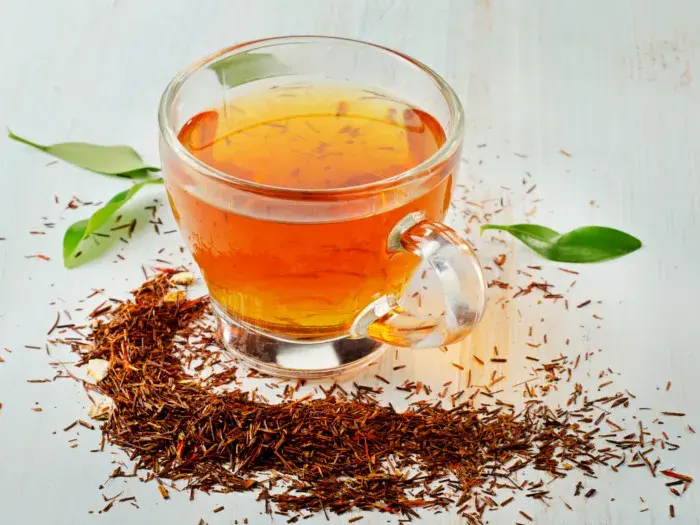
Rooibos leaves brewed in water and served with or without milk. It is South African, and it is one of very few plants used as a tea that grows nowhere else on earth. Rooibos means red bush in Afrikaans, and the plant, *Aspalathus linearis*, grows only in the Cederberg, a small mountainous area of the Western Cape. Attempts to cultivate it elsewhere have consistently failed, which makes it genuinely unusual: not a plant that happens to be associated with a region but one that is confined to it. The European Union granted it protected designation of origin status in 2021, the first African food to receive it. It is not tea in the botanical sense. Rooibos contains no *Camellia sinensis* and therefore no caffeine at all, and it has very little tannin, which is why it does not turn bitter however long it brews. That is the practical difference: black tea over-steeped becomes astringent, rooibos simply becomes stronger. Red rooibos is oxidised after harvest, which is what produces the colour and the sweeter, fuller flavour. Green rooibos is unoxidised, lighter and more expensive. The source's health claims have not been carried across.
Note de Patrimoine AFN
Rooibos is made from Aspalathus linearis, a plant that grows only in the Cederberg region of South Africa's Western Cape and has never been cultivated successfully elsewhere. It contains no caffeine. In 2021 it became the first African food product granted protected designation of origin status by the European Union.
Ingrédients
Les mentions alimentaires sont fournies par les contributeurs à titre indicatif. Elles ne sont pas vérifiées par AFN et dépendent des produits que vous achetez. En cas d’allergie grave, vérifiez vous-même chaque ingrédient. Cuisine, allergies et votre propre jugement
Préparation
- 1
Pour the water into a clean saucepan and mix in the tea leaves.
- 2
Cover and bring to the boil over high heat.
- 3
Lower the heat and let it brew, uncovered. Rooibos has very little tannin, so unlike black tea it will not turn bitter, a longer brew simply makes it stronger and darker.
- 4
Ten to fifteen minutes gives a full-strength brew. The source suggests thirty, which produces something very concentrated.
- 5
Strain the tea into cups.
- 6
Add milk, sugar or honey to taste, or drink it as it is.
Notes de l’Africook
 Notes personnelles de Jennifer Ezeokoli
- It cannot over-brew. Rooibos has almost no tannin, so a long steep makes it stronger rather than bitter, the opposite of black tea.
- Fifteen minutes gives a good full-strength cup. The source's thirty is not wrong, just very strong.
- It contains no caffeine at all, which is why it is drunk in the evening and given to children across South Africa.
- It takes milk well, unlike most herbal infusions, and is often drunk that way in South Africa.
- Green rooibos is unoxidised, lighter and grassier. Red is the traditional and far more common form.
- It is excellent iced, with lemon and mint, and does not go cloudy the way black tea does.
Questions fréquentes
Is rooibos actually tea?
Not botanically. Tea proper comes from Camellia sinensis; rooibos comes from Aspalathus linearis, an unrelated shrub in the legume family. That is why it contains no caffeine at all and very little tannin. It is called tea because it is brewed and drunk like one, in the same way that chamomile and peppermint are. The distinction matters practically: rooibos cannot become bitter no matter how long it brews.
Why does rooibos only grow in South Africa?
Nobody has managed to grow it commercially anywhere else. It is native to the Cederberg, a small mountainous region of the Western Cape with a particular combination of soil, altitude and Mediterranean climate, and attempts at cultivation elsewhere have consistently failed. That confinement is unusual for a widely traded crop, and it is why the European Union granted rooibos protected designation of origin status in 2021, the first African food product to receive it.
Can it be over-brewed?
No, which is the practical difference from black tea. Black tea contains tannins that become astringent and bitter with long steeping, which is why the brewing time matters so much. Rooibos has very little tannin, so a long brew simply produces a stronger, darker, more concentrated cup. Fifteen minutes gives a good full-strength result; the source's thirty minutes is not a mistake, just very strong.
What is the difference between red and green rooibos?
Oxidation. Red rooibos, which is the traditional and by far the more common form, is bruised and left to oxidise after harvest, which develops the deep red colour and the fuller, sweeter, slightly vanilla flavour. Green rooibos is dried immediately without oxidising, giving a lighter, grassier, more delicate brew. Green is more expensive because the processing is more demanding and the yield lower.
Avis
Soyez le premier à noter cette recette
Vous l’avez cuisinée ? Votre note aide la personne suivante à se décider.
Aucun avis sur cette recette pour le moment. Si vous l’avez cuisinée, le vôtre serait le premier.
Vous Aimerez Aussi
Voir toutes les recettes South Africa →
Dombolo (Dumplings or Steamed Bread)

Boeber (Cape Malay Sweet Milk Drink)