
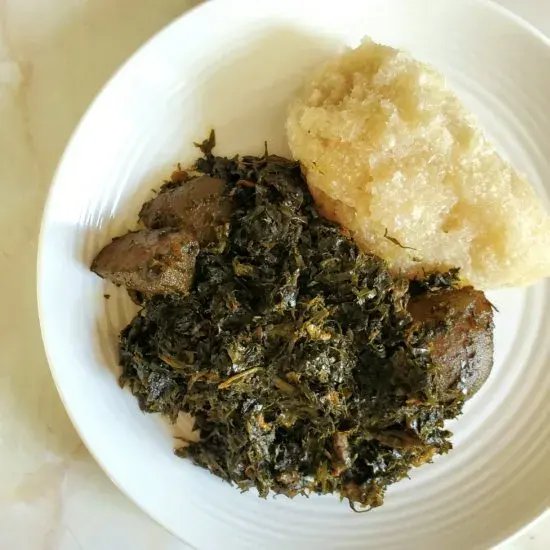
Eru Soup (Cameroonian Wild Vegetable Soup)
Abuja, Nigeria · Voir toutes les recettes
Aperçu
Eru soup is finely shredded eru leaves cooked down with waterleaf or spinach, palm oil, crayfish, smoked fish, beef and cow skin. It is Cameroonian, most closely associated with the Bayangi of the southwest, and it is one of the country's best-known dishes. Eru is the common name for two closely related climbing vines, *Gnetum africanum* and *Gnetum buchholzianum*, gathered wild from the forest rather than farmed. The leaves are tough and leathery, which is why the method insists on soaking them for hours, or on cooking them with kanwa. That toughness is also why eru is always shredded very finely, much more finely than any cultivated green would be. The pairing with a soft green is not optional. Waterleaf traditionally, or spinach where waterleaf cannot be found, provides the moisture and bulk that eru alone would not, and the ratio is roughly one to one. Palm oil goes in generously and late. The Nigerian relative is afang soup, made by the Efik and Ibibio of Cross River with the same leaf under the name afang or okazi. The two are close cousins: afang tends to be soupier and eru is more finely ground. They are kept as separate pages here because they are genuinely separate national dishes, and that is flagged. The source's health claims about eru's protein and mineral content have not been carried across.
Note de Patrimoine AFN
Eru is the Cameroonian name for the leaves of Gnetum africanum and Gnetum buchholzianum, wild forest vines gathered rather than cultivated. Eru soup is closely associated with the Bayangi people of southwestern Cameroon. The same leaf is called afang or okazi in Nigeria, where it is used in afang soup.
Ingrédients
Les mentions alimentaires sont fournies par les contributeurs à titre indicatif. Elles ne sont pas vérifiées par AFN et dépendent des produits que vous achetez. En cas d’allergie grave, vérifiez vous-même chaque ingrédient. Cuisine, allergies et votre propre jugement
Préparation
- 1
Soak the dried eru leaves for 3 to 6 hours. Alternatively soak them for an hour and then cook them with a small pinch of kanwa for 30 minutes, eru is tough and this step cannot be skipped.
- 2
Wash and shred all the leaves finely. Eru needs to be cut much finer than a cultivated green would be.
- 3
Use roughly equal quantities of eru and waterleaf or spinach. Waterleaf is traditional; spinach is the standard substitute where it cannot be found, and the two are not the same thing.
- 4
Wash and cut the cow skin, then cook it for 30 minutes. Put in the cleaned and cut beef and season with salt.
- 5
Cook for a further 10 minutes until a gravy has formed. Add chilli to taste. Put the soaked smoked fish in towards the end of the cooking. Keep the cooking liquid, it is needed later.
- 6
In a separate pot, cook down the waterleaf or spinach. After 10 minutes, work in the eru and cook the mixture gently, turning it occasionally.
- 7
Tip in the meat and fish, mix through and cook for 5 minutes.
- 8
Pour in the reserved cooking liquid and the palm oil, mix, and cook gently for 15 minutes.
- 9
Finally mix in the crayfish and cook for a further 5 to 10 minutes. Serve with garri, fufu or water fufu.
Notes de l’Africook
- Soak the eru properly. Three to six hours is the honest requirement, and undersoaked eru stays leathery no matter how long you cook it.
- Shred it very finely. This is not a green that can be roughly chopped.
- Keep the eru and the soft green in roughly equal proportion. Eru alone is dry and tough; the waterleaf or spinach provides all the moisture.
- Be generous with the palm oil, and add it late. It is a defining flavour rather than a cooking medium here.
- Kanwa softens the leaves, and a pinch is enough. More affects both texture and flavour, and it is an alkaline salt rather than a seasoning.
- Waterleaf and spinach are genuinely different plants. Spinach works but the source is right to flag the substitution.
Questions fréquentes
What is eru?
The leaves of two closely related climbing vines, Gnetum africanum and Gnetum buchholzianum, gathered wild from Central and West African forests rather than cultivated. The leaves are tough and leathery, which is why they are soaked for hours and shredded extremely finely before cooking. They are eaten across Cameroon, Nigeria, Gabon and the Congo basin under a range of local names, and they are an important wild food in the region.
How is eru soup different from afang soup?
They are close cousins made with the same leaf. Afang is the Nigerian name, used by the Efik and Ibibio of Cross River, where the leaf is also called okazi; eru is the Cameroonian name. The main practical difference is texture and consistency: afang tends to be soupier, while eru is ground or pounded finer and cooked drier. Both pair the leaf with a soft green, palm oil, crayfish and assorted meat.
Can I use spinach instead of waterleaf?
Yes, and the source specifically recommends it for cooks who cannot find waterleaf. They are different plants, waterleaf is succulent and holds more moisture, which is exactly the property the dish relies on, so spinach is a substitution rather than an equivalent. Use it in the same quantity and expect a slightly drier result. What you cannot do is leave the soft green out, since eru alone is far too tough and dry.
What is kanwa?
An alkaline mineral salt, also called potash or akanwu, used across West and Central African cooking to soften tough ingredients and to help emulsify soups. Here it shortens the time eru takes to become tender. A small pinch is the correct quantity, it is not a seasoning, and larger amounts change both the texture and the taste noticeably. Bicarbonate of soda does a similar job and is more widely available.
Avis
Soyez le premier à noter cette recette
Vous l’avez cuisinée ? Votre note aide la personne suivante à se décider.
Aucun avis sur cette recette pour le moment. Si vous l’avez cuisinée, le vôtre serait le premier.