
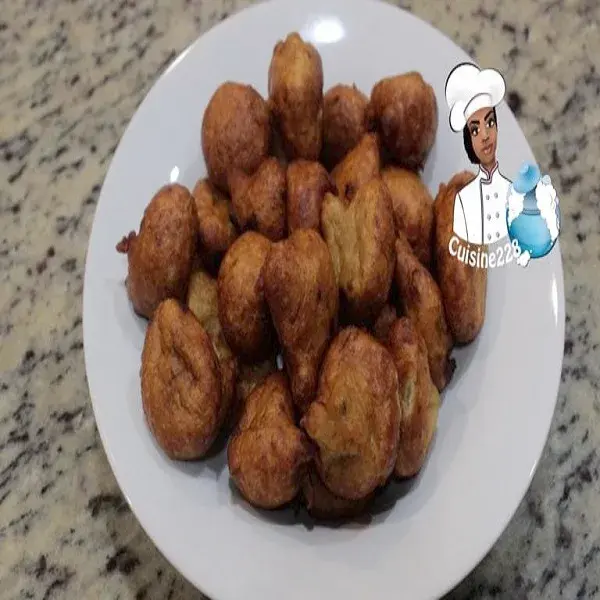
Cameroonian Banana and Corn Fritters
Aperçu
These are fritters of mashed ripe banana and corn flour, leavened with yeast and deep fried, and the contributor is candid about where they came from: banana fritters exist, corn fritters exist, and this combines the two. It is an invention rather than an inherited dish. Both parents have their own histories. Corn fritters are a traditional sweet and savoury snack in the southern United States and in Indonesia, where they are perkedel jagung or bakwan jagung, and they originate in Native American cooking. Banana fritters are made across West Africa and much of the tropics, and appear in this archive as klako and krakro. What makes this version work is the yeast. Most fritter batters are leavened chemically or not at all; this one proves for an hour to ninety minutes, which is why the finished fritters are chewy and bread-like inside rather than dense. Very ripe bananas, heavily spotted, mash without lumps and carry more flavour. The result is described as sweet and salty at once, which the salt in the batter is doing deliberately. Peanut oil for frying is a common West and Central African choice, and it carries an allergen worth flagging.
Ingrédients
Les mentions alimentaires sont fournies par les contributeurs à titre indicatif. Elles ne sont pas vérifiées par AFN et dépendent des produits que vous achetez. En cas d’allergie grave, vérifiez vous-même chaque ingrédient. Cuisine, allergies et votre propre jugement
Préparation
- 1
Crush the peeled bananas with a fork or blender and add the flours.
- 2
Add the yeast, slaked in a little room temperature water.
- 3
Add the salt.
- 4
Mix well and leave to prove for 1 hour to 1 hour 30 minutes.
- 5
Heat the oil in a saucepan.
- 6
Using two teaspoons, drop small amounts of the batter into the hot oil.
- 7
Let the fritters brown, turning as needed.
- 8
Drain on several layers of absorbent paper and serve.
Notes de l’Africook
- Use bananas with dark brown spots. They mash smooth without lumps and carry considerably more flavour than yellow ones.
- Give the batter the full prove. This is a yeasted batter, not a quick one, and the hour or more is what makes the inside light rather than dense.
- Slake the yeast in room temperature water first. Hot water kills it and cold water leaves it sluggish.
- Use two teaspoons to shape and drop the batter. It is too loose to handle and the two-spoon method gives even rounds.
- Do not crowd the pan. Crowded fritters absorb oil rather than crisping.
- Peanut oil is what the recipe specifies. It carries a peanut allergen, so use a neutral oil instead if that matters.
Questions fréquentes
Is this a traditional Cameroonian dish?
Not exactly, and the contributor says so directly: banana fritters and corn fritters both exist separately, and this combines them. It is a contemporary Cameroonian invention. Both parent dishes are traditional in their own right, banana fritters across West Africa and corn fritters in the southern United States and Indonesia.
Why does the batter need yeast?
Because it is what makes these light. Most fritter batters use baking powder or nothing at all and come out dense. Yeast plus an hour or more of proving gives an open, bread-like interior against the crisp fried outside, which is the texture the recipe is aiming for.
What kind of corn flour should I use?
Fine corn flour or corn meal, not cornflour in the British sense, which is a refined starch and will not work. In this recipe it is combined with a small amount of wheat flour for structure, since corn has no gluten. Masa harina is a reasonable substitute.
How are these different from banana fritters?
The corn flour and the yeast. Plain banana fritters are usually banana mashed into a wheat batter and fried straight away, giving something soft and cakey. These use mostly corn flour, are yeasted and proved, and come out chewier with a more pronounced savoury note from the salt.
Avis
Soyez le premier à noter cette recette
Vous l’avez cuisinée ? Votre note aide la personne suivante à se décider.
Aucun avis sur cette recette pour le moment. Si vous l’avez cuisinée, le vôtre serait le premier.