
Tunisian Fricassé
Abuja, Nigeria · Voir toutes les recettes
Aperçu
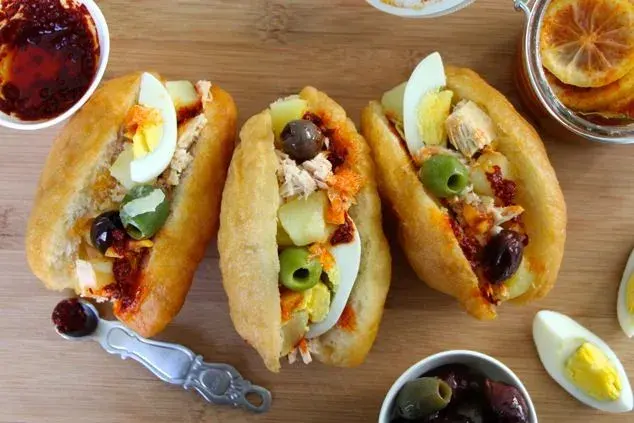
A fricassé is a small oval roll of enriched dough, deep-fried and then split and packed with tuna, potato, olives, egg and harissa. It is Tunisian street food, and it is one of the country's most recognisable things to eat. The word does not mean what it means elsewhere. In French, a fricassée is a braise of meat in a white sauce; in Tunisia and its diaspora it means this sandwich and nothing else. That divergence is complete enough that searching the French term will not find you the Tunisian food. The filling is the point and it is fixed by convention rather than by recipe: tuna in olive oil, cooked potato, black olives, egg and harissa, with slata méchouia, the grilled pepper and tomato salad, very often alongside. Capers and preserved lemon appear in some versions. What matters is that the bread is fried rather than baked, which gives a rich, slightly greasy roll that stands up to a wet filling. **A significant gap in the source.** Its ingredient list contains only the dough, yeast, water, flour, egg, oil, salt. Not one of the filling ingredients it spends its article describing appears in it. The filling below has been reconstructed from that description and flagged. **It contains eggs and fish.**
Note de Patrimoine AFN
The Tunisian fricassé is a small deep-fried roll filled with tuna, potato, olives, hard-boiled egg and harissa, sold as street food across Tunisia and in its diaspora communities. The word is unrelated to the French fricassée, which is a braise in a white sauce.
Ingrédients
Préparation
- 1
Mix the yeast, water and a tablespoon of the flour in a bowl.
- 2
Leave it until bubbly, about 10 minutes. If it does not bubble, the yeast is dead.
- 3
Work in the remaining flour, the egg, the oil and the salt.
- 4
Mix for five minutes until you have a smooth dough.
- 5
Shape into small oval buns.
- 6
Leave them to rise until doubled in size.
- 7
Deep-fry in hot oil until golden, turning them so they colour evenly.
- 8
Drain on kitchen paper and let them cool enough to handle.
- 9
Split each roll along one side without cutting all the way through.
- 10
Spread harissa inside, then pack with tuna, sliced potato, sliced hard-boiled egg and olives. Add slata méchouia, capers or preserved lemon if you have them.
Notes de l’Africook
- This contains fish and eggs, neither of which the name indicates.
- Fry the rolls rather than baking them. The frying is what gives the fricassé its character and a baked roll is a different sandwich entirely.
- Let the rolls cool before filling. Hot bread wilts the filling and steams itself soggy.
- Be generous with the harissa but taste first, brands vary enormously in heat.
- Use tuna packed in olive oil rather than brine or water. It is what the dish assumes and the oil is part of the filling.
- Slata méchouia alongside is close to standard in Tunisia and is worth making if you have time.
Questions fréquentes
Why is it called a fricassé?
Nobody quite knows, and the name is misleading. In French, a fricassée is a braise of meat in a white sauce, a completely different thing. In Tunisia and among Tunisians abroad, fricassé means this fried roll and only this, and the two usages have diverged so completely that searching the French term will not find you the sandwich. It is a good example of a borrowed word taking on an entirely local meaning.
What goes inside?
Tuna in olive oil, boiled potato, black olives, hard-boiled egg and harissa, which is the fixed combination. Slata méchouia, the Tunisian grilled pepper and tomato salad, is very commonly added, and capers or preserved lemon appear in some versions. The filling is set by convention rather than by any particular recipe, and a fricassé without tuna, egg and harissa would not be recognised as one.
Why is the bread fried rather than baked?
Because it is what the dish is. Frying gives a rich, slightly greasy, dense roll with a crisp exterior, which stands up to a wet filling of oily tuna and harissa in a way a baked roll does not. It also makes it street food, quick to cook to order over a fryer. Baking the same dough gives you a perfectly good small bun and a different sandwich.
Why doesn't the ingredient list include the filling?
Because the source's does not. Its ingredient list covers only the dough, yeast, water, flour, egg, oil and salt, despite its article describing the tuna, potato, egg, olives and harissa filling at length. The filling here has been reconstructed from that description and the reconstruction is flagged. The quantities for it are working proportions rather than the source's.
Avis
Soyez le premier à noter cette recette
Vous l’avez cuisinée ? Votre note aide la personne suivante à se décider.
Aucun avis sur cette recette pour le moment. Si vous l’avez cuisinée, le vôtre serait le premier.