

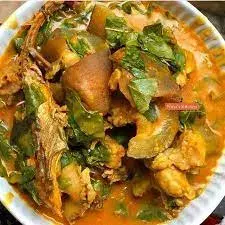
Oha Soup
Aperçu
Oha soup is an Igbo soup from southeastern Nigeria, built on the leaves of Pterocarpus mildbraedii, an African evergreen tree. The leaves are seasonal, which makes the soup an occasion rather than an everyday dish, and there is no substitute that reproduces its flavour. The leaves are shredded by hand, never cut with a knife. The reason given is that a blade turns the soup bitter, and whether or not that holds chemically, the practice is observed universally and is one of the more widely known food rules in Igbo cooking. It is worth following on its own terms. Thickening is where families diverge. Cocoyam, pounded smooth after boiling, is the standard, though achi and ofor are both used and give slightly different bodies. The oil divides along geography: Anambra households use akwu, raw palm kernel oil, while Imo households use ordinary palm oil, and each considers its own version correct. Uziza leaves go in alongside the oha for a peppery counterpoint, and ogiri igbo, the fermented seasoning paste, supplies the deep savoury note the soup is built around.
Note de Patrimoine AFN
Oha soup belongs to the Igbo people of southeastern Nigeria and is made with the seasonal leaves of Pterocarpus mildbraedii. Igbo practice holds that the leaves must be shredded by hand rather than cut with a knife, which is said to make the soup bitter.
Ingrédients
Les mentions alimentaires sont fournies par les contributeurs à titre indicatif. Elles ne sont pas vérifiées par AFN et dépendent des produits que vous achetez. En cas d’allergie grave, vérifiez vous-même chaque ingrédient. Cuisine, allergies et votre propre jugement
Préparation
- 1
Soak and wash the stockfish and smoked fish in hot water to remove any dirt, then set aside.
- 2
Start boiling the meats, beginning with the tougher cuts such as cow leg and shaki, and add the stockfish.
- 3
Add the seasoning cubes and salt to taste and cook until the meat is soft.
- 4
While the meat boils, boil the cocoyam with the skin on and without salt until tender, about 20 minutes on medium heat.
- 5
Peel the cooked cocoyam and pound it smooth in a mortar, or chop and purée it in a blender until smooth. Set aside.
- 6
Blend the yellow scotch bonnet peppers and set aside.
- 7
When the meat is soft, add the smoked fish and the blended pepper and leave to combine for 5 minutes. You should have at least 4 cups of rich stock; add water and seasoning if not.
- 8
Add the palm oil, ground crayfish and ogiri igbo and stir through.
- 9
Add the pounded cocoyam in small lumps and let it dissolve into the stock without stirring hard, until the soup thickens.
- 10
Shred the oha leaves by hand and add them with the uziza leaves.
- 11
Cook for 3 to 5 minutes only, adjust the salt, and serve with pounded yam, fufu or eba.
Notes de l’Africook
 Notes personnelles de Nympha Nzeribe
- Shred the oha leaves with your hands, never with a knife. Igbo cooks are unanimous that a blade makes the soup bitter, and it is observed without exception.
- Add the oha at the very end and cook it briefly. Three to five minutes is enough, and longer dulls both the colour and the flavour.
- Add the cocoyam in small lumps and let them dissolve on their own. Stirring hard before they have melted leaves lumps that never break down.
- Boil the cocoyam without salt. Salt at that stage makes it harder to pound smooth.
- There is no real substitute for oha leaves. If you cannot get them, make a different soup rather than a poor oha.
- Achi or ofor can replace cocoyam as the thickener, and potato flour will do at a push, though each gives a slightly different body.
Questions fréquentes
Why must oha leaves be shredded by hand?
Igbo practice holds that cutting the leaves with a knife makes the soup bitter, and the rule is followed universally rather than occasionally. It is one of the better known food conventions in Igbo cooking. Whether or not it holds chemically, hand shredding also gives irregular pieces that sit better in the soup than knife cut ribbons.
Can I substitute another leaf for oha?
Not convincingly. Oha, Pterocarpus mildbraedii, has a flavour nothing else reproduces, and cooks who have tried substitutes generally conclude it is better to make a different soup. Frozen and dried oha leaves are sold at Nigerian grocers and are a far better option than a fresh substitute of the wrong plant.
What can I use instead of cocoyam to thicken it?
Achi and ofor are both traditional and both widely used, each giving a slightly different body to the soup. Cocoyam flour works if you cannot get the fresh corm, and potato flour will do at a push. Whichever you use, add it gradually and let it dissolve rather than stirring it in hard.
What is ogiri igbo and do I need it?
Ogiri igbo is a fermented seasoning paste made from castor oil seeds or melon seeds, pungent on its own and deeply savoury in a soup. It supplies a depth that is difficult to reach any other way, and most Igbo cooks consider it essential to oha. Iru or dawadawa are the nearest substitutes, though neither is quite the same.
Avis
3 avis
Vous Aimerez Aussi
Voir toutes les recettes Nigeria →
Edo Black Soup
Nigerian Fisherman Soup
Igbo Yam Porridge
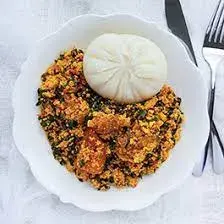
made this yesterday for Sunday lunch. the smell of the okporoko and smoked fish boiling together brought back enugu memories sha. only thing is my cocoyam took almost 35 minutes to get soft enough for mortar, not 20 mins. but once the ede went in with the yellow scotch bonnet, everything balanced out nicely.
Ogiri igbo is what gives real oha soup that proper aroma! My late grandmother always warned us never to cut oha leaves with a knife so they don't turn black, so I tore them with my fingers. The pounded cocoyam thickened the broth so smoothly without any lumps. E sweet well well o.
I tried making this over the weekend here in PE. Couldn't get proper cocoyam so I tried substituting taro root, but 4 tablespoons of crayfish was a bit too strong with the stockfish for my taste. Also took nearly 90 minutes to get the shaki tender, much longer than stated.