
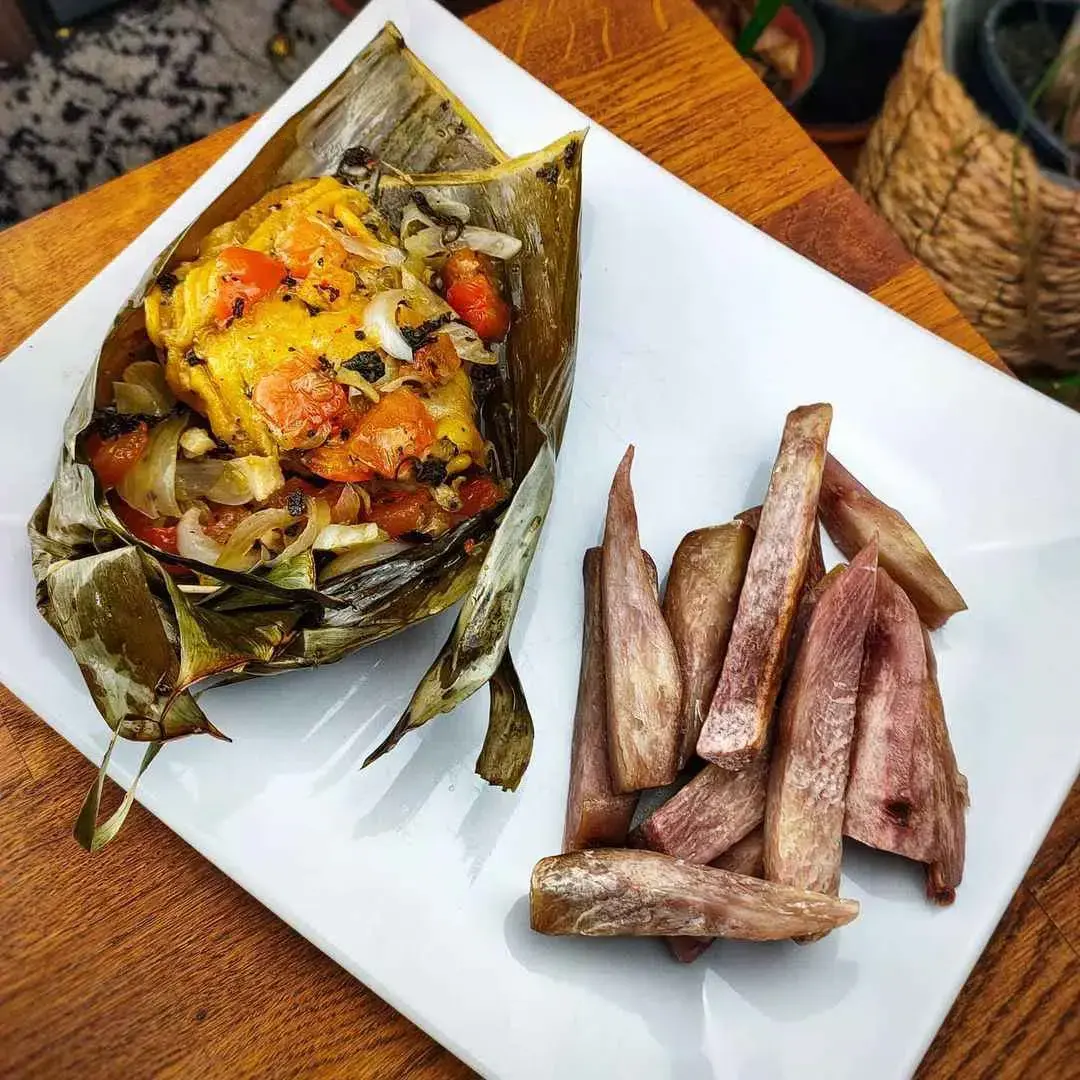
Ndomba (Cameroonian Fish Steamed in Leaves)
Abuja, Nigeria · Voir toutes les recettes
Aperçu
Ndomba is fish, chicken or pork seasoned with a paste of local aromatics, wrapped in banana leaves and steamed. It is Cameroonian, and it belongs to the same family of leaf-wrapped dishes as kwacoco bible and ekpang nkwukwo. Papillote is the technique, and the leaves are not packaging. Wrapped tightly, the parcel traps every drop of moisture the fish releases, so it cooks in its own juices with the aromatics rather than losing them to a pan. The banana leaf also flavours what is inside it, a grassy, faintly tea-like note that foil cannot provide. Joom leaves, which the ingredient list also names, are used the same way in Cameroon. The spice list is what places it. Pèbè (false nutmeg), country onions, white pepper, mesep (wild basil), akpi and garlic are West and Central African aromatics, and the source is right that the blend changes depending on whether you are making the fish, chicken or pork version. Two problems with the source. It calls for two sachets of a branded spice mix, which has been described generically. And the whole recipe is very sparse, five short steps for a dish that involves making a spice paste, portioning, wrapping and steaming.
Note de Patrimoine AFN
Ndomba is a Cameroonian dish in which fish, chicken or pork is seasoned with local aromatics, wrapped in banana or joom leaves and steamed. It belongs to a family of leaf-wrapped Cameroonian dishes and is served with bobolo, plantain or another starch.
Ingrédients
Les mentions alimentaires sont fournies par les contributeurs à titre indicatif. Elles ne sont pas vérifiées par AFN et dépendent des produits que vous achetez. En cas d’allergie grave, vérifiez vous-même chaque ingrédient. Cuisine, allergies et votre propre jugement
Préparation
- 1
Cut the fish into 2 or 3 pieces depending on size, clean and wash it, then leave it to soak in salted water.
- 2
Chop all the aromatics finely, the leek, onion, celery, tomatoes and basil or mesep.
- 3
Mix the chopped aromatics with the spice mix and salt, and work in a little oil to bring it together into a paste.
- 4
Wash the banana leaves. Pass them briefly over a flame or through hot water first, which makes them pliable enough to fold without splitting.
- 5
Divide the fish and the spice paste between the leaves and fold each into a sealed parcel, tying it if needed.
- 6
Steam the parcels for about 20 minutes, until the fish is cooked through.
- 7
Serve with steamed or pounded plantain, bobolo, or any tuber.
Notes de l’Africook
- Soften the banana leaves before folding. Passing them over a flame or through hot water stops them splitting at the folds.
- Seal the parcels tightly. The whole point is that nothing escapes, a leaking parcel loses the juices that are doing the cooking.
- Use banana or joom leaves rather than foil if you can. The leaf flavours the fish as it steams and foil contributes nothing.
- Make the spice paste properly. It is the entire seasoning of the dish and there is nowhere else for flavour to come from.
- The spice blend changes with the protein, the fish version leans on pèbè, country onion and akpi. Adjust to what you are cooking.
- Do not overcook. Twenty minutes is enough for fish in a sealed parcel and longer dries it out.
Questions fréquentes
What does papillote mean here?
Cooking something sealed inside a wrapper so it steams in its own juices. In French cooking that wrapper is usually parchment or foil; across Cameroon and Central Africa it is banana leaves, or joom leaves. The principle is the same, nothing escapes, so the fish cooks in the moisture and aromatics sealed in with it, but the leaf also contributes flavour, which parchment does not.
What spices go into ndomba?
It depends on the protein, which the source is clear about. The fish version uses pèbè (false nutmeg), country onions, white pepper, mesep or wild basil, garlic, onions, black pepper and akpi seeds, with fresh chilli optional but characteristic. These are West and Central African aromatics with no straightforward substitutes; African grocers stock them, and ready-mixed Cameroonian blends are sold for exactly this purpose.
Can I use foil instead of leaves?
It will hold the parcel together and the fish will cook, but you lose a real part of the dish. Banana leaves impart a grassy, faintly tea-like fragrance to anything steamed inside them, and that aroma is characteristic of ndomba rather than incidental to it. Frozen banana leaves are sold at African and Asian grocers, and they need only to be softened over a flame before folding.
What is it served with?
Bobolo, the Cameroonian fermented cassava stick, plantain, either steamed or pounded, or any tuber. The parcels contain very little sauce, so the accompaniment is there to make it a full meal rather than to mop anything up. Miondo, a thinner version of bobolo, is equally common in the coastal regions where ndomba is most eaten.
Avis
Soyez le premier à noter cette recette
Vous l’avez cuisinée ? Votre note aide la personne suivante à se décider.
Aucun avis sur cette recette pour le moment. Si vous l’avez cuisinée, le vôtre serait le premier.