
Coconut Rice in a Rice Cooker
Abuja, Nigeria · Voir toutes les recettes
Aperçu
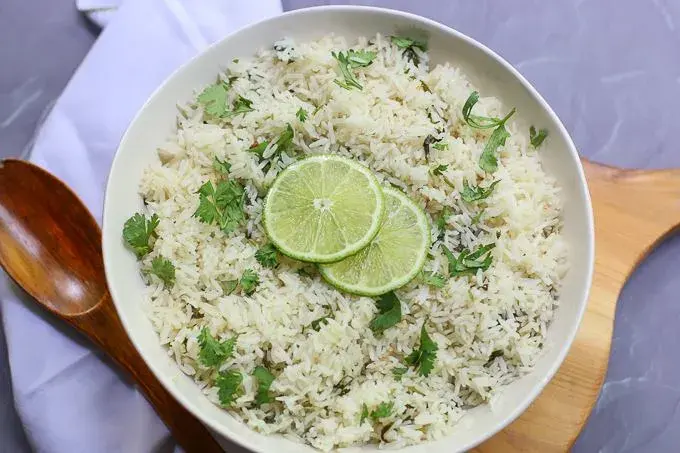
Coconut rice made in a rice cooker: rinsed long grain rice, a tin of coconut milk, water, oil and salt, with peas and carrots folded in at the end. No country is named and the dish belongs to many, which is why none is claimed here. Coconut rice is genuinely pan-regional. It is made across West Africa, East Africa, the Caribbean, Southeast Asia, South America and Oceania, and it takes a different form in each: Nigerian coconut rice carries pepper and vegetables, Jamaican rice and peas uses kidney beans and thyme, Thai khao man gai poaches chicken over it, and Indonesian nasi uduk is scented with lemongrass and pandan. Two practical notes about this version. There is a discrepancy in the source: its ingredient list and its method give different quantities of water, and the method names sugar and turmeric that never appear in the ingredients. The ratio here follows the ingredient list. The other point is the one the source is right about: leave it alone while it cooks. Agitating rice releases starch and turns it gluey, and in a rice cooker there is no reason to lift the lid at all until it switches to warm.
Ingrédients
Les mentions alimentaires sont fournies par les contributeurs à titre indicatif. Elles ne sont pas vérifiées par AFN et dépendent des produits que vous achetez. En cas d’allergie grave, vérifiez vous-même chaque ingrédient. Cuisine, allergies et votre propre jugement
Préparation
- 1
Rinse the rice in a fine mesh strainer until the water runs clear.
- 2
Place the rinsed rice in the rice cooker.
- 3
Pour in the coconut milk and the water.
- 4
Add the oil, salt, and the sugar and turmeric if using, and stir once to combine.
- 5
Set the rice cooker to its standard white rice setting and let it cook for about 15 to 20 minutes, until it switches to warm.
- 6
While the rice cooks, steam or blanch the peas and diced carrots until tender.
- 7
Once the cooker switches to warm, fluff the rice with a fork and fold in the vegetables.
- 8
Garnish with chopped coriander or parsley and serve hot with lime wedges.
Notes de l’Africook
 Notes personnelles de Deborah Olayiwola
- Rinse the rice until the water runs clear. Surface starch is the main cause of mushy coconut rice and rinsing removes most of it.
- Do not stir it while it cooks. Stirring releases starch and turns the rice gluey, and there is no reason to open a rice cooker mid-cycle.
- Get the liquid ratio right. The source contradicts itself between its ingredients and its method; the ratio here follows the ingredient list.
- Cook the vegetables separately and fold them in at the end, so they keep their colour and bite.
- Long grain rice such as jasmine or basmati is what the source recommends, and it is right: short grain turns claggy against coconut milk.
- Fluff with a fork rather than stirring with a spoon, which compacts the grains.
Questions fréquentes
Why is my coconut rice mushy?
Too much liquid, overcooking, or stirring during the cook. Rinse the rice thoroughly first, keep to the ratio, use a long grain variety such as jasmine or basmati, and leave the lid alone until the cooker switches to warm. Stirring releases starch, which is what makes it gluey.
How much water should I use?
The source contradicts itself: its ingredient list says 1 1/4 cups against a tin of coconut milk and 2 cups of rice, while its method says 1 3/4. This entry follows the ingredient list. Rice cookers vary, so if yours tends to run dry, err towards the higher figure.
What are the other coconut rice traditions?
Many, and each is distinct. Nigerian coconut rice carries pepper and vegetables. Jamaican rice and peas uses kidney beans and thyme. Thai khao man gai poaches chicken over it. Indonesian nasi uduk is scented with lemongrass and pandan. Coconut rice is genuinely pan-regional rather than belonging to one place.
Can I make it on the hob instead?
Yes. Use the same ratio, bring it to the boil, then cover tightly and cook on the lowest heat for about 15 minutes, then rest it off the heat for 10 more without lifting the lid. The rice cooker is a convenience rather than a requirement.
Avis
Soyez le premier à noter cette recette
Vous l’avez cuisinée ? Votre note aide la personne suivante à se décider.
Aucun avis sur cette recette pour le moment. Si vous l’avez cuisinée, le vôtre serait le premier.
Vous Aimerez Aussi
Dombolo (Dumplings or Steamed Bread)
Liberian Jollof Rice
Boeber (Cape Malay Sweet Milk Drink)