
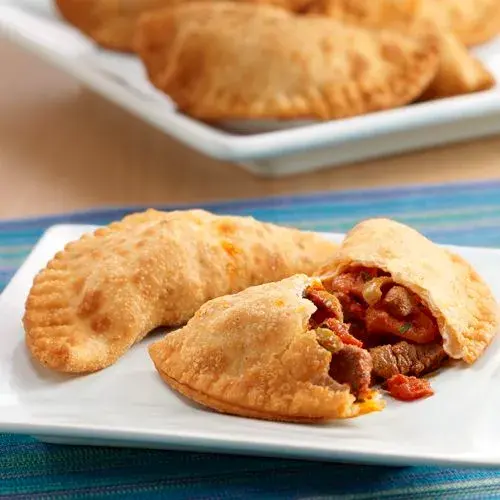
Crispy Beef Empanadas
Aperçu
Discs of short pastry filled with seasoned beef mince, sealed and fried until blistered and crisp. Empanadas are Spanish in origin and are now most strongly associated with Latin America, where nearly every country has its own version. The name comes from empanar, Spanish for to wrap in bread. The form travelled with Spanish and Portuguese colonisation and took root everywhere it landed: Argentine empanadas baked and filled with beef and olives, Chilean pino with egg and olives, Colombian versions made with maize dough and fried, and Filipino ones sweetened. The source is right that the family extends to the Philippines and Indonesia, though describing empanadas as European Philippines is confused phrasing. Africa has its own members of the same broad family of filled savoury pastries, and several are on this site, Nigerian meat pie, Senegalese fataya, East African sambusa. They are relatives rather than the same thing, and the Nigerian meat pie in particular is close enough that the two are often mistaken for each other. The one genuinely useful technique here is resting the dough balls for an hour or two before pressing them out. Rested gluten relaxes, so the rounds hold their shape instead of springing back. The source's ingredient list is scrambled and has been rebuilt from its method.
Ingrédients
Préparation
- 1
Combine the flour and salt in a large mixing bowl.
- 2
Warm the clarified butter in a small pan and pour it over the flour.
- 3
Rub the butter through the flour until the mixture looks like breadcrumbs.
- 4
Pour in the water and knead to a stiff dough.
- 5
Leave the dough on the counter to rest for at least 15 minutes, an hour or two is better, as rested gluten relaxes and the rounds will not spring back when pressed.
- 6
For the filling, warm the oil over medium-high heat and cook the ground beef with the onion, bell pepper, garlic, ginger, crumbled bouillon cube and salt until browned and dry. Let it cool completely.
- 7
Working with one piece of dough at a time on a floured surface, roll it out to about 1/8 inch thick, flipping and turning it as you go so it does not stick.
- 8
Cut circles with a five-inch bowl or cutter, stacking them with wax paper between to stop them sticking.
- 9
Put about 2 tablespoons of the cooled filling in the centre of each disc, fold it over and press the edges to seal firmly.
- 10
Fry in hot oil until golden and blistered on both sides, about 2 minutes, turning halfway. Do not crowd the pan or the oil temperature drops and they come out oily rather than crisp.
- 11
Drain, scatter with chopped coriander and serve hot.
Notes de l’Africook
- Rest the dough properly. An hour or two lets the gluten relax so the rounds keep their shape rather than contracting as you fill them.
- Cool the filling completely before it goes anywhere near the dough. Warm filling releases steam and softens the pastry, and the seals fail in the oil.
- Seal the edges hard. A leaking empanada floods the oil and comes apart. Pressing with a fork is both decorative and effective.
- Fry a few at a time. Crowding drops the oil temperature and the pastry absorbs fat instead of crisping.
- A tortilla press makes uniform rounds much faster than rolling and cutting, and wastes no dough.
- They can be baked instead with an egg wash, though the texture is quite different and less crisp.
Questions fréquentes
Where do empanadas come from?
Spain originally, the name comes from empanar, meaning to wrap in bread, and the form travelled with Spanish and Portuguese colonisation. It is now most strongly associated with Latin America, where almost every country has its own version: Argentine empanadas baked with beef and olives, Chilean pino with hard-boiled egg, Colombian ones made from maize dough and fried, and sweetened Filipino versions. The filling and the dough change; the shape does not.
How are these different from Nigerian meat pie?
They are close relatives and are often mistaken for each other. Nigerian meat pie uses a richer, more shortcrust-like pastry and is almost always baked, with a filling of minced beef, potato and carrot. Empanadas are more often fried, the pastry is thinner and the filling more varied. Both belong to the same worldwide family of filled savoury pastries that also includes samosas, fataya and sambusas, several of which are on this site.
Should I bake or fry them?
Frying gives a blistered, crisp shell and is what the source recommends. Baking with an egg wash works and is less messy, but produces something closer to a small pie, softer, more uniform, less shattering. An air fryer sits between the two. If you fry, the two things that matter are hot oil and not crowding the pan; both failures produce the same greasy result.
Why is my dough springing back?
It has not rested long enough. Kneading develops gluten, which makes the dough elastic, and elastic dough contracts as soon as you stop pressing it. Fifteen minutes is the minimum; an hour or two in a bag at room temperature is much better and makes the rounds far easier to shape. This is the single most useful piece of advice in the original recipe and it is worth following.
Avis
Soyez le premier à noter cette recette
Vous l’avez cuisinée ? Votre note aide la personne suivante à se décider.
Aucun avis sur cette recette pour le moment. Si vous l’avez cuisinée, le vôtre serait le premier.