

Thieboudienne
Aperçu
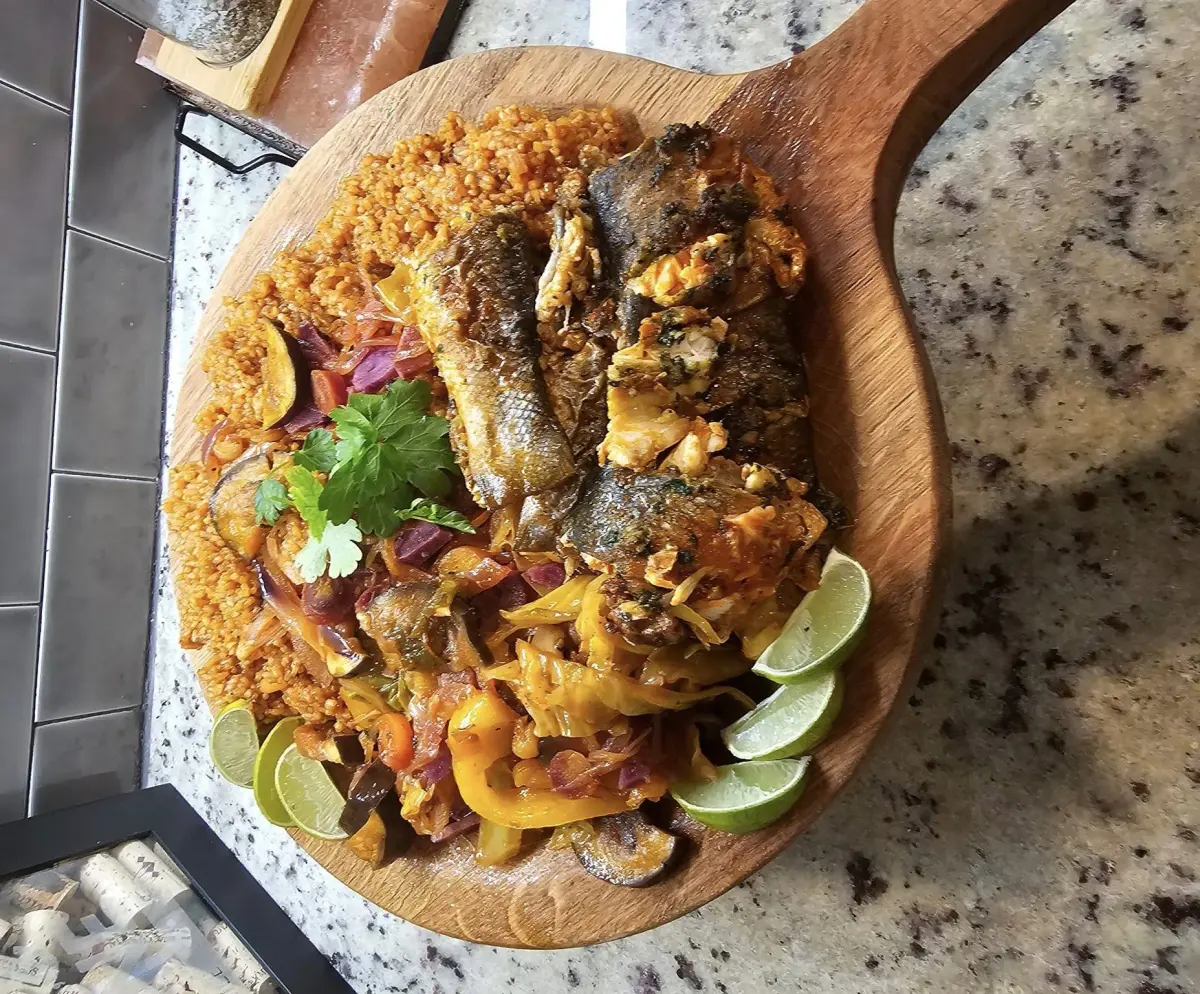
Thieboudienne is the national dish of Senegal and the origin point of the rice tradition that spread along the whole West African coast. The name is Wolof and means rice and fish, which understates it considerably: the dish involves a stuffed whole fish, a long braise of tomato and vegetables, and a rice cooked in the liquid all of that produced. Its history reaches the modern table through oral tradition rather than through documents, and it carries more than one account. One attributes the dish to the city of Saint-Louis in the nineteenth century, where a version known as thieboudienne Penda Mbaye was prepared. Another holds that it emerged in a colonial governor's kitchen when rice was substituted for barley during a shortage. Senegalese tradition names Penda Mbaye, and that named attribution matters in Senegal, where the dish is held as an inheritance with an author rather than an anonymous custom. It is eaten from a large communal platter, each person working the section in front of them, and it is what opens a significant family lunch. Its relatives are everywhere: riz gras in Côte d'Ivoire and Guinea, jollof rice across Anglophone West Africa, and Savannah red rice in the American South, which many hold was carried there and adapted by Creole cooks.
Note de Patrimoine AFN
Thieboudienne is attributed by Senegalese culinary tradition to Penda Mbaye, a cook from Saint-Louis, in the mid nineteenth century, when the port city was a crossroads of Wolof, Tukulor and European influence. UNESCO inscribed ceebu jen on the Representative List of the Intangible Cultural Heritage of Humanity in 2021.
Ingrédients
Les mentions alimentaires sont fournies par les contributeurs à titre indicatif. Elles ne sont pas vérifiées par AFN et dépendent des produits que vous achetez. En cas d’allergie grave, vérifiez vous-même chaque ingrédient. Cuisine, allergies et votre propre jugement
Préparation
- 1
Mix the parsley, half the garlic, a little pepper, salt and half a bouillon cube, pounding in a mortar or blending in a food processor.
- 2
Push this stuffing into slits cut in the fish pieces.
- 3
Heat the peanut oil, add the onions, tomatoes, tomato paste, the remaining garlic and the remaining black pepper. Fry for 15 minutes over medium heat.
- 4
Add the stuffed fish to the tomato sauce.
- 5
Add the remaining bouillon cube, the bay leaves and 1 cup of water.
- 6
Simmer until the fish is cooked through, about 15 minutes.
- 7
Lift out the fish. Add all the vegetables except the okra with 1 cup of water and cook for 25 to 30 minutes, until done but not collapsing.
- 8
Remove the vegetables and add the okra with water.
- 9
After 5 minutes remove the okra and add the rice.
- 10
Cook the rice over low heat, turning often so it cooks evenly.
- 11
When the rice is done, mound it on a large platter and arrange the vegetables and fish on top.
Notes de l’Africook
- Broken rice is the correct rice and not a cheaper substitute for whole grain. It absorbs the cooking liquid faster and more completely, which is the entire point of cooking the rice last in the liquid everything else has flavoured.
- Nététou, fermented locust bean, has a strong and off putting smell in the jar and turns to pure savoury depth in the pot. It is the ingredient most responsible for the dish tasting Senegalese rather than generically West African.
- Take each component out when it is done rather than leaving everything in the pot. Overcooked cabbage and collapsed potato are the most common faults, and they are avoidable.
- Smoked fish alongside the fresh adds a depth that fresh fish alone does not reach, and it is standard in Senegalese kitchens.
- If using fillets rather than whole fish, marinate them in the stuffing paste for at least 30 minutes, refrigerated, since there are no slits to hold it.
Questions fréquentes
Can thieboudienne be made without whole fish?
It can, but you lose the stuffing, which is central to the flavour. The parsley, garlic and pepper paste is pushed into slits cut in whole fish and seasons the flesh from the inside as it cooks. With fillets, marinate them in the same paste for at least 30 minutes before cooking. The result is good, but Senegalese cooks would regard it as a compromise.
What is nététou and can I make thieboudienne without it?
Nététou is fermented locust bean, ground or pressed, used across Senegal and West Africa as a savoury base. It smells strongly unpleasant raw and transforms completely on cooking into deep umami. You can make the dish without it and it will still be good, but it will taste like a generic West African rice rather than specifically like thieboudienne. It is sold at West African grocers.
What is the difference between thieboudienne and jollof rice?
Thieboudienne is the older dish and the source. It is built around a stuffed whole fish and a full braise of vegetables that are cooked and removed in stages, then served over rice cooked in that liquid. Jollof rice, as it developed across West Africa, lost the fish and the vegetable braise and became a tomato rice dish typically served with a separate protein. They are ancestor and descendant rather than variants.
What rice should I use for thieboudienne?
Broken rice, sold at West African and Asian grocers and sometimes labelled brisures de riz. It is not a lesser grade for this purpose; it takes up the cooking liquid far more completely than whole grain, which is what the dish needs. If you cannot find it, use a short or medium grain rice rather than basmati, which stays too separate.
Avis
4 avis

Pounding the parsley and garlic in the mortar felt so much like making a green masala paste for Gujarati stuffed fish. The way the chopped onions and tomato paste build up that rich base in the peanut oil is basically making a bhuna base. Took a bit longer than 15 mins to get the tomatoes fried down properly, but the flavour inside the grouper was wonderful.
fried the tomatoes and paste in the peanut oil until it got proper dark before dropping the snapper in. That garlic and parsley paste stuffed right into the fish slits is so lekker, total game changer. Couldn't get grouper at the fishmonger so used red snapper instead. Will make this again just now for the family on Sunday.
couldnt find grouper at the shop here so used snapper fillets instead. stuffing that parsley garlic mix into the slits no be small thing but e sweet well well! Only issue is 1 cup of water was too small for the carrots and potatoes to cook through properly, I had to add almost another cup o. Still came out good sha.
Délicieux plats à découvrir et préparer régulièrement Bon appétit