
Bitter leaf Soup (Ofe Onugbu)
Aperçu
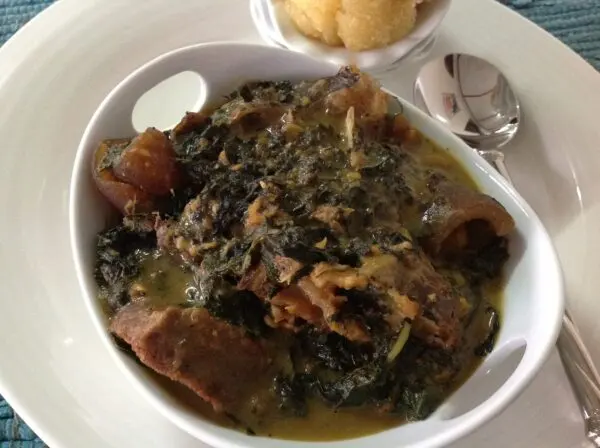
Ofe Onugbu is the bitter leaf soup of the Igbo people of southeastern Nigeria, and its whole character rests on how much bitterness is left in the leaf. Onugbu is Vernonia amygdalina, bitter leaf, and it is genuinely bitter, unpalatably so if used straight. The preparation therefore begins with washing and squeezing the leaves repeatedly until most of that bitterness is drawn out. How far to go is a judgement, and it is where cooks differ: too little and the soup is harsh, too much and you have removed the thing the soup is named for. Some bitterness should remain. Cocoyam is the traditional thickener. The corms are boiled, peeled and pounded to a smooth paste, then dropped into the pot in small lumps that dissolve as it simmers, giving the soup its heavy, slightly sticky body. Palm oil, assorted beef including shaki, stockfish and dried fish, crayfish and ogiri Igbo make up the rest. Washed bitter leaf is sold ready-prepared in African grocers, which removes the most laborious and most judgement-dependent step.
Note de Patrimoine AFN
Ofe Onugbu is an Igbo soup from southeastern Nigeria built on bitter leaf, Vernonia amygdalina, which is washed and squeezed to reduce its bitterness before use. Pounded cocoyam serves as the traditional thickener, and ogiri Igbo provides the fermented seasoning note.
Ingrédients
Les mentions alimentaires sont fournies par les contributeurs à titre indicatif. Elles ne sont pas vérifiées par AFN et dépendent des produits que vous achetez. En cas d’allergie grave, vérifiez vous-même chaque ingrédient. Cuisine, allergies et votre propre jugement
Préparation
- 1
Make sure that the bitter leaves are well washed, such that there is no trace of bitterness left. If not, wash and squeeze it more.
- 2
If the bitterness cannot be completely washed off (which is usually the case with most washed bitter leaves sold in the market), boil it for about 15 minutes and wash it in cold water.
- 3
Wash and cook the cocoyam till soft.
- 4
Remove the peels and use a mortar and pestle to pound the corms into a smooth paste.
- 5
Boil the shaki (cow tripe), stockfish, and dry fish in 1 liter of water till they are well done. The first sign of a done shaki is that the cuts will start curling on themselves.
- 6
Wash the beef and add to the pot of shaki etc. and continue cooking.
- 7
When the meat is done, add 3 cubes of Maggi/Knorr and cook for 5 minutes.
- 8
Add pepper, ground crayfish, bitter leaves (if they have not been parboiled) and cook for 10 minutes.
- 9
Then add the cocoyam paste (in small lumps) and the palm oil.
- 10
Note: If the bitter leaves were parboiled to remove the bitterness, then for step 4; add pepper, ground crayfish, the cocoyam paste (in small lumps), the bitter leaves, and the palm oil. In other words, add all the ingredients at this stage.
- 11
Cover the pot and leave to cook on high heat till all the cocoyam lumps have dissolved.
- 12
Add salt to taste and the soup is ready.
Notes de l’Africook
- Wash the bitter leaf until most but not all of the bitterness has gone. Removing it entirely defeats the point of the soup.
- Pound the cocoyam properly smooth. Lumps that have not been worked will not dissolve into the soup.
- Add the cocoyam paste in small pieces and let each dissolve before adding more, or it clumps.
- Buy pre-washed bitter leaf if you can. It removes the longest and most judgement-heavy step.
Questions fréquentes
How bitter should the soup be?
Noticeably, but not aggressively. The leaves are washed and squeezed to draw out most of the bitterness, and a soup with none left has lost the character it is named for. Where exactly to stop is a matter of household preference, which is why two cooks working from the same recipe can produce quite different pots.
Can I use a different thickener?
Cocoyam is traditional and gives the soup its characteristic heavy, slightly sticky body. Achi and ofo are used in other Igbo soups and will thicken this one, but the texture is different, lighter and faster-setting. If you want ofe onugbu as it is normally eaten, cocoyam is the one.
Where can I buy bitter leaf?
African grocers sell it fresh, frozen and dried, and often pre-washed, which is by far the most convenient option since washing is the longest step. Dried bitter leaf needs soaking and is generally considered inferior to fresh or frozen for this soup.
Avis
Soyez le premier à noter cette recette
Vous l’avez cuisinée ? Votre note aide la personne suivante à se décider.
Aucun avis sur cette recette pour le moment. Si vous l’avez cuisinée, le vôtre serait le premier.
Vous Aimerez Aussi
Voir toutes les recettes Nigeria →
Edo Black Soup
Nigerian Fisherman Soup
Igbo Yam Porridge