

Twisted Doughnuts
Aperçu
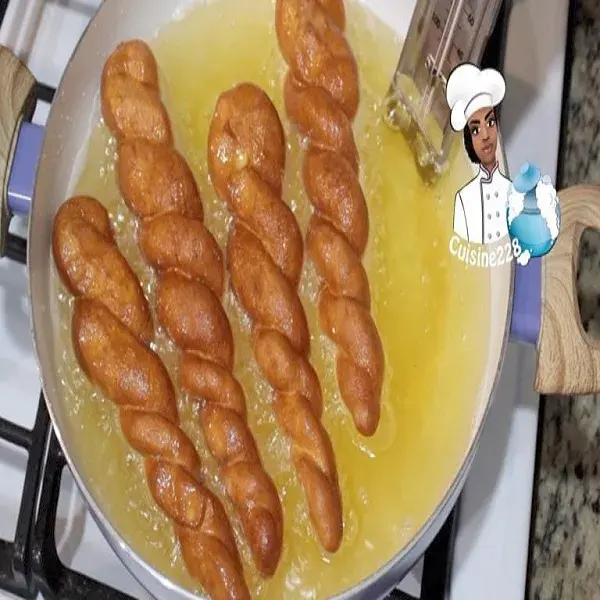
Twisted doughnuts are yeasted dough rolled into ropes, twisted on themselves and deep fried, and the source names their homes clearly: kkwabaegi in Korea, shakoy and pilipit in the Philippines, mahua in China, sakubei in Japan. That is an East and Southeast Asian family of pastries rather than an African one. The twist is not decoration. Rolling the rope with one hand moving up and the other down puts tension into the dough, and when the two ends are brought together and the rope is allowed to hang, it twists itself. That structure is what gives the finished doughnut its ridged surface and its particular texture: crunchy outside, light and pillowy inside, deflating slightly under the bite and springing back. The version here is the cinnamon sugar one, which is the most common way they are finished. The source claims the form runs "from Africa to Asia", and while there are certainly twisted fried doughs in North Africa, Tunisian and Algerian yoyo, Moroccan sfenj in its own way, and the syrup-soaked mkhabez family, this specific recipe is the Korean and Filipino one. It is filed under Worldwide Recipes for that reason, with its URL unchanged.
Ingrédients
Les mentions alimentaires sont fournies par les contributeurs à titre indicatif. Elles ne sont pas vérifiées par AFN et dépendent des produits que vous achetez. En cas d’allergie grave, vérifiez vous-même chaque ingrédient. Cuisine, allergies et votre propre jugement
Préparation
- 1
Fully melt the butter in a small saucepan over medium heat. Remove from the heat and add the milk, sugar and salt, mixing until dissolved. Crack in the egg and mix well. Add the yeast, stir, and let it sit for 5 minutes.
- 2
Transfer to a large bowl, add the 3 cups of flour and mix well with a wooden spoon. Once combined, knead by hand for a few minutes and shape into a large lump. Cover with plastic wrap.
- 3
Let the dough rise until doubled in size, about 1 to 1 1/2 hours.
- 4
Deflate the dough by hand and knead for a few minutes until soft and smooth. Cover again and let it sit 30 minutes to 1 hour until doubled again.
- 5
Uncover and knead for a few minutes. Dust a corner of your board with the 2 tablespoons of flour. Divide the dough into 16 equal pieces.
- 6
Roll a piece into a rope about 25cm long and 1cm thick, moving one hand upward and the other downward as you roll so the rope twists between your hands. Dust with flour if it sticks.
- 7
Lift the rope, hold it up and bring the two ends together. The tension will twist it as it hangs.
- 8
Place the twisted dough on a floured board or tray and repeat with the rest.
- 9
Let the doughnuts expand for about 30 minutes, gently flipping each one halfway through so the bottoms do not flatten.
- 10
Heat 10cm of oil in a deep skillet over medium-high heat until it reaches 175°C.
- 11
Fry for about 5 minutes, gently turning with tongs, until crunchy outside and evenly golden brown.
- 12
Drain and roll in cinnamon sugar while still warm.
Notes de l’Africook
- Roll with one hand going up and the other down. That opposing motion is what puts the twist into the rope, and rolling it evenly like a sausage will not work.
- Let the rope hang from your hand and it will twist itself. Trying to twist it on the board gives an uneven result.
- Flip the doughnuts halfway through the second rise so all sides stay round rather than flattening on the bottom.
- Keep the oil at 175°C. Hotter and the outside colours before the inside cooks; cooler and they absorb oil.
- Coat in cinnamon sugar while still warm so it sticks.
- They are best within a few hours. Yeasted fried dough stales quickly.
Questions fréquentes
Where are twisted doughnuts from?
East and Southeast Asia. They are kkwabaegi in Korea, shakoy and pilipit in the Philippines, mahua in China and sakubei in Japan. The source claims the form runs from Africa to Asia, and while North Africa has its own twisted fried doughs such as yoyo, this particular recipe is the Korean and Filipino one.
How do I get the twist?
Roll the rope with one hand moving upward and the other downward, so the dough twists between your palms as it lengthens. Then lift the rope, bring the two ends together and let it hang: the tension in the dough makes it wind around itself. Twisting it flat on the board does not work as well.
Why are my doughnuts flat on one side?
They sat on the same side through the whole second rise. Flip each one gently about fifteen minutes into the thirty minute proof so the bottom does not compress. A floured board or tray rather than a bare surface also helps them keep their shape.
What else can I coat them in?
Cinnamon sugar is the standard and what the source uses, but plain sugar, a simple glaze, honey or melted chocolate all work. In Korea kkwabaegi are usually cinnamon sugar; in the Philippines shakoy are often plain sugar. Coat while warm whatever you choose, or it will not adhere.
Avis
4 avis
Vous Aimerez Aussi
Liberian Jollof Rice
Dombolo (Dumplings or Steamed Bread)
How to Make Crispy Fried Chicken Feet
The double proofing takes a fair bit of patience but the texture was lovely and fluffy. I had to turn the gas right down because the oil was a bit too hot at first and the cinnamon sugar coating was browning before the middle cooked through. Once I adjusted that they turned out great.
chale this brought back memories oo! My grandmother used to twist the dough just like this before deep frying. I picked up the dry yeast packet from the tropical foods shop in Croydon, divided the dough into 16 pieces as stated and they fried up so light and airy.
Making yeast dough in London winter is no be small thing, I had to leave the bowl right next to the radiator for the full 1 hour 30 mins so it would double in size. Reminds me of the twisted sugar doughnuts from back home. E sweet sha o, so soft inside.
Made these over the weekend, used 250ml Clover milk and melted Stork bake instead of butter. That second 30 min rise after deflating is crucial for getting them light enough or else they end up heavy. Lekker with morning coffee.