

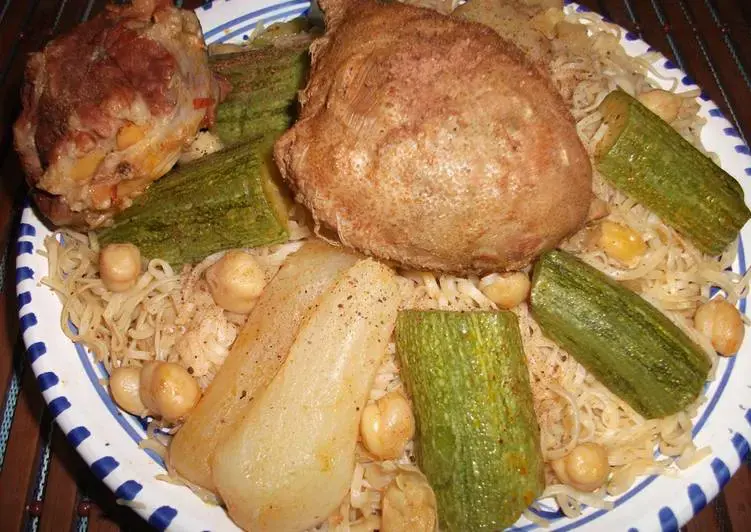
Rachta
Aperçu
Rachta, also written rechta, is an Algerian dish of flat handmade noodles served under a pale, cinnamon-scented sauce, and it is celebration food rather than everyday cooking. The noodles are made from flour, salt, water and ghee, rolled and cut into flat ribbons, then steamed rather than boiled. Steaming is what gives them their particular texture, and it is the same technique used for couscous, which tells you something about how the dish is understood in Algerian kitchens: rechta is treated as a member of the steamed-semolina family rather than as pasta. The sauce, the marga, is deliberately white. There is no tomato in it. It is built on chicken or lamb, onion, garlic and chickpeas, with turnip, potato and courgette, and it is perfumed with cinnamon and ras el hanout. That pale, sweet-spiced character is unusual in North African cooking and is the reason the dish reads as special. It appears at the occasions that matter. Rechta is strongly associated with Mawlid an-Nabawi, the Prophet's birthday, and with Ashura, Eid al-Fitr and weddings, particularly in Algiers, where it is close to the definitive festive dish. It is a relative of chekhchoukha, which uses torn flatbread rather than noodles and is usually served in a red sauce.
Note de Patrimoine AFN
Rechta is documented as an Algerian celebration dish associated with Mawlid an-Nabawi, Ashura, Eid al-Fitr and weddings, particularly in Algiers. Its noodles are steamed rather than boiled, following the same technique used for couscous.
Ingrédients
Les mentions alimentaires sont fournies par les contributeurs à titre indicatif. Elles ne sont pas vérifiées par AFN et dépendent des produits que vous achetez. En cas d’allergie grave, vérifiez vous-même chaque ingrédient. Cuisine, allergies et votre propre jugement
Préparation
- 1
In a large bowl, mix semolina, flour and salt.
- 2
Sprinkle water over the semolina mixture, little by little.
- 3
Mix everything with your hand and stop adding water once the dough gets together. No need to knead the dough.
- 4
Cover the dough with plastic wrap and let rest on the counter for about 30 minutes.
- 5
Divide the dough into 3 pieces. You can do this step before letting the dough rest.
- 6
Dust your working board with flour and roll out each piece of dough into thin long strip or sheet, using a rolling pin (you may need to cut the long strip into half to make the work easy).
- 7
Pass each pasta sheet (slightly dusted with flour) in the pasta machine to get a thin sheet. You should set up your machine to the thickness close to that of your pasta sheets, then end up with the lowest setting to get the thinest sheet.
- 8
Place your thinnest sheets on a clean kitchen towel and let them dry for about 15 to 20 minutes.
- 9
Pass each pasta sheet in the part of the machine that makes thin noodles.
- 10
Place a plate underneath to catch the noodles or the Rechta.
- 11
Once you make about a plate of Rechta, start to steam it. Place the Rechta in the top of a steamer( the top of the steamer should be oiled with olive oil to avoid stickiness).
- 12
Steam for about 5 minutes or less.
- 13
Work on the other pasta sheets and make more Rechta.
- 14
Steam the Rechta in small batches.
- 15
Dump the steamed Rechta in a large shallow dish.
- 16
Drizzle with about 1 tbsp olive oil and start separating the noodles with hands. You may not need to add olive oil for the second batch of Rechta.
- 17
Once all the Rechta or noodles are separated, let cool then store in ziploc bags.
- 18
Place the bags in the freezer for later use.
Notes de l’Africook
- Steam the noodles, do not boil them. Boiling gives a soft, slippery result and loses the texture the dish depends on.
- Keep the sauce white. No tomato, the pale colour is part of what makes this rechta rather than a general stew.
- Cinnamon should be present but not dominant. Add it early and taste, rather than adding more at the end.
- Oil the noodles lightly between steamings so they do not clump together.
- Cook the chickpeas until genuinely soft. They are a texture element, not a garnish, and undercooked they spoil the balance.
Questions fréquentes
What is the difference between rechta and chekhchoukha?
They are closely related Algerian dishes with the same broad structure, a starch under a sauce, but the starch differs. Rechta uses flat handmade noodles, steamed. Chekhchoukha uses a thin flatbread torn into pieces. Rechta is usually served in a pale white sauce scented with cinnamon, while chekhchoukha is more often served in a red, tomato-based one, which makes them look and taste quite different despite the shared idea.
Why is the sauce white rather than red?
It is a deliberate feature of the dish. Where much North African cooking builds on tomato, the rechta marga is left pale and is perfumed with cinnamon and ras el hanout instead. That pale, gently sweet-spiced character is what marks rechta as a celebration dish and distinguishes it from everyday stews.
When is rechta traditionally eaten?
At occasions rather than on ordinary days. It is particularly associated with Mawlid an-Nabawi, the Prophet's birthday, and also appears at Ashura, at Eid al-Fitr marking the end of Ramadan, and at weddings. In Algiers it is close to the defining festive dish, and many families make it only a few times a year.
Can I use shop-bought pasta instead of making the noodles?
You can make something enjoyable that way, but it will not be rechta. The noodles are made with ghee worked into the dough and then steamed, which gives a texture dried pasta does not have. If you want to try the sauce without the labour, fresh flat noodles steamed rather than boiled will get you closer than dried pasta boiled in water.
Avis
4 avis
Got the fine semolina from the Turkish supermarket near West Croydon station. I was doubtful when you said no need to knead the dough, but after resting it for 30 minutes under the cling film it rolled out very smooth paa. Divide into 3 pieces makes it much easier to handle on a small counter.
Adding the water little by little is the key sha. First time I tried rachta dough I poured too much water at once and had to keep adding flour. Following your step to just mix with hand until it comes together worked out clean o. Very nice base for chicken sauce.
Never made Algerian food before so I was nervous. Grand job altogether though! Was strange not kneading it at all after mixing the semolina and salt, but it came together lovely once it sat on the counter for a half hour.
Habari. I followed the steps for the dough using fine semolina and olive oil, and letting it rest for 30 minutes made it very soft. Please I have a small question, after dividing into 3 pieces, how thin should we roll each piece before cutting the strands?