

Kizaca
Aperçu
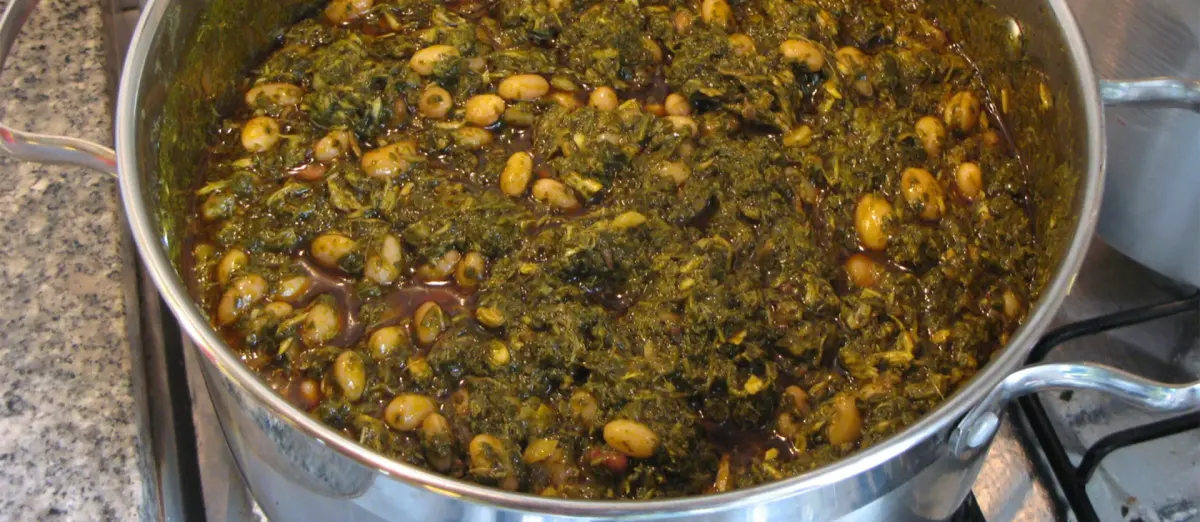
Kizaca, also written kizaka or quizaca, is pounded cassava leaves cooked slowly with groundnuts until the leaves soften and the nuts break down into a thick, savoury sauce around them. It is among the most widely eaten dishes in Angola and one of the few that is vegetarian by default. Its composition tells a compressed version of Angolan history. Cassava is not indigenous to Angola; it arrived from Brazil, another Portuguese colony, and became so completely established that its leaves are now a national green. Palm oil, groundnuts and slow cooking are the local contribution. Angolan food is often described as Portuguese influence over African ingredients, and kizaca shows the arrangement is more complicated than that: the central ingredient is an import that has been African for centuries. It is normally eaten as an accompaniment to meat or fish rather than as the centre of a plate, and kizaka com peixe, made with fish, onions and tomato, is the most common form in Angola. Rice or chikuanga goes alongside. Angolan cooks make it in advance deliberately, because the flavour of cassava leaf and groundnut needs several hours together before it settles.
Note de Patrimoine AFN
Cassava was carried to Angola from Brazil through Portuguese colonial trade routes and became established as a staple crop, with its leaves entering Angolan cooking as the base of kizaca. Both territories were Portuguese possessions, and the crop's movement between them is documented as part of the Atlantic exchange.
Ingrédients
Les mentions alimentaires sont fournies par les contributeurs à titre indicatif. Elles ne sont pas vérifiées par AFN et dépendent des produits que vous achetez. En cas d’allergie grave, vérifiez vous-même chaque ingrédient. Cuisine, allergies et votre propre jugement
Préparation
- 1
Soak the dried fish in warm water, cover and set aside.
- 2
Bring 4 cups of water to the boil in a medium pot. Add the pounded cassava leaves, the bicarbonate of soda and a pinch of salt. Cover and boil for 30 minutes.
- 3
Peel and roughly chop the onions, pepper, aubergine, garlic and ginger. Blitz them in a food processor until smooth.
- 4
Stir the mixture into the cassava leaves along with the seasoning and simmer for a further 15 minutes.
- 5
Mix the groundnuts with a little water to form a paste.
- 6
Once the leaves have softened and thickened, add the stock, the dried fish and the peanut paste to the pot.
- 7
Reduce the heat and simmer for 15 minutes.
Notes de l’Africook
 Notes personnelles de Nympha Nzeribe
- Make it several hours ahead, or the day before. Cassava leaf and groundnut need time together, and kizaca eaten straight from the pot tastes noticeably less settled than kizaca that has rested.
- Raw and undercooked cassava leaves contain naturally occurring cyanogenic compounds. The 30 minute boil is a safety requirement and not a matter of texture.
- The bicarbonate of soda softens the leaves and holds their green colour. A very small amount does the job; too much gives a soapy taste.
- Frozen pounded cassava leaves from an African grocer are the practical route outside Angola. Spinach can stand in but produces a different and much milder dish.
- Kizaka com peixe, made with fish, onion and tomato, is the most common Angolan version. White rice or chikuanga is the usual accompaniment.
Questions fréquentes
What can I use instead of cassava leaves in kizaca?
Spinach is the common substitution and Angolan cooks abroad use it, but it makes a milder and much less structured dish, because cassava leaves are fibrous and hold their body through a long cook. Frozen pounded cassava leaves are sold by African and Caribbean grocers and are far closer. Collard greens are the next best fresh option.
Is kizaca vegetarian?
It can be, and often is. The base of pounded cassava leaves, groundnuts and palm oil contains nothing animal, which is why kizaca is one of the standard vegetarian dishes in Angolan cooking. The dried fish in this version and the fish in kizaka com peixe are additions. Use a vegetable stock powder and it is fully vegan.
How long does kizaca keep?
Three to four days refrigerated, and it freezes for up to three months. It is one of the dishes that genuinely improves on keeping, which is why Angolan cooks make it ahead deliberately. Reheat gently with a splash of water, because the groundnuts thicken further as it sits.
What is kizaca served with?
White rice or chikuanga, the cassava loaf wrapped and cooked in leaves, are the standard accompaniments in Angola. It is usually served alongside a meat or fish dish rather than as the centre of the plate, though it is substantial enough to be eaten on its own.
Avis
8 avis
Vous Aimerez Aussi
Voir toutes les recettes Angola →
Mufete

Funge
Muamba De Galinha (Angolan Chicken Stew)
managed to get frozen cassava leaves from the african market here in baltimore. blitzing the aubergine and green pepper together felt strange at first, but it gave the leaves great body o. just needed a bit more than half a sachet of stock powder to get the flavor right for me sha.
That aubergine trick is spot on, Tobi! Blitzing it gives it such a lekker thick texture. I do the same when making this as a side dish for a braai. Baie good call on extra stock powder too, cassava leaves really soak up the seasoning, just like my ouma se resep for wild greens.
My Angolan neighbor brought me this years ago and I have been looking for a solid recipe since moving to Houston. Found the red palm oil at Southwest Farmers Market. That combination of the ground peanuts with the palm oil and cassava leaves... abeg e sweet no be small thing!
My sister, that combination of peanut paste and palm oil with cassava leaves is pure magic sha. Here in Lagos we don't usually add groundnut to cassava leaves, but when I first tried the Angolan version, I was hooked. Glad you found good palm oil in Houston o!
Boiling cassava leaves with the bicarb really helped soften them up fast. Reminds me of how we soften trad greens back home in Kenya. I skipped the nyama and dried fish cause I didn't have any on hand, but the groundnut paste made it so rich and creamy. Sawa kabisa.
Chale, groundnut paste really saves the day paa! Finding good dried fish here in Croydon is not easy oo, so skipping it makes sense. But herh, that bicarb trick is very clever, cassava leaves can be so tough if you don't boil them for hours.
Blending the onion, ginger, garlic and aubergine into a smooth paste before stirring into the boiled greens felt very familiar, very much like preparing a saag base. I skipped the dried fish to keep it vegetarian. The groundnut paste gives it a lovely rich texture, though boiling the cassava leaves took closer to 40 minutes on my hob.
Had to trek down to an Afro-Caribbean shop on Spital Hill in Sheffield to find the pounded cassava leaves, but so glad I bothered. Pureeing the aubergine with the green pepper and ginger was a revelation for thickening the stew alongside the palm oil.