
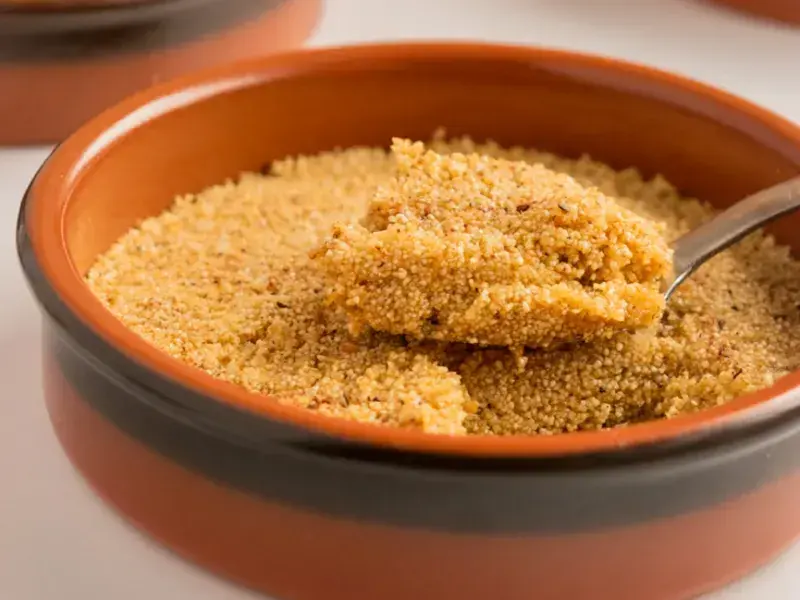
Tamina (Algerian Toasted Semolina with Honey)
Abuja, Nigeria · Voir toutes les recettes
Aperçu
Tamina is semolina steamed, toasted until golden, and worked into warm honey and butter. It is Algerian, and it is made for occasions, engagements, weddings, baby showers and Mawlid, the birthday of the Prophet Muhammad. The three ingredients carry meaning, and the source explains it well: semolina for sustenance, honey for the sweetness of love, butter for blessings. That symbolism is why tamina appears at the birth of a child in particular, offering it to guests is the Algerian way of announcing a new baby, which makes the dish a message as much as a dessert. The toasting is the whole technique and it cannot be rushed. Semolina taken to a proper golden colour tastes nutty and complex; under-toasted, it tastes raw and pasty. It also burns from golden to black very quickly, so it needs constant movement over medium-low heat. The steaming step is unusual and the source explains its own reasoning: it is a safety measure, in case the semolina has not been toasted thoroughly enough. Many recipes skip it and toast alone. Economics have changed the ingredients. Margarine and sugar syrup now often replace butter and honey, which the source records without judgement. One caution: it identifies tamina with bsisa, which is a different Tunisian and Libyan preparation.
Note de Patrimoine AFN
Tamina is an Algerian dessert of toasted semolina worked into honey and butter, served at engagements, weddings, births and Mawlid. Its three main ingredients are traditionally understood to represent sustenance, love and blessings. Offering it to guests is an Algerian way of announcing the birth of a child.
Ingrédients
Les mentions alimentaires sont fournies par les contributeurs à titre indicatif. Elles ne sont pas vérifiées par AFN et dépendent des produits que vous achetez. En cas d’allergie grave, vérifiez vous-même chaque ingrédient. Cuisine, allergies et votre propre jugement
Préparation
- 1
Line the top of a steamer with a cheesecloth and spread the semolina over it.
- 2
Set the steamer over a pot of boiling water and steam the semolina for about 15 minutes.
- 3
Tip the steamed semolina into a large shallow dish and let it cool.
- 4
Transfer it to a large frying pan over medium-low heat.
- 5
Toast the semolina, turning it constantly, until it takes on a golden colour and smells nutty. This is the step that makes the dish, and it goes from golden to burnt quickly. Set aside.
- 6
Melt the butter in a saucepan over medium heat.
- 7
Mix in the honey and let it just warm through, do not let it boil.
- 8
Turn off the heat and work the toasted semolina in thoroughly.
- 9
Let it stand for about 5 minutes. Butter will rise to the top; mix it back through and turn the mixture out onto a serving plate.
- 10
Press a cookie cutter into the tamina, then dip the cutter into a plate of cinnamon and stamp the pattern onto the surface.
- 11
Decorate with nuts or sweets if you like.
Notes de l’Africook
- Toast it properly and do not stop stirring. Golden is the target, and the gap between golden and burnt is a matter of seconds.
- Do not boil the honey. Warmed it stays fragrant; boiled it goes flat and bitter.
- Mix the butter back in after resting. It separates out as the mixture stands and needs redistributing.
- The steaming is a safety net against under-toasting, as the source explains. Many recipes leave it out.
- Medium semolina is what this needs, fine semolina turns pasty and coarse stays gritty.
- It keeps well at room temperature and is often made in quantity for a gathering.
Questions fréquentes
Why is tamina served at celebrations?
Because of what its ingredients are taken to mean. Semolina represents sustenance, honey the sweetness of love between people, and butter the blessings of the Creator, the source sets this out clearly. It is served at engagements, weddings, baby showers and at Mawlid, the birthday of the Prophet Muhammad. At a birth in particular, offering it to visitors is the Algerian way of saying that a child has arrived.
Why steam the semolina before toasting it?
As a safety measure, and the source is explicit about its reasoning: if the semolina has not been toasted thoroughly enough, steaming it first means it has still been cooked and is safe to eat. Many recipes skip the step entirely and rely on toasting alone. It also hydrates the grains slightly, which affects the final texture, steamed then toasted tamina is a little softer.
Is tamina the same as bsisa?
No, though the source identifies them. Bsisa is a Tunisian and Libyan preparation, a flour made from roasted grains and pulses, often with fenugreek and spices, mixed with olive oil and eaten as a paste or a drink. Tamina is Algerian toasted semolina with honey and butter. They share the idea of toasted grain and nothing else, and the claim has been flagged rather than repeated.
Can I use margarine and sugar instead?
Many Algerian households now do, and the source records this without judgement, butter and honey are expensive, and margarine and sugar syrup are the common substitutions. The result is sweeter and flatter, since honey brings aroma that sugar does not, but it is a real and widely made version rather than a corruption. If you are making it for an occasion, the butter and honey are worth it.
Avis
Soyez le premier à noter cette recette
Vous l’avez cuisinée ? Votre note aide la personne suivante à se décider.
Aucun avis sur cette recette pour le moment. Si vous l’avez cuisinée, le vôtre serait le premier.