
Kahk
Abuja, Nigeria · Voir toutes les recettes
Aperçu
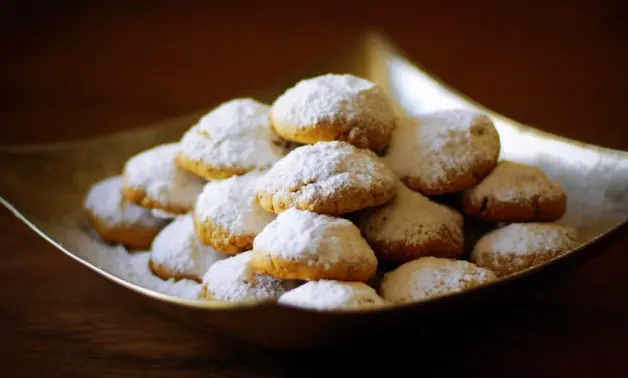
Kahk are round Egyptian shortbread-style cookies, buttery and crumbly, buried under a heavy layer of icing sugar, and made for Eid. Their history is unusually well documented for a biscuit. Kahk is believed to date to Ancient Egypt: carvings showing people making it have been found in temple ruins at Memphis and Thebes, and a recipe was recorded in the Great Pyramid of Khufu at Giza. Few foods anyone still eats have that kind of paper trail. They are made in enormous quantity in the weeks before Eid al-Fitr, and the making is social, families and neighbours gathering to shape trays of them together, which is as much the tradition as the eating. Fillings vary. Plain kahk is common, but so are versions stuffed with agameya, a paste of honey, ghee, flour and nuts; with dates; with pistachio or walnut; or with lokum. The texture is what people judge them on: a proper kahk should collapse in the mouth rather than snap. That comes from ghee and from not overworking the dough. The icing sugar is not a garnish, it is applied generously and is part of the thing.
Note de Patrimoine AFN
Kahk is documented to Ancient Egypt through carvings depicting its preparation found in temple ruins at Memphis and Thebes, and a recipe recorded in the Great Pyramid of Khufu at Giza. It is made for Eid al-Fitr.
Ingrédients
Les mentions alimentaires sont fournies par les contributeurs à titre indicatif. Elles ne sont pas vérifiées par AFN et dépendent des produits que vous achetez. En cas d’allergie grave, vérifiez vous-même chaque ingrédient. Cuisine, allergies et votre propre jugement
Préparation
- 1
Preheat the oven to 160C/ 320F.
- 2
In a large mixing bowl, whisk together the flour, powdered sugar, baking powder, sesame seeds, salt, instant yeast and kahk essence until combined (you can use a stand mixer or electric hand mixture).
- 3
Now, add the ghee and mix for 2-3 minutes until well blended and the dough turns crumbly.
- 4
Add in the milk and vanilla extract; mix (do not over mix).
- 5
Scoop out a tablespoon of the dough and roll it in a ball, then place it on a baking sheet; repeat making balls (leave space between each one).
- 6
Now, decorate your kahk, press gently into a Maamoul mould or use a kahk stamper.
- 7
Bake for 20-22 minutes until the bottom is golden brown. Allow them to cool completely, then dust with powdered sugar.
Notes de l’Africook
- Do not overwork the dough. Kahk should crumble, and gluten development is what makes it snap instead.
- Use ghee rather than butter if you can. It has no water and gives a shorter, more tender crumb.
- Rest the dough before shaping so the fat firms up and the cookies hold their form.
- Sugar them once cooled, and generously. Dusting hot cookies makes the sugar dissolve into a glaze.
Questions fréquentes
How old is kahk?
Genuinely ancient. Carvings depicting people making it have been found in temple ruins at Memphis and Thebes, and a recipe was recorded in the Great Pyramid of Khufu at Giza. It is one of very few things still commonly eaten today with a documented line back to Ancient Egypt.
What are they filled with?
Plain is common, but so are several fillings: agameya, a paste of honey, ghee, flour and nuts; dates; pistachio or walnut; or lokum. Households tend to make a mixture of types in the same session, which is part of why kahk-making is done in bulk.
Why are mine hard rather than crumbly?
The dough was overworked. Kahk depends on a short, tender crumb that collapses in the mouth, and mixing or kneading past the point where the dough comes together develops gluten and makes them tough. Using ghee rather than butter also helps, since ghee contains no water.
Avis
Soyez le premier à noter cette recette
Vous l’avez cuisinée ? Votre note aide la personne suivante à se décider.
Aucun avis sur cette recette pour le moment. Si vous l’avez cuisinée, le vôtre serait le premier.
Vous Aimerez Aussi
Voir toutes les recettes Egypt →
Tarb (Grilled Kofta Wrapped in Lamb Fat)
Egyptian Meshabek