

Chebakia (Moroccan Sesame Cookies)
Aperçu
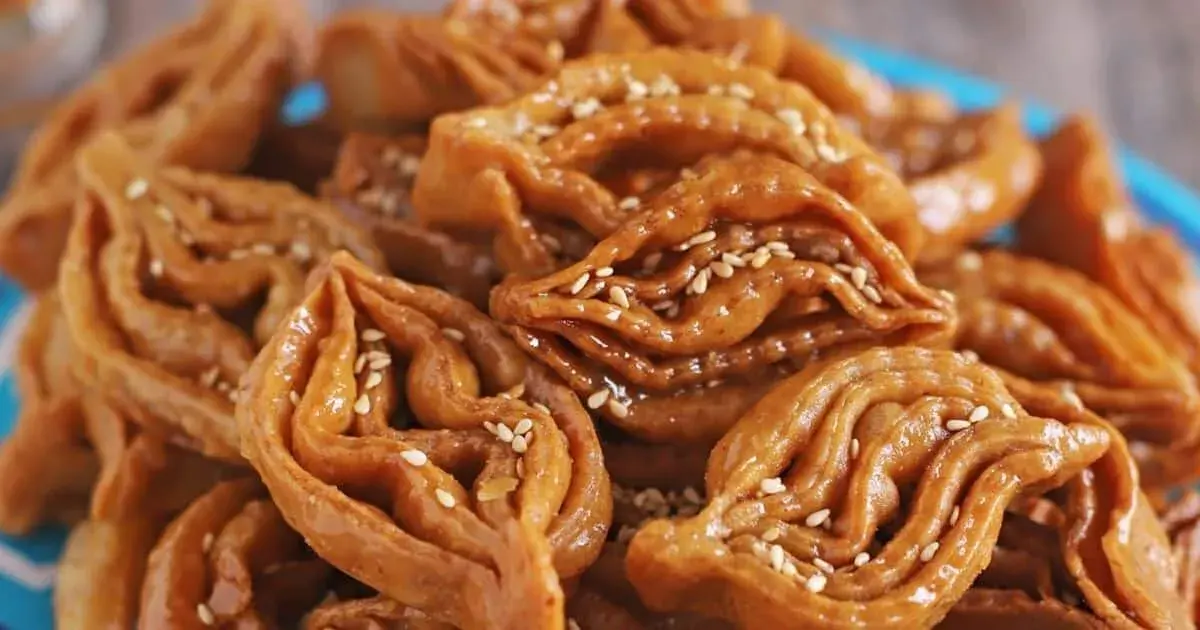
Chebakia is the Moroccan pastry of Ramadan. Spiced dough is rolled thin, cut into rectangles, slashed and folded through the fingers into an elongated flower shape, fried until golden, then dropped into hot honey scented with orange flower water and finished with sesame. Its association with the fast is close to absolute. Moroccans break the fast with harira soup and chebakia together, and the two are made in quantity in the weeks beforehand. It also appears at weddings and baby showers, and is sold year round at bakeries and market stalls. It goes by other names in other regions, including griouech and mkharka. The folding is what makes it difficult and what makes it recognisable. Each rectangle is cut into five attached strips, threaded onto a finger, and turned inside out around a pinched centre, which produces the rose shape. It takes practice and it is why chebakia is often made communally, several women working through a large batch together. The dough itself is heavily spiced, with anise, cinnamon, saffron and ground toasted sesame, and mastic gum, a resin used across North Africa and the Middle East, gives it a distinctive aroma.
Note de Patrimoine AFN
Chebakia is a Moroccan pastry closely associated with Ramadan, conventionally eaten alongside harira soup to break the fast. It is also known as griouech and mkharka, and is served at weddings and other celebrations.
Ingrédients
Les mentions alimentaires sont fournies par les contributeurs à titre indicatif. Elles ne sont pas vérifiées par AFN et dépendent des produits que vous achetez. En cas d’allergie grave, vérifiez vous-même chaque ingrédient. Cuisine, allergies et votre propre jugement
Préparation
- 1
Gather the dough ingredients. Grind the toasted sesame in a food processor until powdery and moist enough to press together.
- 2
Crush the mastic grains with the quarter teaspoon of sugar into a powder.
- 3
Mix the mastic mixture, ground sesame, flour and the other dry ingredients in a large bowl.
- 4
Add the remaining dough ingredients and mix by hand to form a dough, adding more flour if needed to make it stiff but pliable.
- 5
Knead by hand for 7 to 8 minutes, or 4 to 5 minutes in a mixer with a dough hook.
- 6
Divide the dough into four portions, shape each into a smooth mound and rest them in a plastic bag for 10 to 15 minutes.
- 7
Roll one portion out to the thickness of thin cardboard, flouring the surface lightly if needed.
- 8
Cut into rectangles roughly the size of your palm.
- 9
Make four evenly spaced lengthways cuts in each rectangle, stopping short of the edges, so you have five attached strips.
- 10
Thread your middle finger through alternating strips so the rectangle drapes over your finger.
- 11
With the other hand, pinch together the outer corners hanging over your fingertip. This forms the centre of the flower.
- 12
Holding the pinched corners, let the strips slide off your finger while gently turning them inside out around the pinched portion, then pinch the opposite corners closed. This gives the elongated flower shape.
- 13
Place the folded pieces on a tray and repeat with the remaining dough, gathering scraps back into a mound to rest before rerolling.
- 14
Heat the frying oil and fry the shaped pastries until golden brown.
- 15
Warm the honey with the orange flower water and drop the hot fried pastries in to soak.
- 16
Lift out, drain, and sprinkle with the reserved toasted sesame seeds.
Notes de l’Africook
 Notes personnelles de Nympha Nzeribe
- The folding takes practice. Expect the first several to be misshapen, which is why chebakia is traditionally made communally in large batches.
- Roll the dough genuinely thin, to about the thickness of thin cardboard. Thick chebakia stays doughy in the centre.
- Rest the dough properly. It should not spring back when flattened; if it does, give it longer.
- Toast the sesame first: spread on a tray and toast at 200°C for 10 to 15 minutes until crunchy and nutty, then cool completely before grinding.
- The longer they soak in honey the sweeter and less crisp they become. How long is a matter of preference, so pull a test piece early.
- Keep the unrolled portions of dough oiled and bagged while you work, or they dry out and crack.
Questions fréquentes
What is mastic gum and do I need it?
Mastic is a resin from the mastic tree, sold as small hard grains and used across North Africa, the Middle East and Greece. It is crushed with sugar before use and gives a distinctive pine-like aroma. A pinch is enough. It can be left out, and the chebakia will still be good, but the aroma will be less characteristic.
How do I get the flower shape?
Cut four lengthways slits in each rectangle without cutting through the ends, so you have five attached strips. Thread your middle finger through alternate strips, pinch the far corners together with your other hand, then let the strips slide off while turning them inside out around that pinch. It is much easier shown than described, and it takes practice.
Why is chebakia eaten during Ramadan?
It is dense, sweet and rich, which makes it well suited to breaking a long fast, and it keeps for weeks so it can be made in advance. Moroccans traditionally break the fast with harira soup and chebakia together, and both are prepared in large quantities in the weeks before Ramadan begins.
How long does it keep?
Several weeks in an airtight container, which is much of why it is made in bulk before Ramadan. The honey acts as a preservative. It softens over time as it absorbs more honey, so if you want them crisp, eat them within the first few days and store the rest for later.
Avis
6 avis
Vous Aimerez Aussi
Voir toutes les recettes Morocco →
Moroccan Chicken Rfissa
Tanjia Marrakchia
Maakouda (Moroccan Potato Cakes)
Made these for a dinner party last night! I was a little nervous because I had never worked with mastic gum before, and the mixture felt super stiff at first. After 5 minutes in my mixer with the dough hook it smoothed out, though I did need a tiny drop extra water. The saffron and anise aroma while kneading was incredible.
Megan, that stiff dough can really test your faith o! I had the exact same thing happen when I made it, Chicago air is so dry that I had to add a splash extra water too. But that anise and saffron aroma taking over the kitchen while kneading? No be small thing!
Herh, kneading this dough by hand for 8 minutes is no joke at all chale! Reminded me of making chin chin dough back home. I could not get mastic gum anywhere near Ridley Road market so I just crushed the sugar with extra ground anise instead. The smell of the toasted sesame in the dough is heavy paa, came out so good oo.
Herh, that hand kneading will test your strength chale! But for the mastic gum, Ridley Road African stalls won't have it oo, you have to check the Turkish or Arabic grocers nearby instead. I had to search all over Leeds for mine. But that toasted sesame aroma filling the whole house is heavy paa!
Had to pop down to the shop on City Road in Cardiff to hunt down mastic gum, but so glad I did. Grinding the toasted sesame seeds until they were moist and powdery worked brilliantly to give that deep nutty base. Kneading that stiff dough by hand for 8 minutes was a proper arm workout though!
Gareth, that dough kneading is no be small thing o! My own arms almost gave up when I made it. But once you taste that deep ground sesame base, e sweet so much you forget the stress. Sourcing those special ingredients around here is always a full mission sha.