

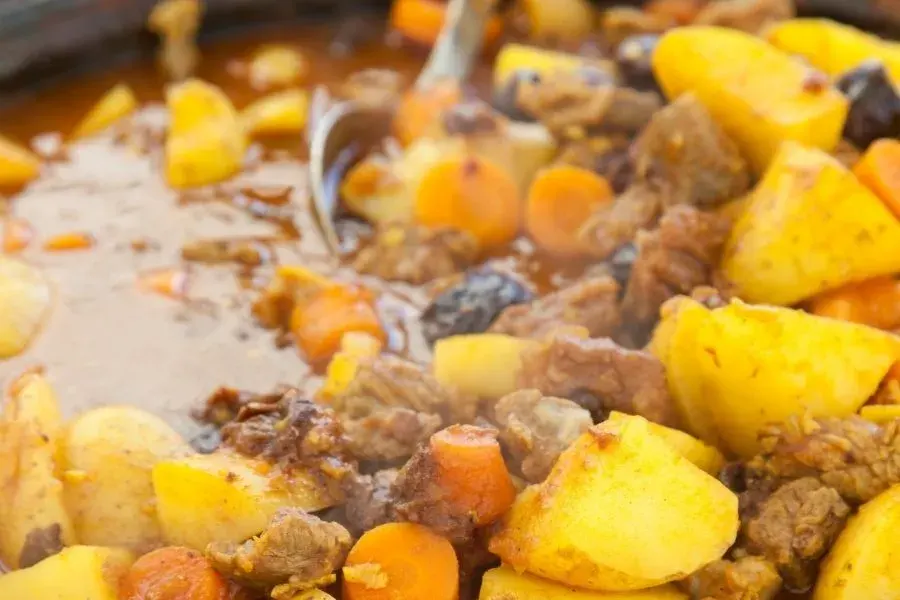
Kawari (Sheep's Hooves Stew)
Aperçu
Kawari is Sudanese hooves soup, and it belongs to the family of dishes built on the parts of an animal that carry no muscle at all. Sheep or cattle hooves are cleaned and cooked for hours until the collagen breaks down and the broth turns thick and gelatinous, which is the whole reason the dish exists. It is spiced in a way that places it squarely in the northeast of the continent. Cinnamon, cloves, cardamom, coriander, black pepper, ginger and garlic together are a Red Sea and Nile valley combination, and vinegar goes in to cut the richness. That combination reaches across the region: Egyptian kawaree uses calf feet with turmeric, Moroccan hergma uses ginger and paprika, and Turkish paça uses beans. All are the same idea handled by different kitchens. It is regarded in Sudan as a dish worth taking seriously, and the source that carries this recipe calls it the country's most popular soup. Like most long cooked offal dishes it splits opinion, and like most of them it is cheap, which is not incidental. A cut that takes six hours and yields a thick broth from almost nothing is a dish built by households that could not waste an animal.
Note de Patrimoine AFN
Kawari belongs to the Nile valley and Red Sea tradition of long cooked hoof and trotter dishes, which appears across the region as Egyptian kawaree, Moroccan hergma and Turkish paça. Its earliest documented date in Sudanese cooking is uncertain.
Ingrédients
Les mentions alimentaires sont fournies par les contributeurs à titre indicatif. Elles ne sont pas vérifiées par AFN et dépendent des produits que vous achetez. En cas d’allergie grave, vérifiez vous-même chaque ingrédient. Cuisine, allergies et votre propre jugement
Préparation
- 1
Clean and scrape the hooves thoroughly under running water.
- 2
Put the hooves in a pressure cooker or a large heavy pot with the onion, garlic, ginger, green chillies, black pepper, cinnamon, cardamom, cloves, coriander, vinegar and salt.
- 3
Cover with water.
- 4
Cook until the hooves are tender and the meat is coming away from the bone.
- 5
Skim the surface during cooking and adjust the salt at the end.
Notes de l’Africook
 Notes personnelles de Nympha Nzeribe
- Cleaning is the whole difference between a good kawari and an inedible one. Scrape the hooves thoroughly, blanch them and discard that first water before the cook proper begins.
- A pressure cooker takes this from around five or six hours to roughly ninety minutes, which is why most households now use one.
- The vinegar is doing a job. It cuts the richness of a broth that is almost entirely collagen, and without it the soup is heavy.
- The broth sets solid when cold. That is a sign it was cooked properly rather than a fault, and it loosens again on reheating.
- Use whole spices rather than ground. Over a long cook, whole cinnamon, cardamom and cloves release steadily where ground spices turn muddy.
Questions fréquentes
How long does kawari take to cook?
Around five to six hours in an ordinary pot, or roughly ninety minutes in a pressure cooker, which is what most Sudanese households use for it. The hooves are almost entirely skin, bone and connective tissue, so there is no way to shorten the process. They are ready when the meat is falling away from the bone.
How do I clean hooves properly?
Scrape them thoroughly under running water to remove any remaining hair and debris, then blanch them in boiling water until a scum forms and discard both the scum and the water. Only then start the cook proper. This step is not optional and it is where the difference between a clean broth and an unpleasant one is decided.
Why is my kawari broth solid in the fridge?
Because it was cooked properly. Hooves are dense in collagen, which dissolves into the broth over a long cook and sets as gelatin once cold. It is the sign of a well made kawari rather than a problem, and it will loosen back to liquid as soon as it is reheated.
What is kawari served with?
Bread is the usual accompaniment, used to take up the broth. It is also served over rice. Related dishes elsewhere in the region give an idea of the range: Egyptian kawaree is sometimes served as kawaree fettah over rice with tomato sauce, and Moroccan hergma has rice added directly to the pot.
Avis
5 avis
Reminds me of my ouma cleaning sheep trotters back in the day, but that dash of vinegar and whole cinnamon sticks in the pressure cooker makes the broth so rich and sticky. We sommer ate it with warm bread to soak up all that gelatinous gravy. My broer thought it would be too gamey but the ginger and chillies cut right through it.
Chantelle, that sticky gelatinous gravy is no be small thing! Over here in Thamesmead, I always tell my local butcher to cut the trotters small so they fit my pressure cooker properly. You are so right about the ginger and chillies cutting through that gameyness, if you don't balance it, the smell will just fill the whole flat sha. Warm bread to soak up that broth is pure heaven o.
I had to ask the butcher down the road to get me the sheep hooves special for this. Was a bit intimidated by the scraping step to be honest! Ended up boiling it in the big pot for nearly three hours before the meat started coming away from the bone, but the smell of the cardamom and cinnamon through the house was unbelievable.
Managed to source a pair of skinned sheep hooves from a local halal butcher. I did not have a pressure cooker so used my heavy casserole dish instead, but it took well over 3 hours for the tendons and meat to soften up properly. The addition of vinegar is genius though, really helps cut through the richness of the hoof broth.
Used 2kg of sheep hooves from Woolies and popped them in the pressure cooker for 70 minutes. That stickiness from the collagen is super lekker! Just a tip: don't skip skimming the surface at the start before you close the lid, otherwise the broth gets cloudy. Going to make this again just now for after the braai on Saturday.